Knowledge base
1000 FAQs, 500 tutorials and instructional videos. Here, there are only solutions!
This guide explains how to view information about visitors who have accessed your Web Hosting sites (traffic statistics).
✘ UNAVAILABLE with
Site Creator standalone (independent of web hosting)
Starter hosting plans
Introduction
- Please refer to this other guide if you are specifically looking for access logs.
- Consult this other guide about the Site Creator Pro offer.
Access website traffic statistics
To view statistics regarding the traffic to your websites:
- Click here to access the hosting & website management section in your Infomaniak Manager (❓: help).
- Click on the name of the website in question:
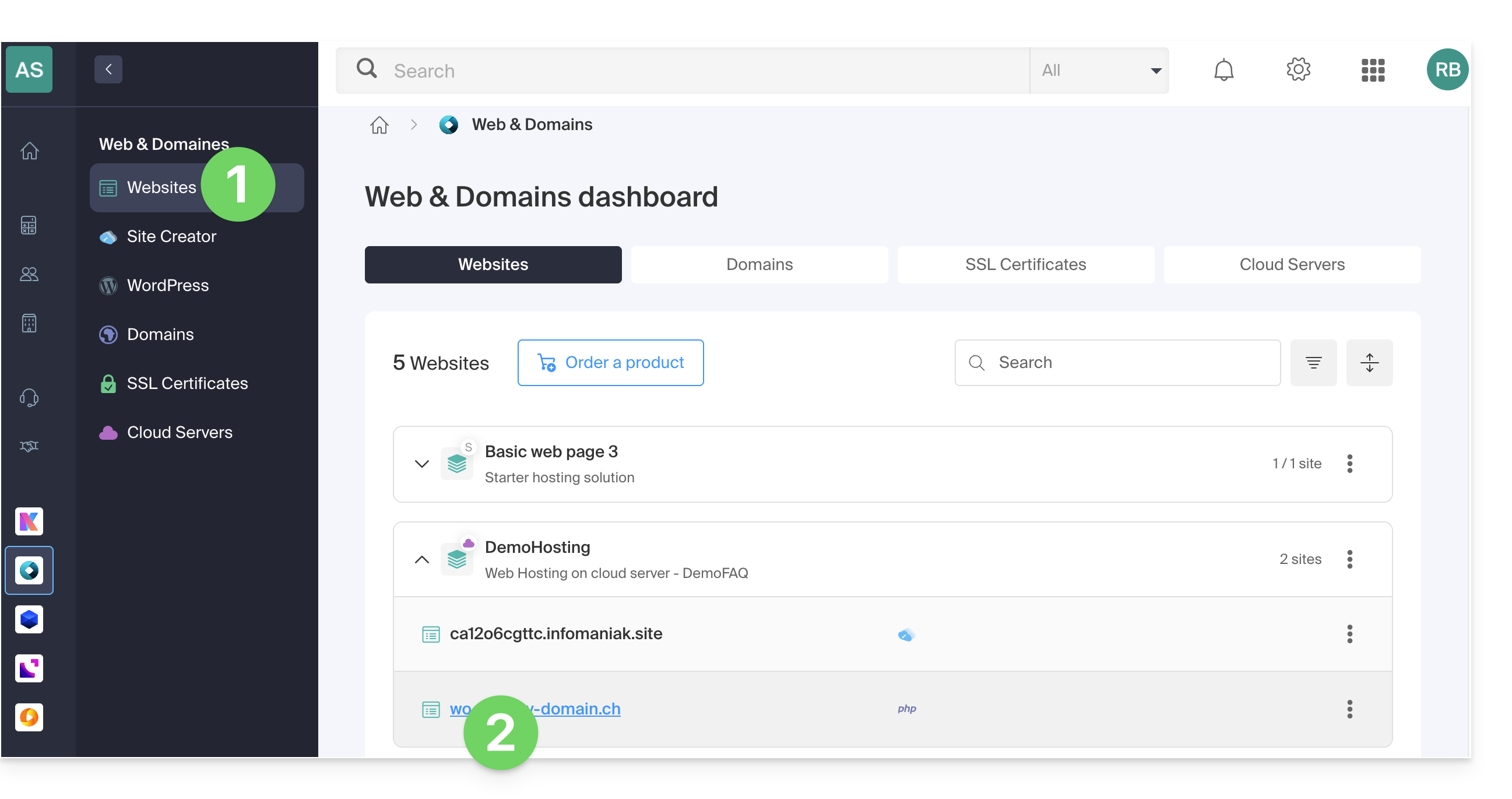
- Click on Statistics in the left-hand menu:
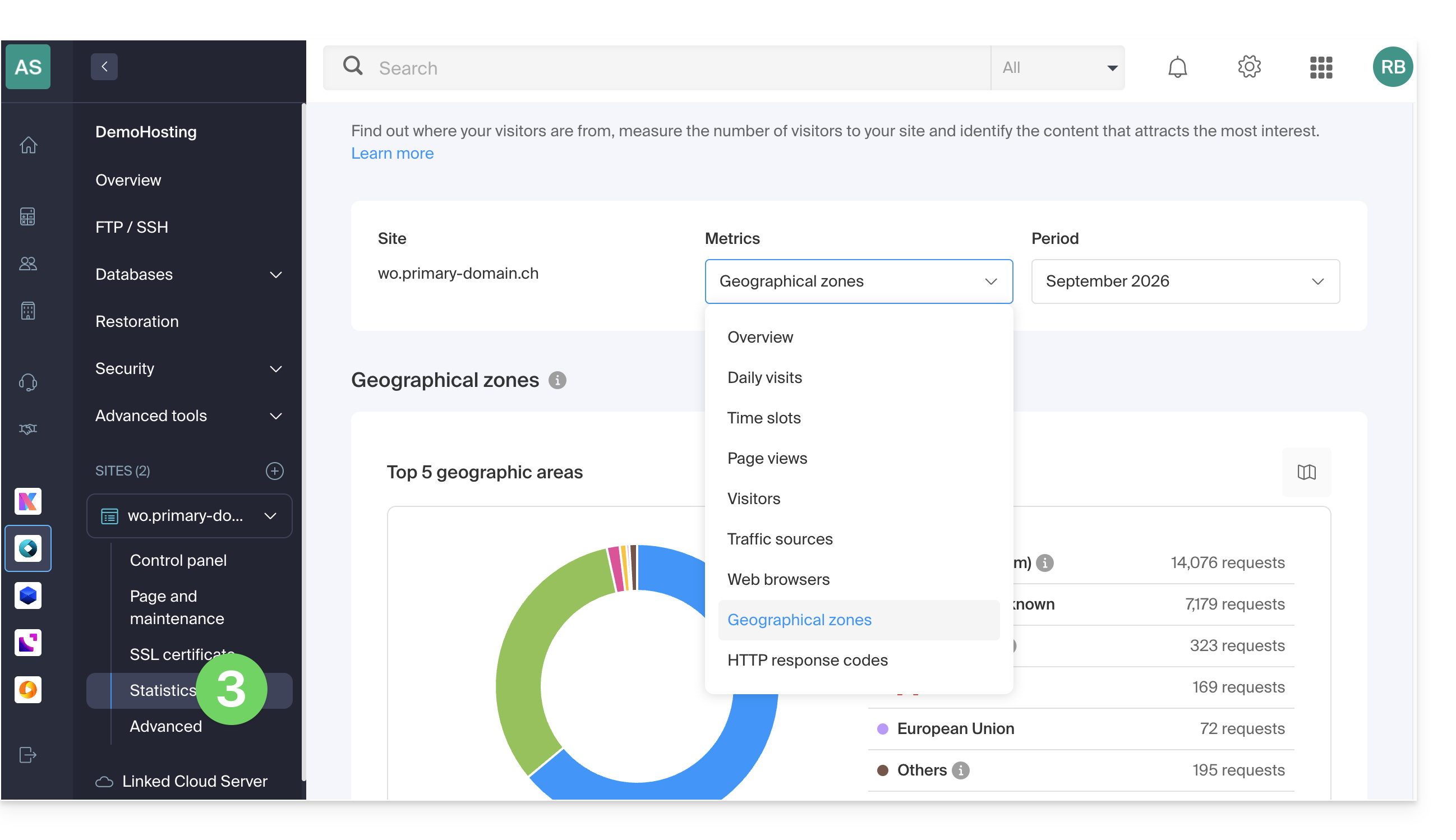
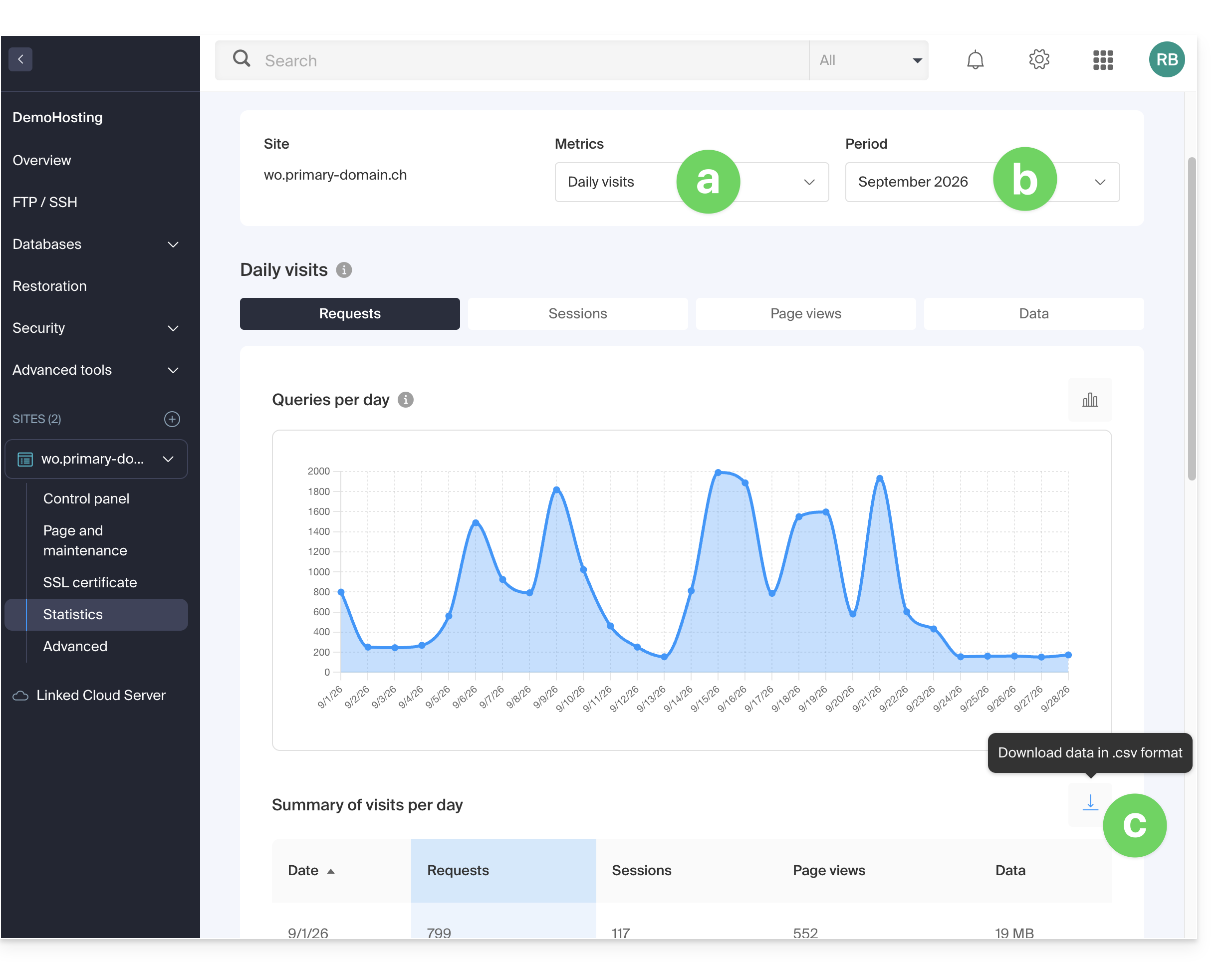
- The toolbars allow you to choose:
- the type of statistics,
- the period,
- or to download the data for a third-party tool:
Explanation of terms
There is no distinction between humans and robots. You can also use tools like Matomo, Open Web Analytics, or Google Analytics.
| Category | Description | Details |
|---|---|---|
| Hits | Every request sent to the server. | Includes everything (HTML, images, audio, etc.). Each requested element, whether visible or not, counts as a hit. It's as if a visitor activated an invisible button with each interaction. |
| Files | Requests requiring data to be sent in return. | Records requests that require the server to send back a file (graphic, HTML). The difference with hits corresponds to the ratio between incoming requests and outgoing data. |
| Pages | Number of pages displayed on your website. | Measures the HTML pages viewed, excluding graphic or audio files. Each access to a new HTML page is recorded as a page view. |
| Visits | Sessions based on IP address. | A visit starts with an IP request. If the address returns within 30 minutes, it is counted as a single visit. After that, a new visit is recorded. |
| Sites | Estimated visits based on fixed IP addresses. | Excludes mobile or dynamic connections. This targets regular visitors (businesses, institutions) to better understand your target audience. |
| Ko | Data volume sent by the server. | Total amount of data transferred during the period, calculated via log files (with a possible margin of error depending on the size of the files). |
| Total hits | Total number of requests. | A page with 3 images and text generates 5 hits (the page + the text + the 3 images). This total is therefore much higher than the number of page views. |
| Total Pages / Visits | Engagement metrics. | The number of pages viewed compared to the number of unique visits allows you to assess the level of interest users have in your content. |
| Total unique sites | Number of distinct IPs. | Represents the diversity of traffic sources and helps identify the most active audience segments during the period. |
| Total number of unique URLs | Distinct paths taken. | Corresponds to the different pages or files visited, providing an overview of your navigation structure and the most popular content. |
| Total number of unique referring domains | Number of source sites. | External sites that have directed traffic to you. This is a key indicator of the effectiveness of your marketing and partnerships. |
Meaning of "Commercial (com)" and "Unresolved"
"Commercial" often represents a significant portion of geographic traffic. It includes users connected via internet service providers (ISPs) using a .com domain. As this extension is used by many ISPs and global companies, it does not allow for the identification of a specific country.
"Unresolved" refers to IP addresses that cannot be geographically located, often due to privacy settings, the use of VPNs, or network restrictions.
Link to this FAQ: https://faq.infomaniak.com/83
Has this FAQ been helpful?
This guide will help you quickly discover the essential features of the Euria writing assistant available on Infomaniak's Site Creator.
Introduction
- The writing assistant will help you write text on the topic of your choice, including if it needs to be based on existing elements, using artificial intelligence.
- This is not a conversational agent or chatbot; it will not necessarily answer generic questions or engage in a dialogue with you.
- Use it, for example, to write:
- a new title that must contain specific elements
- a new paragraph on a particular theme
- a reformulation of a text excerpt
- correct grammatical syntax
- a translation into a foreign language
- a blog post
- etc.
- Read this other guide about the model used by the writing assistant and the responsibilities of each party.
How to use the assistant?
Start by logging into the Infomaniak Manager with your credentials (user account with the necessary permissions for the relevant product):
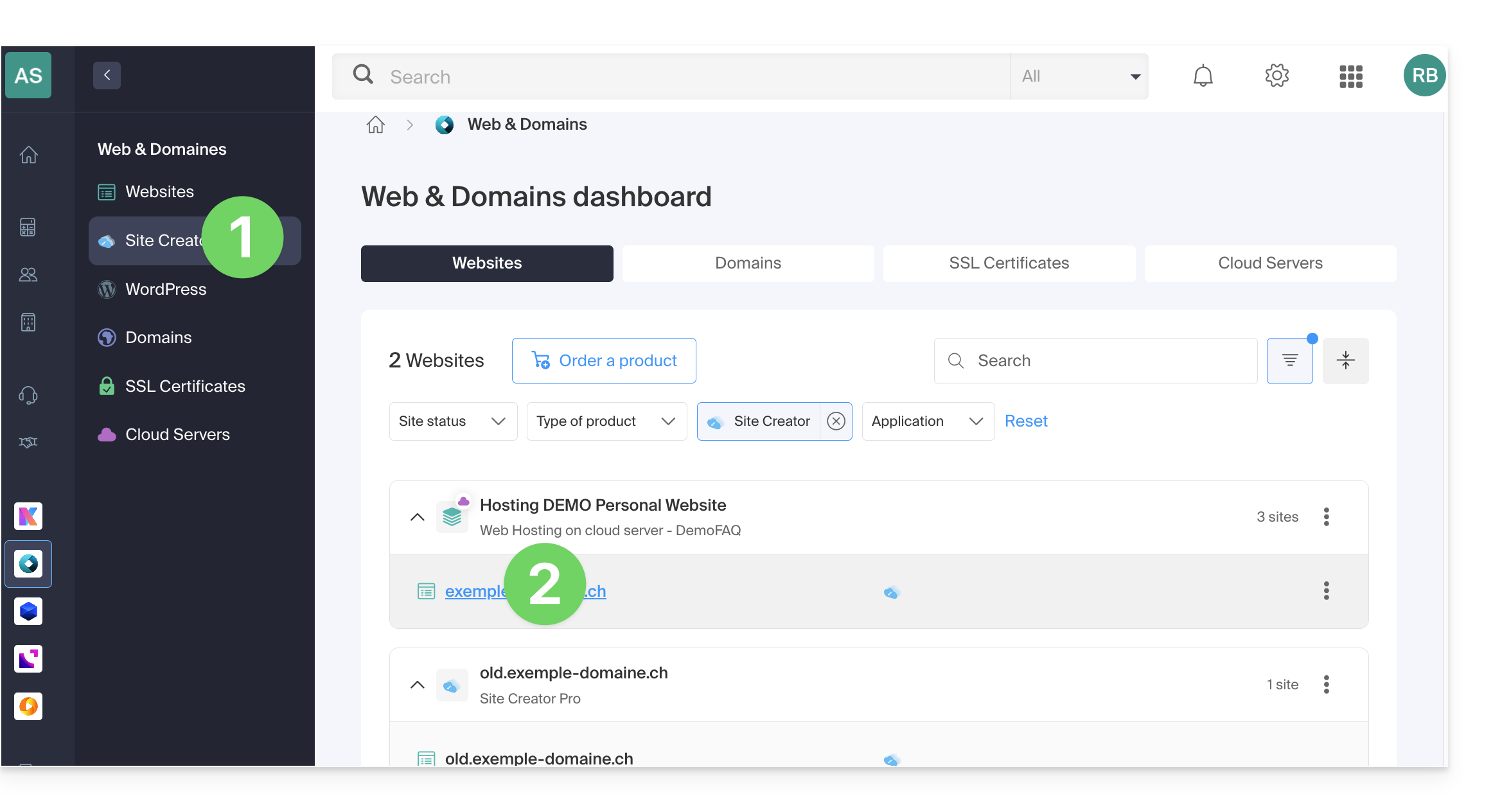
- Click here to access the hosting & site management section (filtered to display only Site Creator).
- If nothing is displayed, you may not be in the Organization to which your site is linked (❓: help).
- Click on the name of the Site Creator in question:
- Click the button to edit your website:
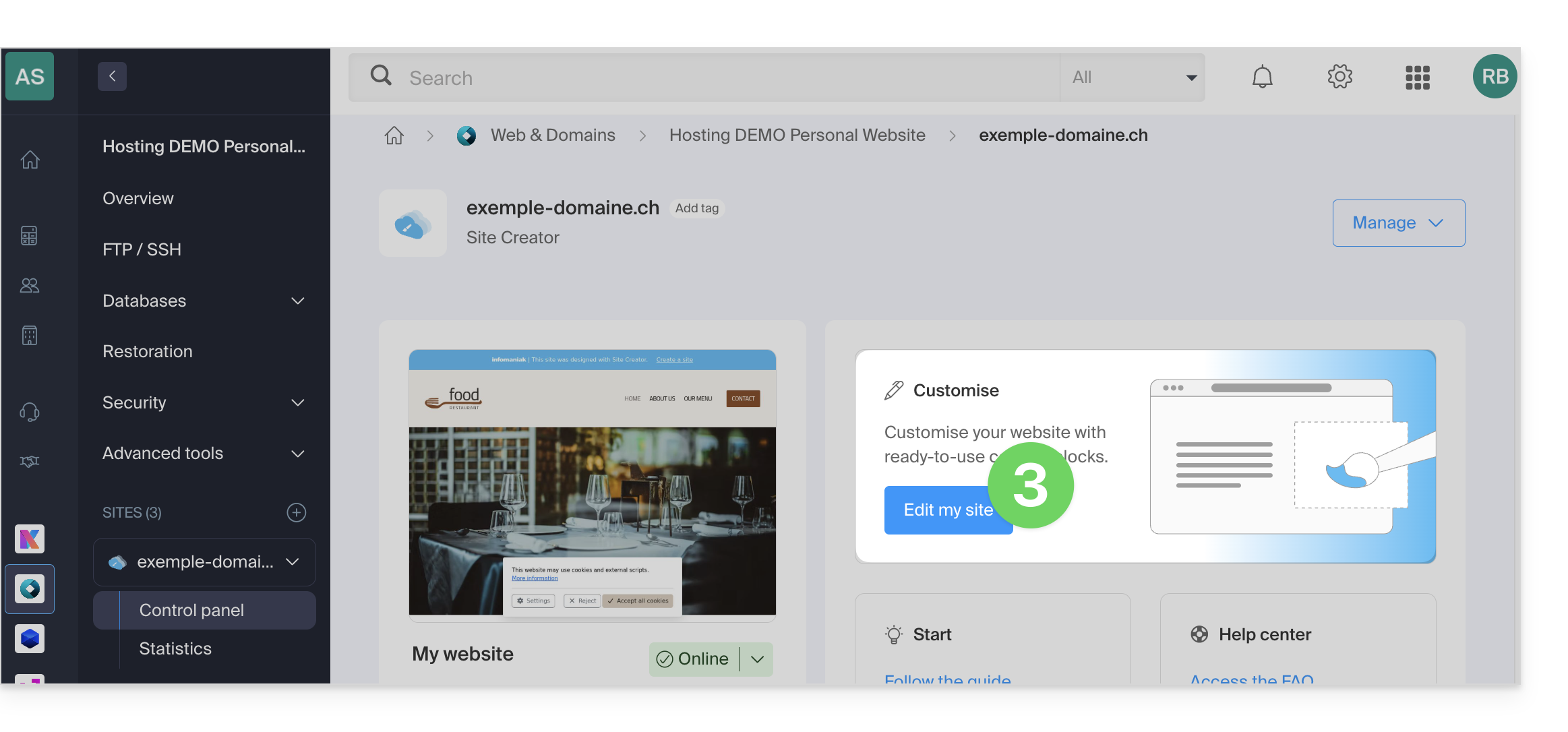
Once in Site Creator, to start the writing assistant:
- Click on a content block, text, etc.
- Click on the Euria icon in the editing bar to open the wizard:
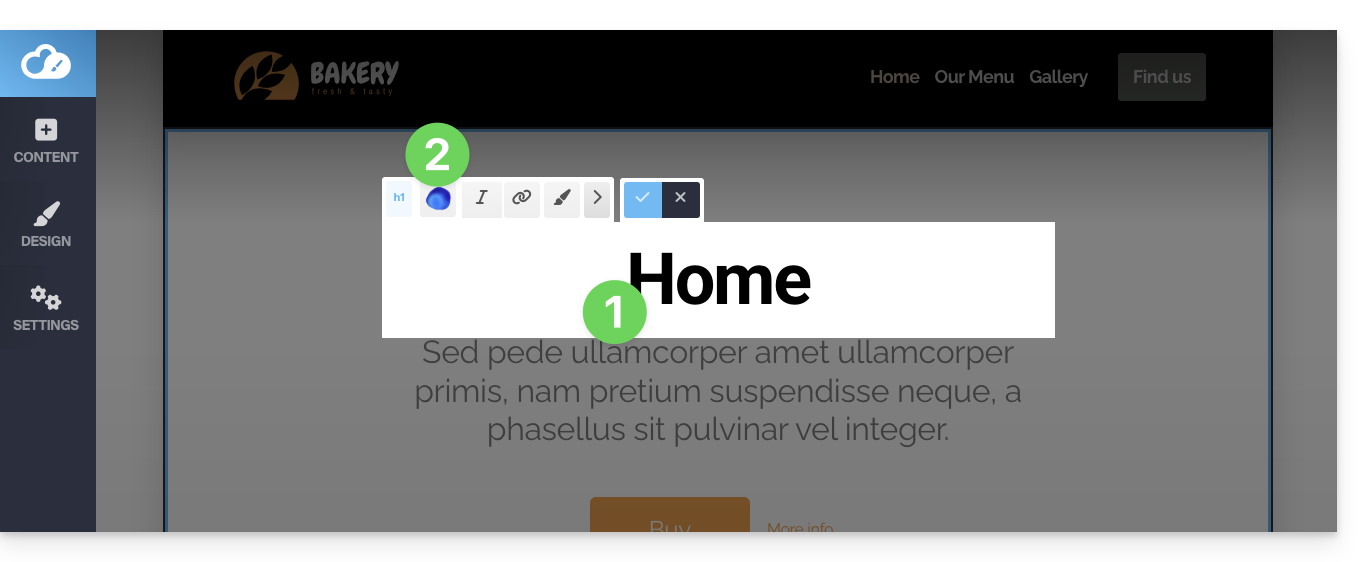
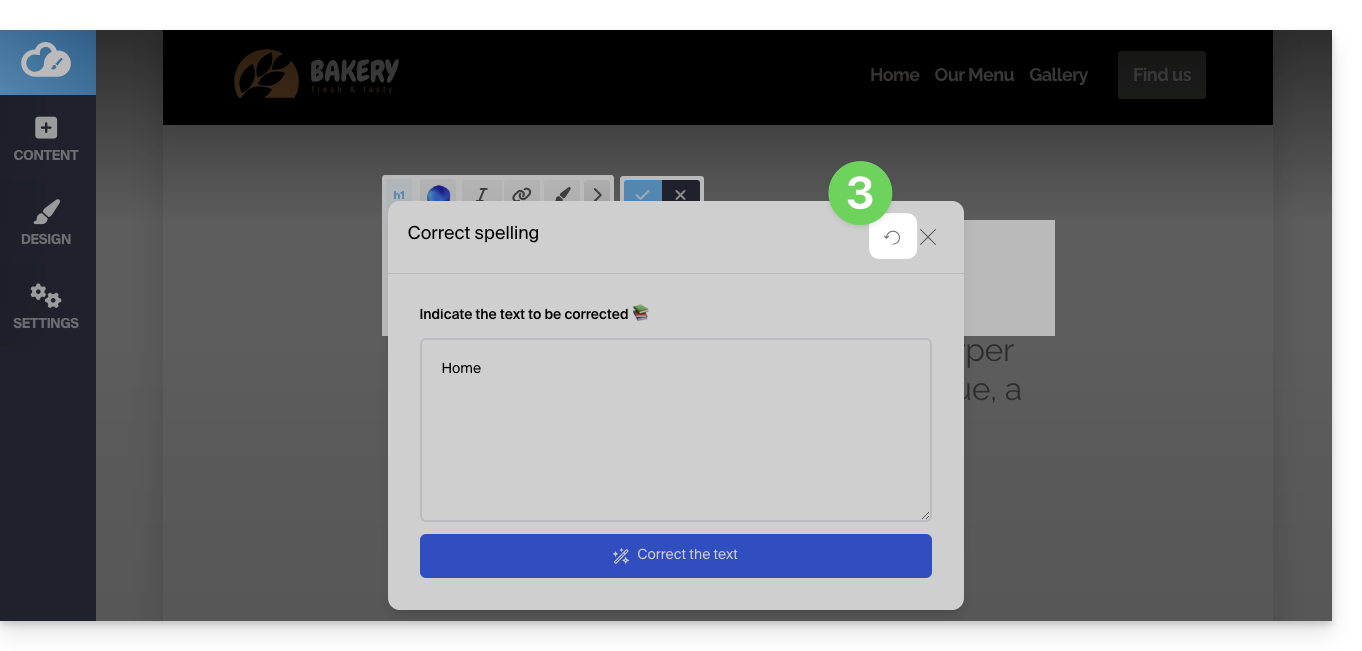
- To go back to the main selection after choosing a type of addition, click on the icon in the top right corner:
If the block already contains content and you choose to rephrase a paragraph, you will be able to use the assistant's buttons to select the tone for your text (serious / friendly) and add or shorten the suggested phrases…
- For example:
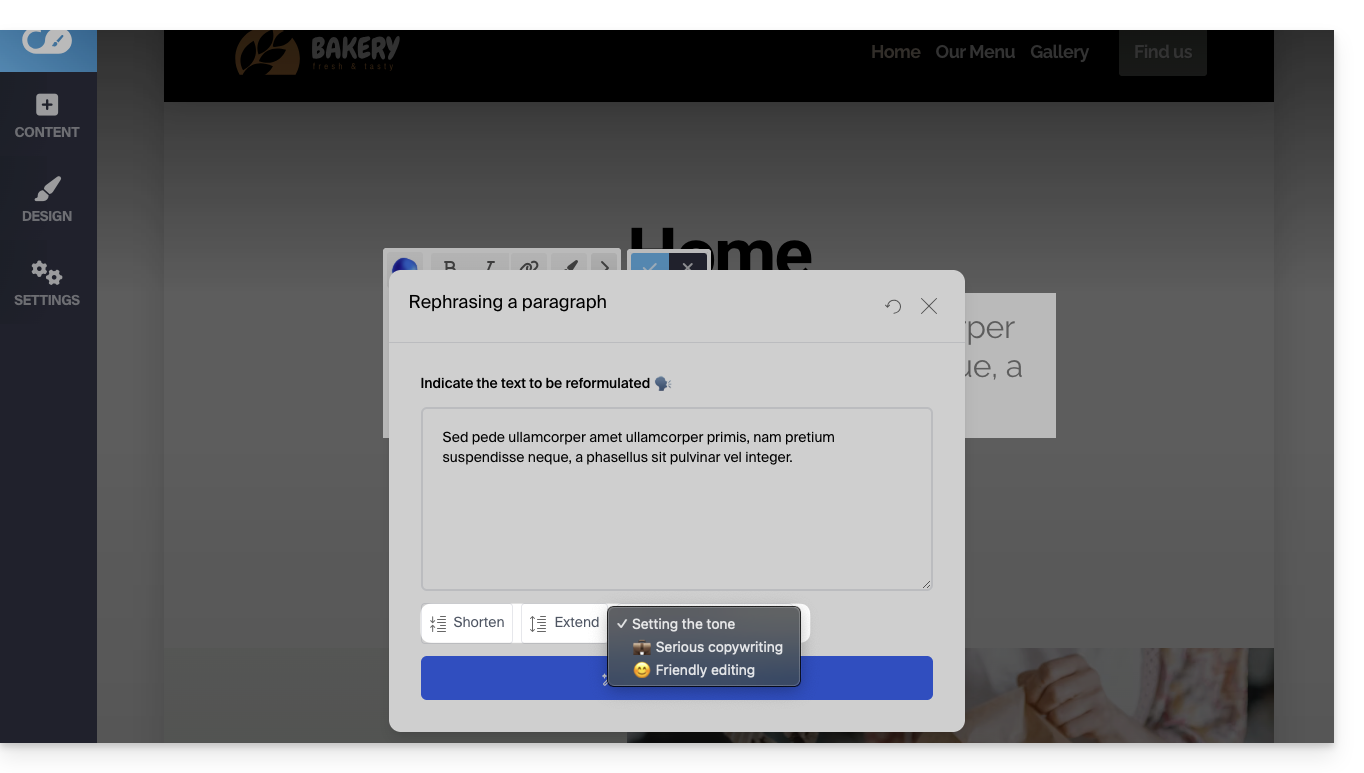
Link to this FAQ: https://faq.infomaniak.com/1542
Has this FAQ been helpful?
Thank you for choosing Infomaniak to host your website and for creating its content with Site Creator. This guide will help you quickly use the essential functions of this accessible and easy-to-use website creation tool.
Introduction
- Site Creator is available…
- … with every paid web hosting plan
- … or as a standalone product (available in 3 versions) and does not require any other specific offer in this case
- It is recommended to use the latest version of a browser such as Chrome, Firefox, Safari, and Microsoft Edge, preferably on a computer.
Operations Guides
Basic information:
- Manage pages
- Simple page editing
- Manage content blocks
- Manage media (images, videos, documents, etc.)
- Manage the navigation menu(s)
- Manage themes, colors, and fonts
- Manage the site name and details
Advanced information:
- Advanced page editing
- Manage additional modules (gallery, blog, shop, etc.)
- Manage languages and translations
- Create a contact form
- Cookie Management (GDPR)
- Site Creator Limitations
You can also delete your website created with Site Creator and start from scratch by recreating a blank website.
Learn more about Site Creator:
- French | Webinar recorded at Infomaniak headquarters.
- German | Quickstart :: Tutorial
- Italian | Tutorial
Contextual help
To view or review the contextual help for getting started with Site Creator, click here in your Manager: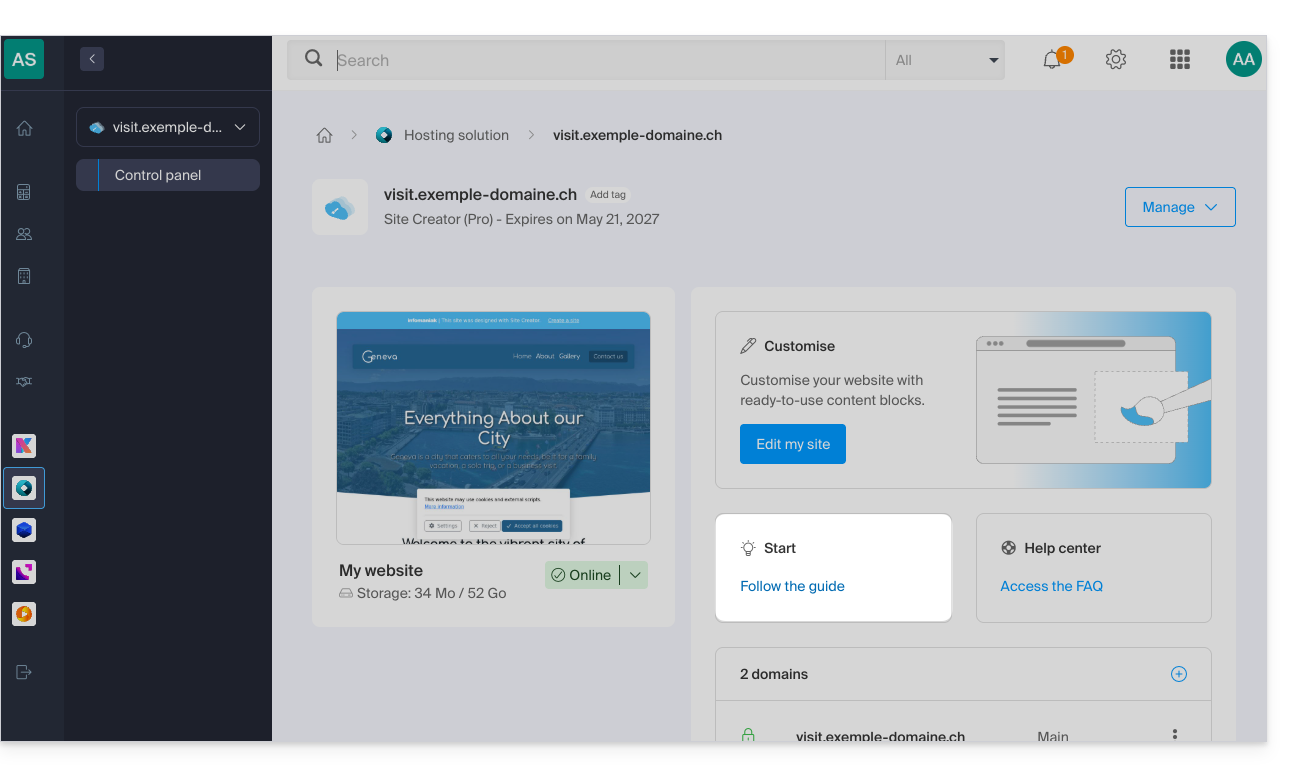
If you encounter any issues, consult the knowledge base before contacting Infomaniak support.
Click here to share feedback or suggestions about an Infomaniak product.
Link to this FAQ: https://faq.infomaniak.com/1698
Has this FAQ been helpful?
This guide presents the Knowledge Base module for Infomaniak's Site Creator, similar to the Questions & Answers module, which allows you to quickly format articles of the FAQ type or similar, within your page.
Configuration and use
Start by logging in to the Infomaniak Manager with your credentials (user account with the necessary rights for the relevant product):
- Click here to access the hosting & site management interface (filtered to display only Site Creator).
- If nothing is displayed, you may not be in the Organization to which your site is linked (❓: help).
- Click on the name of the Site Creator in question:
- Click on the button to edit your site:
Once in Site Creator, to insert the module in the desired location:
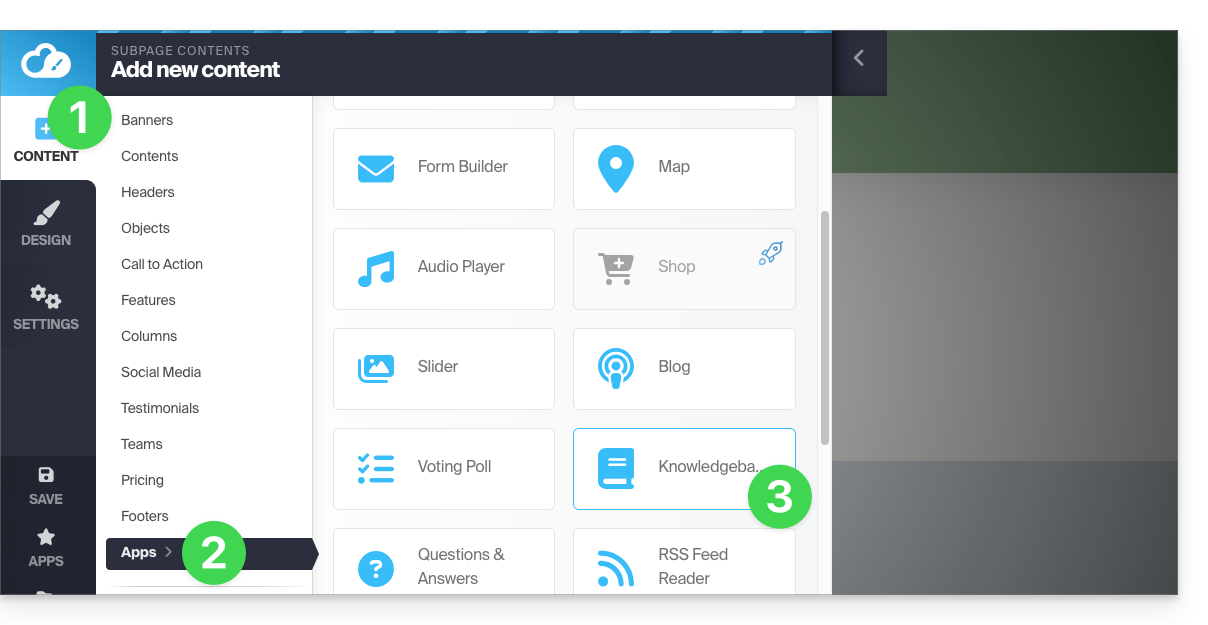
- Click on the Content button in the left-hand menu.
- Click on Applications at the bottom of the list.
- Click on Knowledge Base:
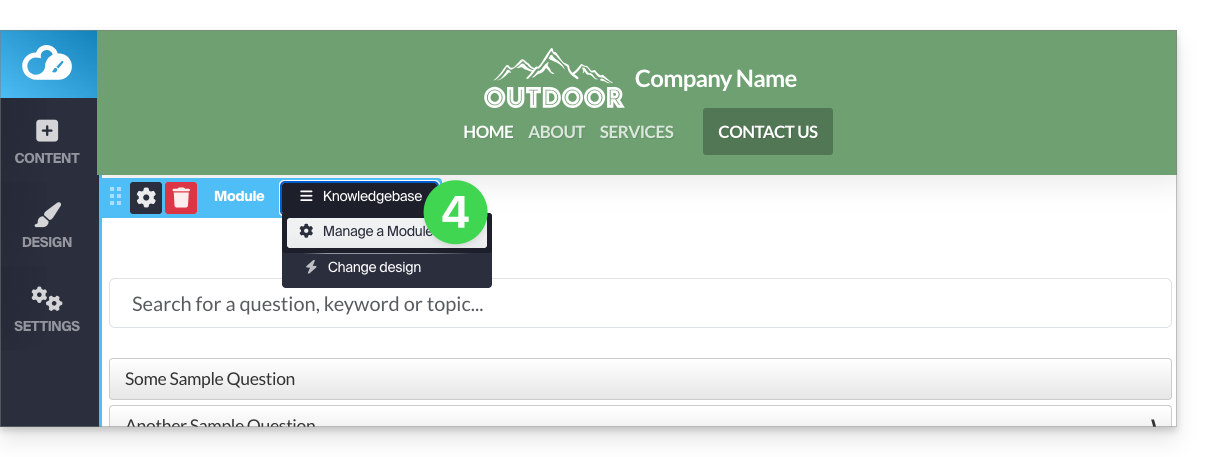
- Once the module has been added, hover over it to edit it:
- The blue button allows you to add a new question:
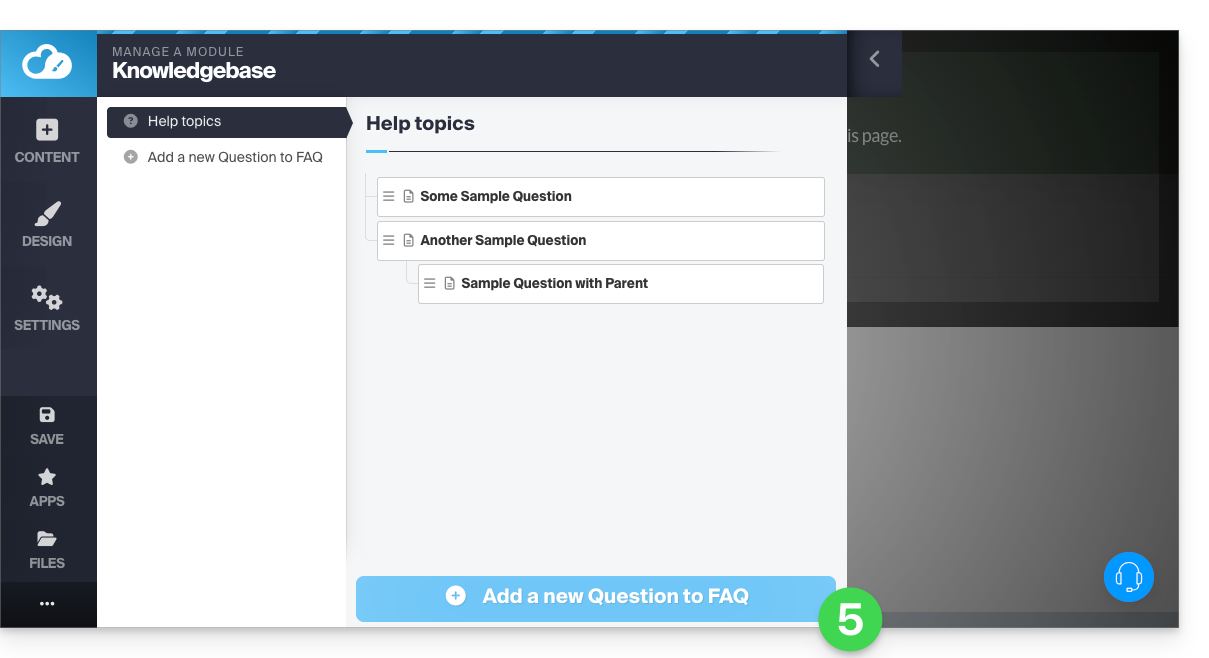
Once the form is completed (title, text with formatting, keyword to facilitate searching, summary, and an optional link to a YouTube video), save at the bottom of the page.
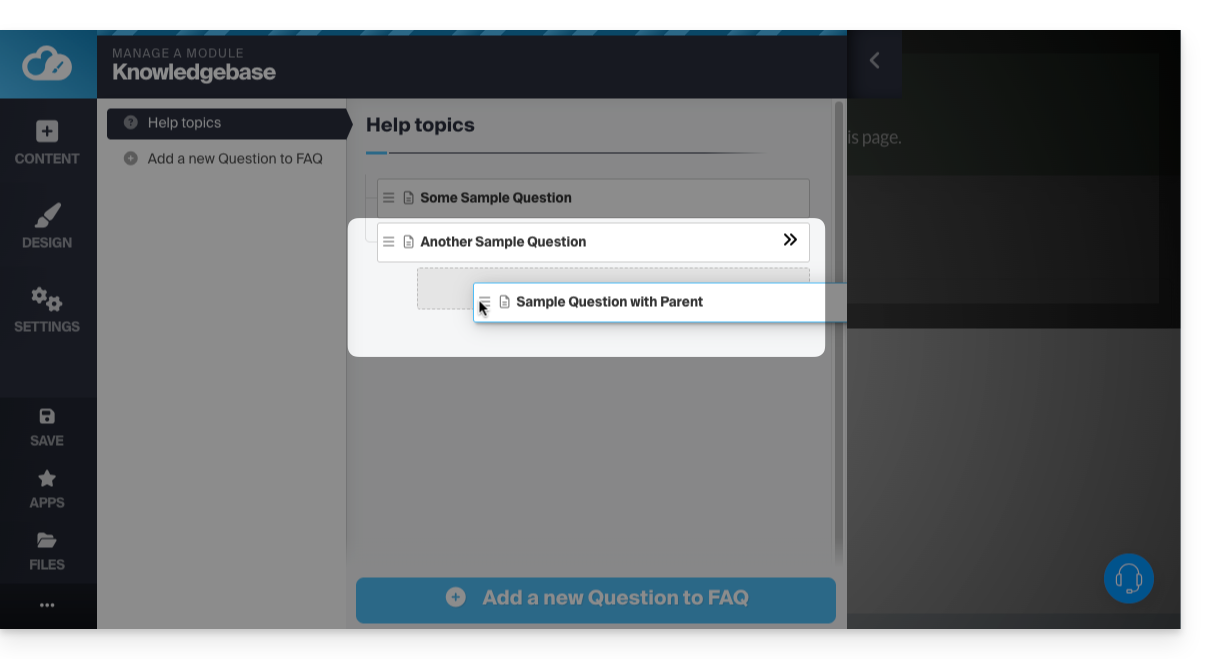
- You can organize your texts by creating a form with only a "category" title (e.g., "General"), then drag your forms to the right to sub-categorize them (parent - child):
Browse the knowledge base
Navigating through your articles will be presented as shown below. Clicking on the "category" created will expand the questions/answers: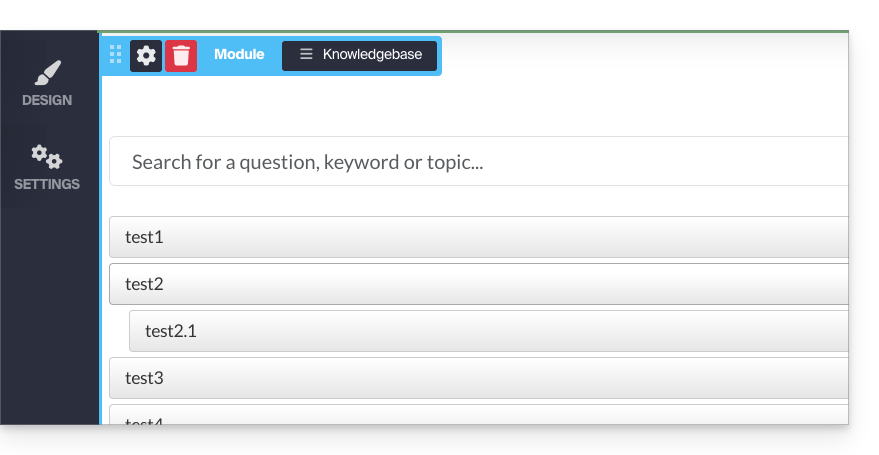
URL of the created entries
Clicking on a question will open a separate web page, with the question as the title and its answer below. The URL of this answer page will consist of the address of the page where you placed the module, followed by "/kb/X-the-question", where X is the number corresponding to the order in which you created your entries: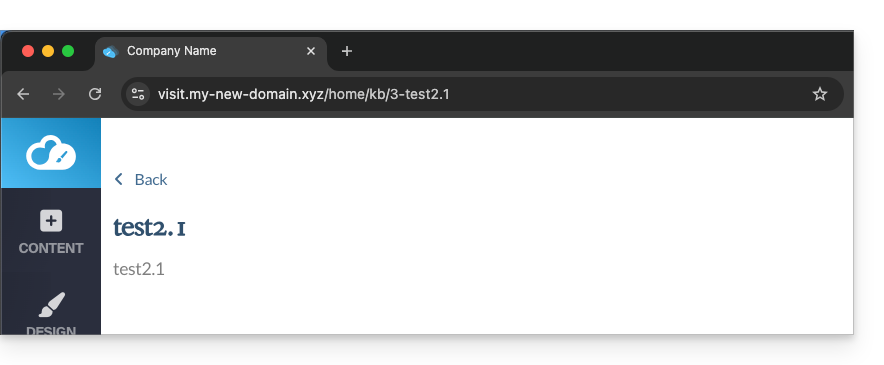
Customize the display
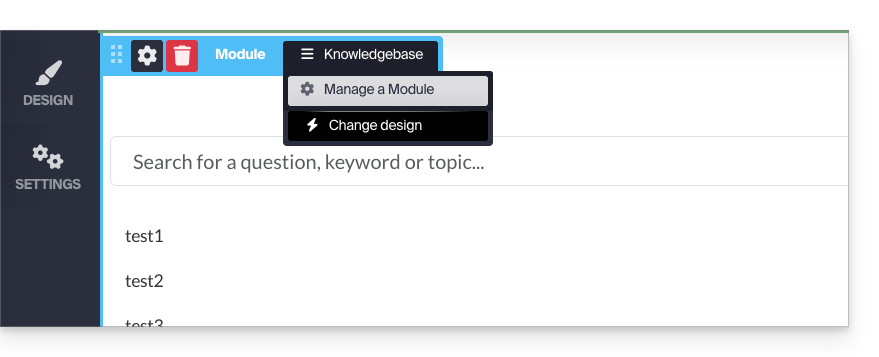
Hover over your module again in edit mode to change the display and make your tree structure transparent:
Add keywords
Keywords (separated by a space) can be added: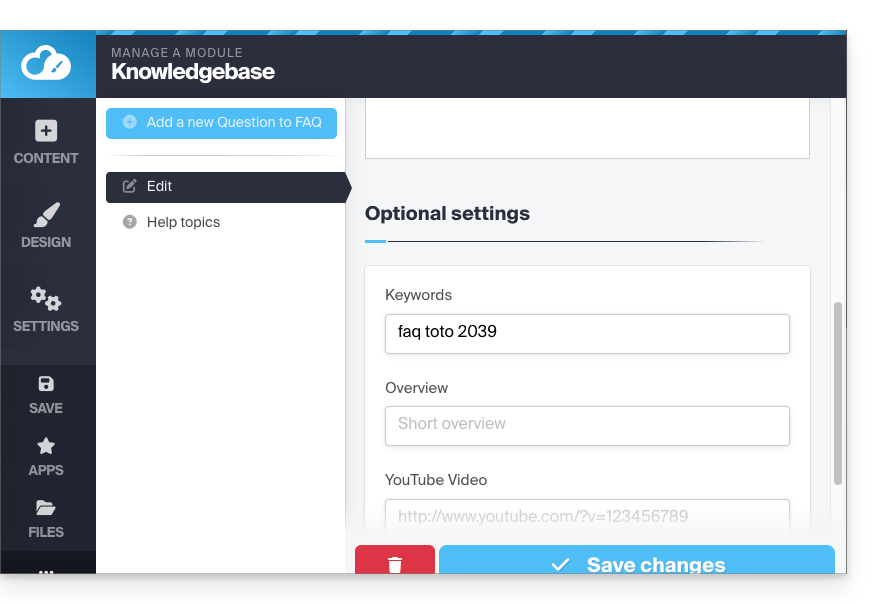
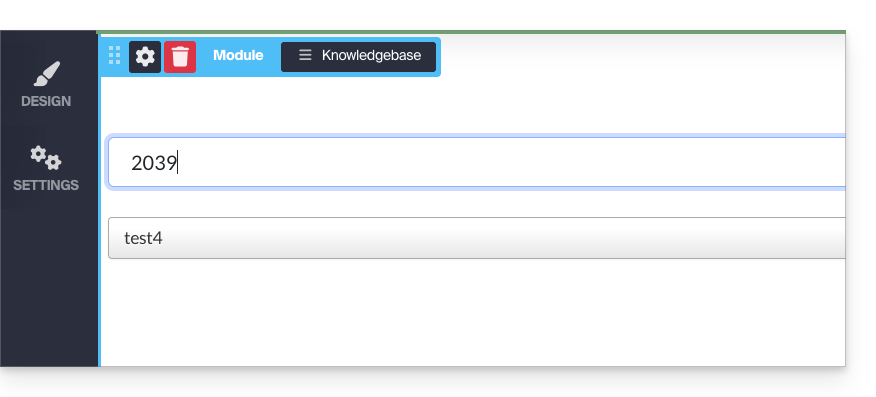
This allows you to filter the display of responses if you enter the tag in the search bar (of the inserted module):
Display the module in multiple locations
The Knowledge Base application can be added to different locations on your site, but it will always be the same single module. It is not possible to differentiate the display or content depending on the pages where the module is inserted.
Link to this FAQ: https://faq.infomaniak.com/1783
Has this FAQ been helpful?
This guide presents the Questions & Answers module for Infomaniak's Site Creator, similar to the Knowledge Base module, which allows you to quickly format FAQ-style articles within your page.
Configuration and usage
Start by logging in to the Infomaniak Manager with your credentials (user account with the necessary permissions for the relevant product):
- Click here to access the hosting & site management interface (filtered to display only Site Creator).
- If nothing is displayed, you may not be in the Organization to which your site is linked (❓: help).
- Click on the name of the Site Creator in question:
- Click on the button to edit your site:
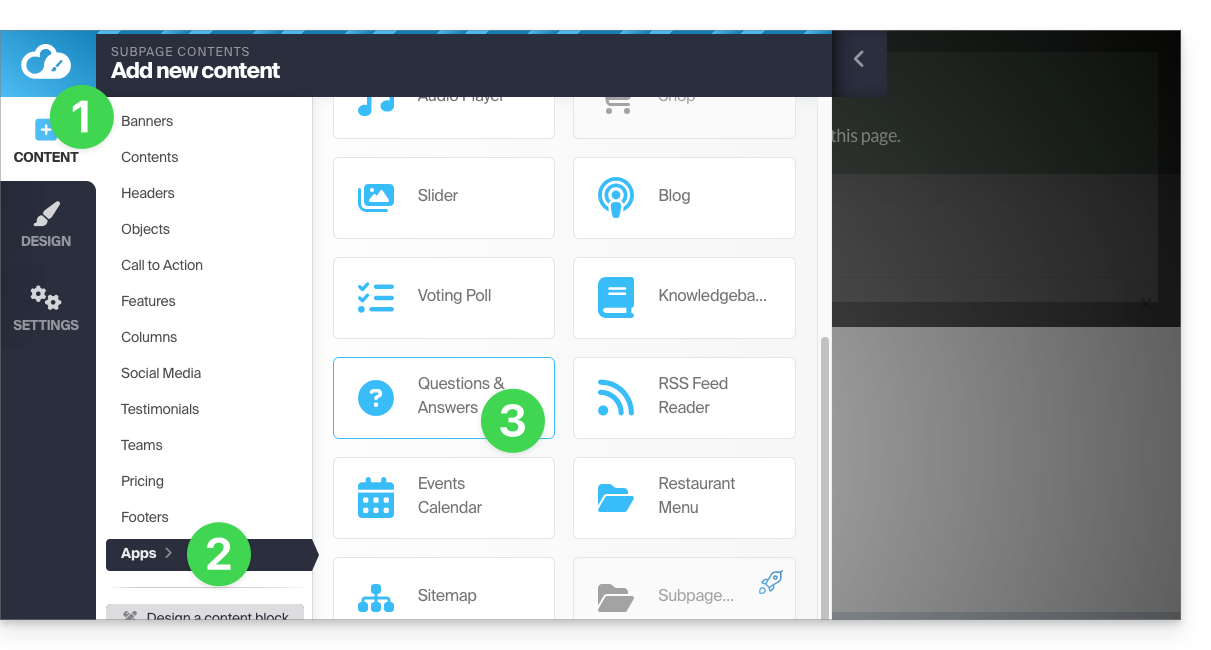
Once in Site Creator, to insert the module in the desired location:
- Click on the Content button in the left-hand menu.
- Click on Applications at the bottom of the list.
- Click on Knowledge Base:
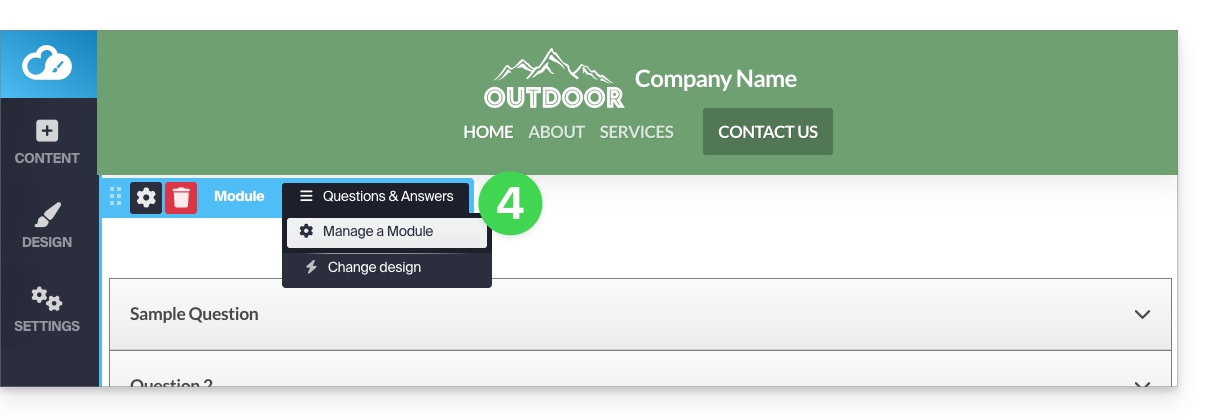
- Once the module has been added, hover over it to edit it:
- The grey button allows you to add a new question/answer:
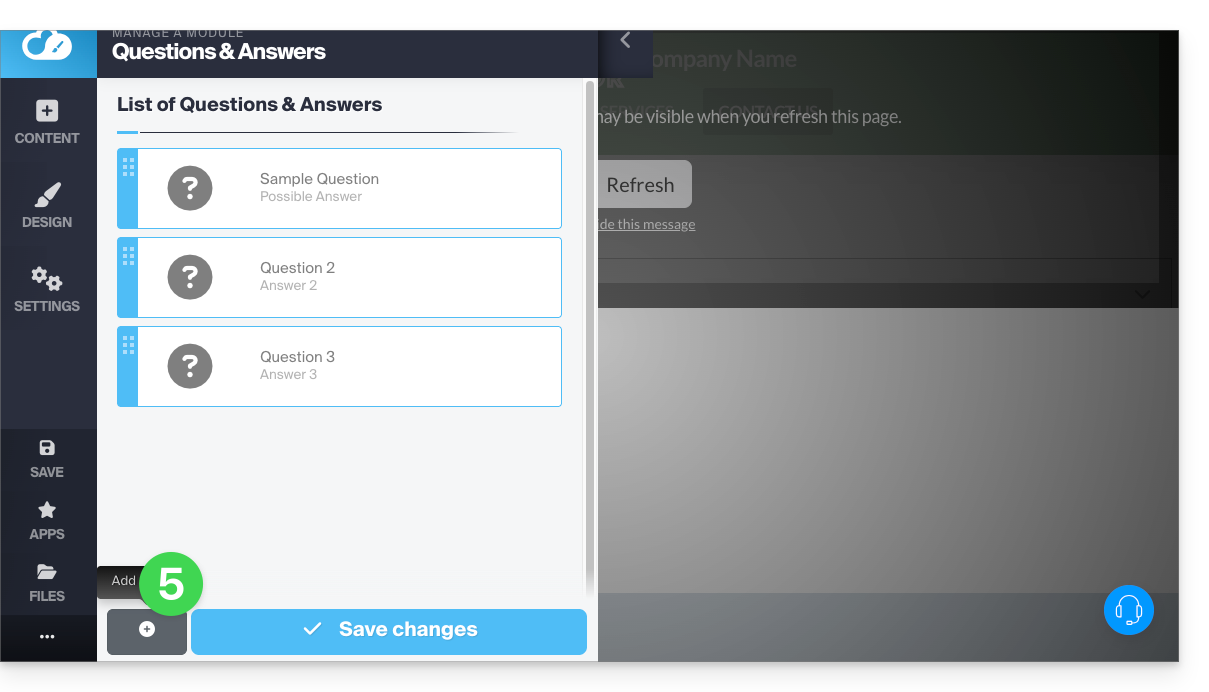
Save your changes at the bottom of the page.
These questions can be transformed into a heading (e.g., a small title block) if you want to format your entries within "categories," for example. To do this, hover over the card and click on the pencil, then on the gear icon to switch to the desired display system: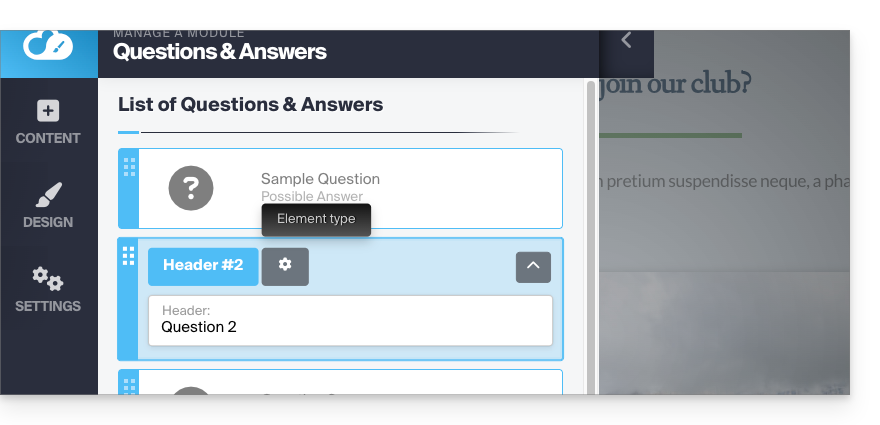
Reorganize the order of your questions/answers as needed by dragging the cards up or down: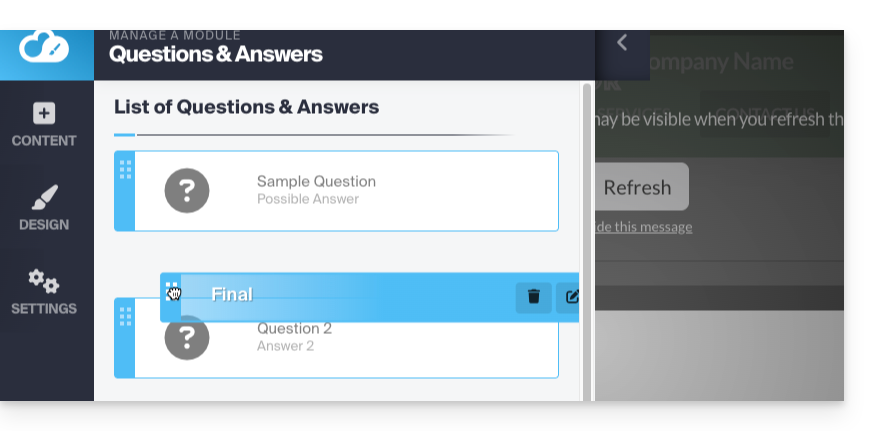
Browse questions / answers
Navigating through your entries will be presented as shown below. Clicking on the question (or ) will display the answer: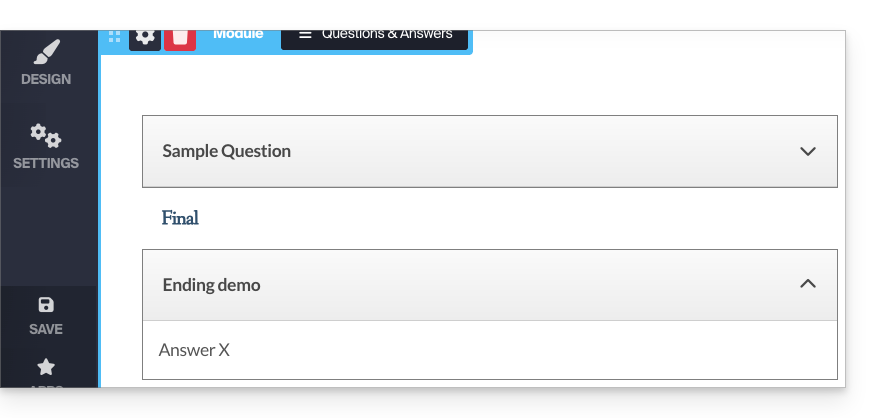
Customize the display
By reviewing your module again in edit mode, you can change the display and make your tree structure transparent.
You can also apply HTML code when writing your responses, in order to create a hyperlink, for example: 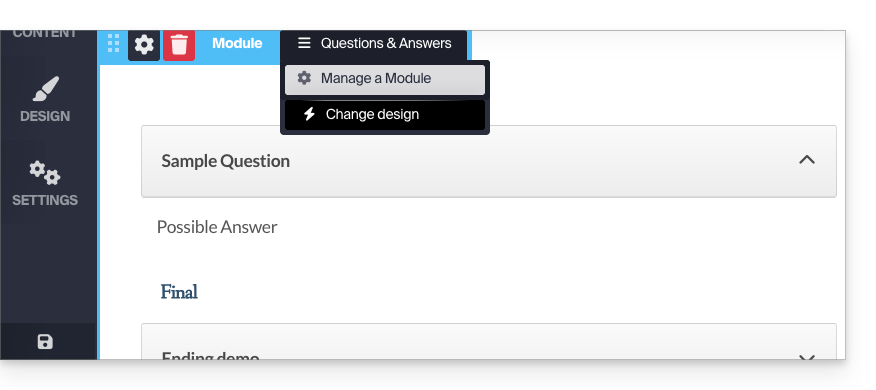
Display the module in multiple locations
The application can be added to different locations on your site, but it will be the same single module each time. It is not possible to differentiate the display or content depending on the pages where the module is inserted.
Link to this FAQ: https://faq.infomaniak.com/1784
Has this FAQ been helpful?
This guide concerns messages sent from Site Creator (e.g., contact form or e-commerce module).
Introduction
- By default, emails are sent using the unauthenticated PHP mail() protocol (❓: help).
- It is recommended to use the authenticated SMTP method instead (❓: help).
Modify the sending method
Prerequisites
- Have a valid email address or create one (❓: help my kSuite | Mail/kSuite Service).
- Create a device password (❓: help my kSuite | Mail/kSuite Service) named, for example, “
Site Creator” (or “SC2026”, etc. – it doesn’t matter) for this email address: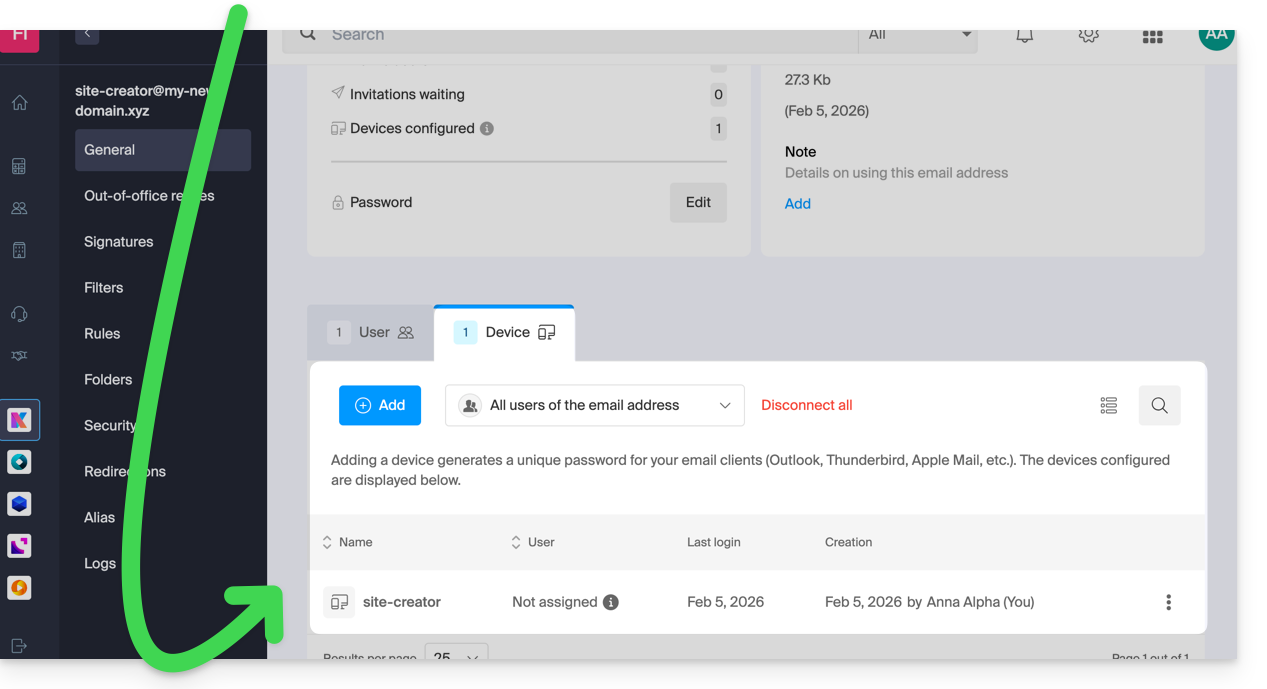
- Check that the domain is configured correctly (❓: help Mail/kSuite service).
Start by logging into the Infomaniak Manager with your login credentials (user with the necessary rights for the product in question):
- Click here to access the hosting & site management section (filtered to display only Site Creator).
- If nothing is displayed, you may not be in the Organization to which your site is linked (❓: help).
- Click on the name of the Site Creator in question:
- Click on the button to edit your website:
Once in Site Creator, to modify the email sending method:
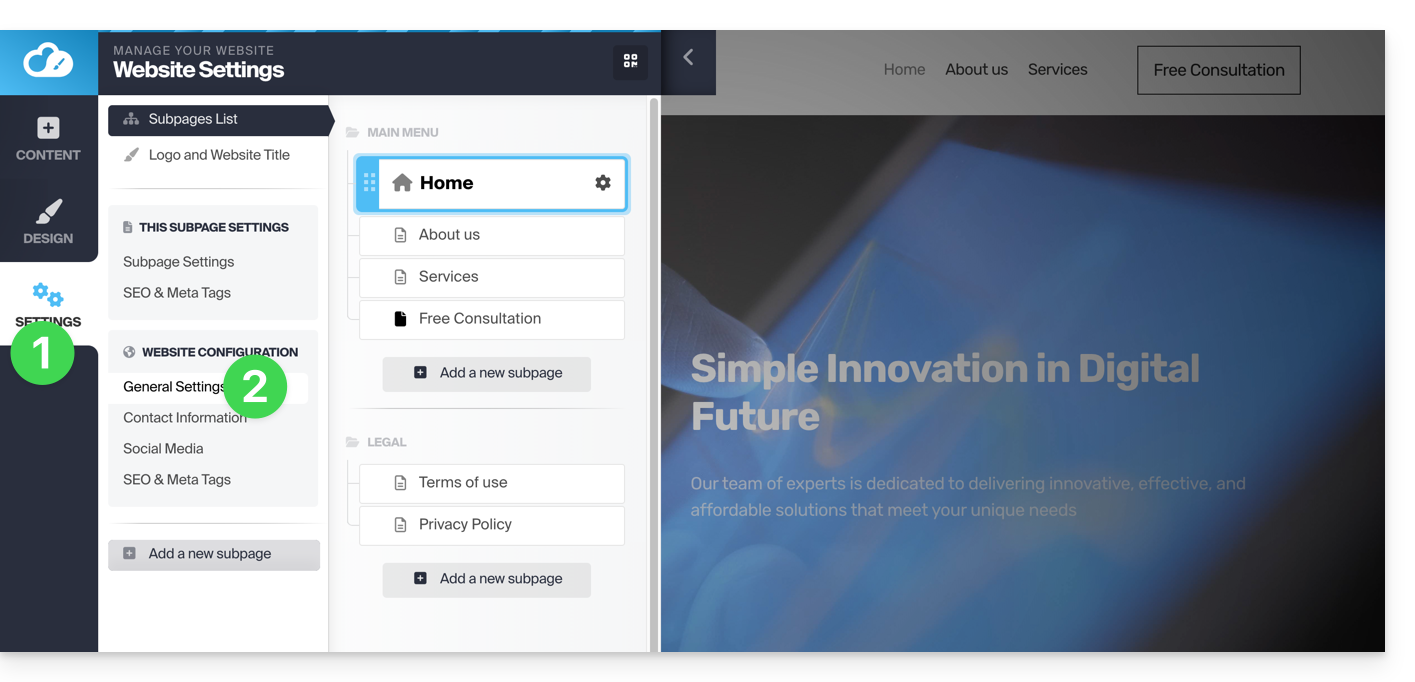
- Click on the Settings button in the left-hand menu.
- Click on General Settings:
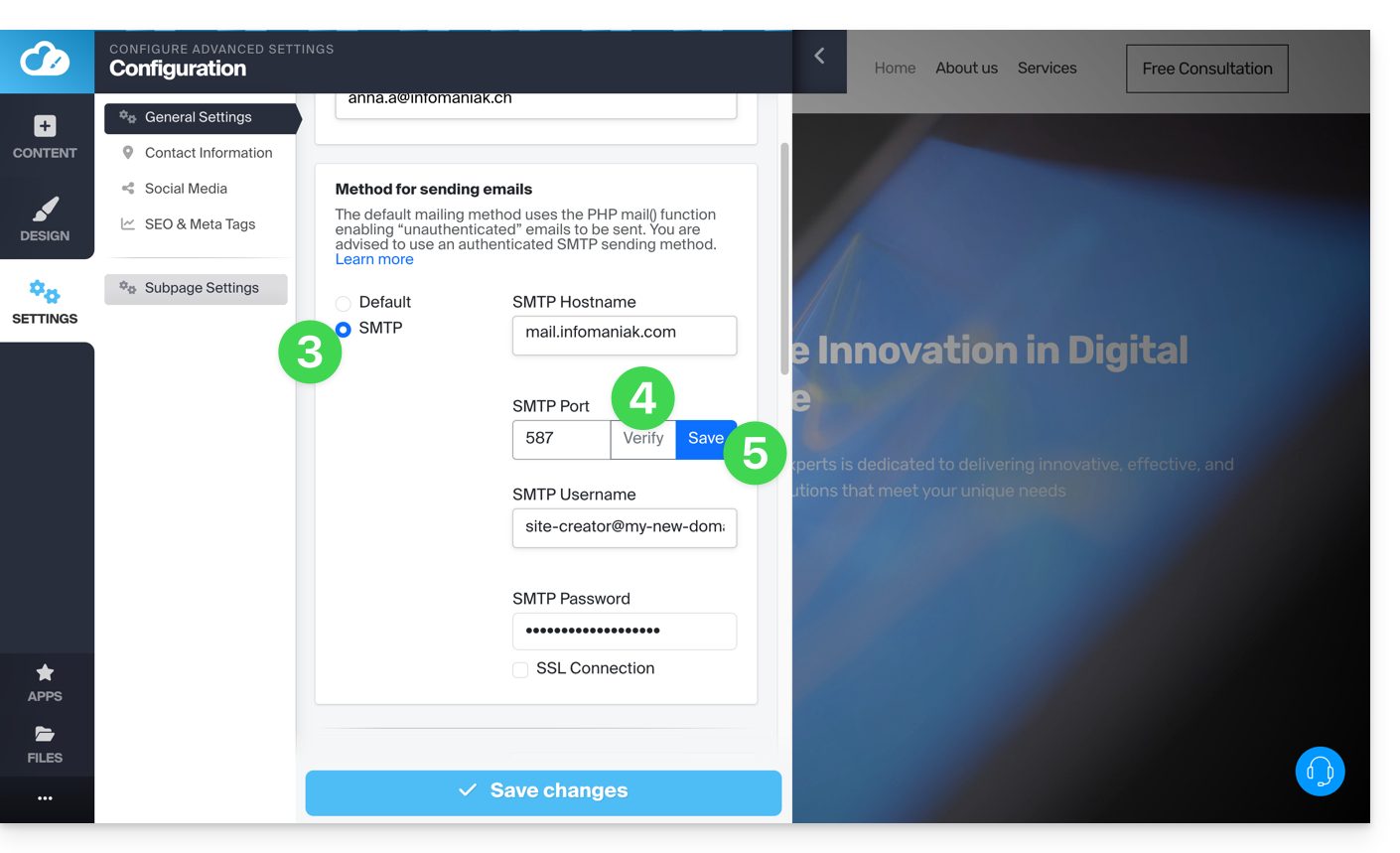
- Choose the SMTP method, then fill in the fields with the SMTP server details and the information related to your email address and its password:
- Outgoing SMTP server =
mail.infomaniak.com - SMTP port:
587 - Username = the complete email address (❓: help)
- Password = the password generated for the email address you want to access (❓: help my kSuite | Mail/kSuite Service).
- Refer to this other guide if you are looking for information about other compatible ports.
- Outgoing SMTP server =
- Once all the fields are filled in, click on the Verify button.
- If everything is correct, the Save button will appear, and you can click it to save your email settings:
Link to this FAQ: https://faq.infomaniak.com/1867
Has this FAQ been helpful?
This guide helps you troubleshoot configuration errors if you are experiencing difficulties linking your domain name to Site Creator.
Common issues and solutions
Identify the current status of your domain to apply the appropriate solution:
| Domain name status | Recommended solution |
|---|---|
| Managed by another provider (external) | Order a DNS zone or transfer the domain to Infomaniak |
| Already associated with a website or defined as an alias (synonym) | Delete the existing website or detach the domain |
| Currently using a dedicated IP address | Uninstall the dedicated IP |
| Protected by an SSL certificate (Self-signed, DV or EV) | Uninstall the certificate |
| Insufficient permissions on the hosting | Modify access rights |
Link to this FAQ: https://faq.infomaniak.com/1956
Has this FAQ been helpful?
This guide explains how to add and configure an online store moduleon your website created with Site Creator Infomaniak to start selling online and offer your products for sale.
Add the online store to Site Creator
Start by logging in to the Infomaniak Manager with your credentials (user account with the necessary permissions for the relevant product):
- Click here to access the hosting & website management interface (filtered to display only Site Creator).
- If nothing is displayed, you may not be in the Organization to which your website is linked (❓: help).
- Click on the name of the Site Creator in question:
- Click on the button to edit your site:
Dedicated themes
If you plan to create a website entirely dedicated to your products in the form of an online store, you can choose from the start to apply a theme from the E-Commerce category: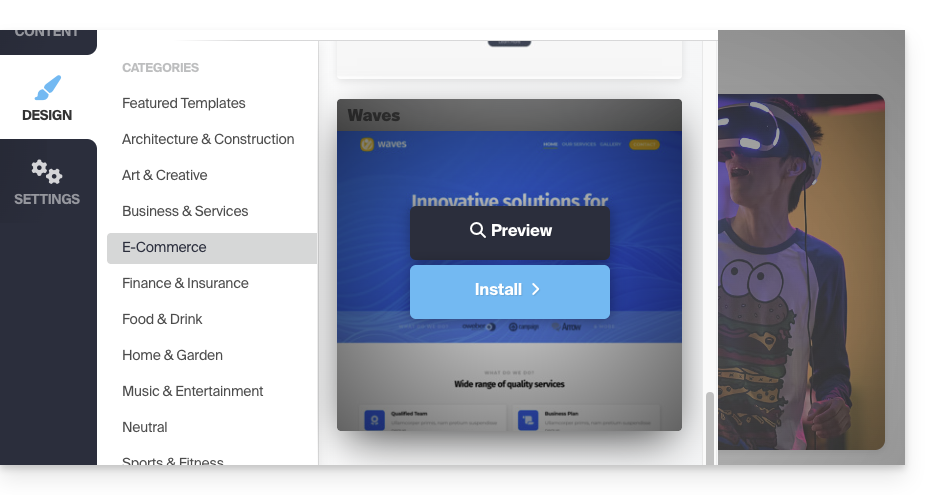
Shop module for Site Creator
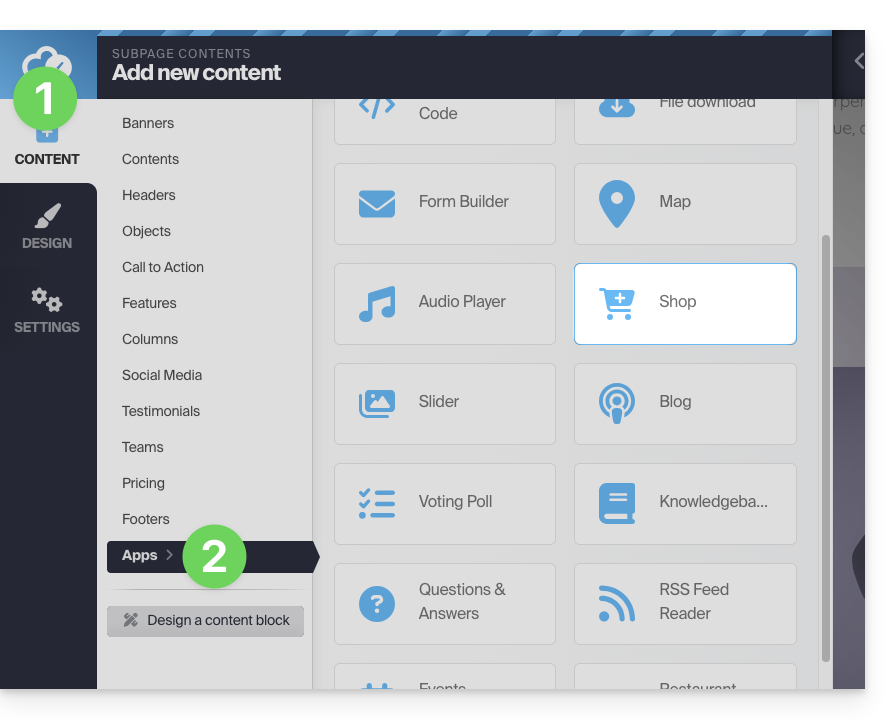
If the Shop module is not yet integrated into your pages, simply add it to the location of your choice:
- Click on the Content button in the left sidebar.
- Click on Applications at the bottom of the list, then on Store:
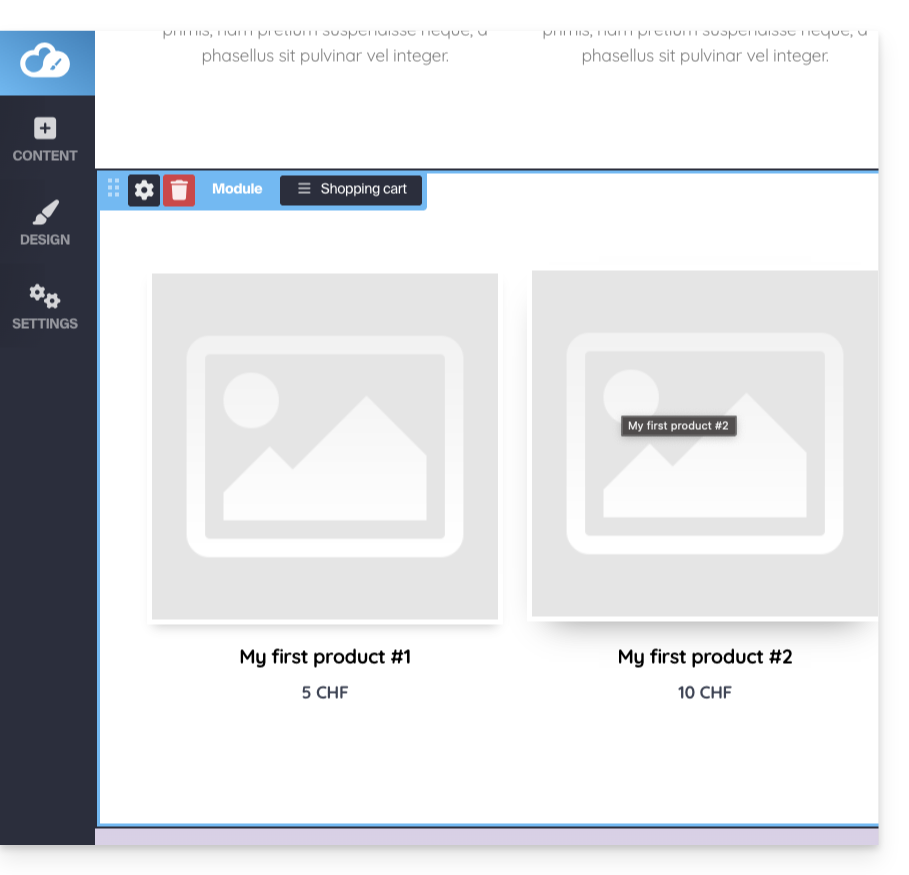
- The store and 3 example products are inserted:
Configure the store
Refer to this other guide about the different configuration options for the Site Creator store.
Link to this FAQ: https://faq.infomaniak.com/2450
Has this FAQ been helpful?
Infomaniak offers various Site Creator plans, both free and paid, to meet different needs. It is essential to understand the terms and conditions associated with each type of plan before making your choice.
Understanding the Different Site Creator Plans
Site Creator is available…
- … either free of charge with every paid Web Hosting plan (add one if necessary):
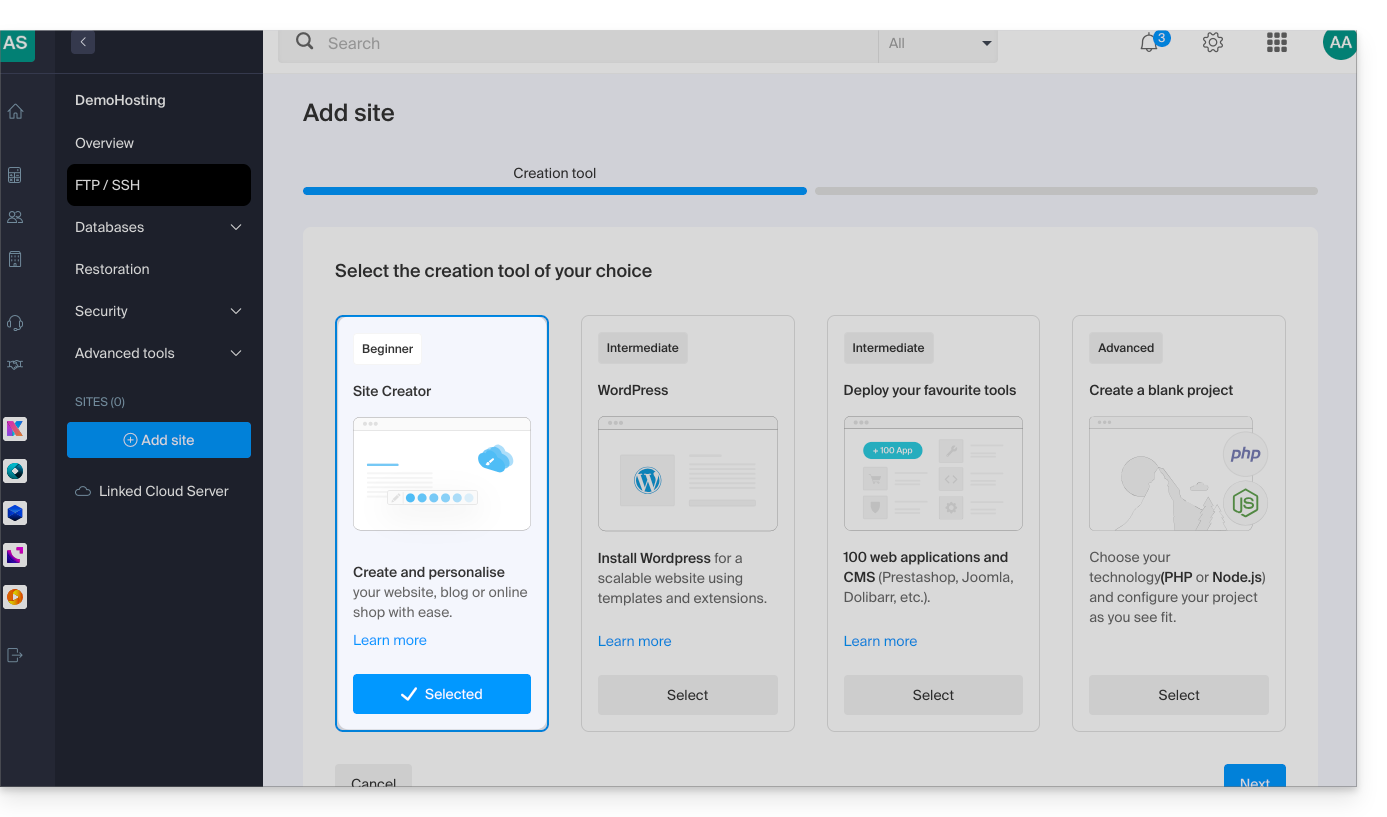
- In this case, only 1 Site Creator can be set up per Infomaniak Web Hosting plan.
- To manage multiple sites created with Site Creator within the same Organization, it is therefore necessary to have multiple Web Hosting plans.
- … oras a standalone solution (standalone available in 3 versions) and in this case, does not require any other specific offer:
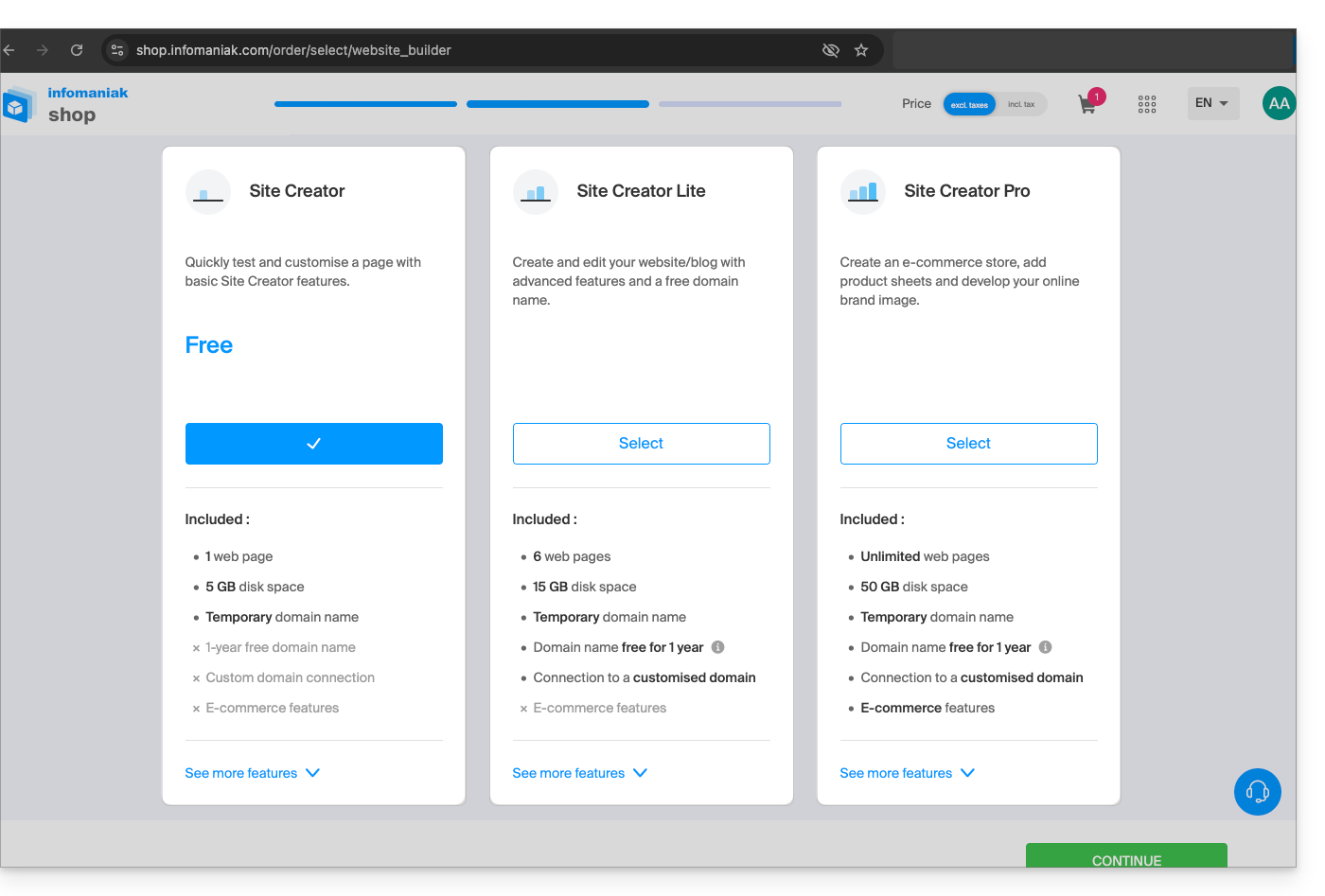
- Site Creator Free
- Site Creator Lite
- Site Creator Pro
1. Site Creator Free
This offer is designed as a trial and discovery solution and is completely free. It is intended for users who want to familiarize themselves with the tool or publish an extremely simple web page:
- It only allows one web page and offers limited disk space (5 GB).
- This offer does not allow connection to a custom domain name (it will be in the format
*.infomaniak.site) and includes the mandatory display of Infomaniak's advertising message. - Important growth modules, such as full blog management, the use of Artificial Intelligence for text generation, or the "Sitemap" function, are not included.
2. Site Creator Lite
The Lite plan is Infomaniak's entry-level paid plan. It is ideal for creating a simple showcase website or personal blog, as it eliminates the main limitations of the free version and unlocks the modules needed for a complete website:
- It allows you to create a more comprehensive website with a limit of 6 web pages and more generous disk space (15 GB).
- It includes a domain name for one year and, most importantly, removes all Infomaniak advertising from the website.
- Unlike the Free plan, the Lite plan unlocks access to important features for navigation and organization, including the module for creating and managing a blog, as well as the sitemap module.
3. Site Creator Pro
The Pro plan is the premium plan for Site Creator. It is exclusively designed for the most ambitious projects, such as launching a complete online store, by removing all content restrictions and integrating advanced e-commerce and analytics tools:
- It removes all limitations on content by offering unlimited web pages and a large disk space of 50 GB.
- This is the only plan that includes complete e-commerce management (orders, inventory, discounts) and allows the integration of essential payment gateways (Stripe, PayPal, Mollie) for an online business.
- The Pro plan is the only one that provides access to crucial external analysis and performance tracking tools, such as Google Analytics, Hotjar, and tools like Google reCaptcha.
Commitment related to paid offers
Unlike other Infomaniak products, some Site Creator offers include a free domain name. These offers require a firm commitment for a minimum period of 12 months, with no possibility of a refund, even partial, even if:
- you decide to stop using Site Creator before the end of the first year,
- you cancel your products,
- you close your user account or your Organization.
Changes to offers and maintaining your site
You can upgrade from a free plan to a more comprehensive paid plan:
- Click here to access the hosting & site management interface (filtered to display only Site Creator).
- If nothing is displayed, you may not be in the Organization to which your site is linked (❓: help).
- Click on the action menu ⋮ to the right of the website in question in the table that appears.
- Click on Modify offer:
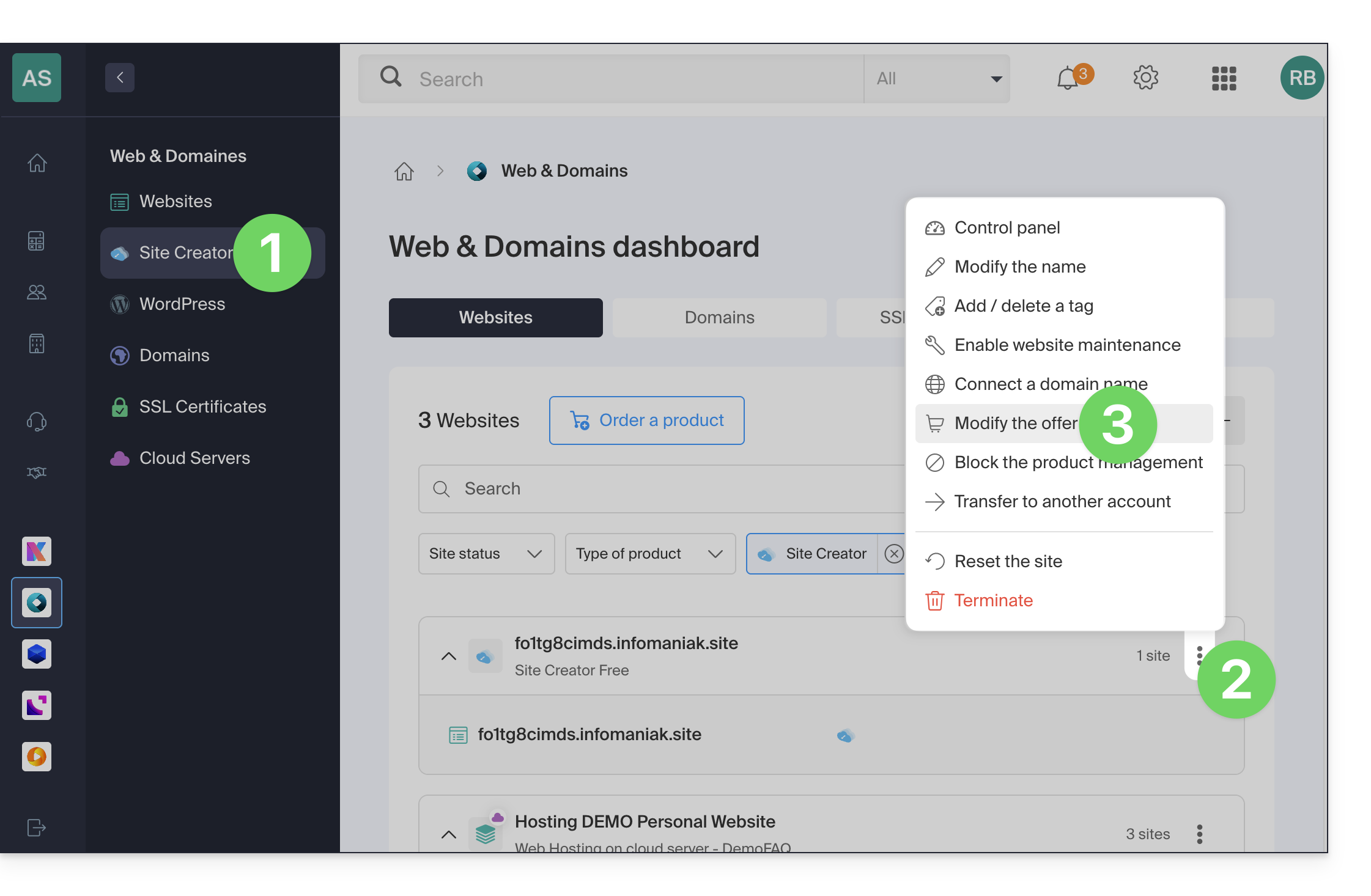
It is also possible to upgrade to a higher plan (e.g., from Lite to Pro).
However,It is not possible to downgrade to a lower planor revert to a free plan once a paid plan has been activated.
If you wish to keep your site active, you must renew the same paid plan. It is not possible to switch to a free version of Site Creator, even if:
- you are not using any of the paid modules,
- your website only has one page.
What should you do if you want to revert to the free plan?
In this case, you must:
- cancel your current site after manually copying all the information you wish to keep,
- activate a new free Site Creator offer,
- recreate your site by pasting the content retrieved from the old one.
Link to this FAQ: https://faq.infomaniak.com/2518
Has this FAQ been helpful?
This guide explains how to embed video/audio files imported into an Infomaniak VOD/AOD service on web pages.
Introduction
- This VOD/AOD integration code is unique and corresponds to the settings you are specifying on the page.
- It allows you to embed the same video with different display configurations, according to your needs.
- You can then modify the settings for this integration by adjusting them from the integration history page in the Infomaniak Manager.
- You can also share a media file in various ways.
Generate and copy the embed code
The embed code can be found in your VOD interface; here is an example with a default Player:
- Click here to access the management interface for your product in the Infomaniak Manager (need help?).
- Click directly on the name assigned to the product in question:
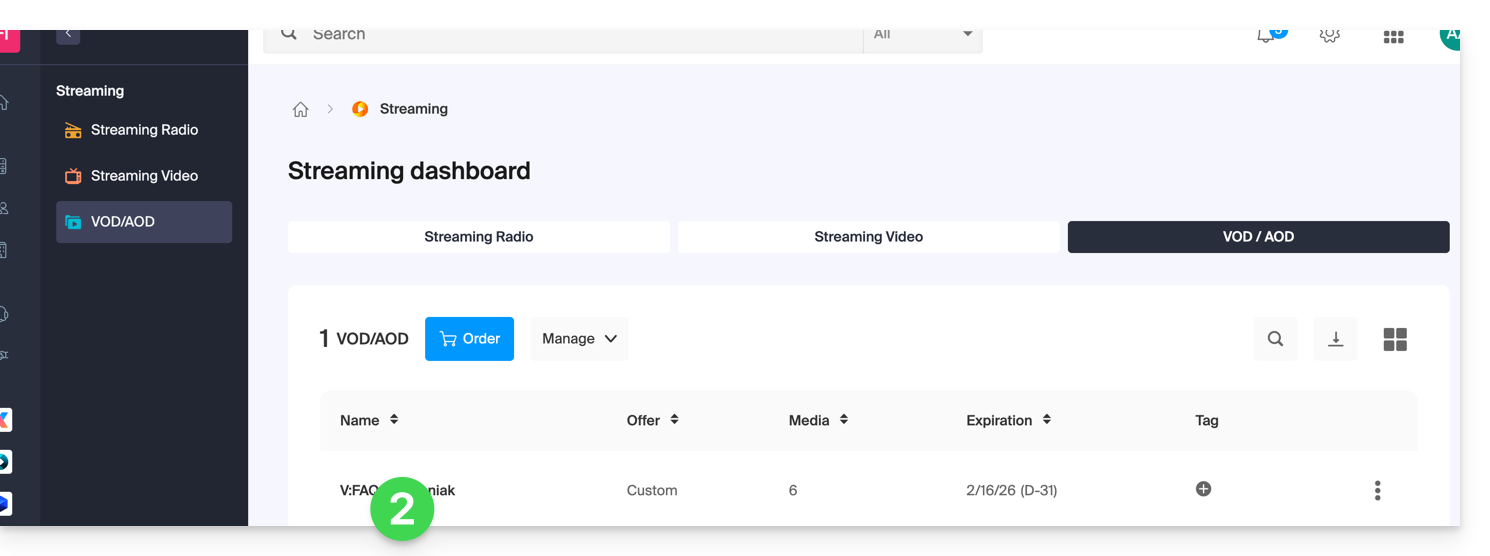
- Click on Media in the left-hand menu.
- Click on Media Management in the left-hand menu.
- Click on the relevant media in the table that appears:
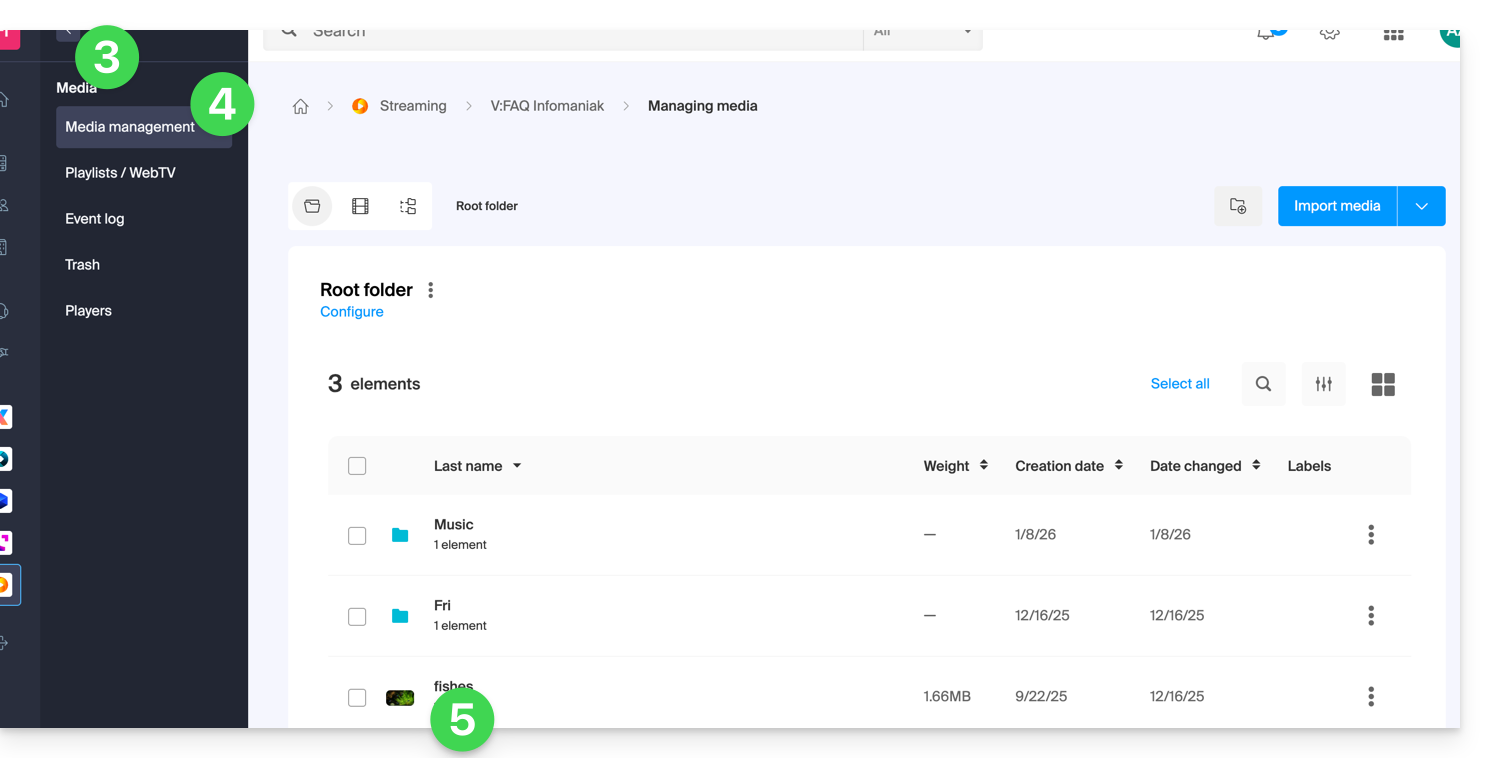
- Click on the blue Embed button.
- Click on Create an integration:
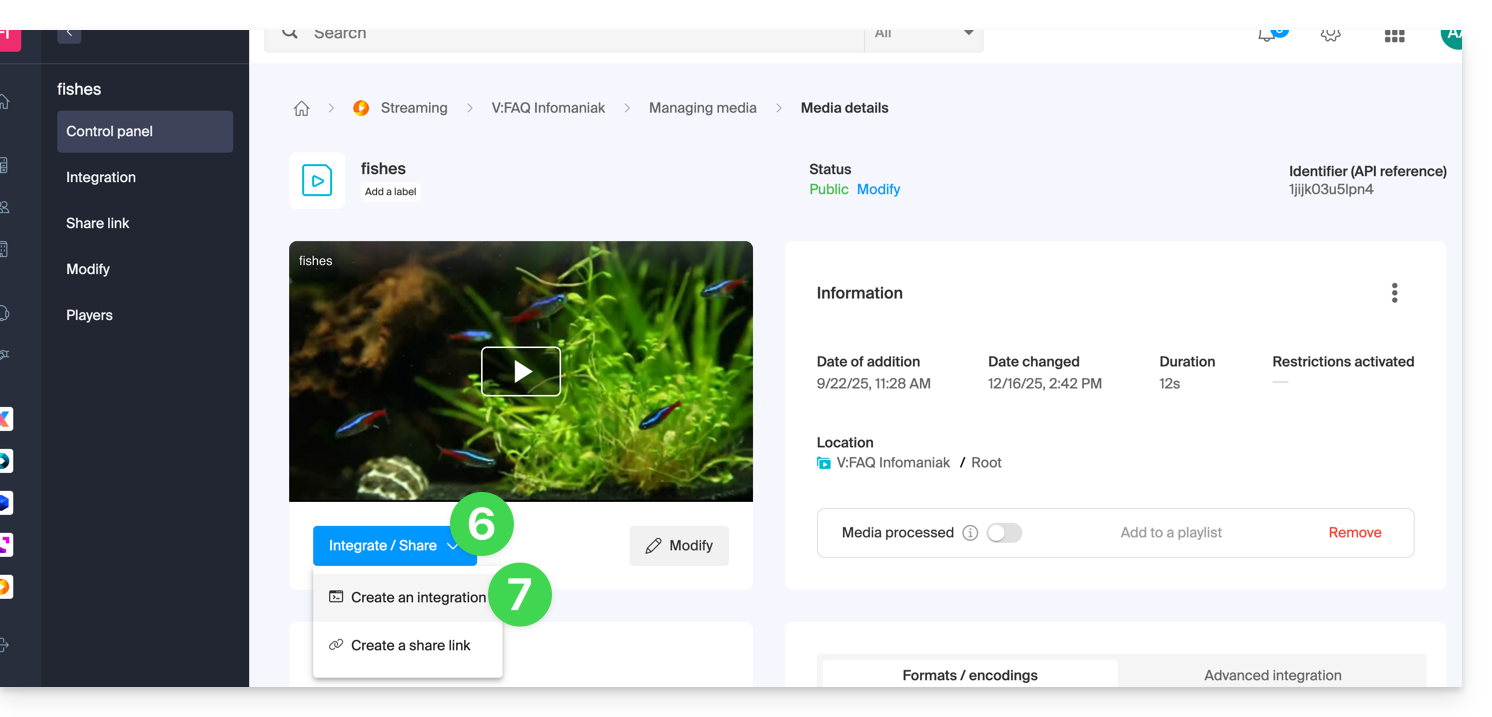
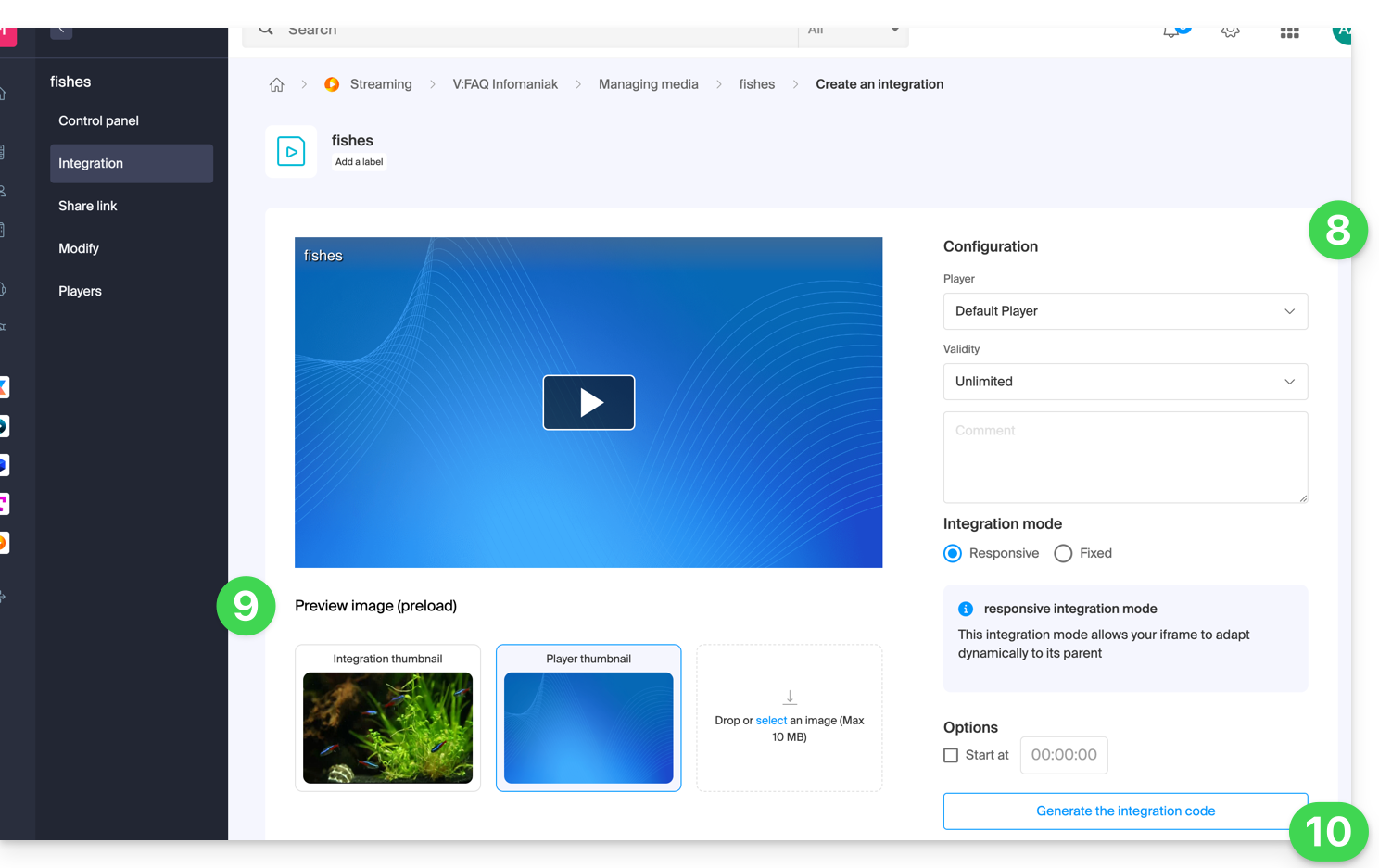
- Customize the media integration (Player to use, timestamp, loop playback, automatic start, …).
- Choose the thumbnail to display when the media is paused.
- Click the button to Generate the embed code:
- Copy the code to embed it in the location of your choice:
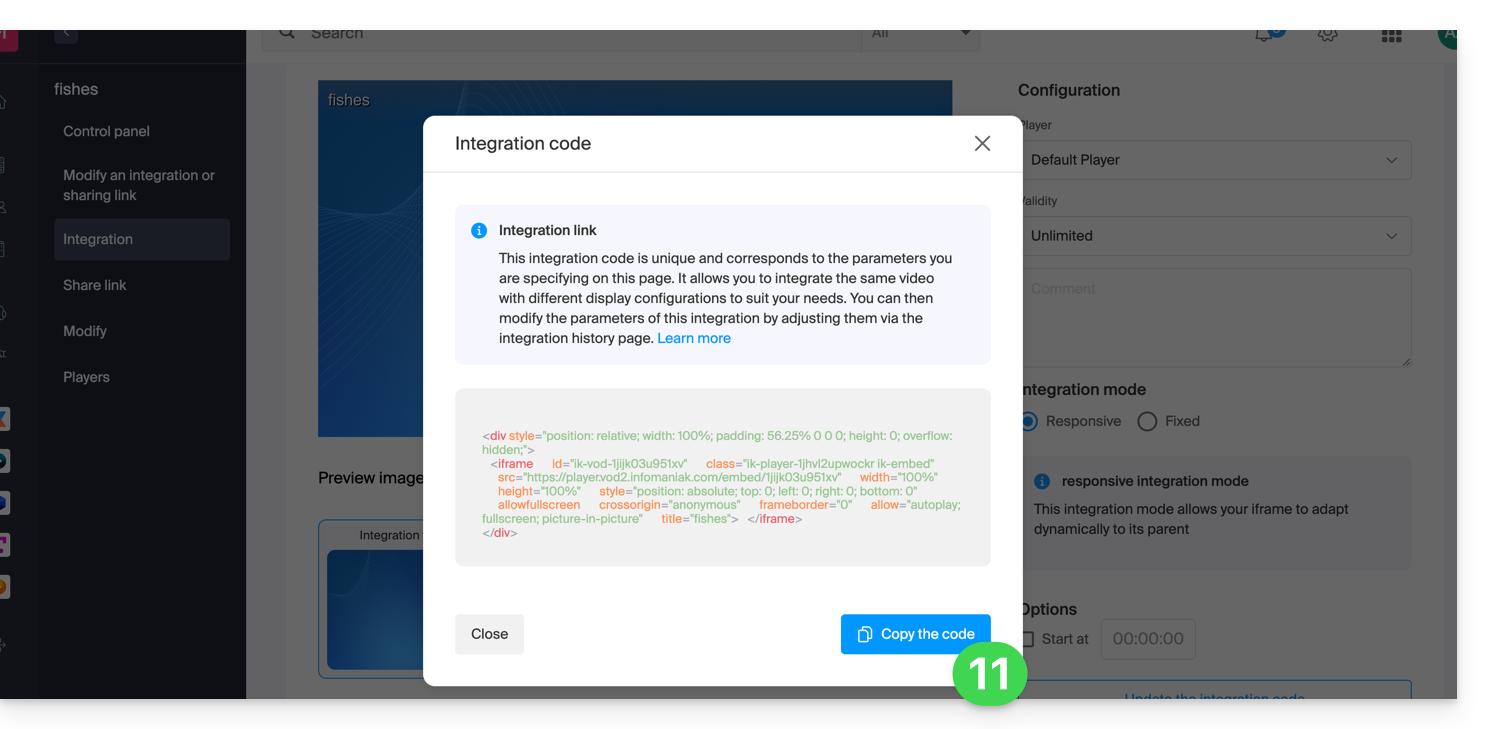
The media will then be inserted with the default Player, but you have the option to choose from your created Players the one that should be offered during the integration.
Modify a previous integration
To customize the integration of your media again, and to keep the corresponding code without having to insert it again:
- Click here to access the management interface for your product in the Infomaniak Manager (need help?).
- Click directly on the name assigned to the product in question.
- Click on Media in the left-hand menu.
- Click on Media Management in the left-hand menu.
- Click on the relevant media in the table that appears.
- Click on the blue Embed button.
- Click on Edit an integration:
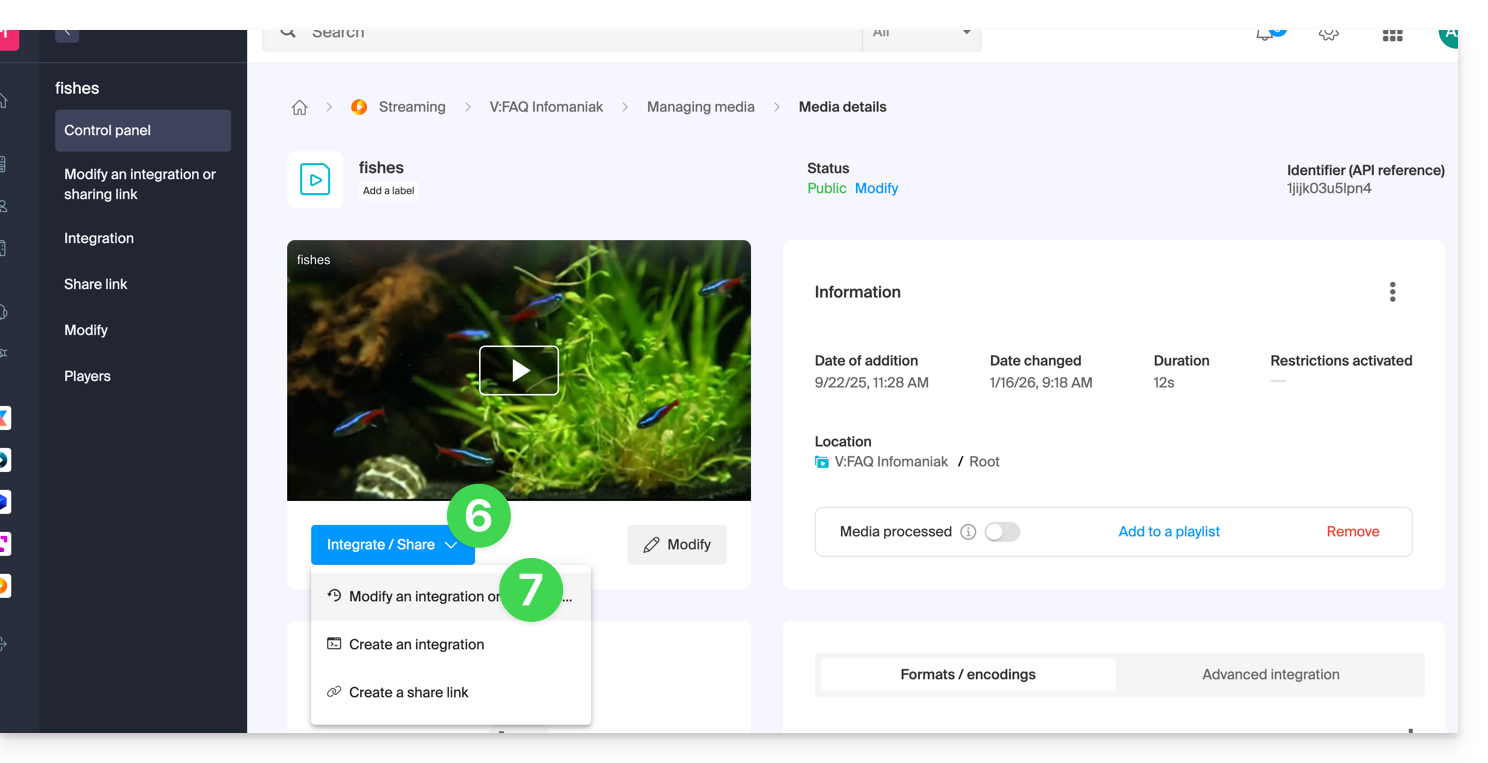
- Click on the action menu ⋮ to the right of the relevant item in the table that appears.
- Click on the desired item to obtain/modify the integration codes:
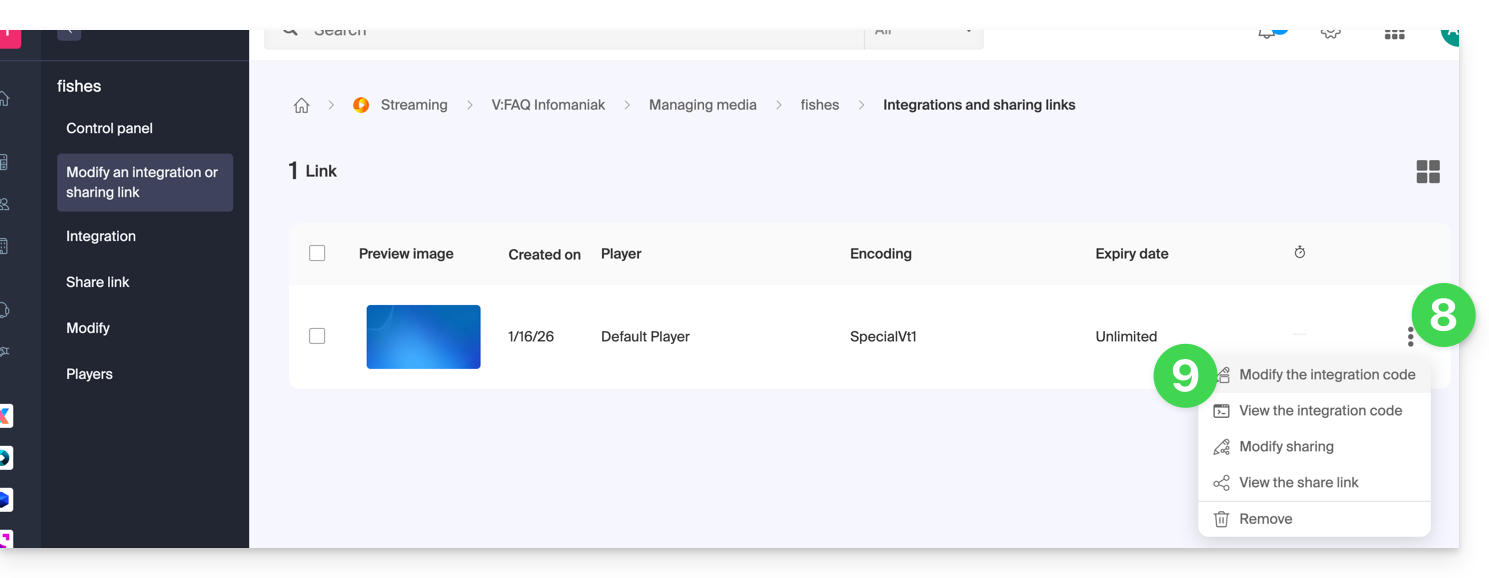
Paste the integration code…
On the webpage of your choice, paste the HTML code where you want it: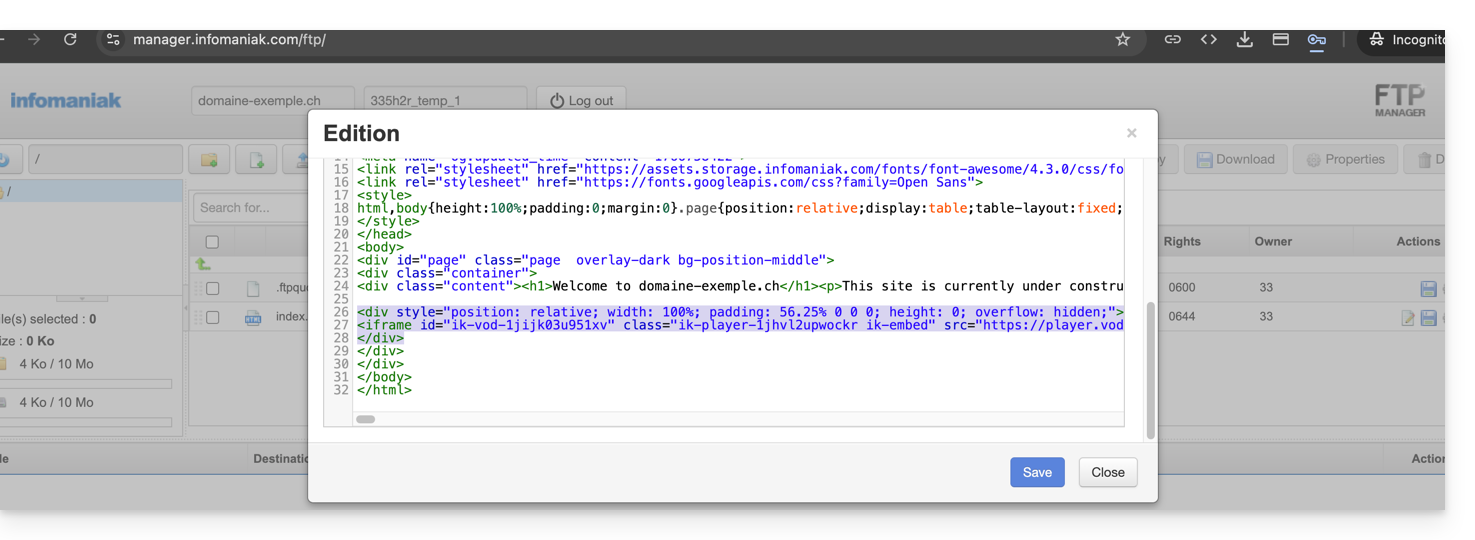
… on Infomaniak Site Creator
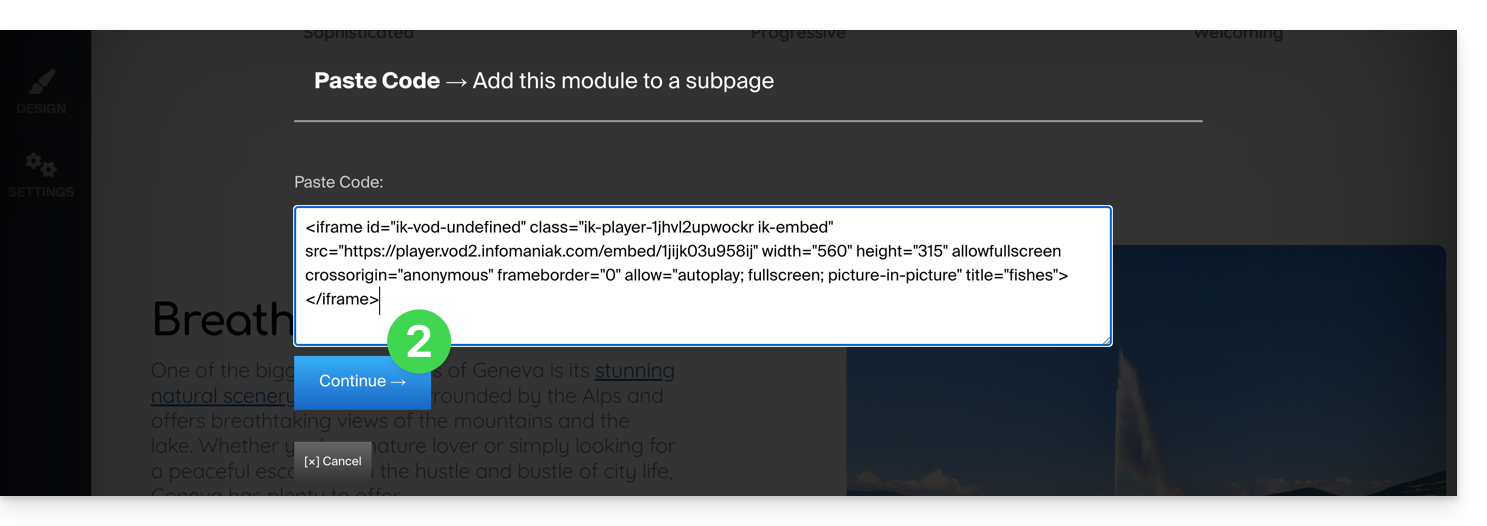
- For Site Creator, you need to generate a “Fixed” embed code (and not “Responsive”):
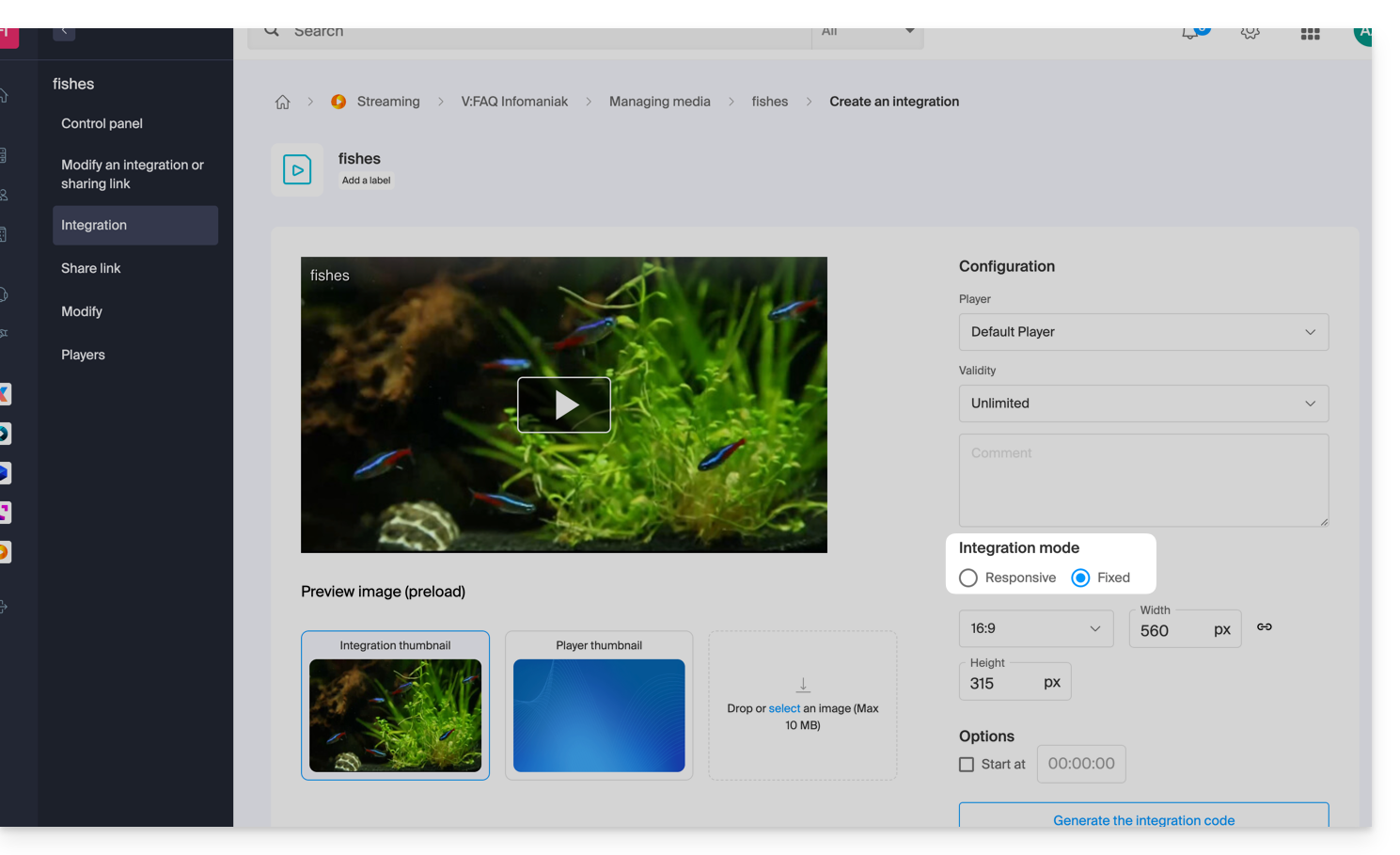
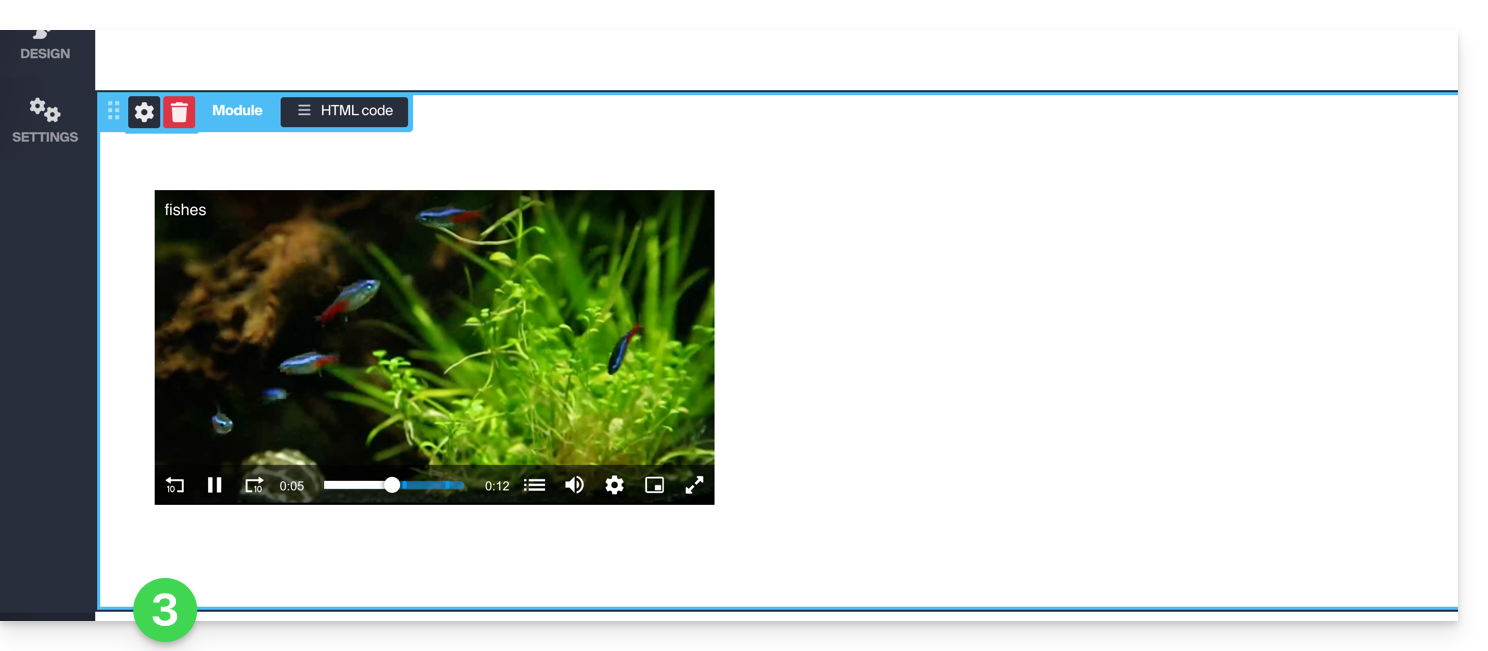
- Then, paste this code into Site Creator within a “Custom HTML” block:
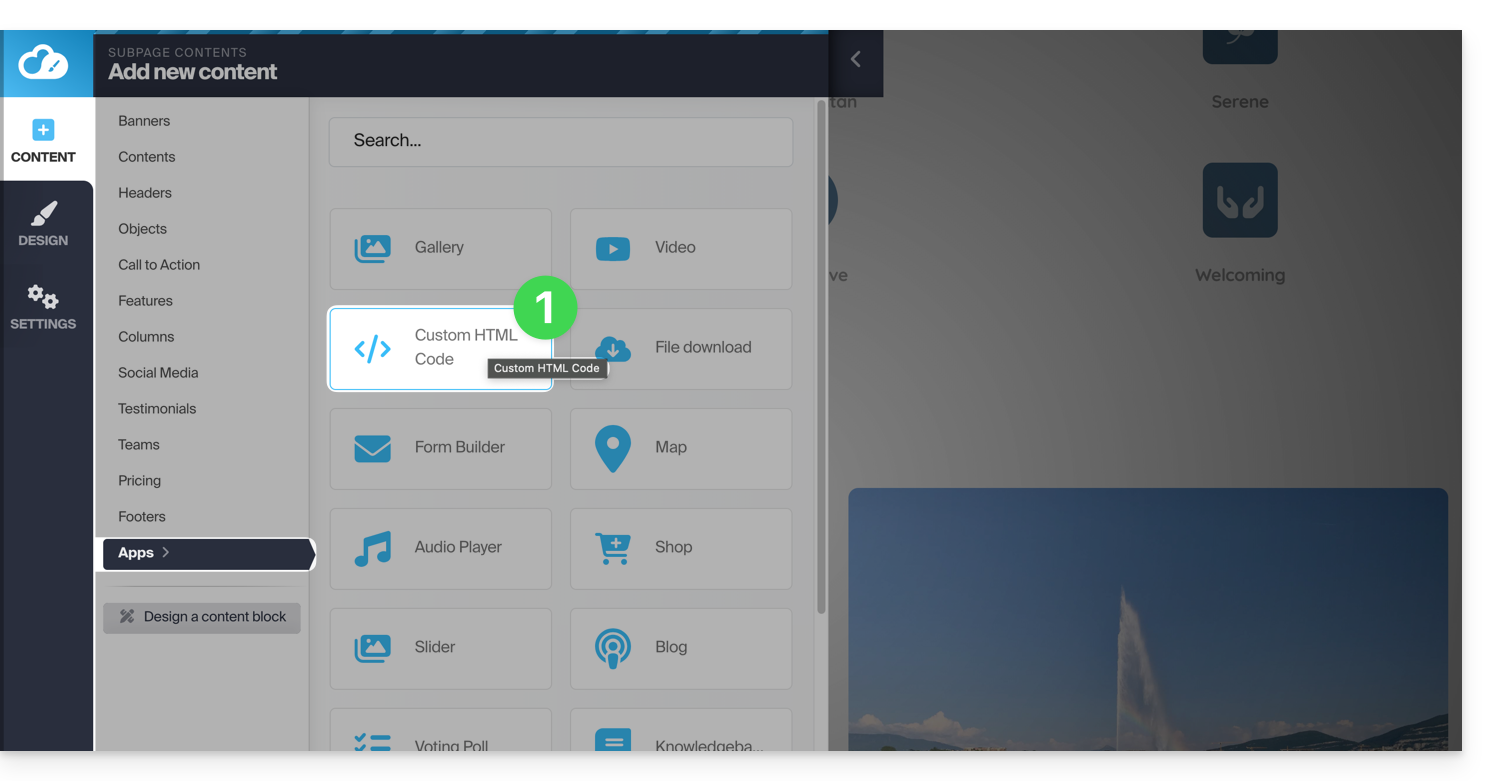
Link to this FAQ: https://faq.infomaniak.com/2525
Has this FAQ been helpful?
This guide presents the Calendar and Calendly modules for Infomaniak's Site Creator.
Calendar Module
Start by logging in to the Infomaniak Manager with your credentials (user with the necessary rights for the product in question):
- Click here to access the hosting & site management section (filtered to display only Site Creator).
- If nothing is displayed, you may not be in the Organization to which your site is linked (❓: help).
- Click on the name of the Site Creator in question:
- Click on the button to edit your site:
Once in Site Creator:
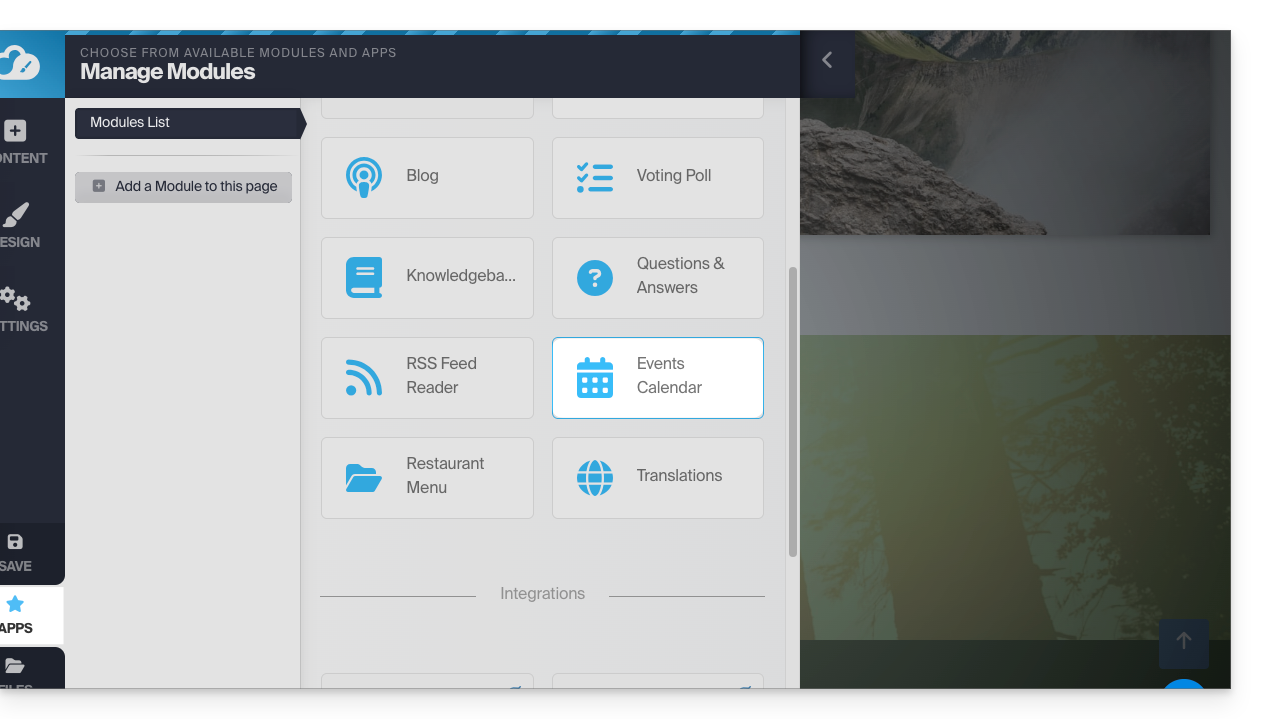
- Click on the Applications button in the left-hand menu.
- Click on Calendar:
Add events related to your activity that you want to display on your website in a dynamic way: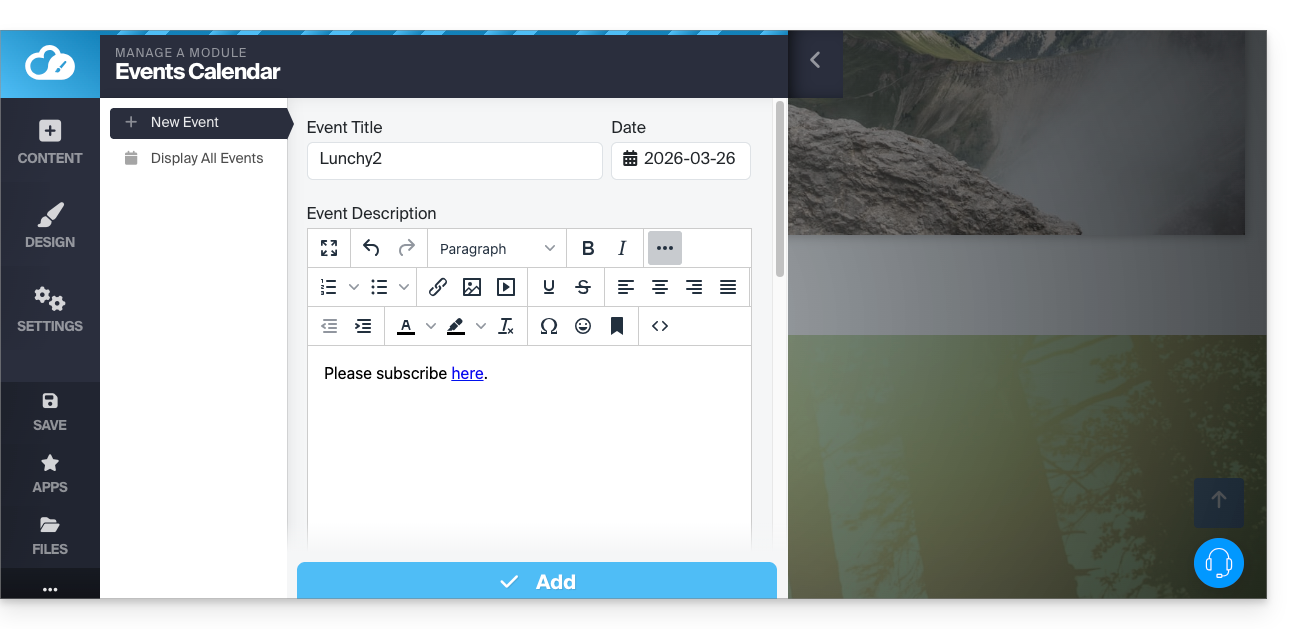
Once you have added a few events, you can view them on the calendar in the same place: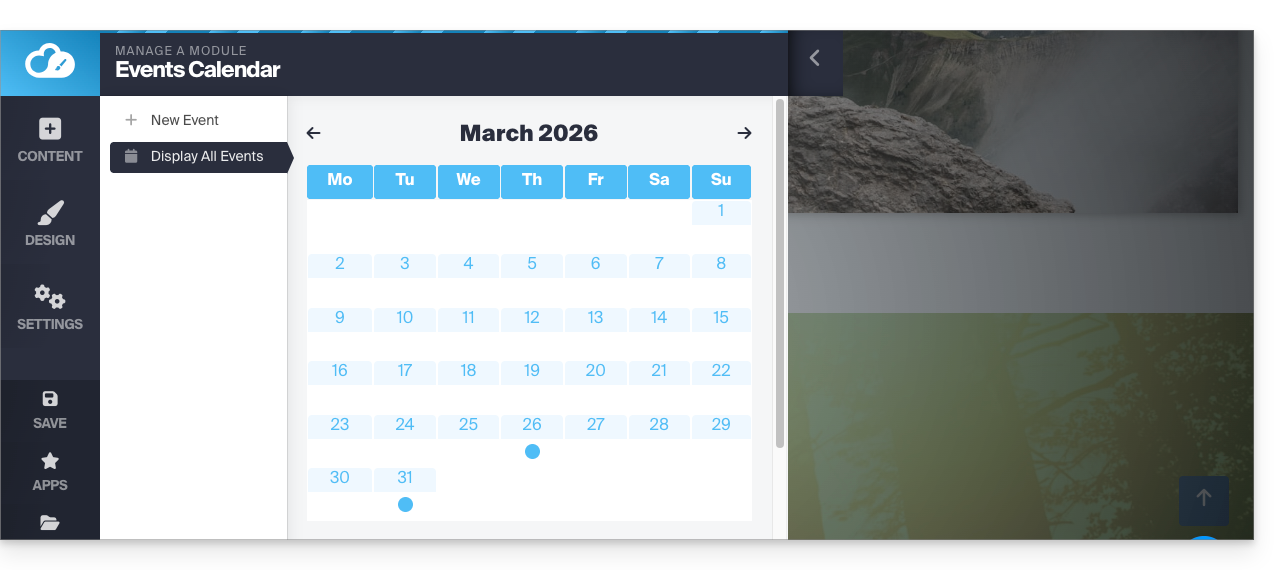
Then, insert the Calendar module in the desired location on your site: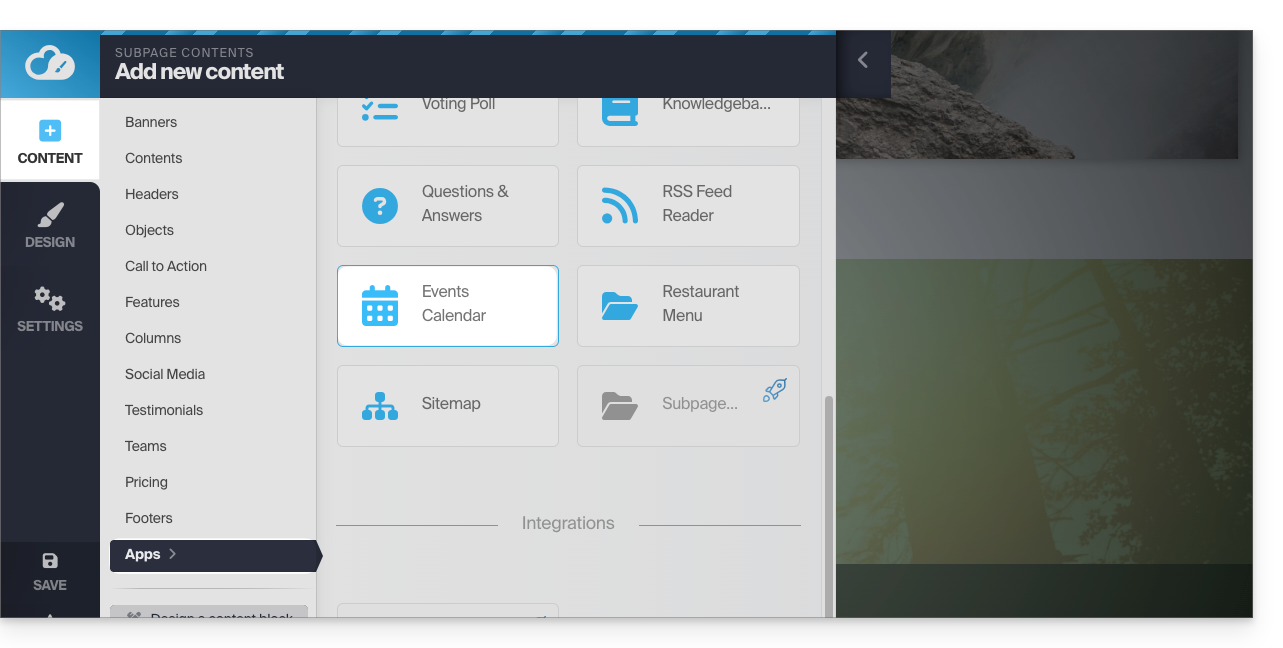
Your visitors will be able to see the scheduled events, including when you modify them in your calendar: 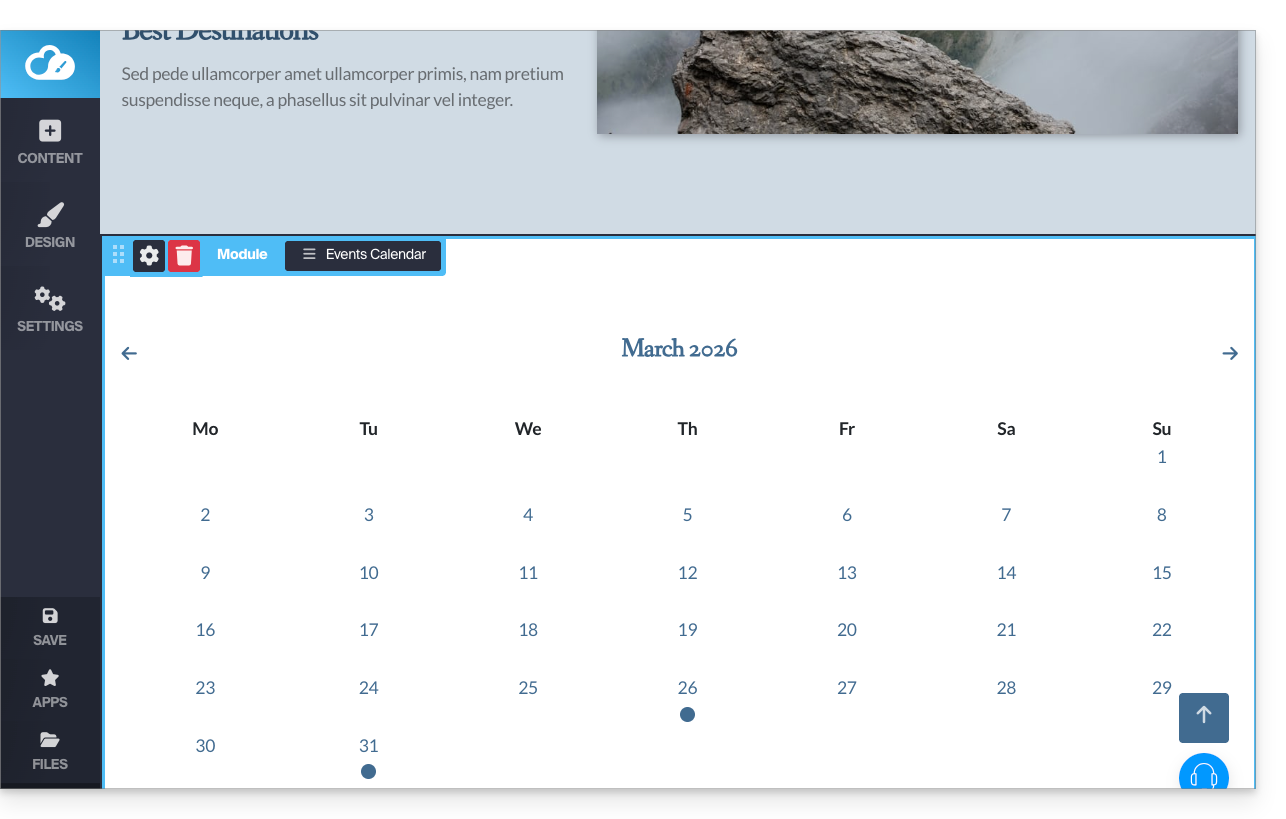
Calendly Module
✘ UNAVAILABLE with
Site Creator Free / Lite
This integration is possible if you have an account on the external Calendly service.
From Site Creator:
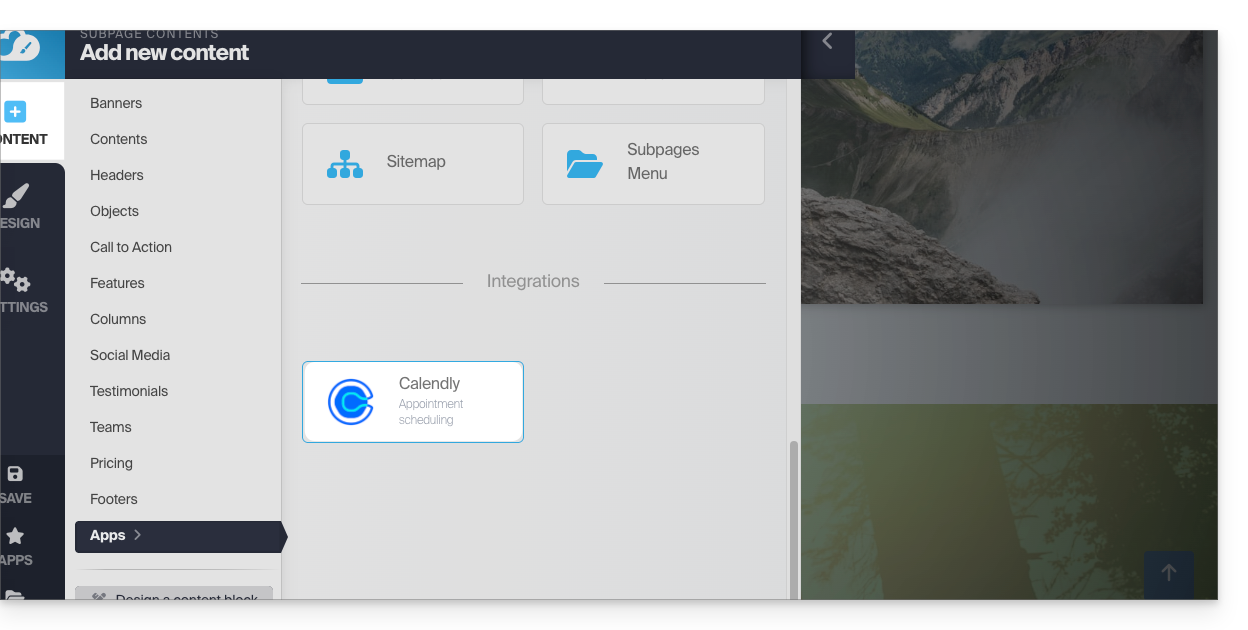
- Click on the Content button in the left-hand menu.
- Click on Apps in the left-hand menu.
- Click on Calendly to insert the module:
- Click to configure the application with the information related to your Calendly account:
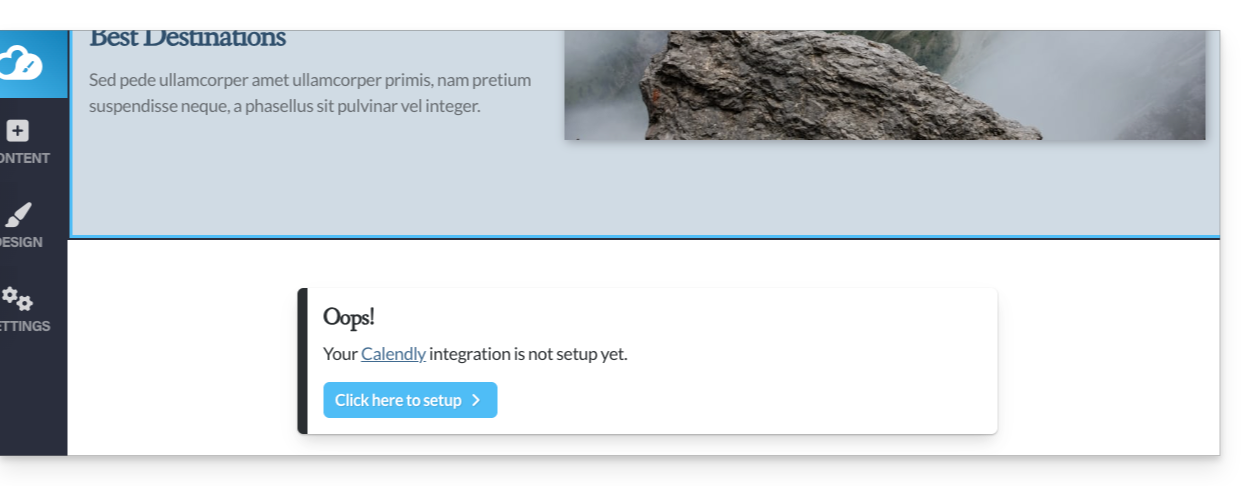
Then, insert the Calendly module in the desired location on your site to access your Calendly information: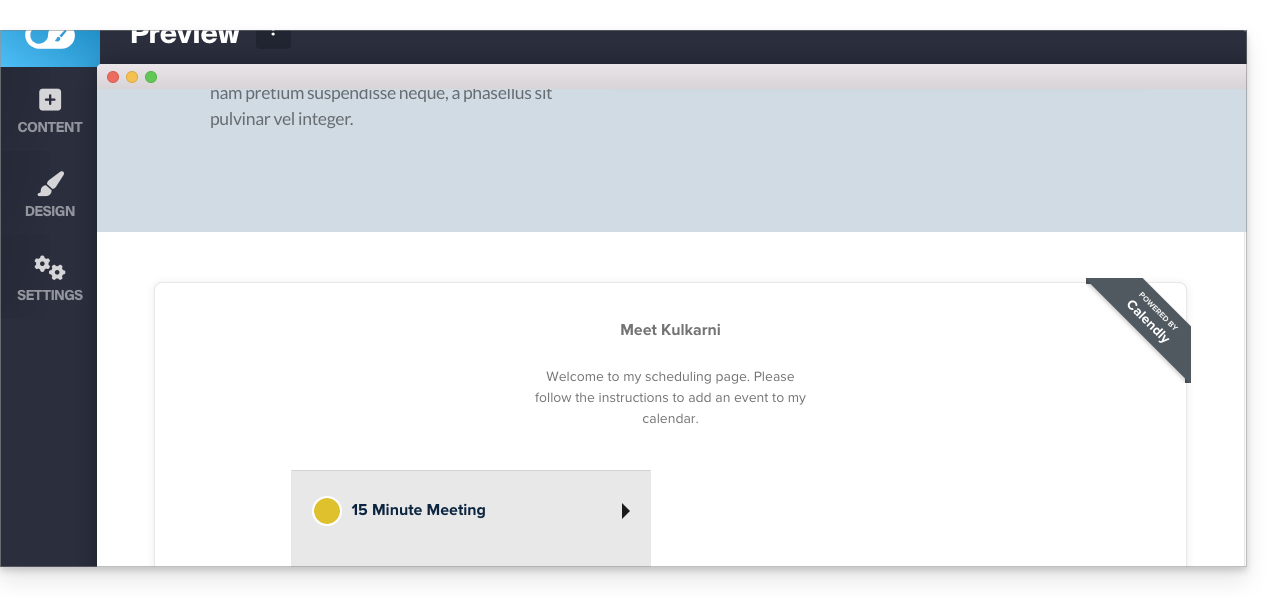
Link to this FAQ: https://faq.infomaniak.com/2578
Has this FAQ been helpful?
This guide explains how to manage the first page of an Infomaniak Site Creator, i.e., the homepage that is displayed when you enter your website's address (e.g., www.domain.xyz).
Introduction
- The homepage is mandatory, but you can easily define a new one from your existing pages at any time.
- Refer to this other guide to manage additional pages.
Modify the website's homepage
Start by logging into the Infomaniak Manager with your credentials (user account with the necessary rights for the product in question):
- Click here to access the hosting & site management section (filtered to display only Site Creator).
- If nothing is displayed, you may not be in the Organization to which your site is linked (❓: help).
- Click on the name of the Site Creator in question:
- Click the button to edit your website:
Once in Site Creator:
- Click on the Settings button in the left-hand menu – the list of your pages will appear:
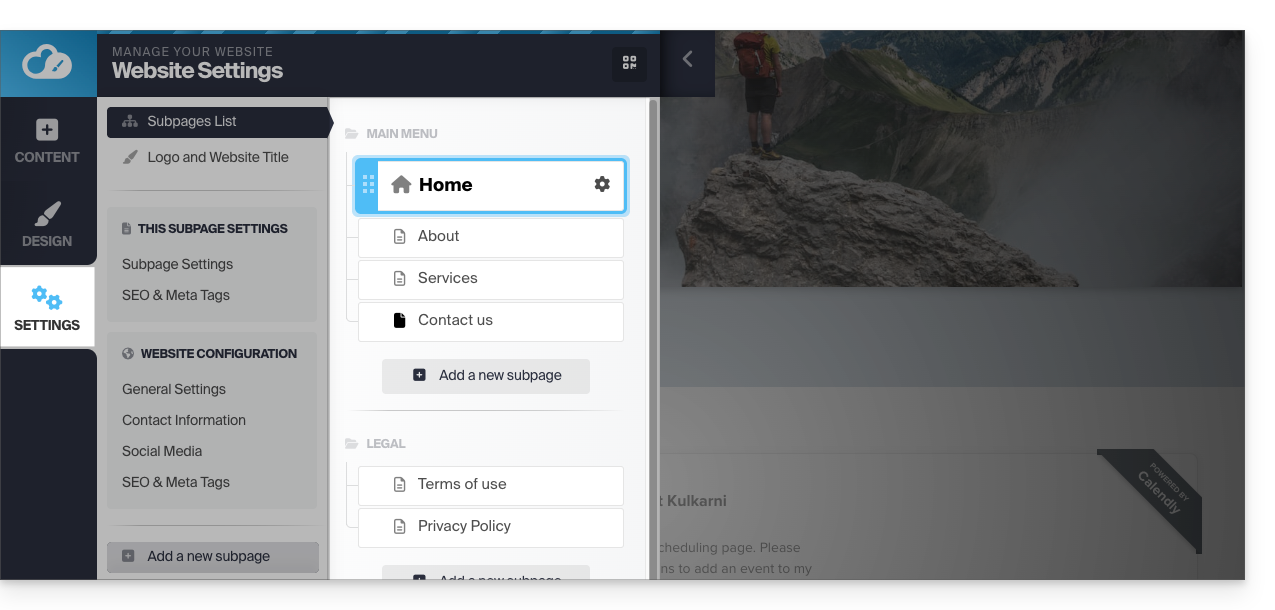
- Click, then drag and move the current homepage (represented by a house icon) to the bottom of the list:
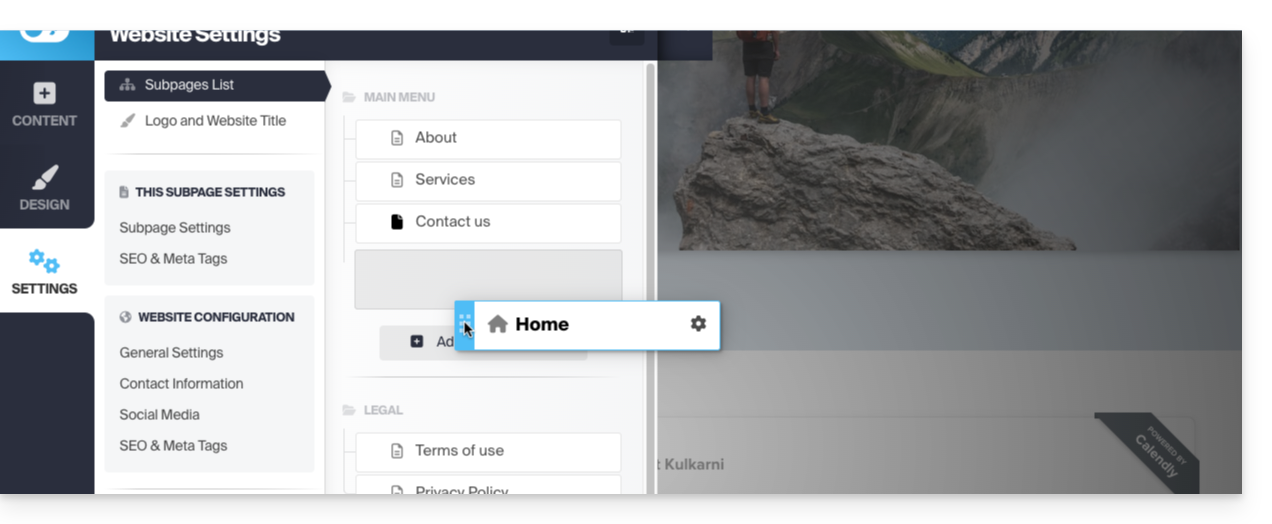
- Click the icon on this page to change its page type to a standard page.
- Save the changes:
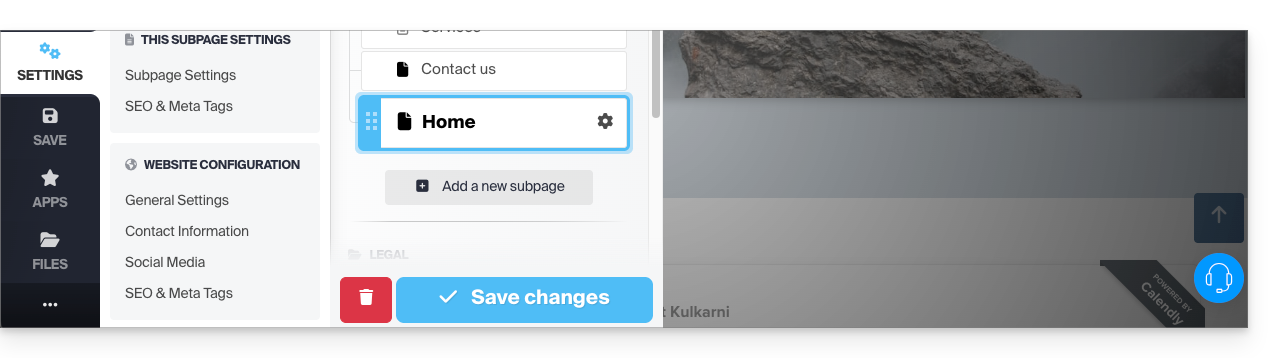
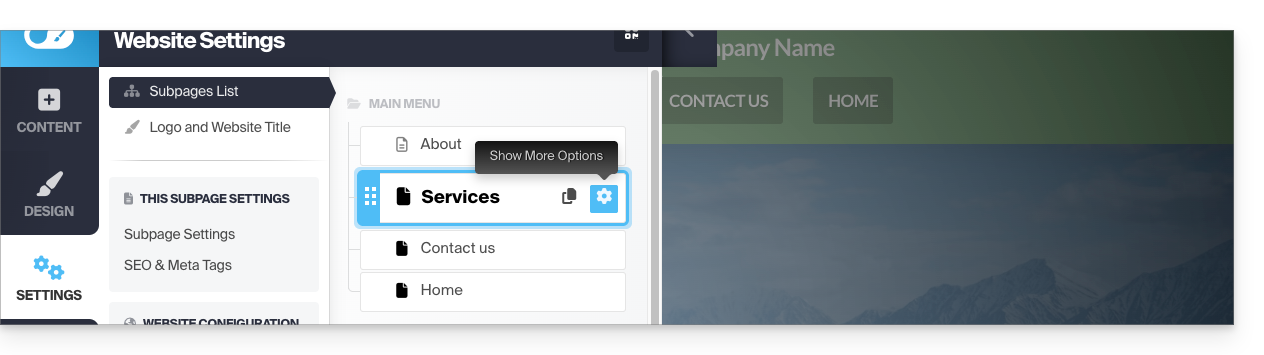
- Go back to the settings and click on Settings of the page that will become the new homepage:
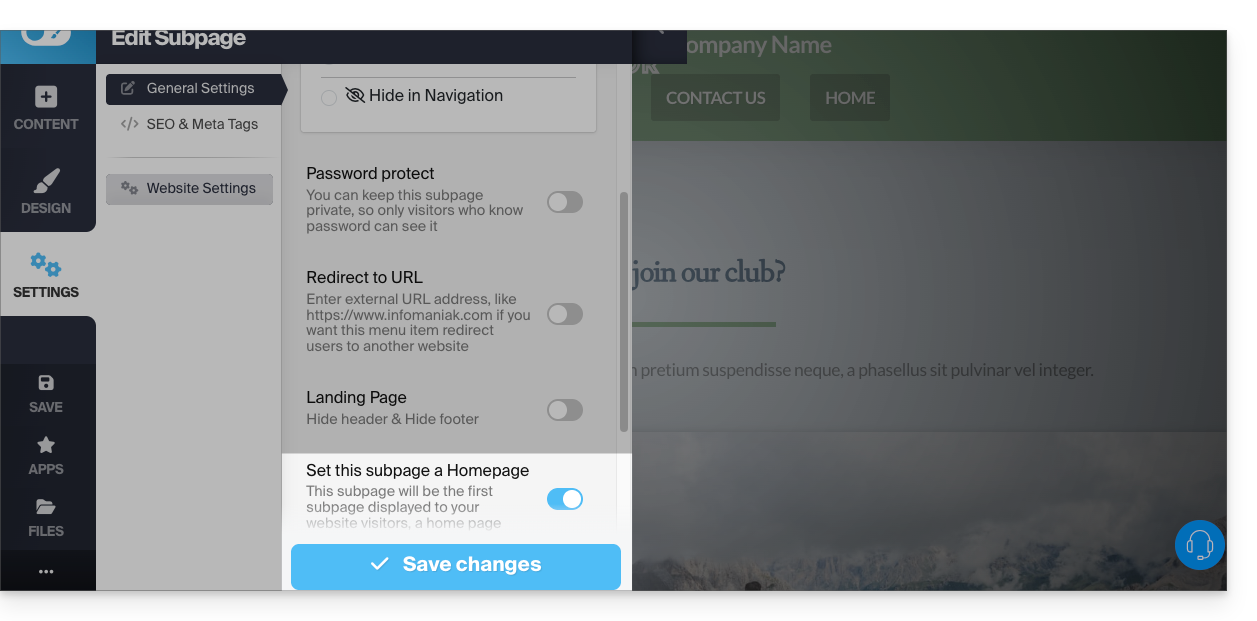
- Click the toggle switch to set this page as the homepage of your website.
- Save the changes:
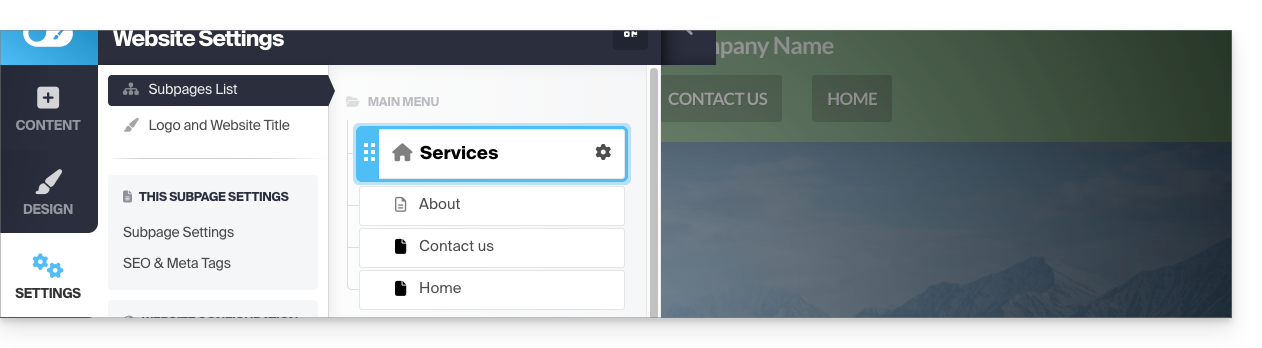
- Go back to the settings and click on the icon of this page to change its page type to a homepage and position it first:
- Save the changes and test the effect of the change by visiting your site, which will no longer have the same default homepage:
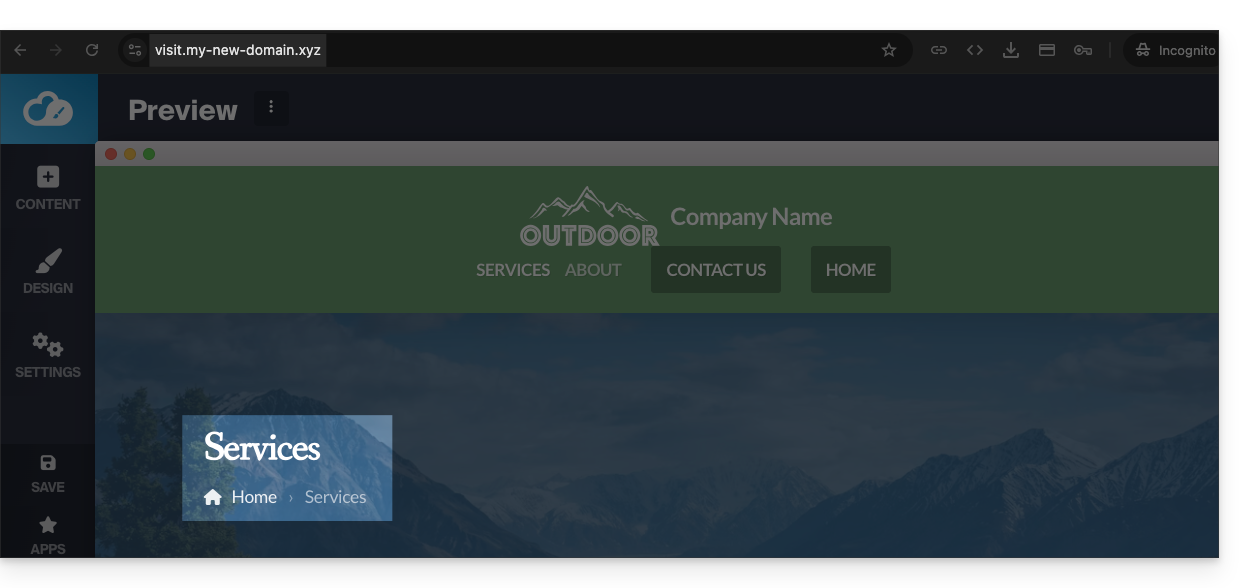
- Before, the homepage was the default one:
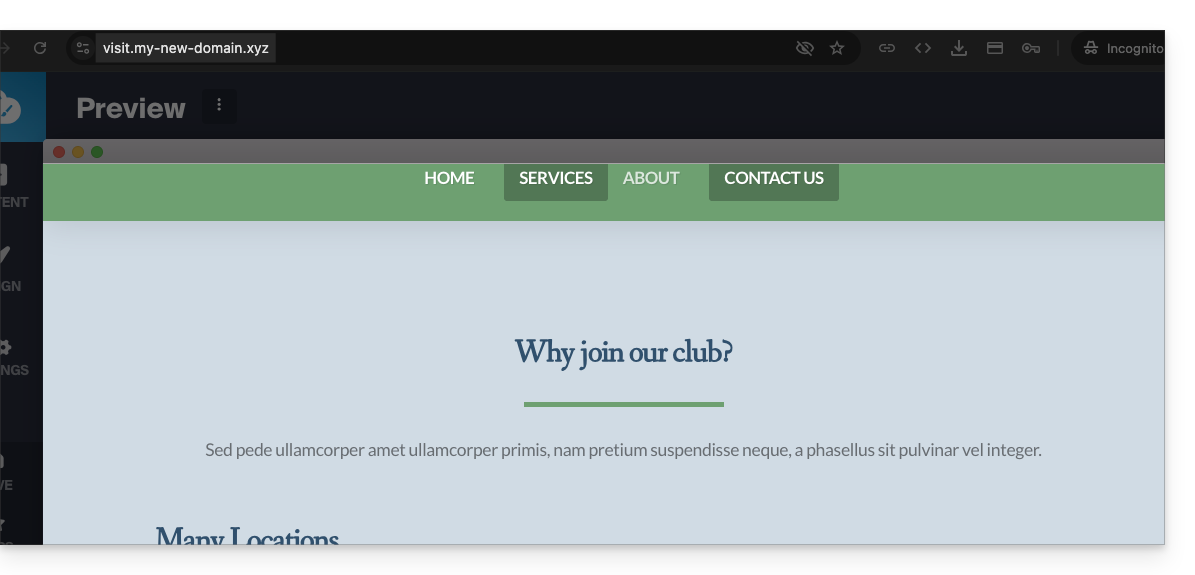
- Before, the homepage was the default one:
Link to this FAQ: https://faq.infomaniak.com/2638
Has this FAQ been helpful?
This guide explains how to obtain and connect to Infomaniak's Site Creator with an existing web hosting account.
Introduction
- Site Creator is available…
- … either free of charge with every paid web hosting plan.
- … or as a standalone product (available in 3 versions) and does not require any other specific offer in this case.
- Refer to this other guide for compare the different plans available.
- You don't need to download anything to use Site Creator; everything is done online through an interface accessible from any browser.
1. Add Site Creator to your existing hosting
To add Site Creator to a website on your existing web hosting:
- Click here to access your hosting management in the Infomaniak Manager (need help?).
- Click directly on the name of the hosting in question.
- To add a website, refer to this other guide from step 3 and choose Site Creator in step 4:
2. Order Site Creator without specific hosting
To obtain Site Creator independently, go to the description of the Site Creator Free, Lite, and Pro plansand simply click on the button for the offer you are interested in.
Access Site Creator
Start by logging in to the Infomaniak Manager with your credentials (user account with the necessary permissions for the relevant product):
- Click here to access the hosting & site management interface (filtered to display only Site Creator).
- If nothing is displayed, you may not be in the Organization to which your site is linked (❓: help).
- Click on the name of the Site Creator in question:
- Click on the button to edit your site:
When Site Creator is installed on your website and you browse it, if you have not logged out of the Infomaniak Manager, the editing menu will then be visible (only to you) so you can use the editor at any time.
You can hide it and return to it whenever you want:

Link to this FAQ: https://faq.infomaniak.com/2704
Has this FAQ been helpful?
This guide concerns Site Creator, the Infomaniak tool for creating websites, which includes a library for your media (images, videos, documents, etc.).
Prerequisites
- Access Site Creator:
- Click here to access the management of your product on the Infomaniak Manager (need help?).
- Click directly on the name assigned to the Site Creator in question.
- Click on the Edit my site button to launch the editor:
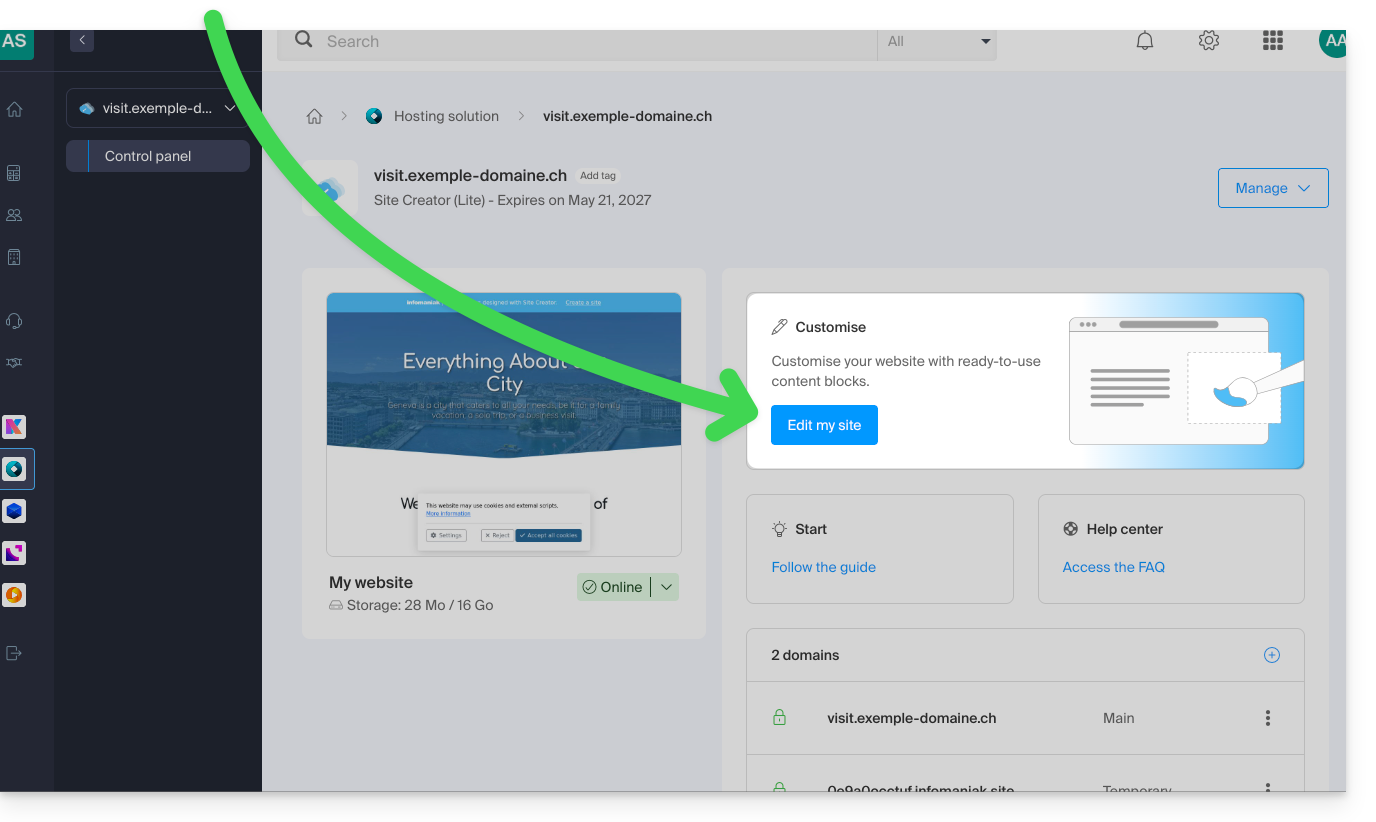
Accessing files
The library is accessible from the bottom of the left-hand side menu, under Files: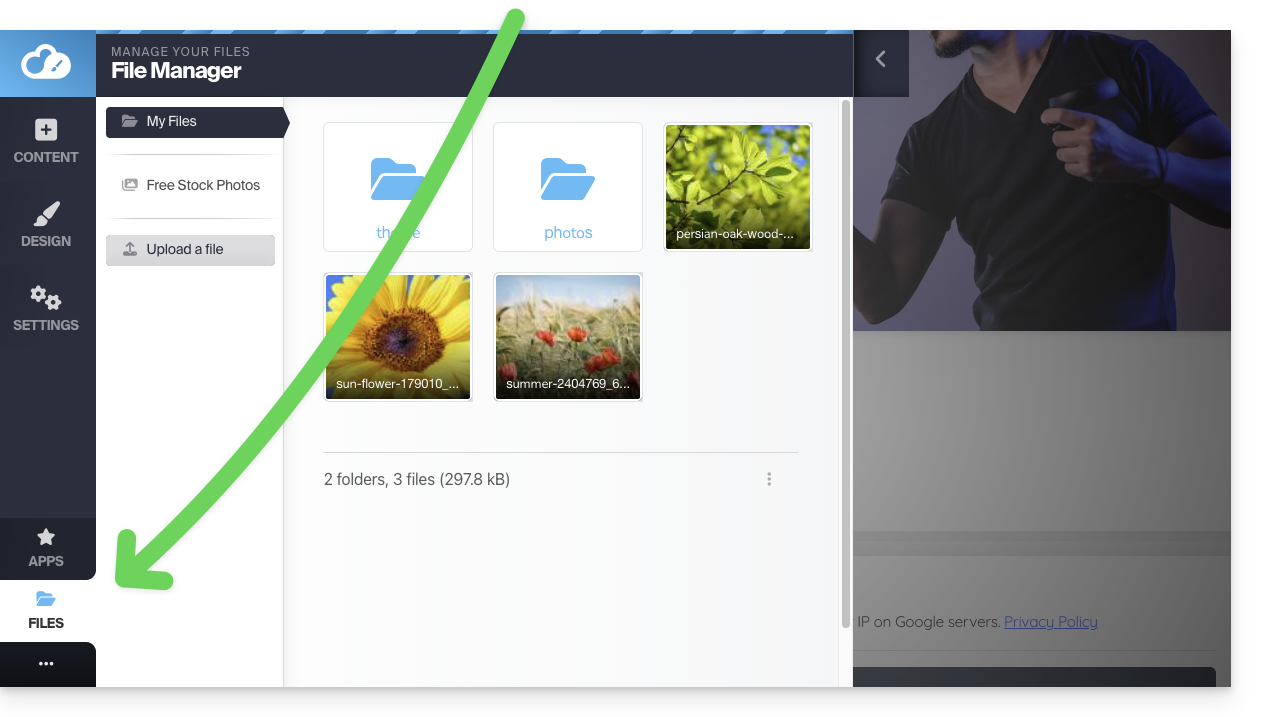
These media will be available to you when you edit your pages and want to insert content.
Organize your files, folders, and subfolders
Please note that you cannot:
- move files/folders
- rename files/folders
- delete a folder if it is not completely empty
Therefore, consider organizing your media and its structure, if possible, before creating the website.
Create a new folder
Use the action menu ⋮ at the bottom right of the window: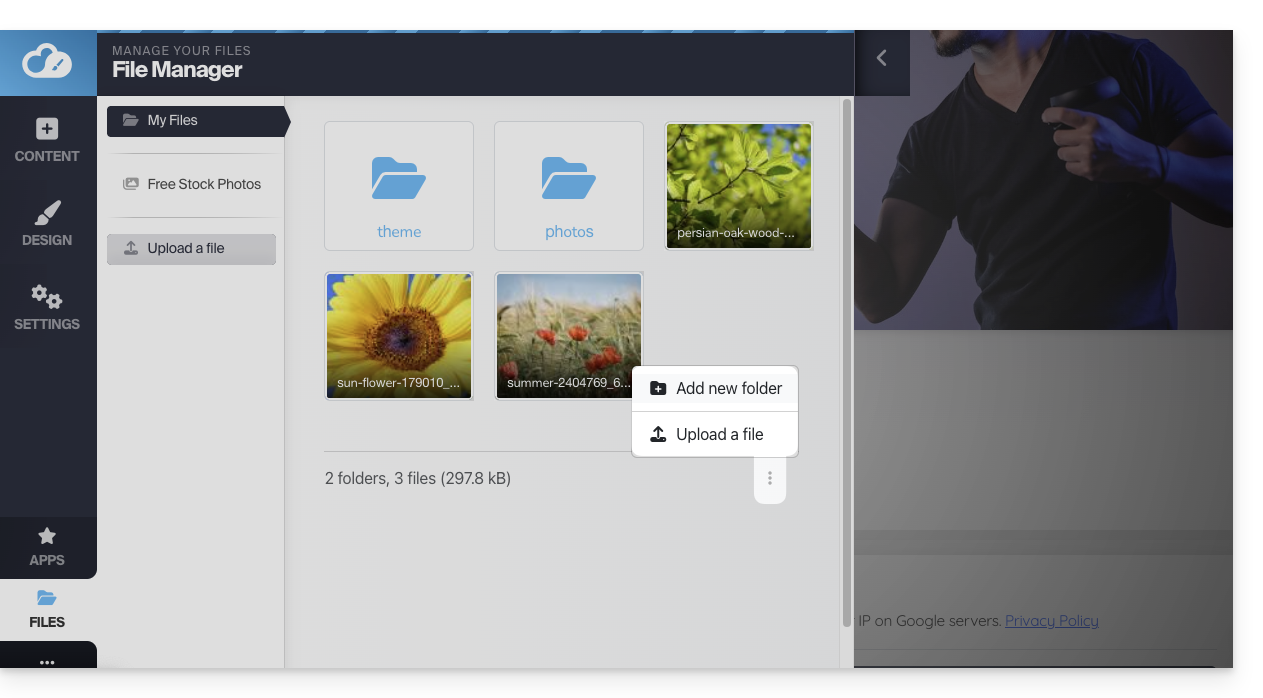
Upload a new file to the library
Click on Send a file to browse your hard drive and upload the desired files: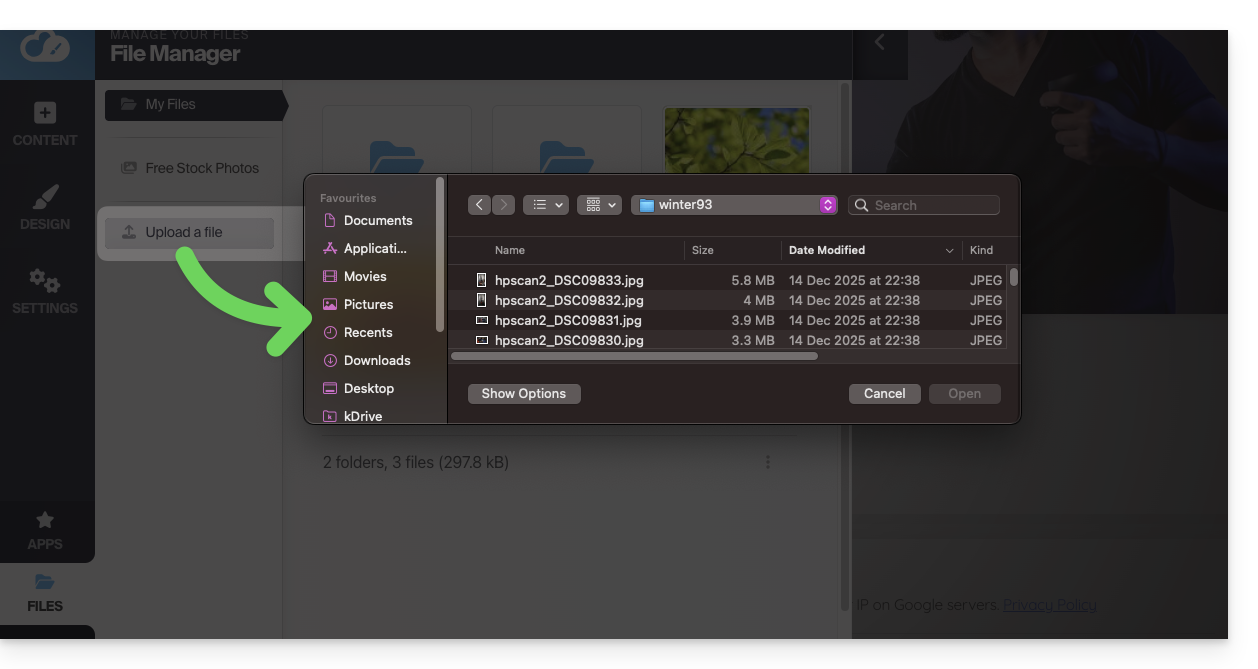
The usual image formats are supported (webp, jpg, jpeg, png, gif, svg, etc.), with the webp format being recommended (it offers the best quality/compression ratio for ultra-fast web display).
The same applies to videos (mp4, mov, etc.), and you can also upload files (zip, pdf, etc.) to make them available to visitors via the File Download module.
Compress an image
Large images are automatically resized by default when imported: images larger than 1200 px are automatically reduced to 1200 px, but you can manage this in the general settings: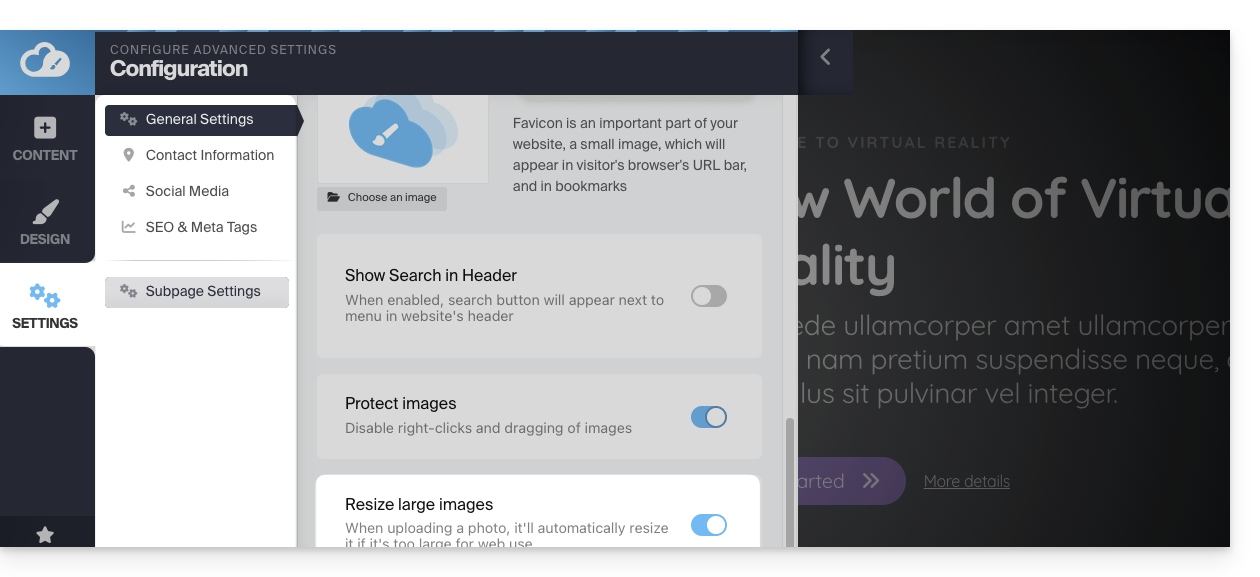
You can also compress the image itself using the Compress an image option from the library, to improve your site's loading speed: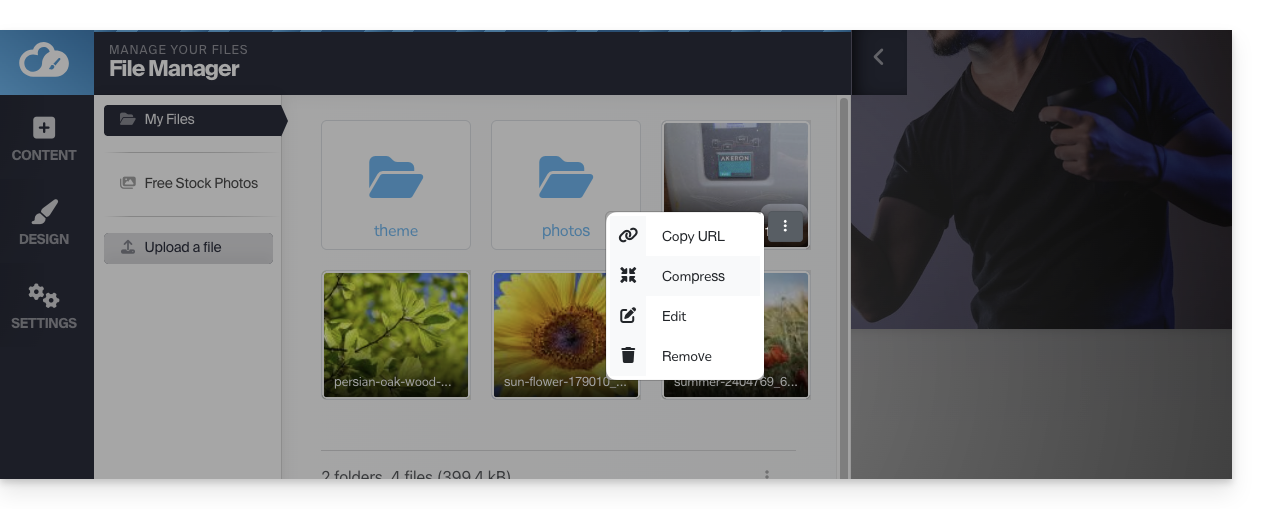
⚠ The Compress an image option generates the TinyPNG API key error (TinyPNG API key is not set)…
To avoid this, obtain a TinyPNG API key on their website and enter it under Applications > TinyPNG in SiteCreator: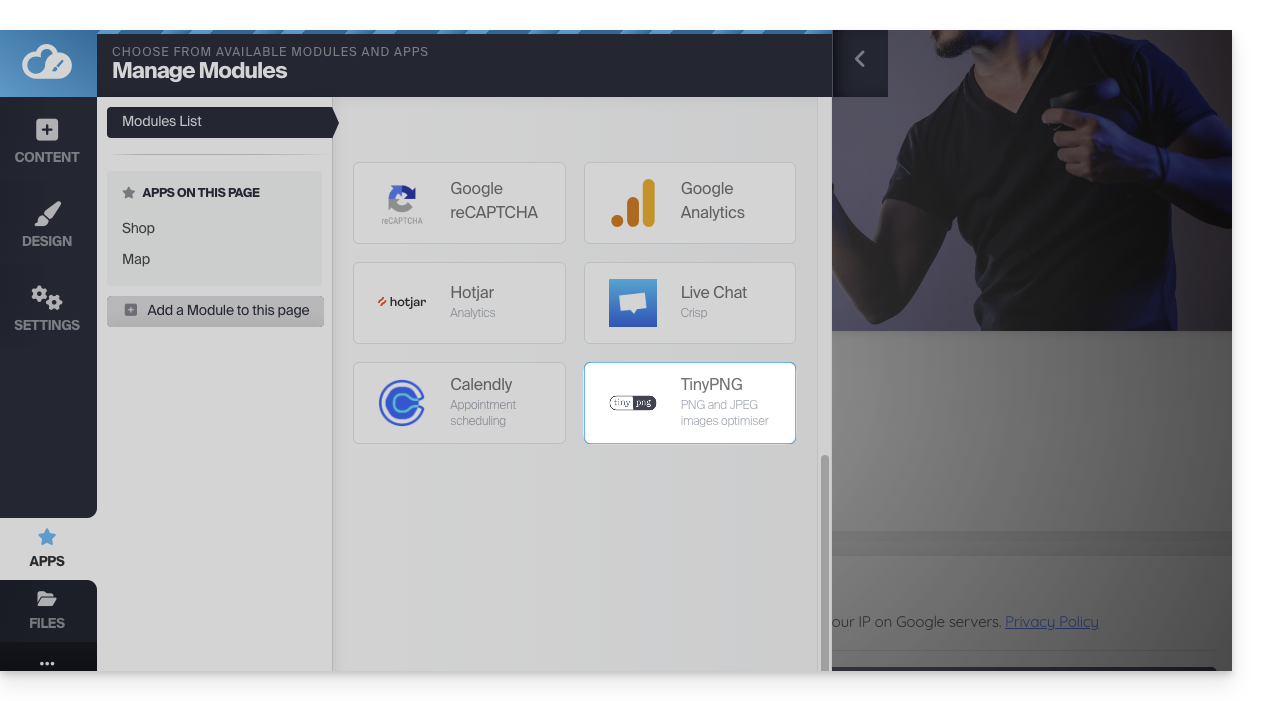
Open the image editor
Hover over an image in the library and click on the action menu ⋮ to access the image editor:
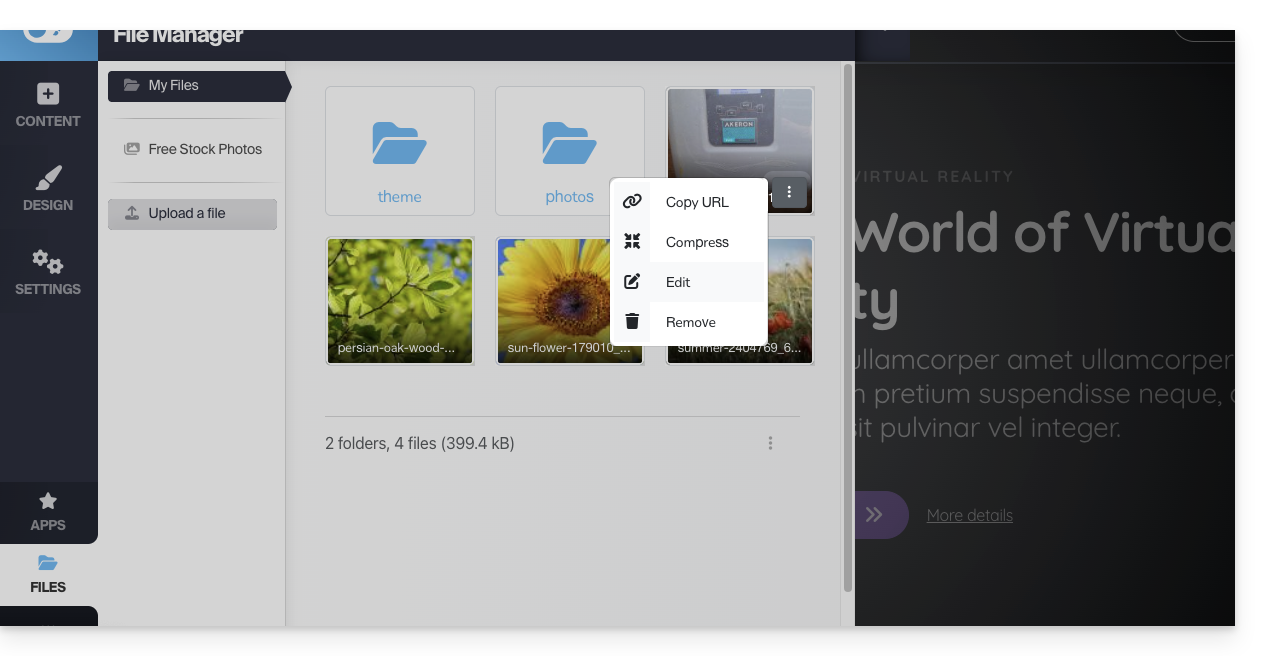
When you save your changes, the image will be saved as a copy in your library: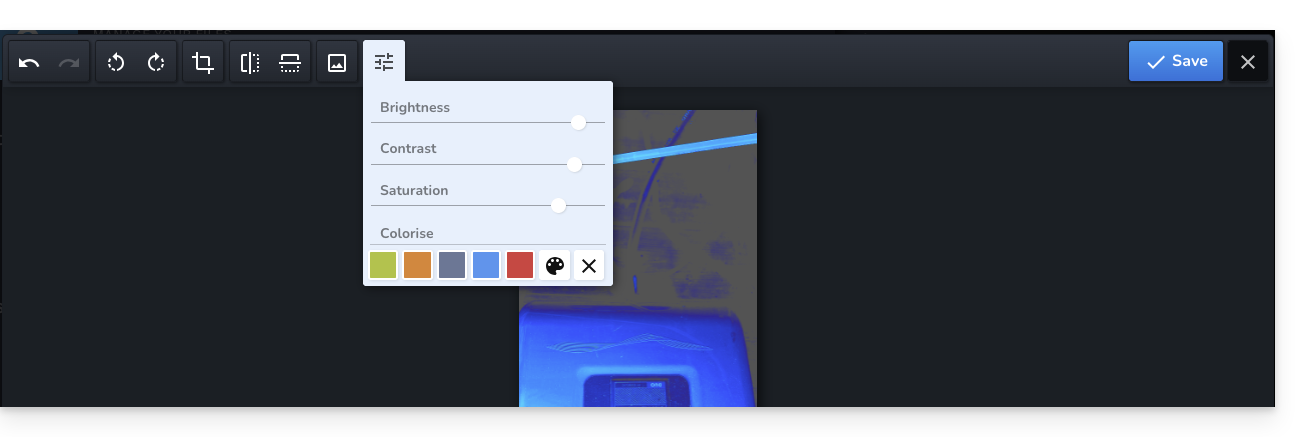
Optimize SEO and Accessibility
Once your images have been imported from the library to your web pages, remember to fill in their Alt text in the image block settings. This text description is essential: it allows search engines (like Google) to understand the content of your visuals, while also making your site accessible to visually impaired people who use screen readers.
Since it is not possible to rename files once they are online, make it a habit to name them correctly on your computer before uploading them. Avoid generic names (e.g., IMG_1234.jpg) and use descriptive names with hyphens (e.g., swiss-home-repair.jpg) to improve your search engine ranking.
Search for and use royalty-free images
In the left sidebar of the library, you will find a menu item that leads to a collection of royalty-free stock images that you can insert into your library to enhance your website: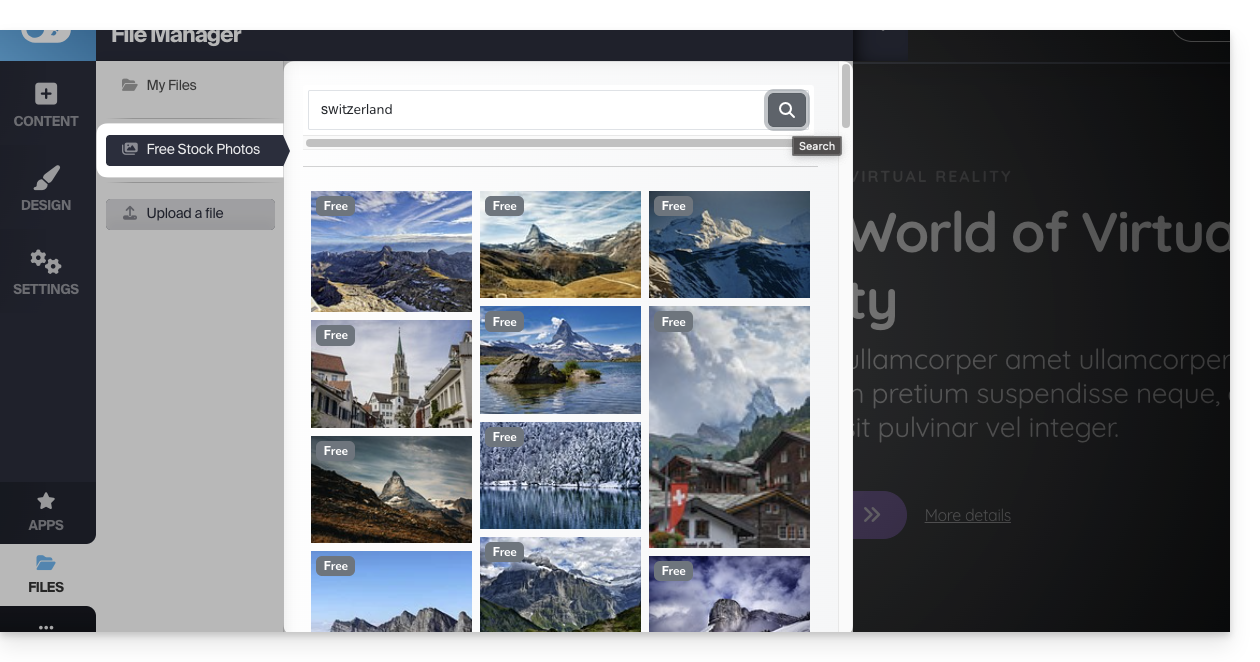
Protect your content: disable right-click
Click on Settings in the left sidebar, then click on General Settings. At the bottom, you will find an option that, when enabled, disables right-clicking for visitors on your site: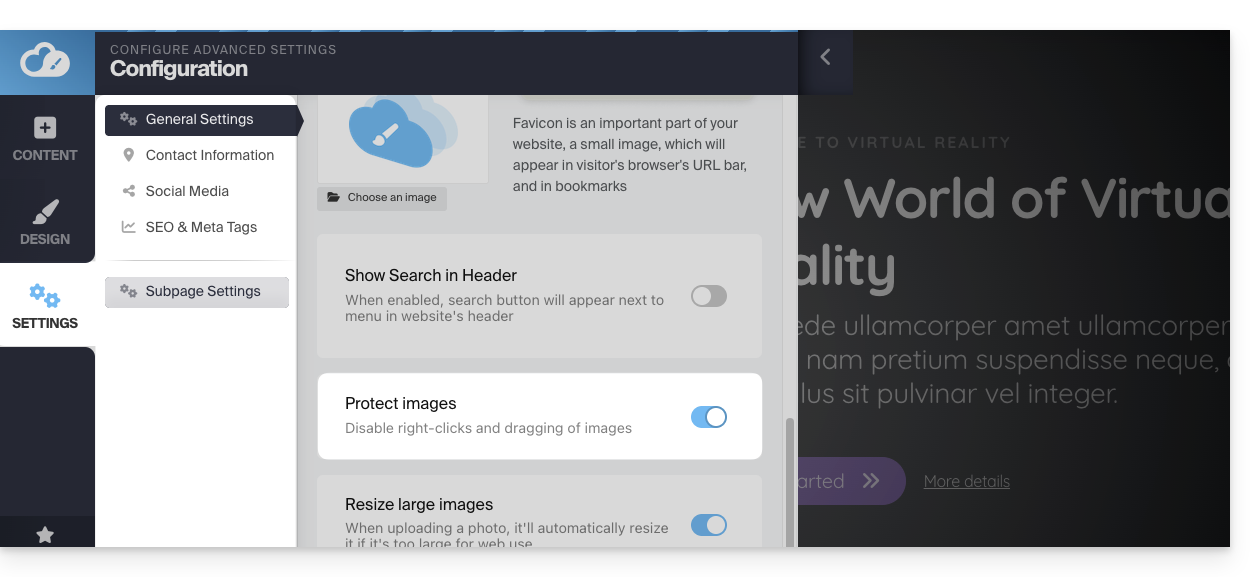
Troubleshooting media sending issues
Try uploading WEBP, JPG, or PNG files that are as lightweight as possible (ideally under 500 KB); it is not necessary to upload images with a width greater than 1000-2000 pixels to the server.
Also, make sure that your image files are saved with the RGB color profile, which is the standard for display on screens. Avoid the CMYK profile, which is very heavy and exclusively reserved for paper printing, as it can cause display errors or block the import.
If you are trying to upload files directly from your camera or smartphone, try resizing them before uploading; for example, if you're using your iPhone, the image may be in HEIF/HEIC format, which is not natively supported by web browsers - try converting it to JPG first.
Link to this FAQ: https://faq.infomaniak.com/2705
Has this FAQ been helpful?
This guide concerns Site Creator by Infomaniak, which allows you to create a complete website consisting of several pages.
Introduction
- The homepage is required (with or without a header and footer).
- Add additional pages, which can be blank, password-protected, or contain specific content directly (e.g., a contact form).
- Add legal pages (e.g., to include your Terms and Conditions).
- These will all be part of the site's navigation menu(s).
- To (re)create a complete website with pages and subpages (examples of pre-designed websites), you can install a website template.
Add a page to the website
Start by logging in to the Infomaniak Manager with your credentials (user account with the necessary permissions for the relevant product):
- Click here to access the hosting & website management interface (filtered to display only Site Creator).
- If nothing is displayed, you may not be in the Organization to which your website is linked (❓: help).
- Click on the name of the Site Creator in question:
- Click on the button to edit your site:
Once in Site Creator:
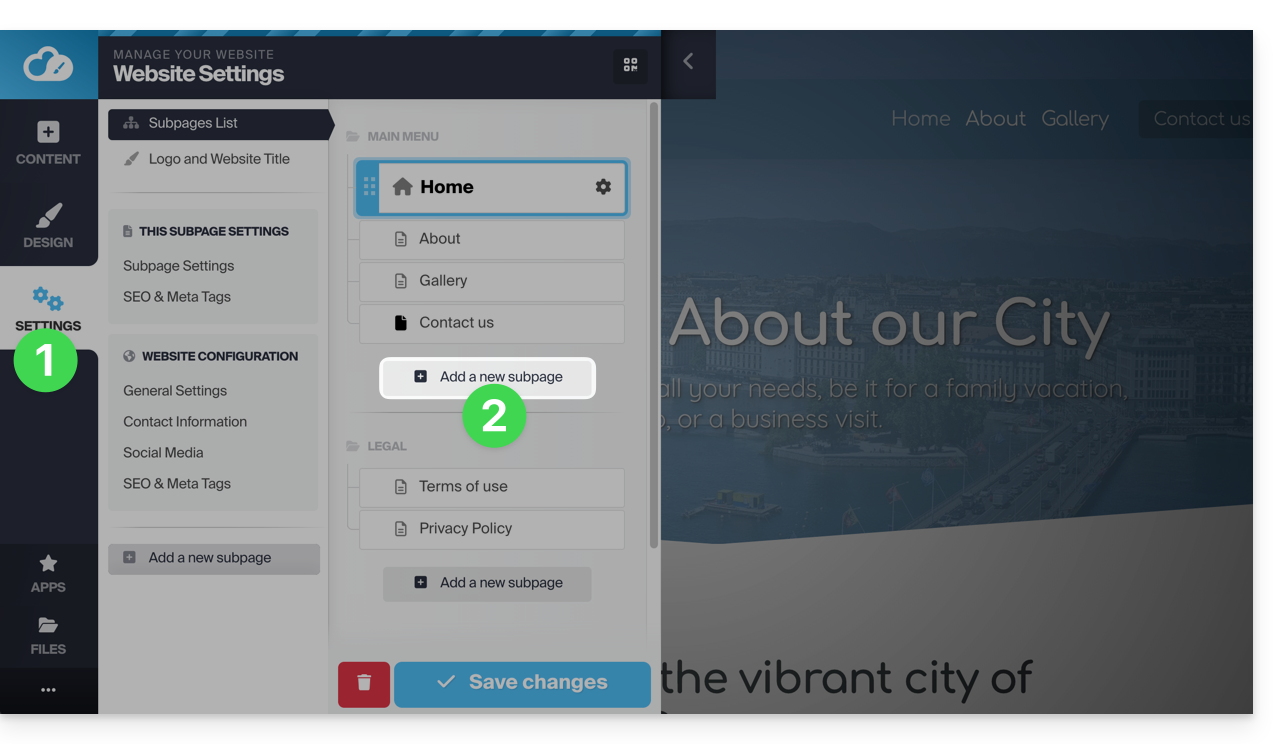
- Click on the Settings button in the left-hand menu – the list of your pages will appear.
- Click the Add Page button below the existing tree:
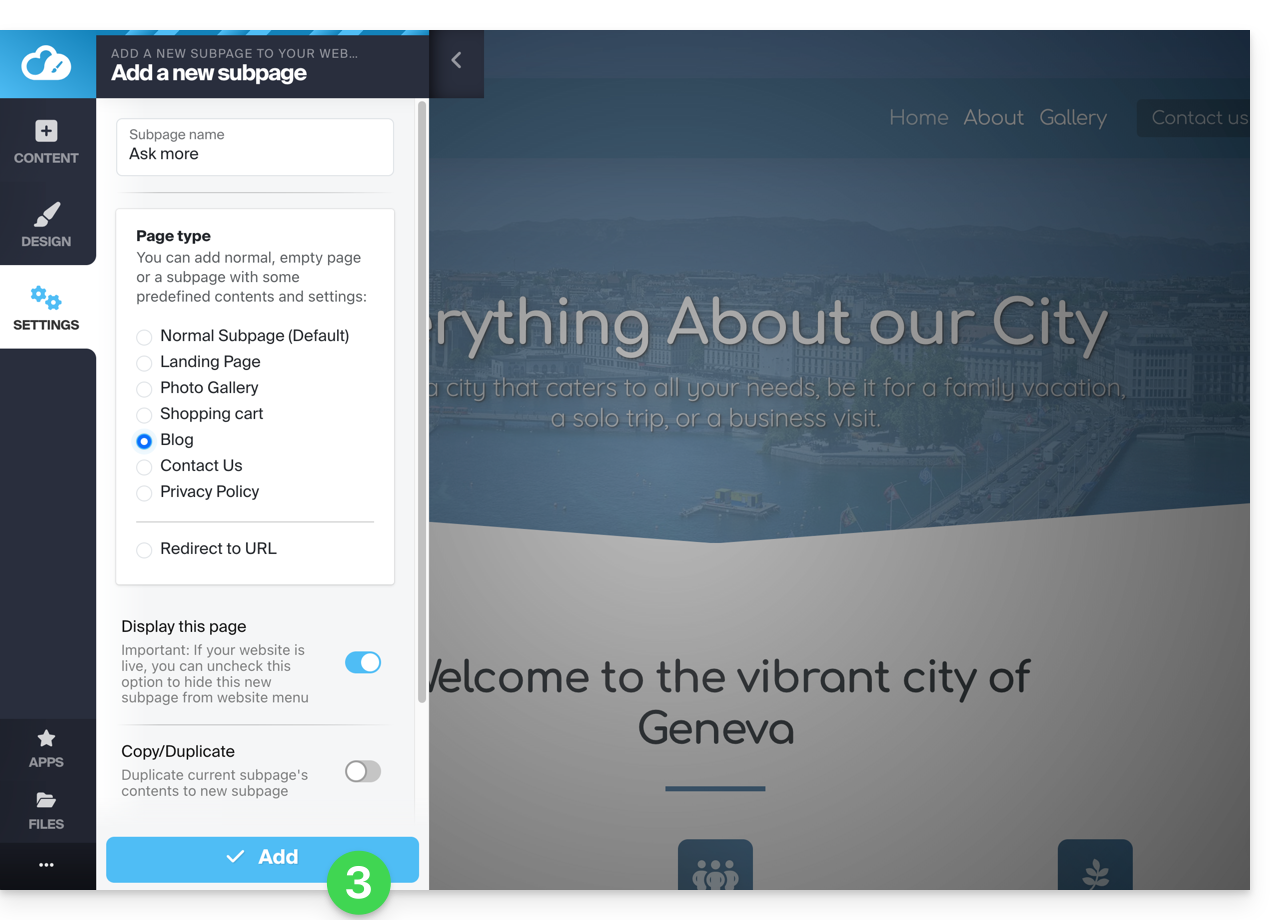
- Choose a page name and Show more options to choose the page type and other settings, then click to Add the page:
Copy / Duplicate a page
To do this:
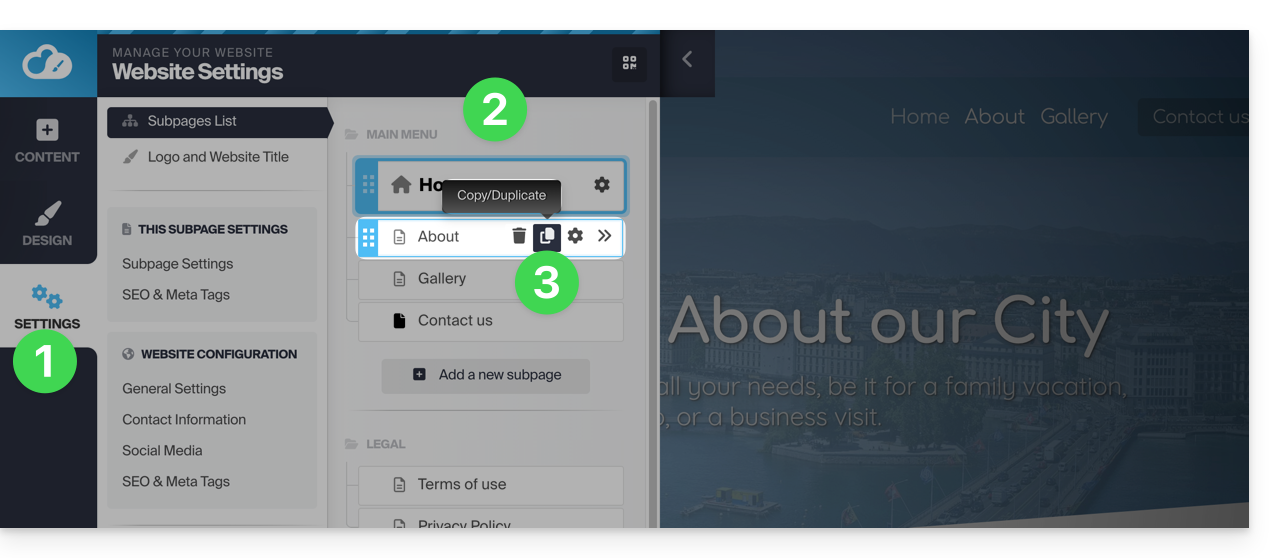
- Click on the Settings button in the left-hand menu – the list of your pages will appear.
- Hover over the desired page in the existing tree.
- Click on the duplicate icon that appears when you hover over it:
Alternatively:
- Go to the page of the website you want to clone.
- Click on the Settings button in the left-hand menu.
- Click on the Add page button below the existing tree. Choose a page name and Show more options to choose the page type.
- In Show more options, enable Clone / Duplicate to reuse the content of the current page.
- Click to Add the page.
- The new page appears in the menu with the same content as the page you were on in step 1:
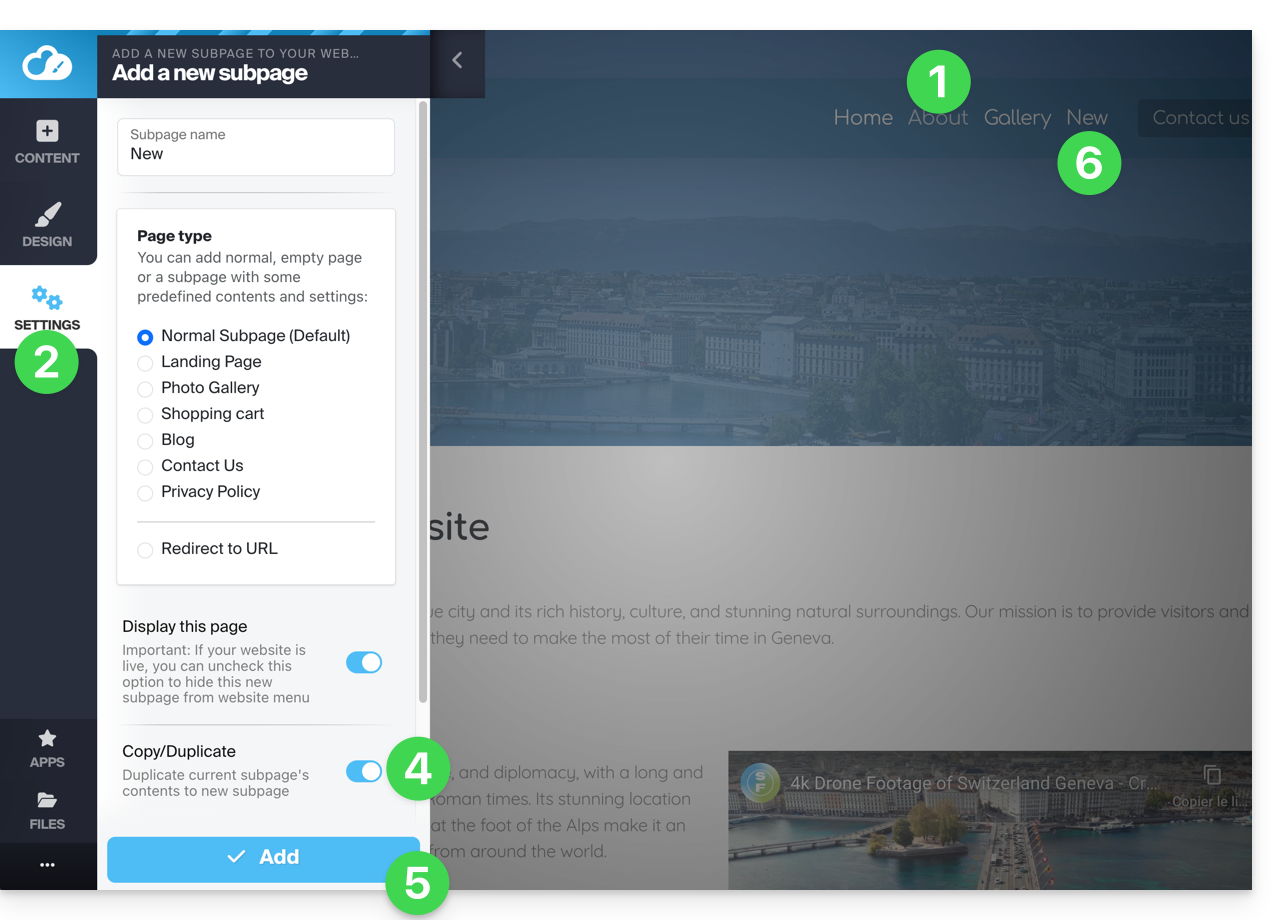
Rename a page
Please note that renaming a page changes its URL.
To do this:
- Click on the Settings button in the left-hand menu – the list of your pages will appear.
- Hover over the desired page in the existing tree and click on the gear icon to access the page options, including the display name:
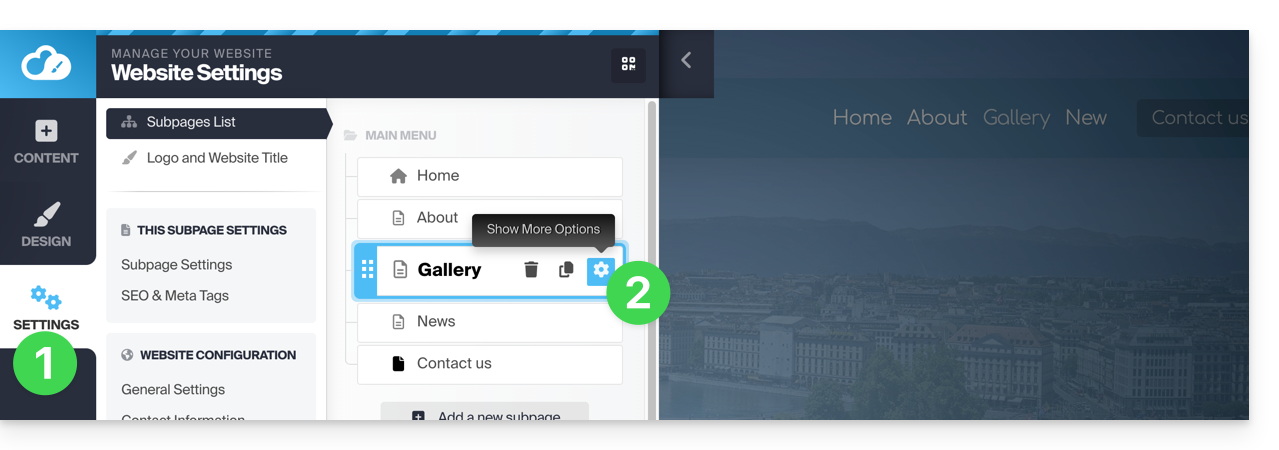
Alternatively, under Settings, in the existing tree, you can directly rename your pages and then Save changes at the bottom of the page: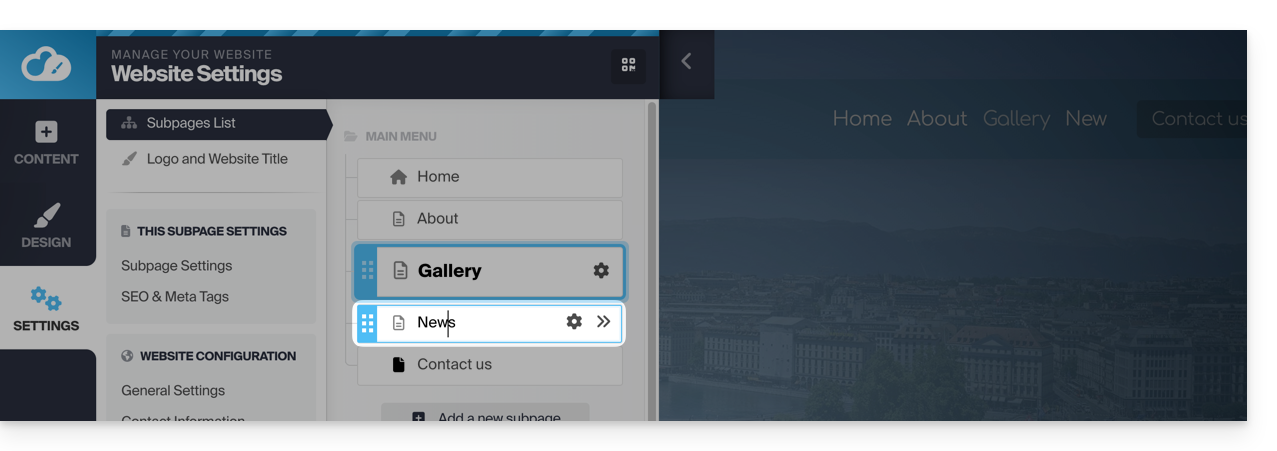
Change the order of pages
This can be useful, especially for set one of your existing pages as the homepage instead of the current homepage. To do this:
- Click on the Settings button in the left-hand menu – the list of your pages will appear.
- In the existing tree structure, you can directly drag and drop your pages to change their order (this mainly affects how the pages are displayed within a menu), then Save changes at the bottom of the page:
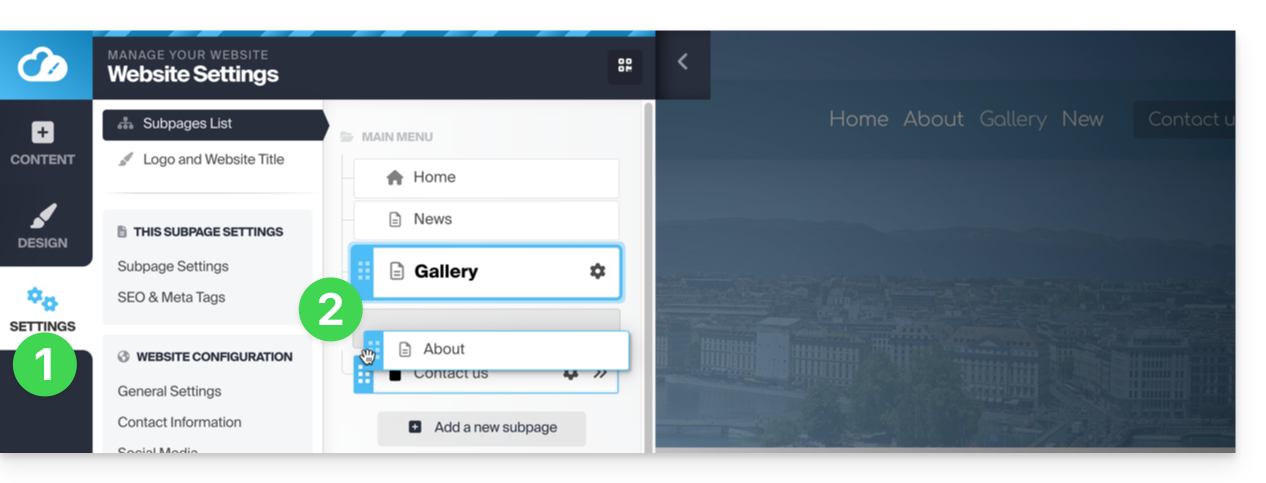
Delete a page
To do this:
- Click on the Settings button in the left-hand menu – the list of your pages will appear.
- Hover over the desired page in the existing tree.
- Hover over the gear icon, then click on the trash can that appears when you hover over it:
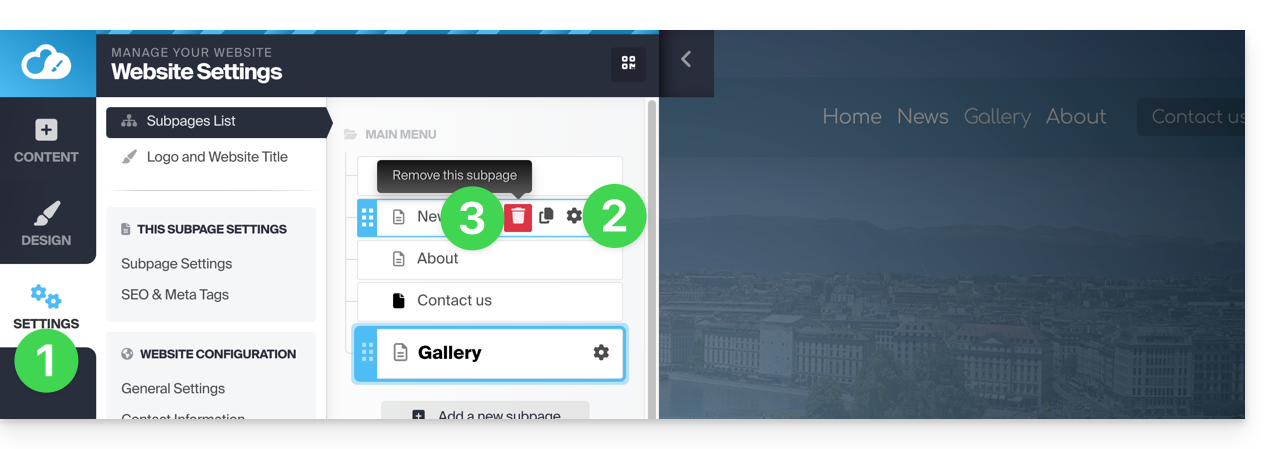
- Confirm the deletion, and the page will disappear without the possibility of canceling.
Another option: go to the page you want to delete. Under Settings, click the red Trash button at the bottom of the page to delete the current page: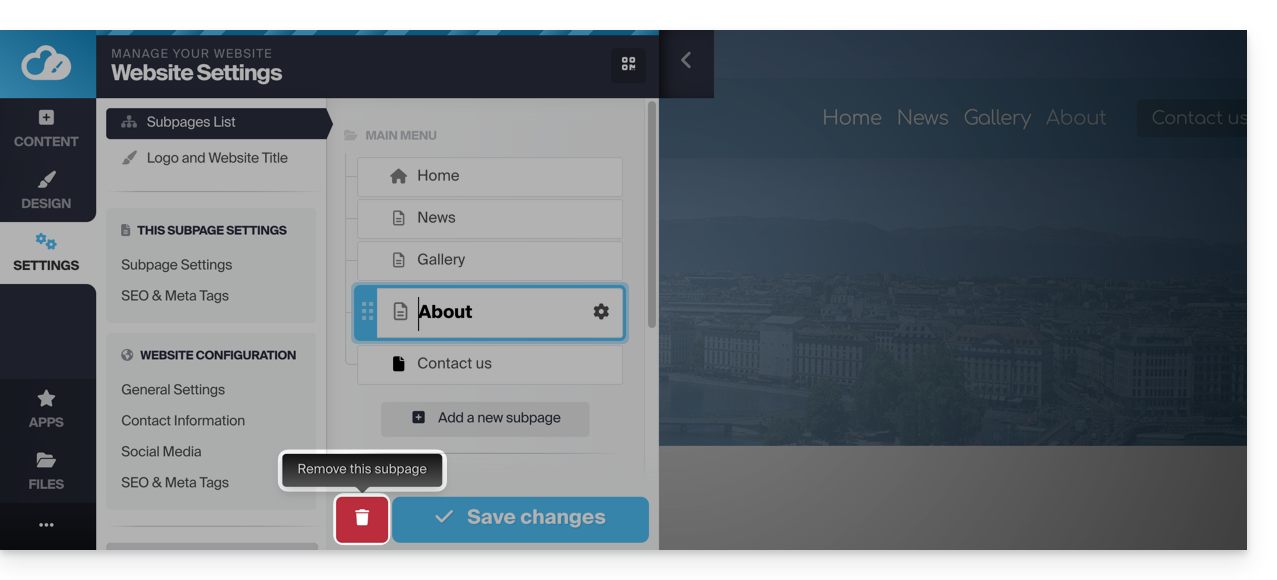
Create a private / password-protected page
To do this:
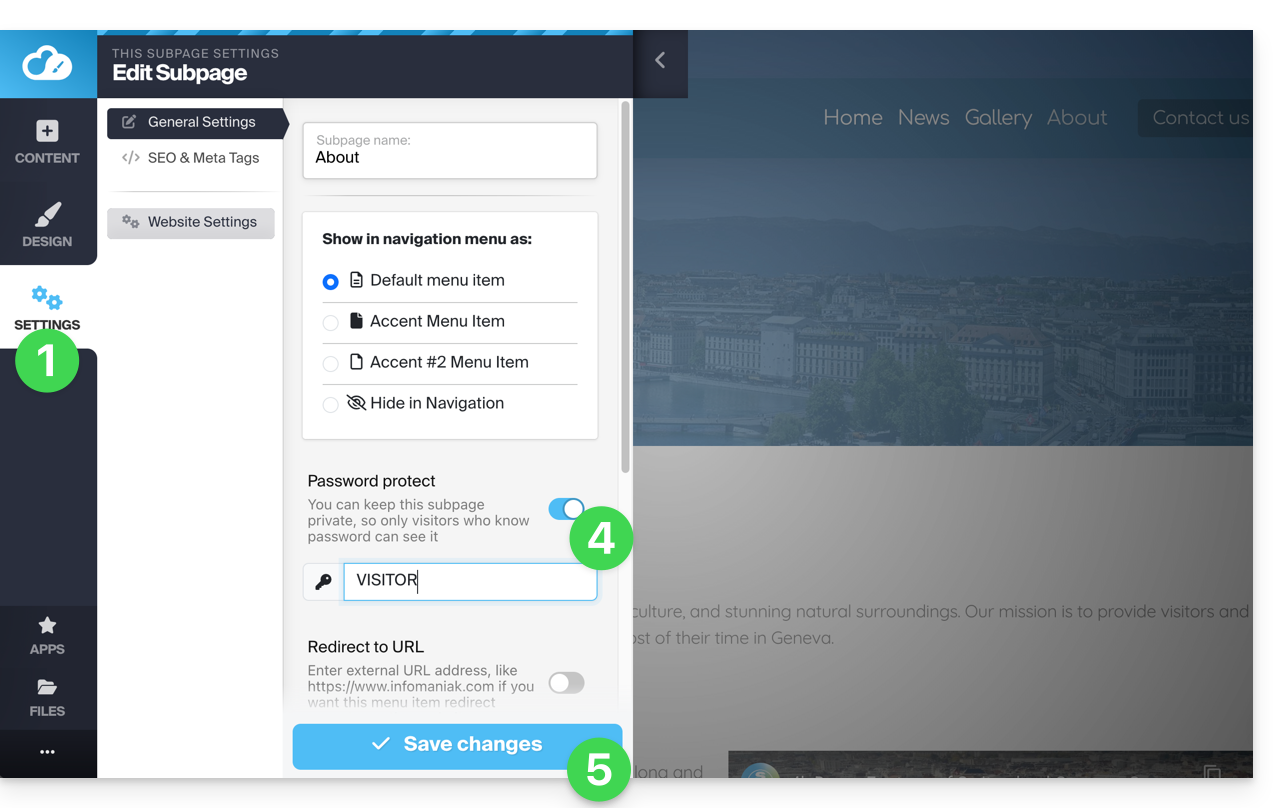
- Click on the Settings button in the left-hand menu – the list of your pages will appear.
- Hover over the desired page in the existing tree structure.
- Click on the gear icon to access the page options.
- Enable the password protection option to set a password that will be required to view the page.
- Save the changes at the bottom of the page:
To test, visit the page from a browser in private browsing mode (to avoid being logged in to Site Creator) or preview the page from the editor: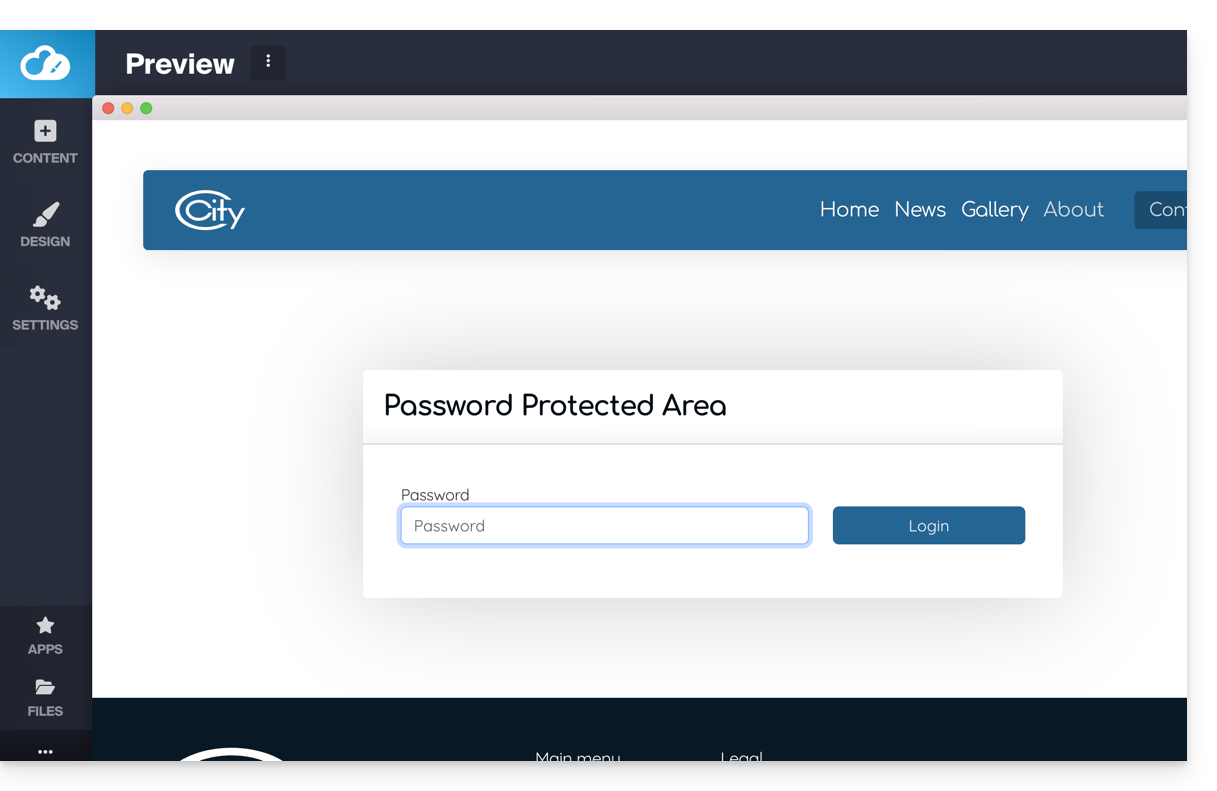
Add a "hidden" page
To add a page that will not appear in the main menu (but will still be accessible via its direct address and by a search engine if it indexes your page, as well as in the sitemap if you wish):
- Click on the Settings button in the left-hand menu - the list of your pages will appear.
- Hover over the desired page in the existing tree structure.
- Click on the gear icon to access the page options.
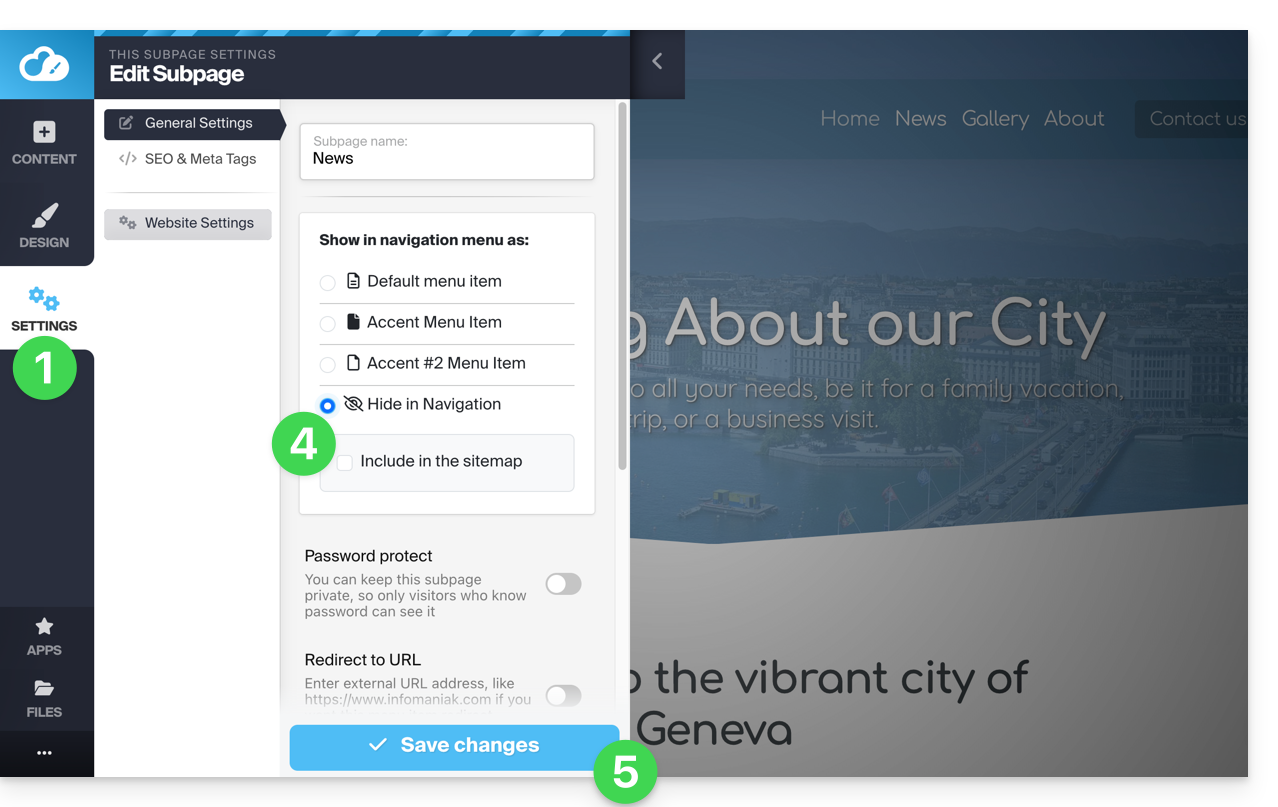
- Choose the latest display type to hide the page in the navigation and determine whether you still want to include the page in the sitemap.
- Save the changes at the bottom of the page:
Another option: hover over the desired page in the existing tree structure and click on the page icon to the left of your page's name until the crossed-out eye appears:
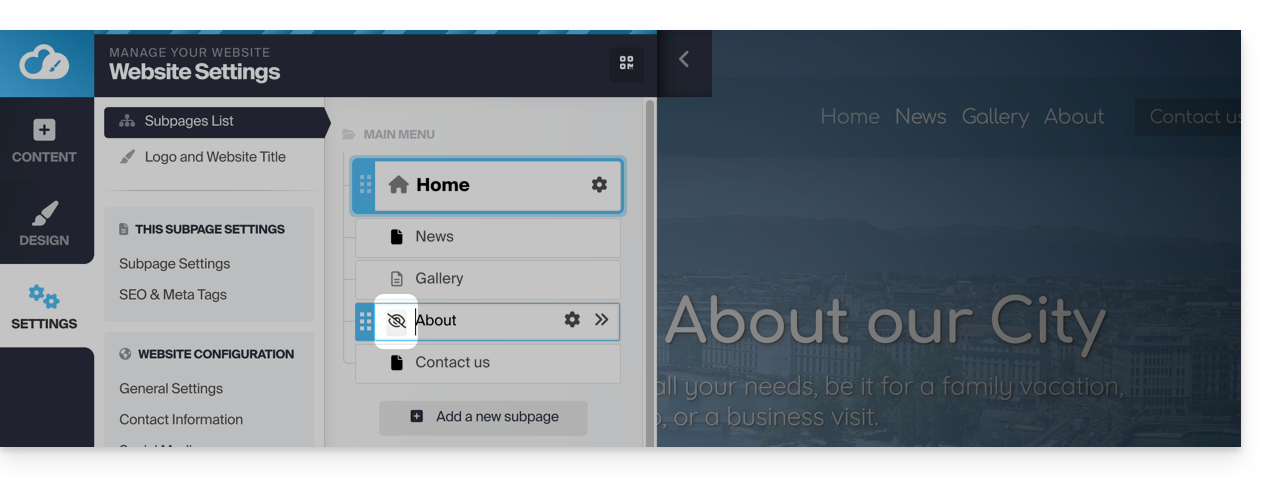
Save the changes at the bottom of the page.
If necessary, you can create a link to this hidden page from another page, as the hidden page will still appear in the list of site pages when you add an internal link: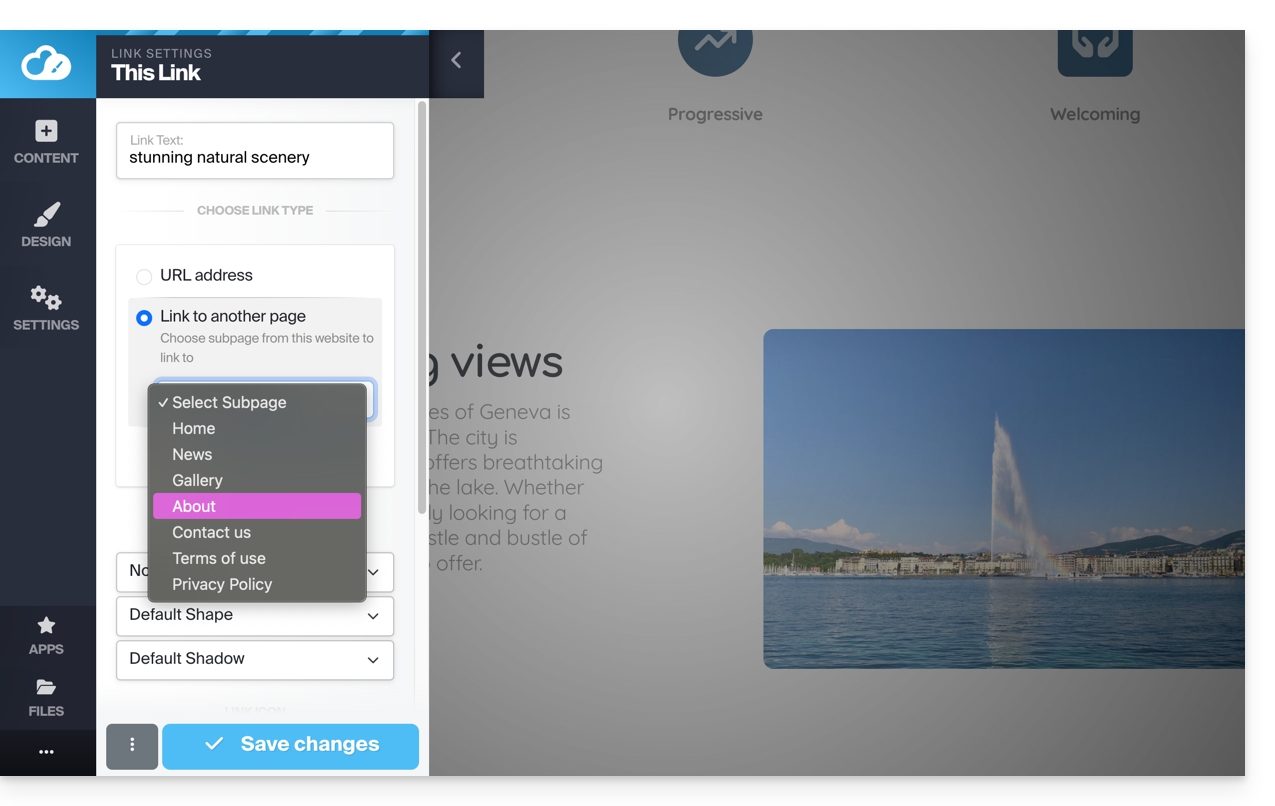
Link to this FAQ: https://faq.infomaniak.com/2706
Has this FAQ been helpful?
This guide details how Site Creator from Infomaniak and the website created with it behave with different screen formats and resolutions.
View the site on different devices
Websites created with Site Creator are automatically adapted to all browsers, regardless of the device (computer, mobile device, tablet, large and small screens, etc.). However, they may behave differently depending on certain settings that you can adjust.
Start by logging into the Infomaniak Manager with your credentials (user with the necessary rights for the product in question):
- Click here to access the hosting & site management section (filtered to display only Site Creator).
- If nothing is displayed, you may not be in the Organization to which your site is linked (❓: help).
- Click on the name of the Site Creator in question:
- Click on the button to edit your website:
Once in Site Creator, to preview the website version based on the display device:
- Click on the ••• button at the very bottom of the left-hand menu to expand the publishing and preview options:
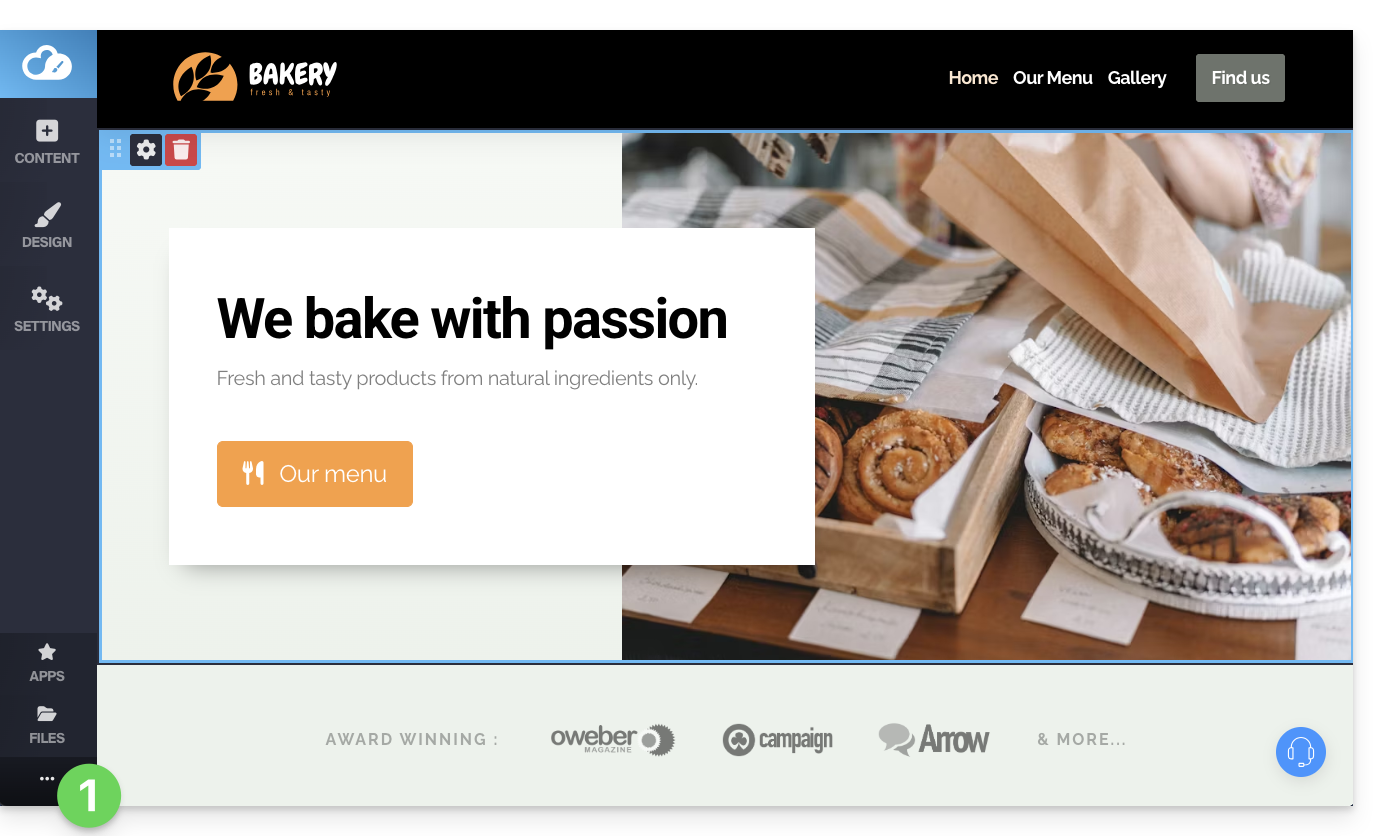
- Click on Preview:
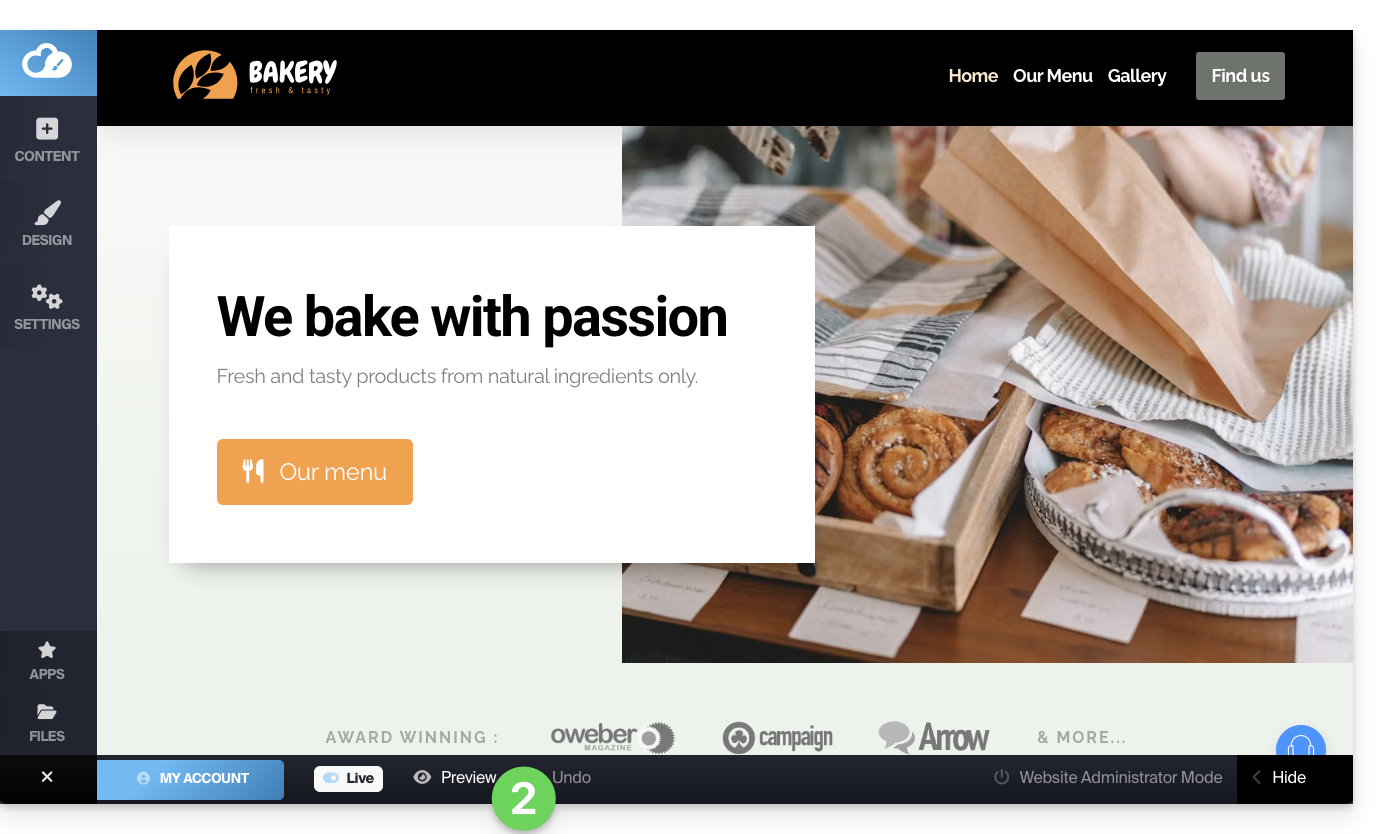
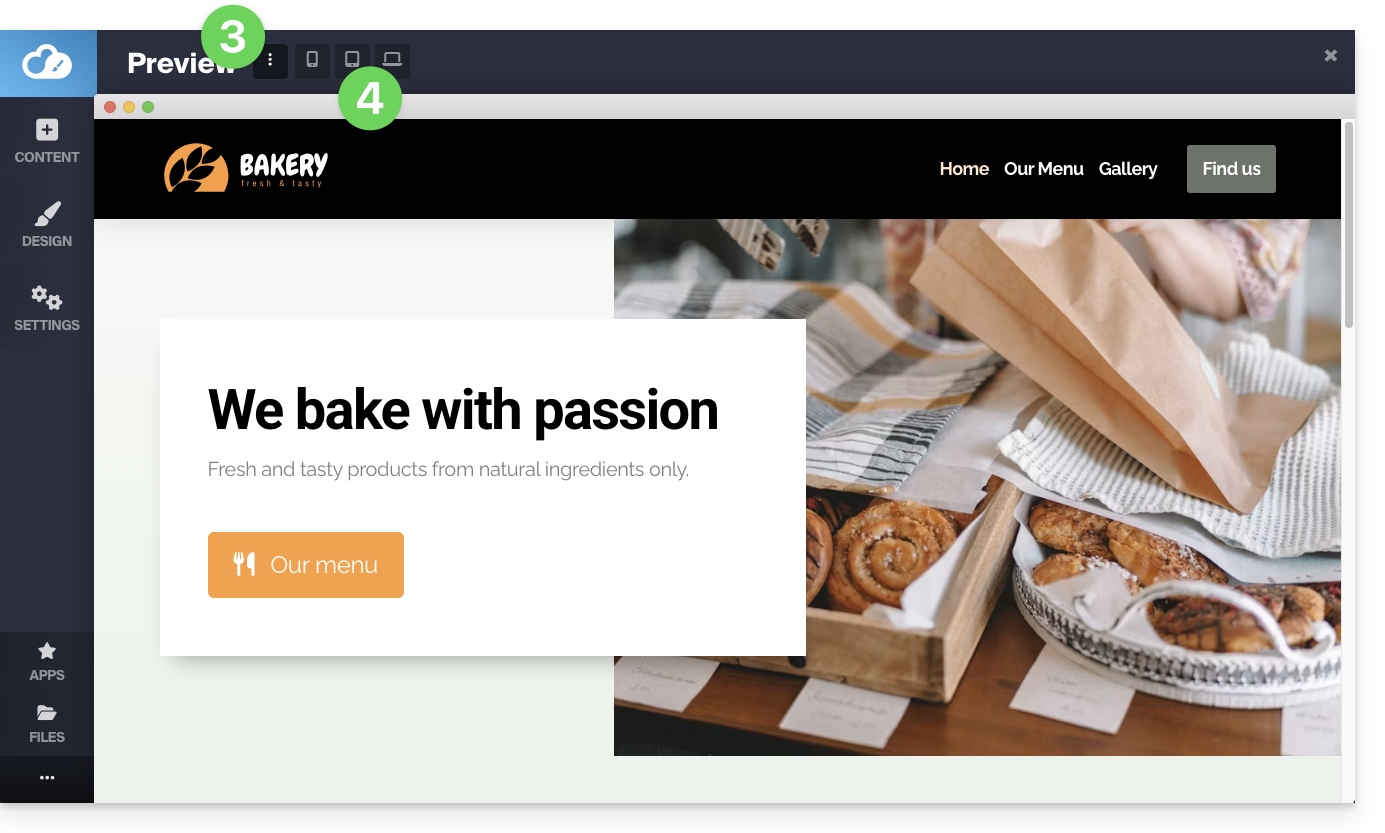
- At the top of the page, click on the action menu ⋮ to the right of Preview to change the type of device used for viewing.
- Click on the different device icons to simulate the different viewing formats (mobile, vertical, horizontal, etc.):
Display your site in a reduced width
You can reduce the width of your site within a "container" or "box". This special display will only be visible on large screens, such as desktop computers:
- Click on the Design button in the left-hand menu.
- Click on More settings.
- Activate the toggle switch for the Container display:
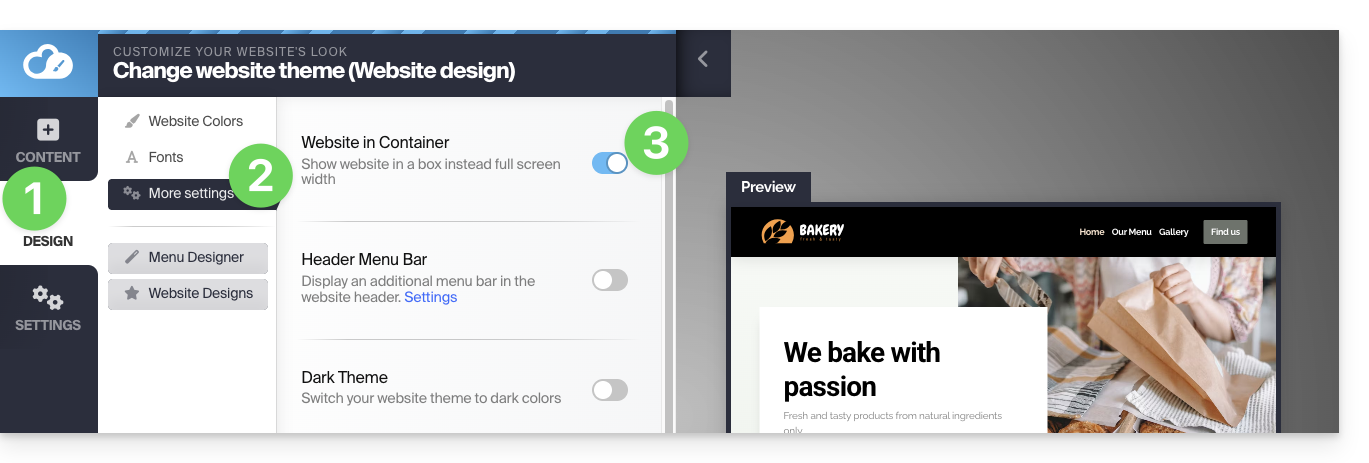
- Save the changes at the bottom of the page.
Hide a content block based on the device type
In the options for a content block, by disabling the default visibility, you can then define that it should only be displayed on certain types of devices (e.g., mobile devices):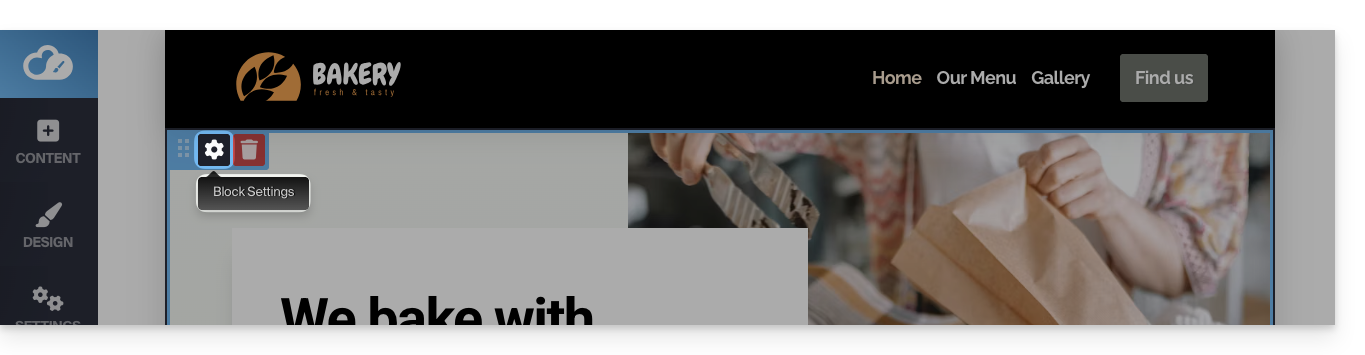
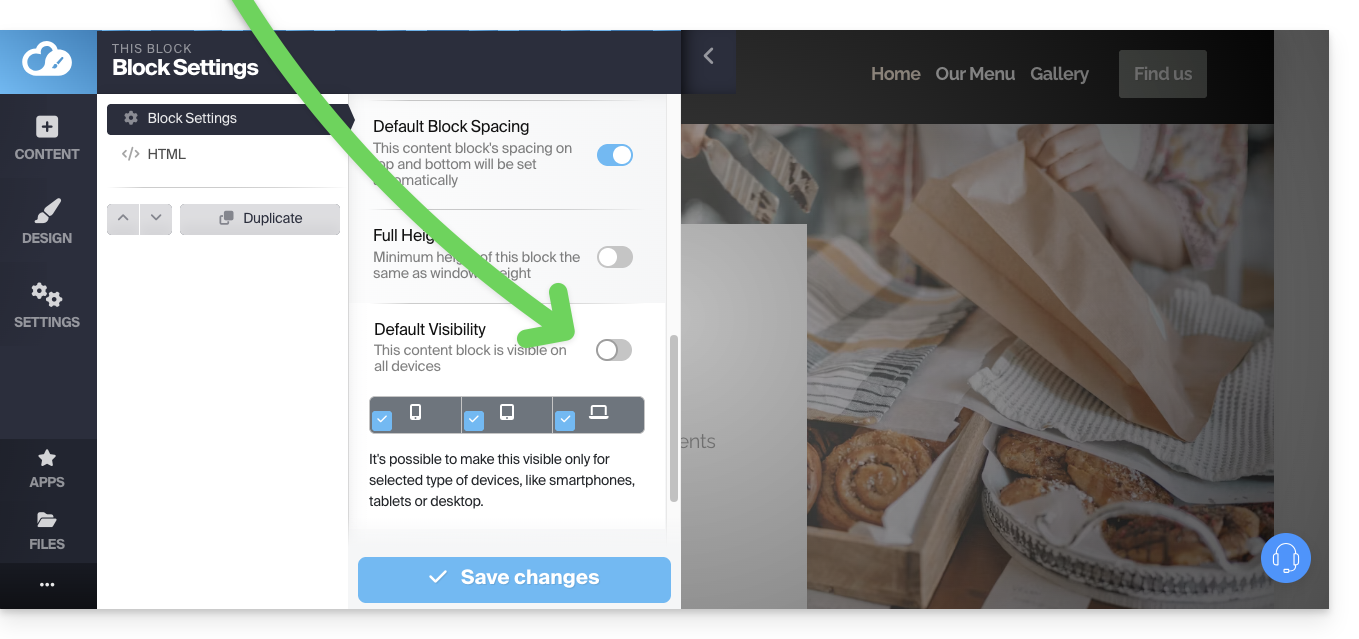
Link to this FAQ: https://faq.infomaniak.com/2707
Has this FAQ been helpful?
This guide concerns content blocks, which are one of the most important elements of Infomaniak's Site Creator.
Introduction
- These are the content blocks that allow you to easily create content on your pages.
- There are all kinds, separator, price list, sitemap, simple text or image blocks, etc.
- They are generally preconfigured to make it easier for you to get started.
Add a content block
Start by logging in to the Infomaniak Manager with your credentials (user account with the necessary permissions for the relevant product):
- Click here to access the hosting & website management interface (filtered to display only Site Creator).
- If nothing is displayed, you may not be in the Organization to which your website is linked (❓: help).
- Click on the name of the Site Creator in question:
- Click on the button to edit your site:
Once in Site Creator:
- Click on the Content button in the left-hand menu: the list of blocks will appear.
- Choose the desired category on the left, then the desired content on the right.
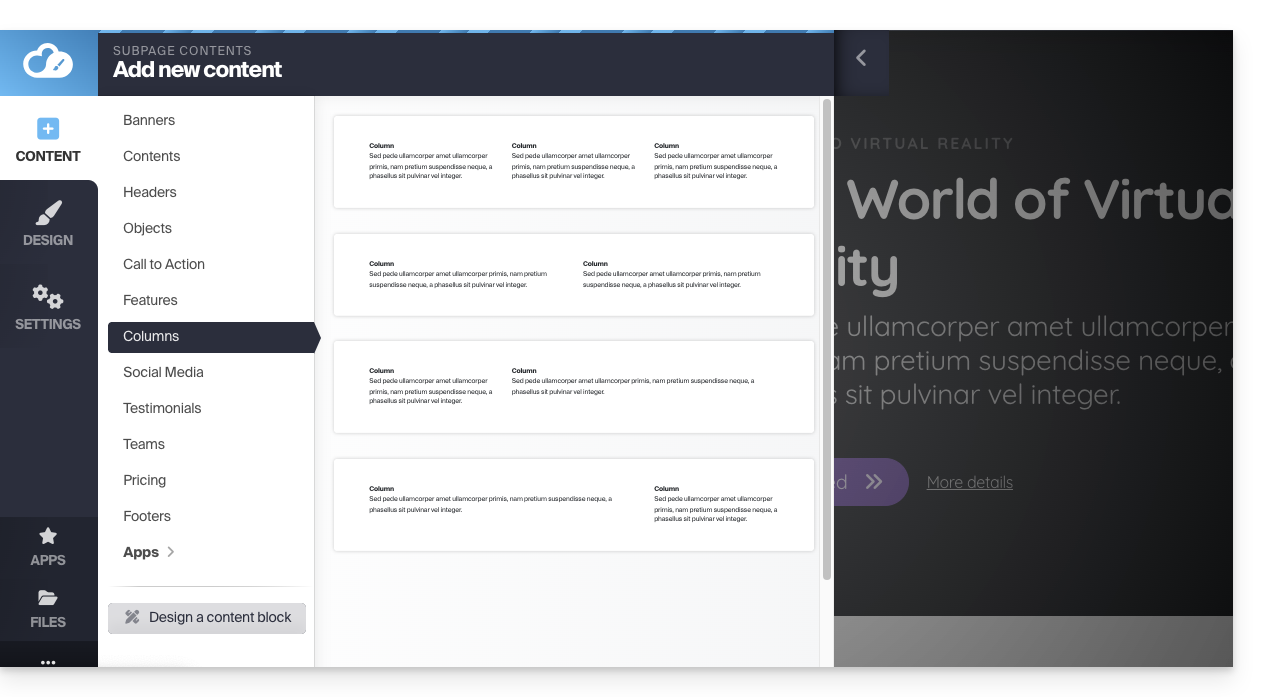
By clicking on the desired content, it will appear on the page you were editing.
Another option: go directly to the page and hover over the area above or below an existing block: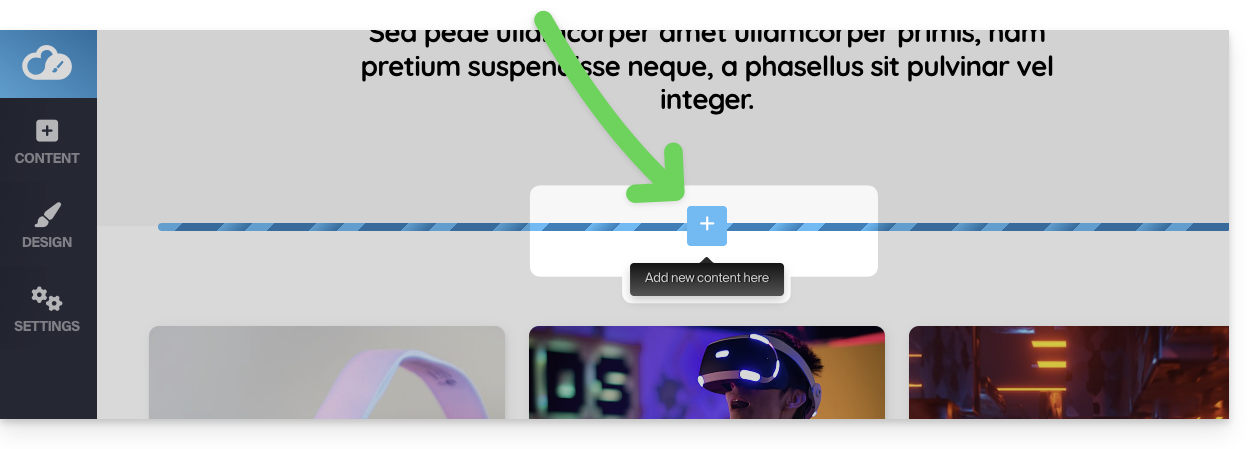
Delete a content block
Hover over the block you want to delete on your page and click on the trash can icon that appears: 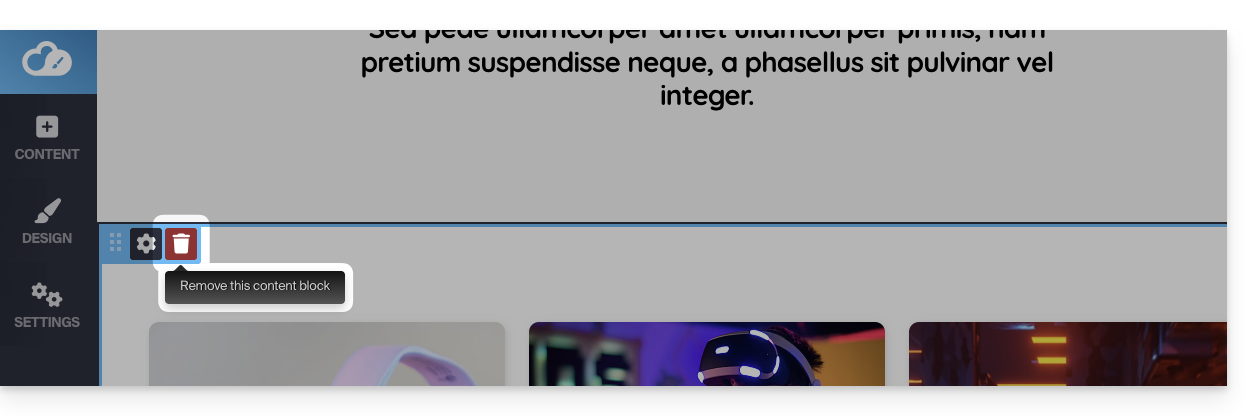
Confirm the deletion, and it will disappear.
You can undo this type of operation.
Duplicate a block
Hover over the block you want to duplicate on your page and click on the gear icon that appears when you hover over it.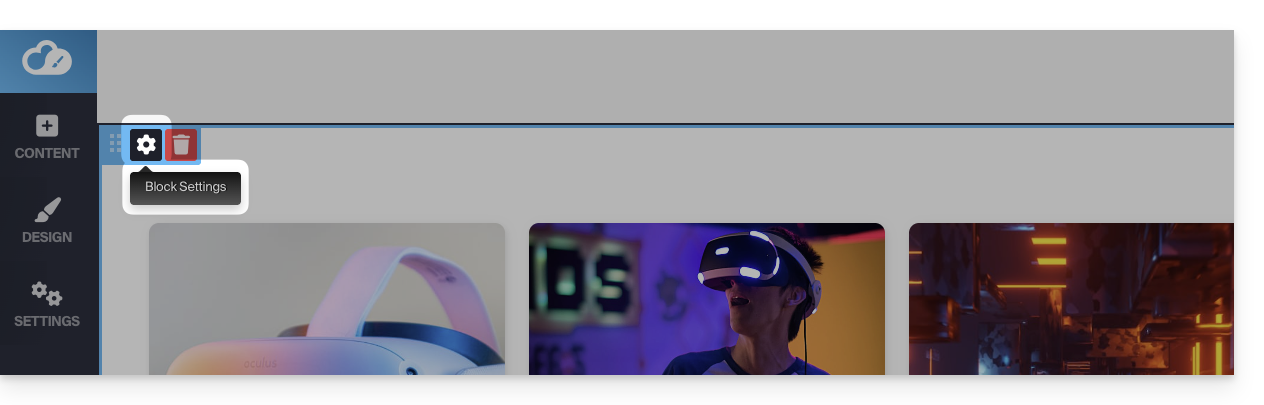
Then, choose the desired location for its duplication: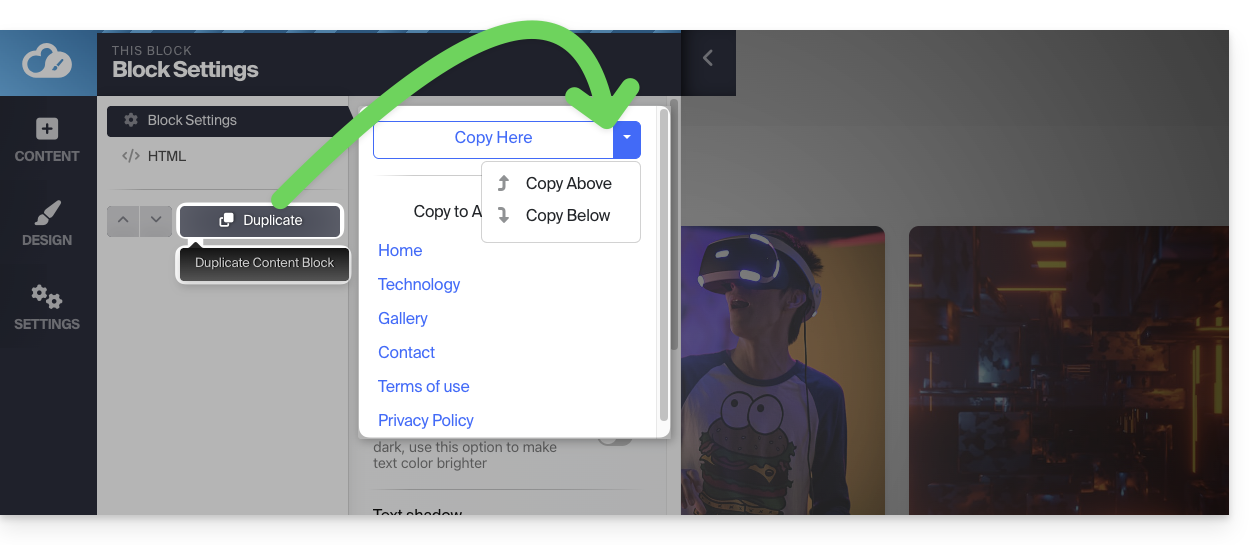
Edit a content block
Each editable element of the content block will be highlighted when you move your mouse over it. Simply click on one of these elements to start editing.
Furthermore, you can edit the HTML code (recommended for advanced users only) if you need more control over any content block; this allows you, for example, to insert an HTML code for subscribing to the Infomaniak Newsletter.
You can also remove certain elements from your content blocks: when editing text, there is the "right arrow" button which displays more options and the Delete button: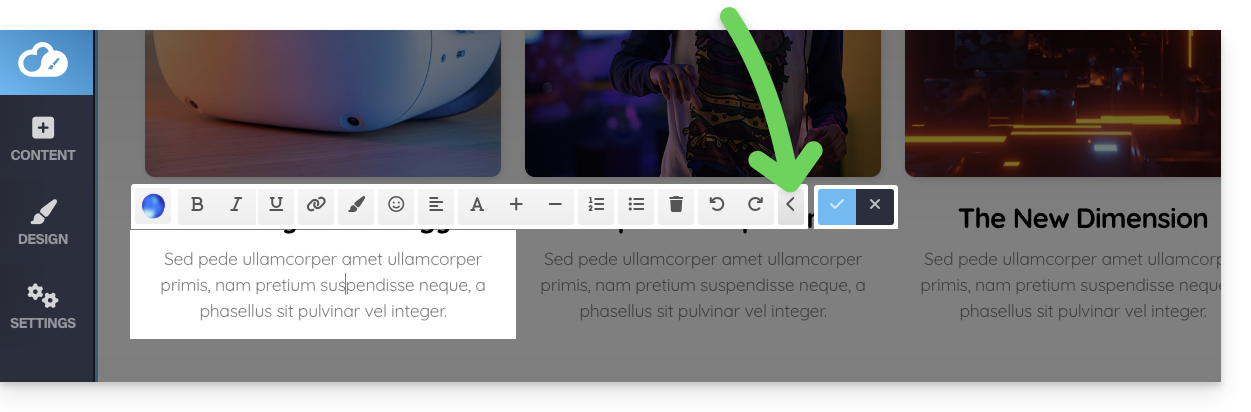
To edit an image, click on it, and a new window will appear. In the lower part, there is the Save button on the right and the red Delete button on the left: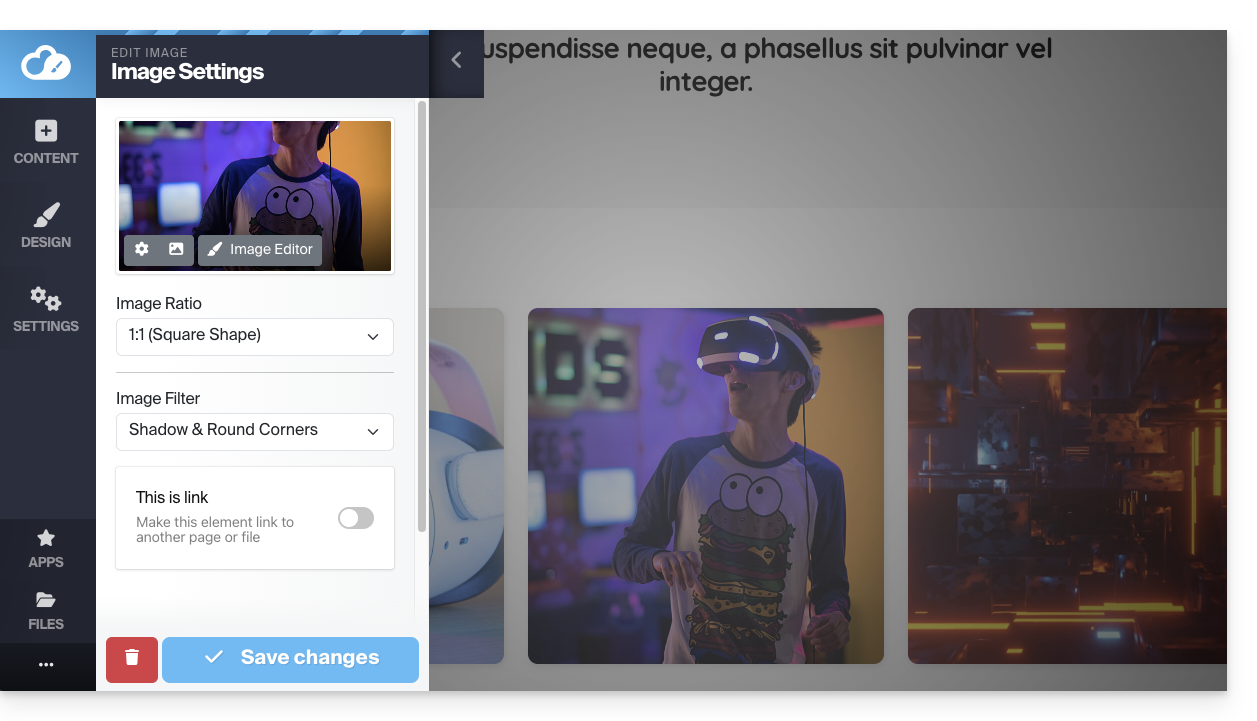
Create a standard content block
In the left sidebar, under the content that can be added to your page, you will find a button to Design a content block: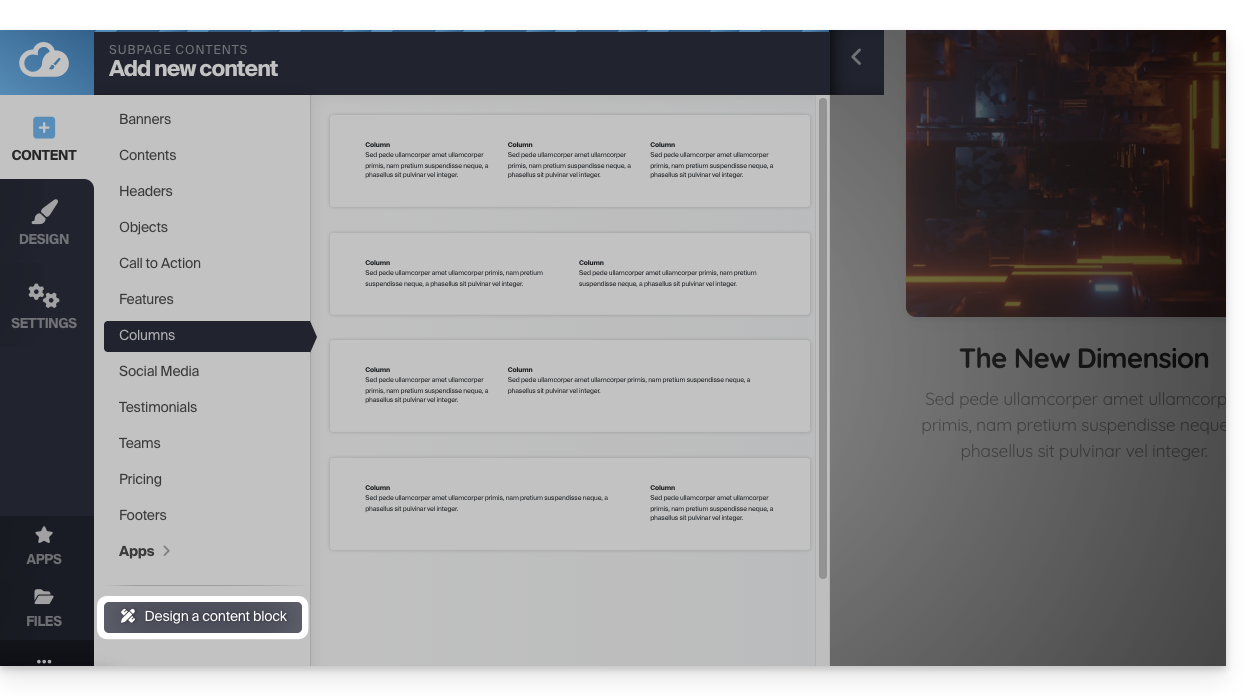
All the elements that make up the blocks are arranged on the left. You can drag them to your template block to design your ideal block. This will be inserted into your page by clicking on Apply changes at the bottom of the page: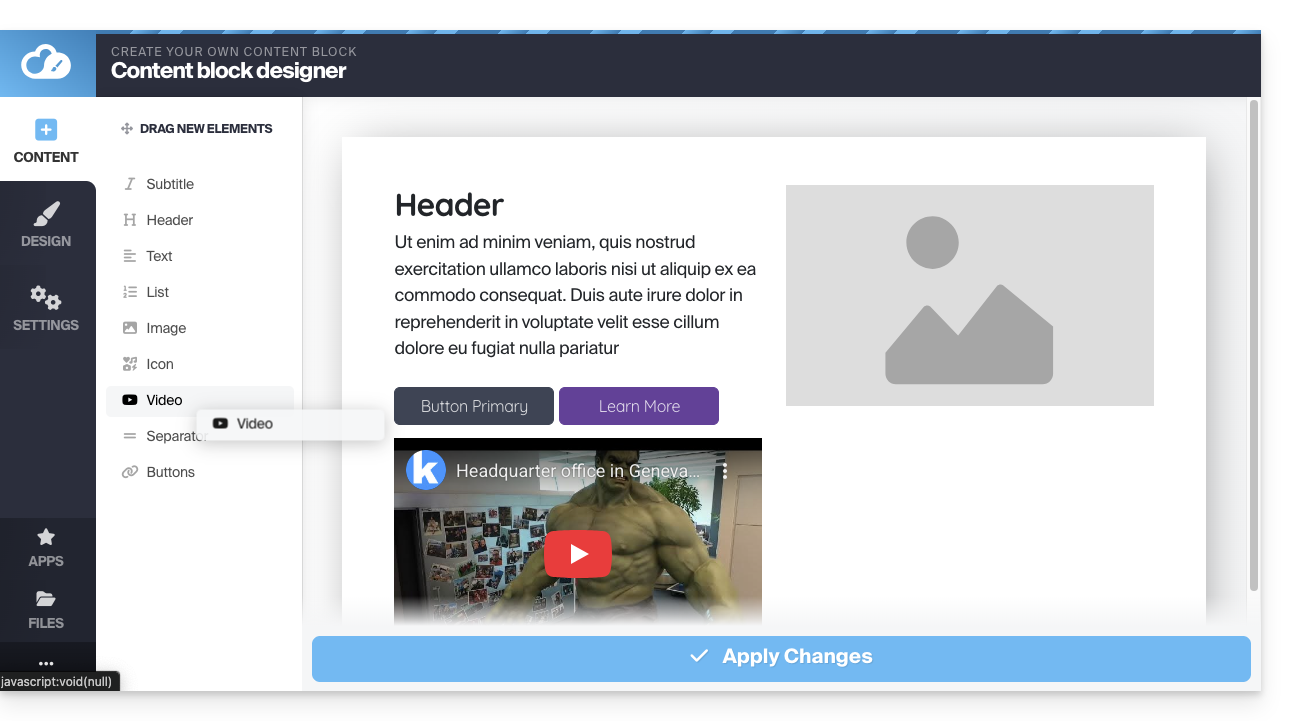
Modify the block margins
Hover over the content block you want to modify and click on the gear icon:
Scroll through the settings to Default block spacing and click on it to define your own settings: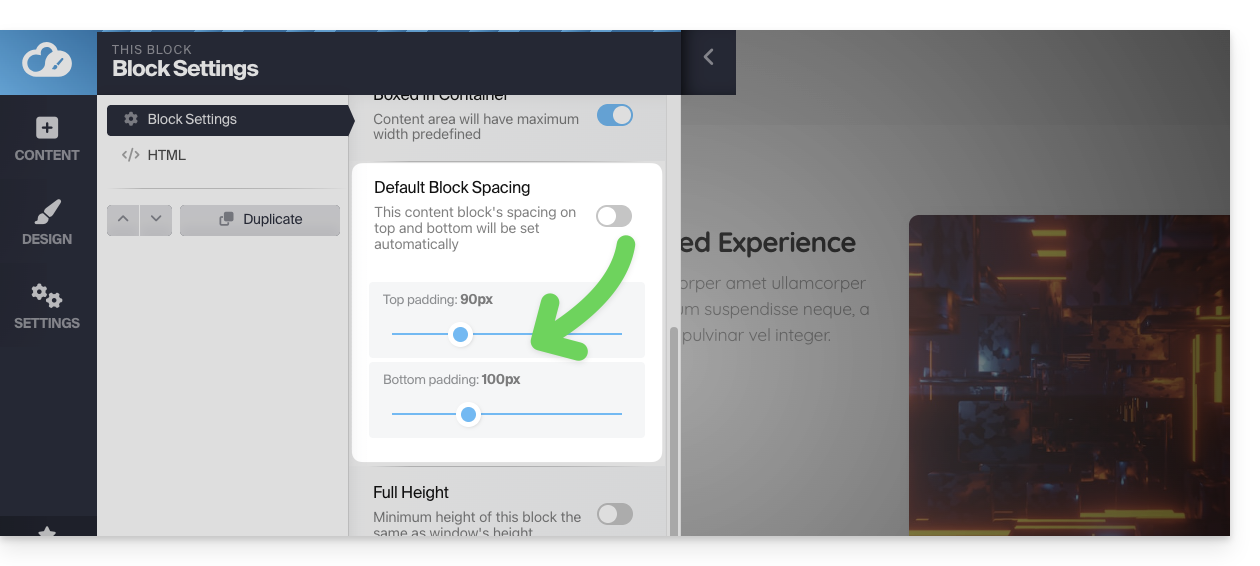
The settings cogwheel also allows you to change the background color or image of the block: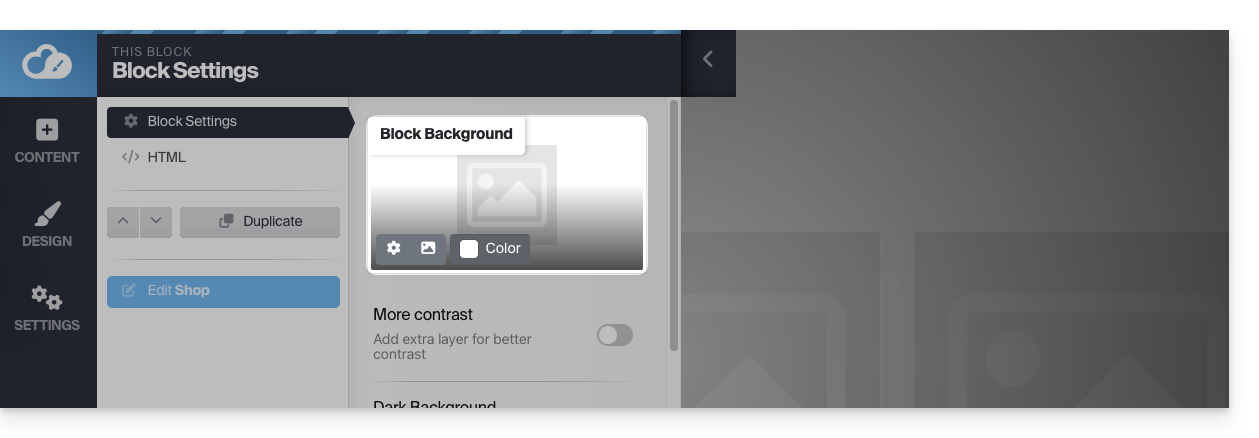
Move a block up or down
The content of your page is divided into "blocks". You can add more blocks and rearrange them.
Hover over the content block you want to move, then click on the area with the dots in the upper left corner; hold down the mouse button to move the block: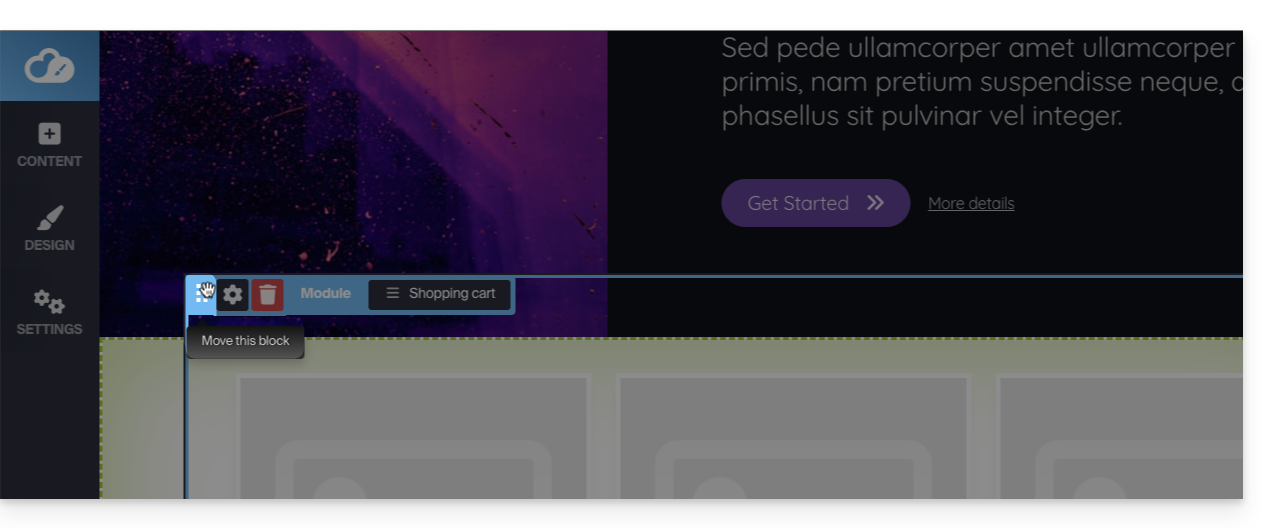
Create space between two blocks
To create horizontal space between content blocks, add a separator manually: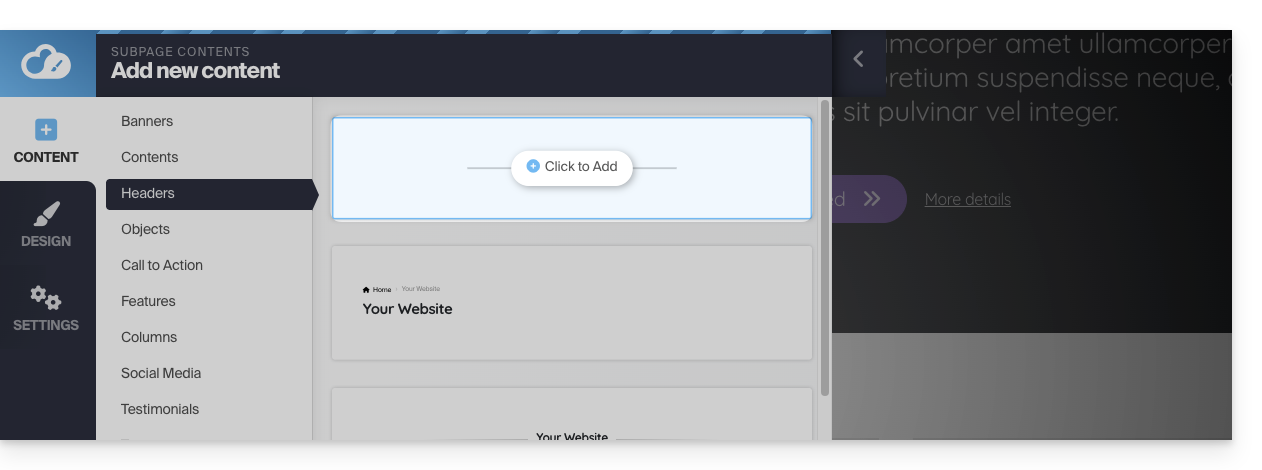
You can then define its color and size by clicking directly on the separator: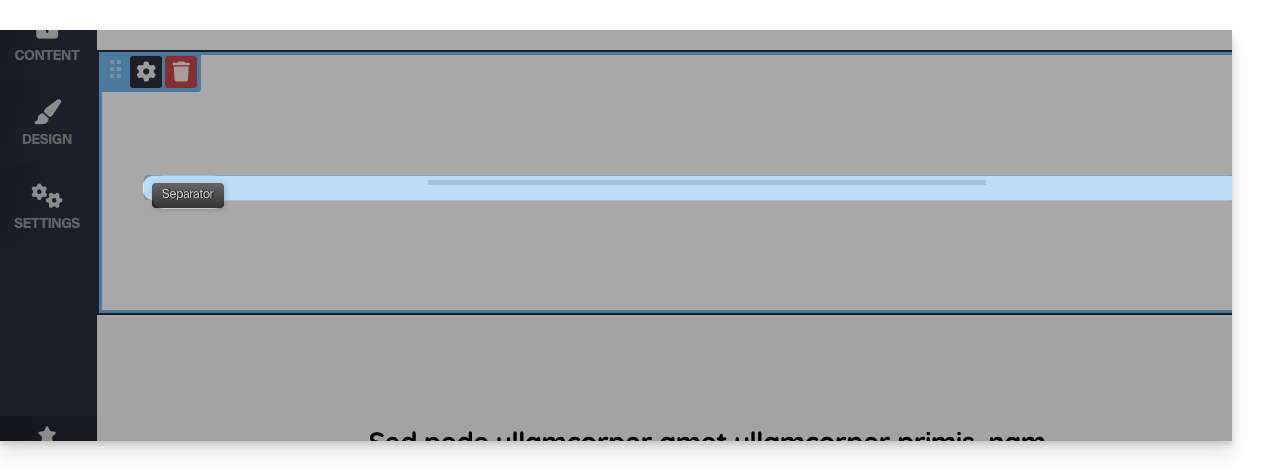
You can also "decorate" the top and bottom of a block more automatically by activating the Decoration option when editing a block: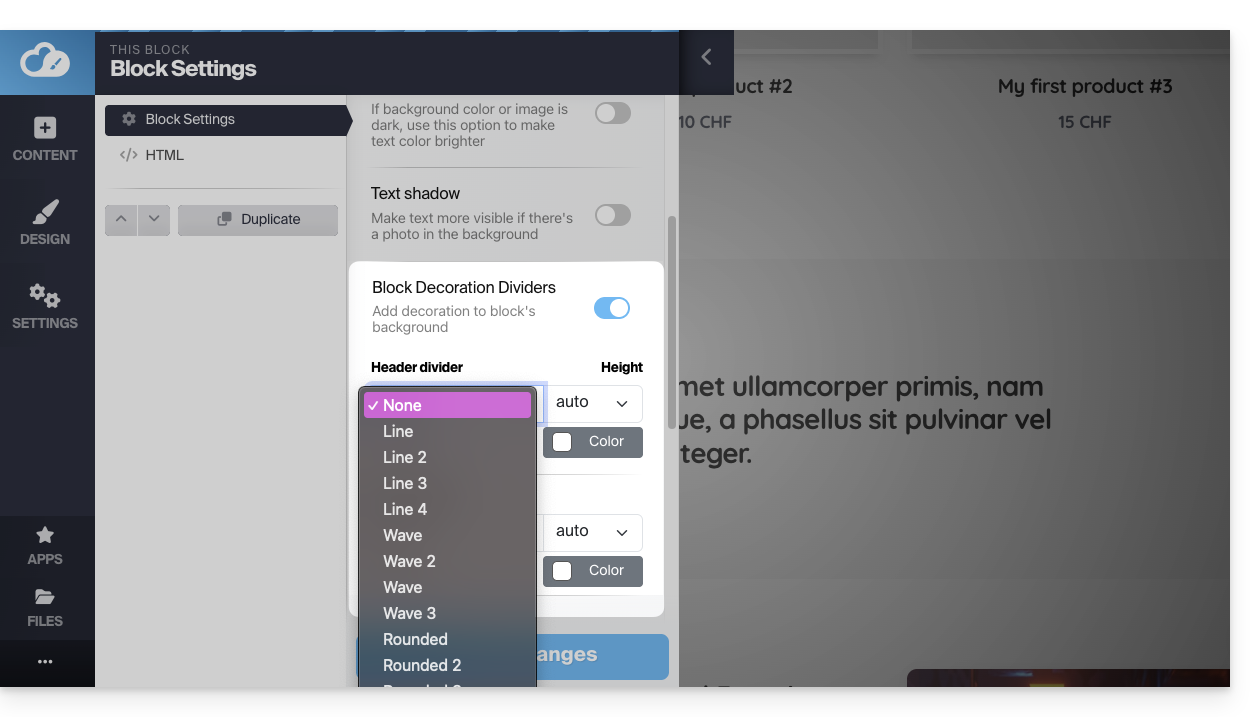
Link to this FAQ: https://faq.infomaniak.com/2708
Has this FAQ been helpful?
This guide helps you understand how to create and edit pages in Infomaniak's Site Creator.
Simple page editing
Start by logging in to the Infomaniak Manager with your credentials (user account with the necessary permissions for the relevant product):
- Click here to access the hosting & site management interface (filtered to display only Site Creator).
- If nothing is displayed, you may not be in the Organization to which your site is linked (❓: help).
- Click on the name of the Site Creator in question:
- Click on the button to edit your site:
Once in Site Creator, editing a page happens in real time, and your changes are saved as you go while you edit the content of your blocks. You can undo your changes if needed.
Create a link
Create a link from an image or text by selecting the object directly. On the toolbar that appears, click on the action menu •••.
Then, click on the chain icon to open the section where you can specify the type of link and the associated options: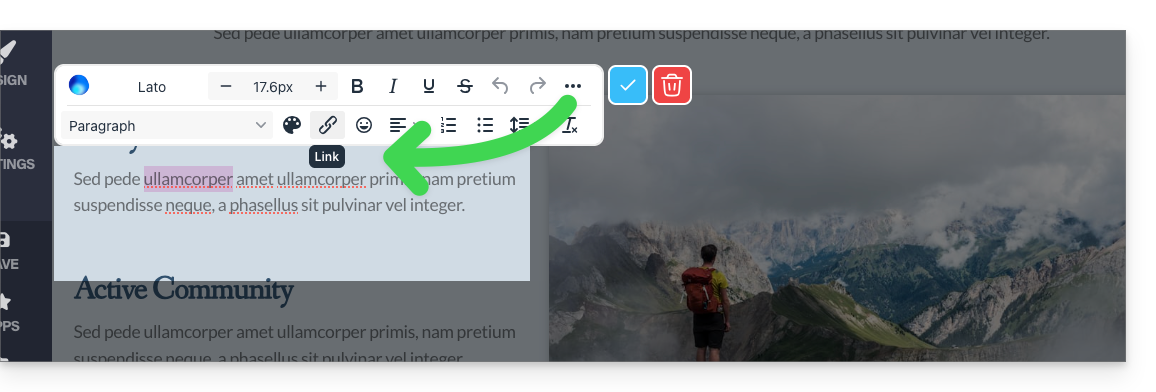
Turn a link into a button
In your link settings, you can choose its style (button, rounded, solid, etc.), the associated icon, etc.: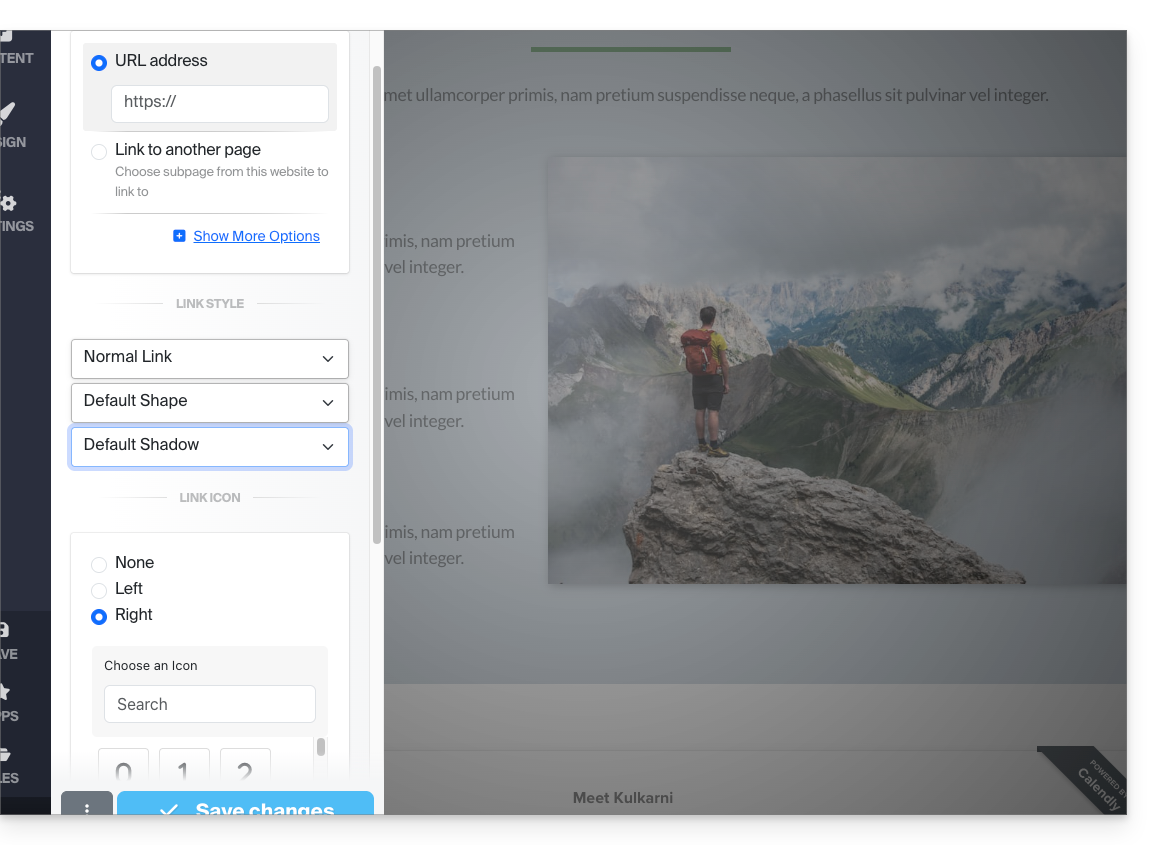
Edit a link
Edit a link by clicking on it, then clicking on the chain icon: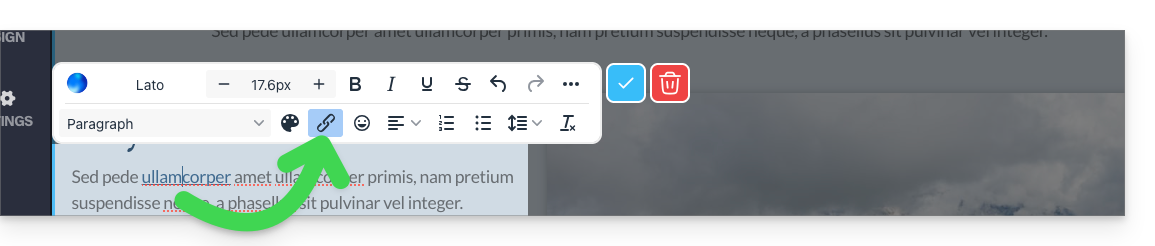
Create a link to a file
To allow your visitors to download a file from a link on an object, click on Show more options in your link settings.
Then, choose the “File” type, which will allow you to upload the corresponding file to the server, so that you can offer it for download to your visitors: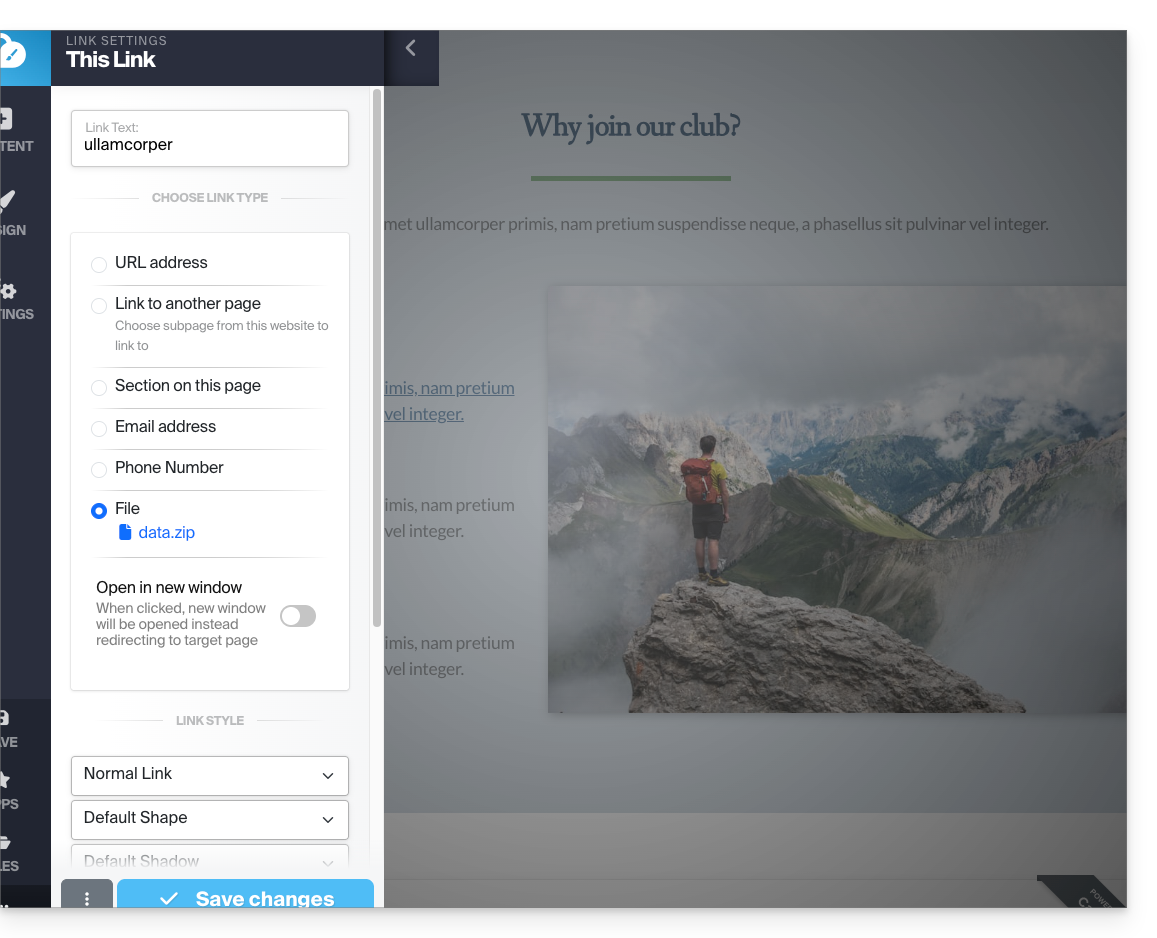
Create a link to an email
Choose the "Email address" type in your link settings. Clicking the link will open the visitor's default email application and start composing an email with the pre-filled email address: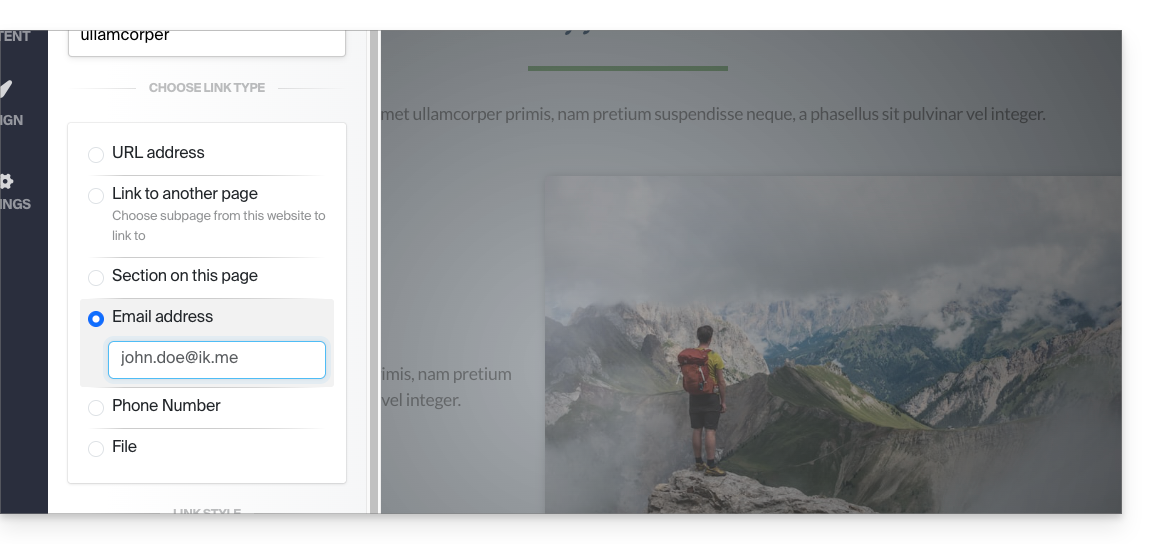
To avoid hardcoding the email address on your page, insert a contact form.
Create a link to a specific section
To direct visitors to a specific section of your site or another site, use the anchor system.
Create a link from an image
When you click on an image to edit it, simply activate the "This is a link" button below the image to specify the URL that will be displayed when a visitor clicks on it: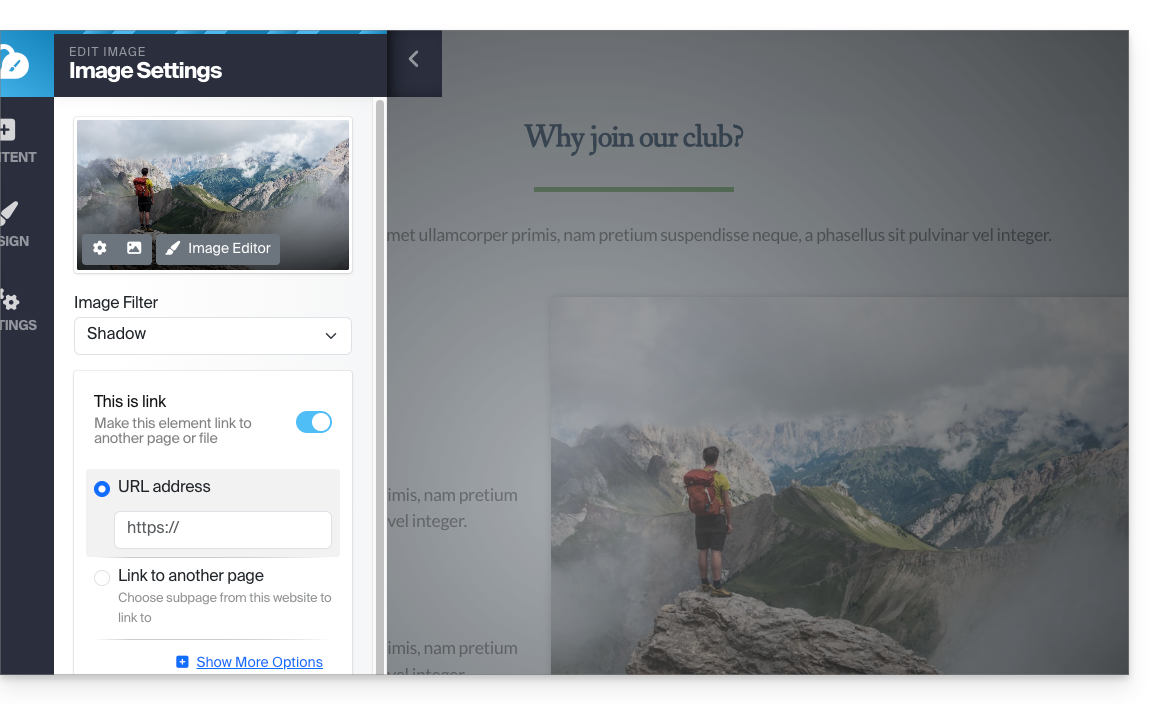
You can also apply a link to an imageby using a YouTube video as the URL: this will automatically create a PLAY-type icon that, when clicked, will open the video in aLightbox window.
Create a list, insert an emoticon... and save
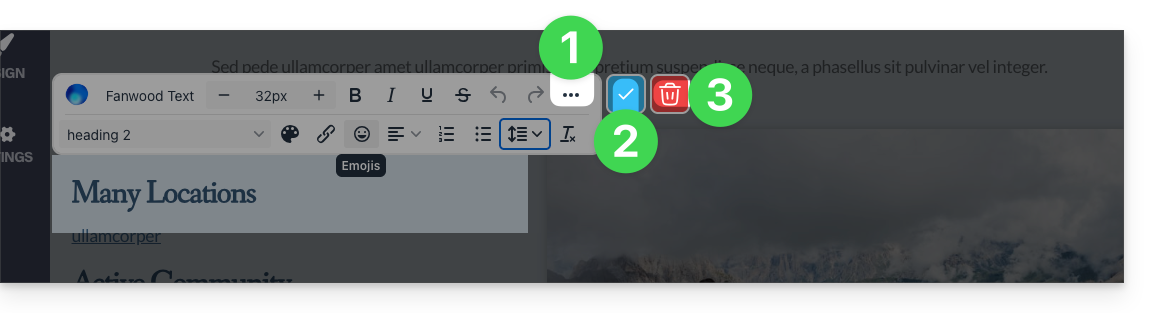
The different text formatting options are located above the text selection:
- Additional options (bulleted lists, alignment, emojis, etc.) are available via the ••• action menu.
- Apply and save the changes using the ✓ symbol.
- Warning: the trash can deletes the text you are currently editing:
Link to this FAQ: https://faq.infomaniak.com/2709
Has this FAQ been helpful?
This guide is intended for users of the Site Creator tool who wish to go further in editing their pages.
Open the HTML editor
Start by logging in to the Infomaniak Manager with your credentials (user account with the necessary rights for the relevant product):
- Click here to access the hosting & website management interface (filtered to display only Site Creator).
- If nothing is displayed, you may not be in the Organization to which your website is linked (❓: help).
- Click on the name of the Site Creator in question:
- Click on the button to edit your site:
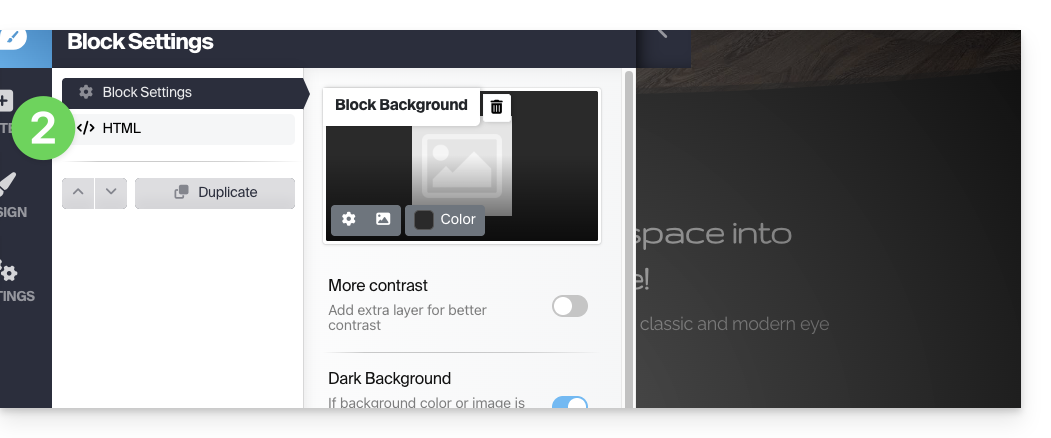
Once in Site Creator, you can modify the HTML code (recommended for advanced users only) if you need more control over any content block:
- Hover over the block you want to edit on your page and click on the gear icon that appears on hover:

- Click on the HTML element in the left sidebar to edit the HTML code of the block:
- Remember to save your changes:
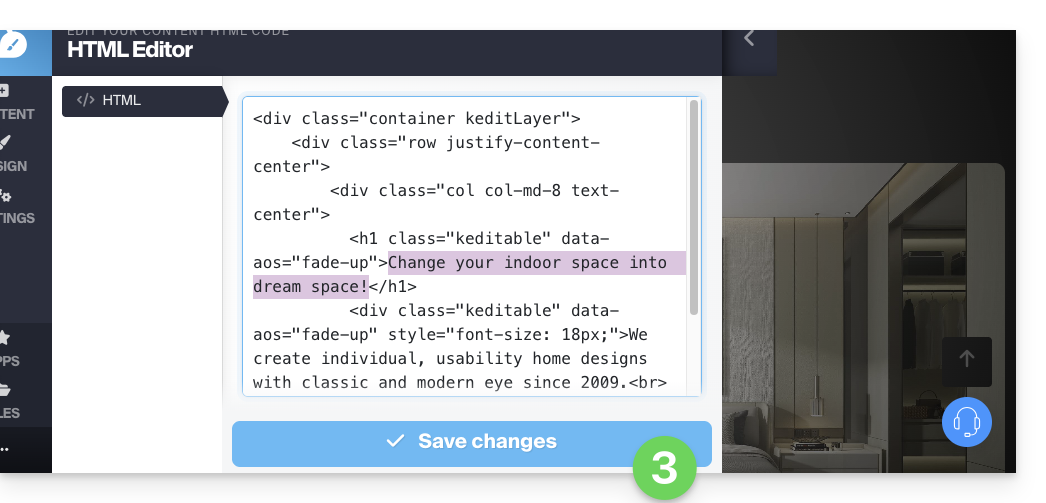
Add an HTML block
To start from scratch with a blank HTML block, you can insert the Custom HTML Code module onto your page from the Apps list: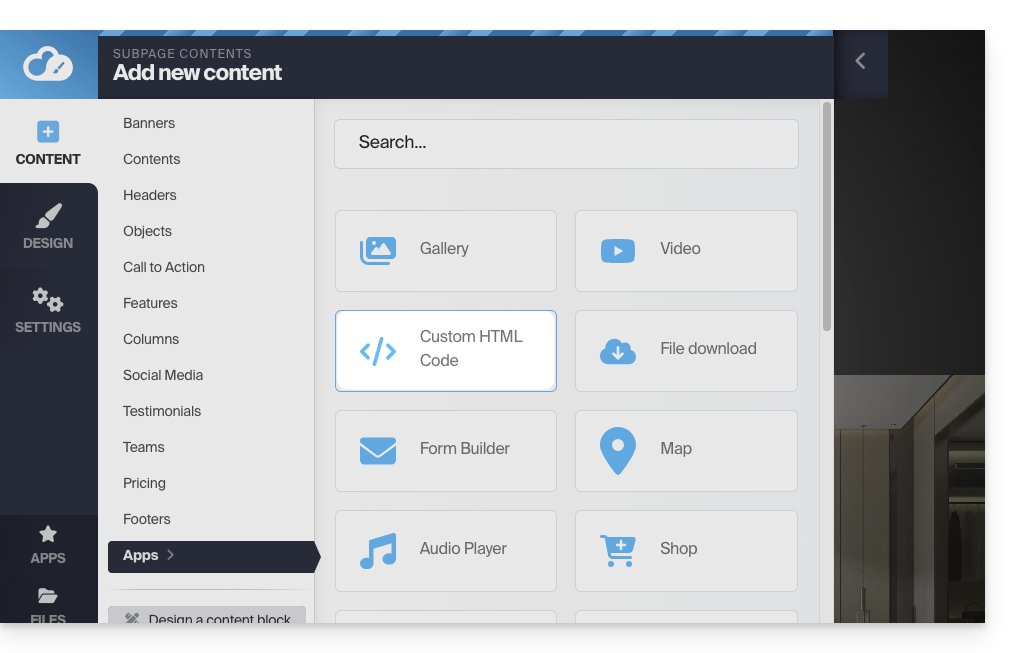
The text can then be edited using the HTML CODE button, which opens the HTML editor:
You can also add code outside of the blocks.
It is strongly recommended that you never insert tags such as html, head, or body, as these could conflict with the application's source code.
Link to this FAQ: https://faq.infomaniak.com/2710
Has this FAQ been helpful?
This guide is intended for users of Infomaniak's Site Creator who wish to optimize their website's SEO.
Introduction
- Infomaniak is one of the most efficient hosting providers on the French-speaking market, which contributes to the good ranking of your websites.
- However, Infomaniak will not intervene on the content or development of the hosted websites (please refer to this other guide regarding SEO).
Add Site Creator to Google
Start by logging in to the Infomaniak Manager with your credentials (user account with the necessary rights for the relevant product):
- Click here to access the hosting & site management section (filtered to display only Site Creator).
- If nothing is displayed, you may not be in the Organization to which your site is linked (❓: help).
- Click on the name of the Site Creator in question:
- Click on the button to edit your website:
Once in Site Creator, to submit your website to the Google search engine:
- Click on the Applications button in the left-hand menu.
- Click on the Add to Google application:
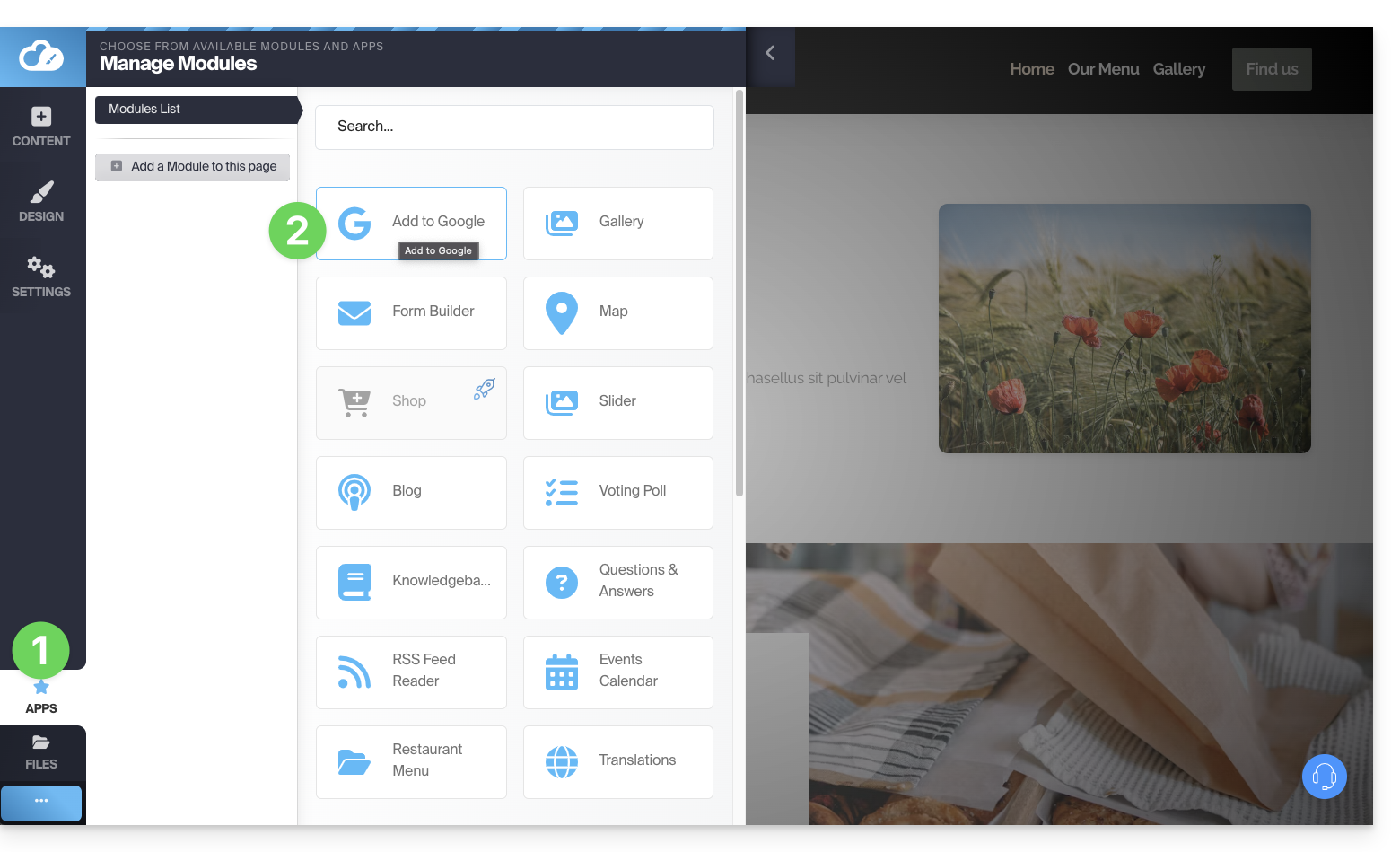
This application allows you to perform 2 operations:
- Open the Google Search Console interface, which allows you to manage the analytics for your website:
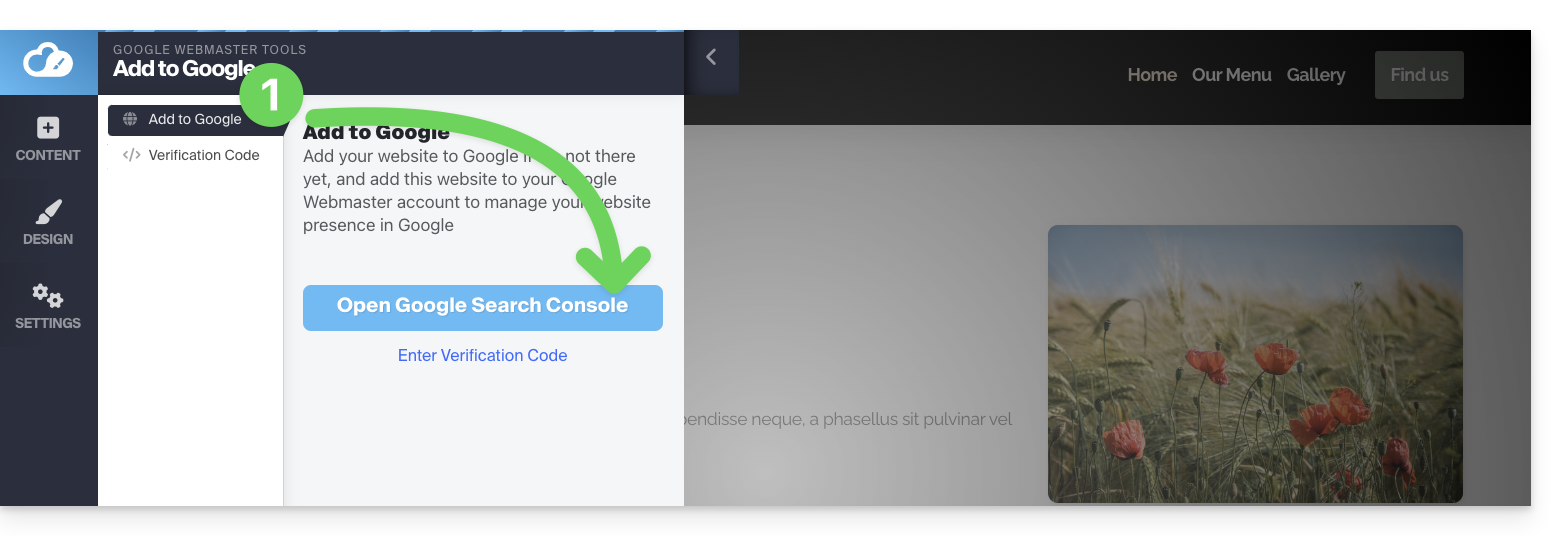
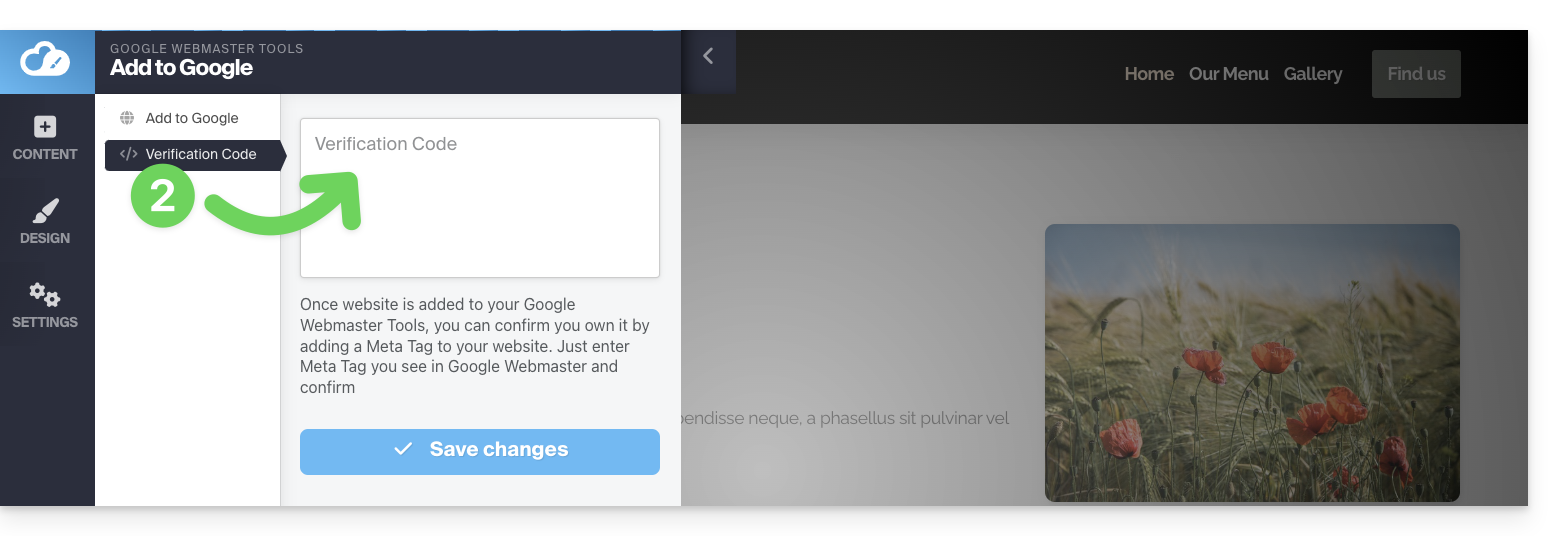
- You can insert the verification code provided by Google Search Console if you choose the simple method (see below):
Ownership verification (required by Google)
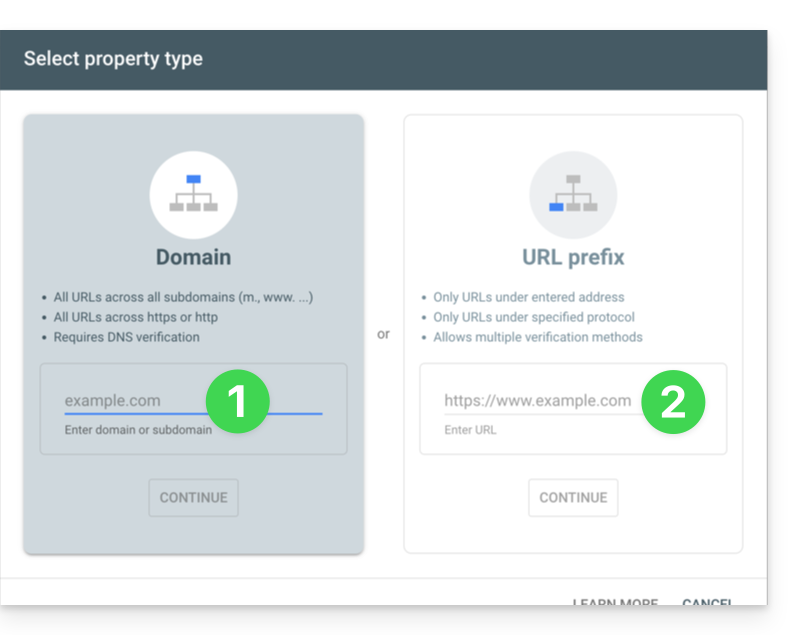
When you want to add your site to the Google tool and click on the button in step 1 above, you will be presented with two options:
- the method for monitoring an entire domain, which requires verification that you will need to perform at the domain name level (on the Infomaniak interface if your domain name/DNS zone is managed by Infomaniak),
- the easiest method for specifying the exact URL of your site, and for which verification will be performed directly from Site Creator:
1. Method with domain ownership verification
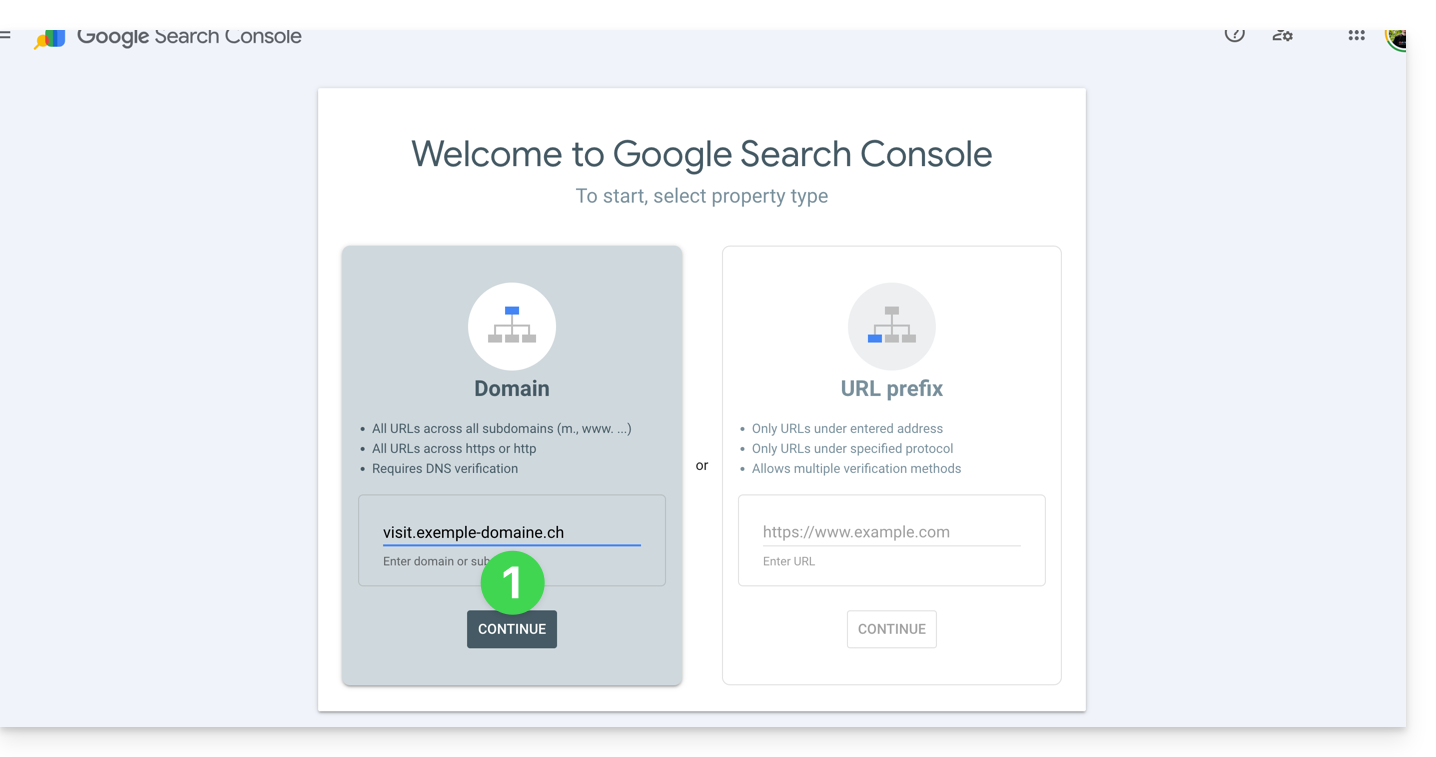
- Enter the complete URL of your Site Creator and click Continue:
- Make sure that the
TXTtype is selected and click the COPY button: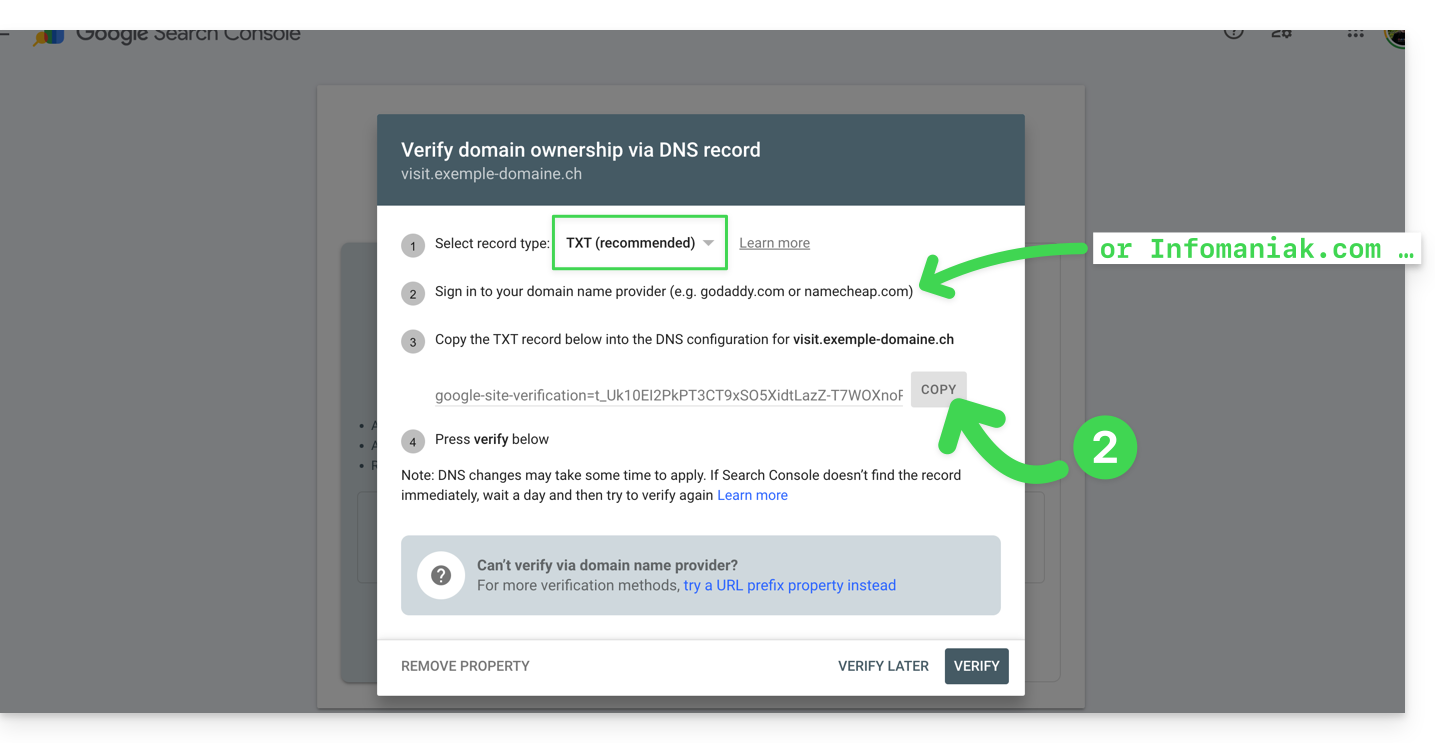
- Click here to access the management of your domain name if it is managed with Infomaniak (otherwise, you will need to perform these operations with the relevant provider).
- Click directly on the name assigned to the product in question.
- Click on DNS Zone in the left-hand menu.
- Click on the button to add a record:
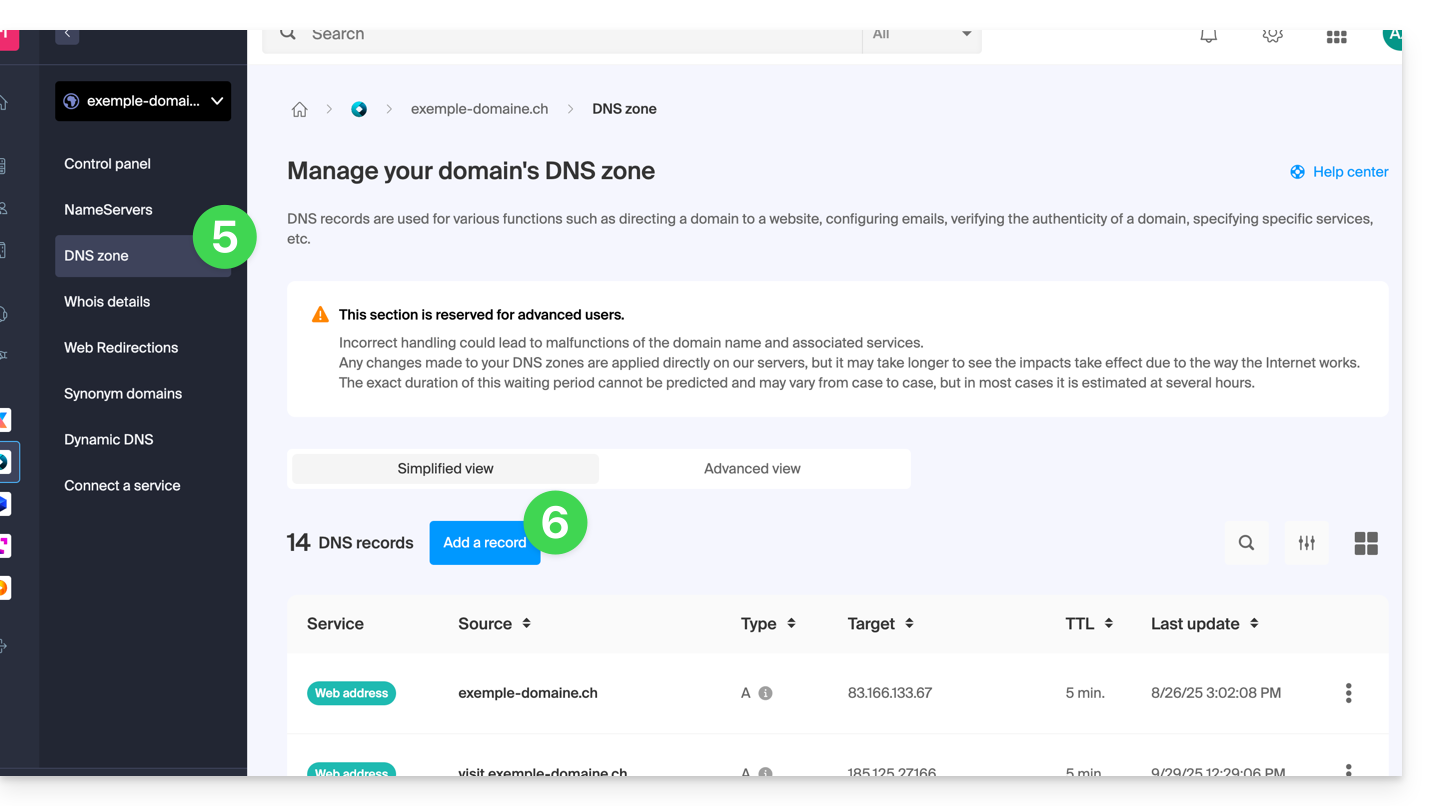
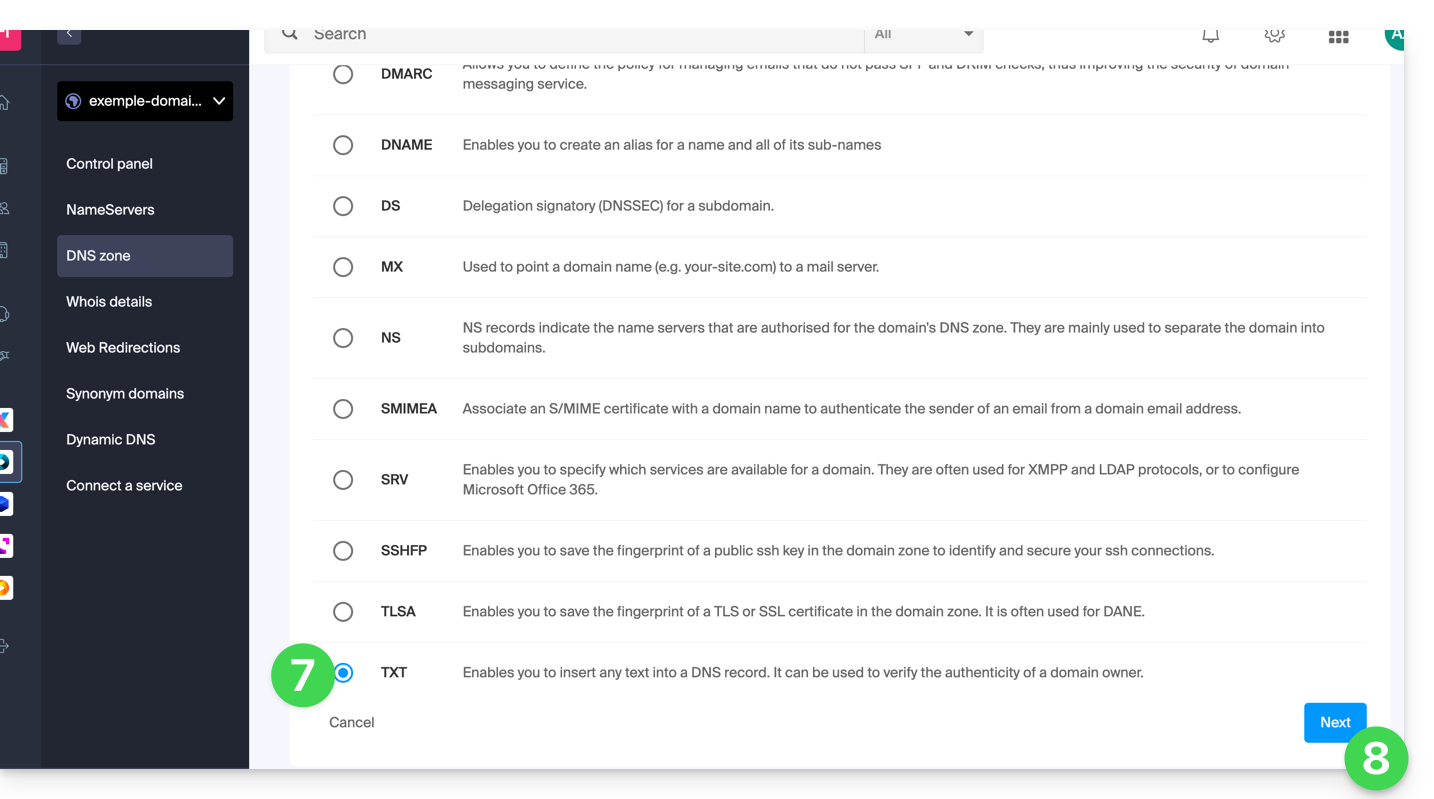
- Select the TXT type from the list.
- Click on the Next button:
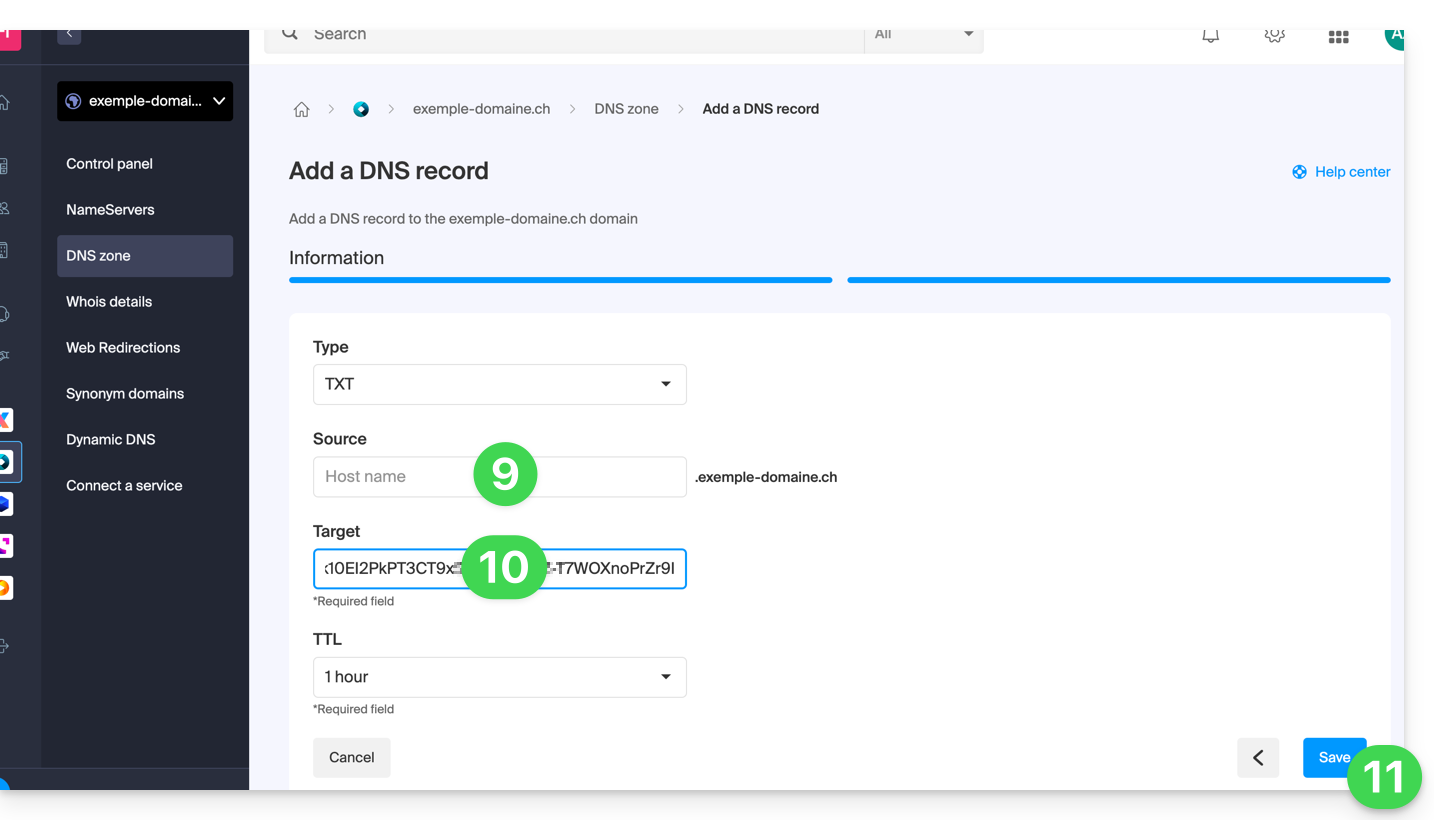
- Leave this field blank or enter the term preceding your domain name if you created a site like
xxx.domain.xyz(in this example, you would entervisitin the Source field, since Site Creator is created onhttps://visit.exemple-domaine.ch). - Paste the information retrieved in step 2 above.
- Click the button to Save:
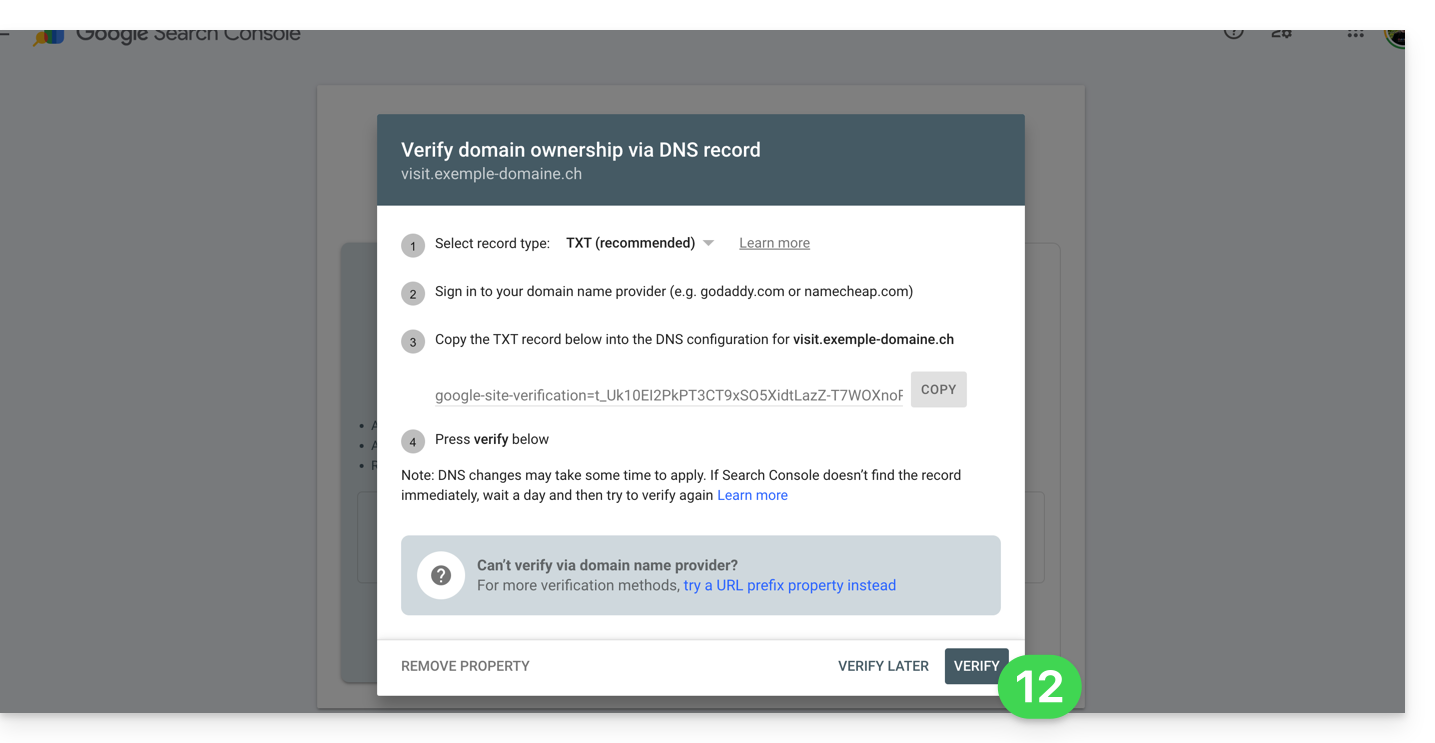
- Go back to the Google tool and click Verify (wait a few minutes if the verification doesn't start):
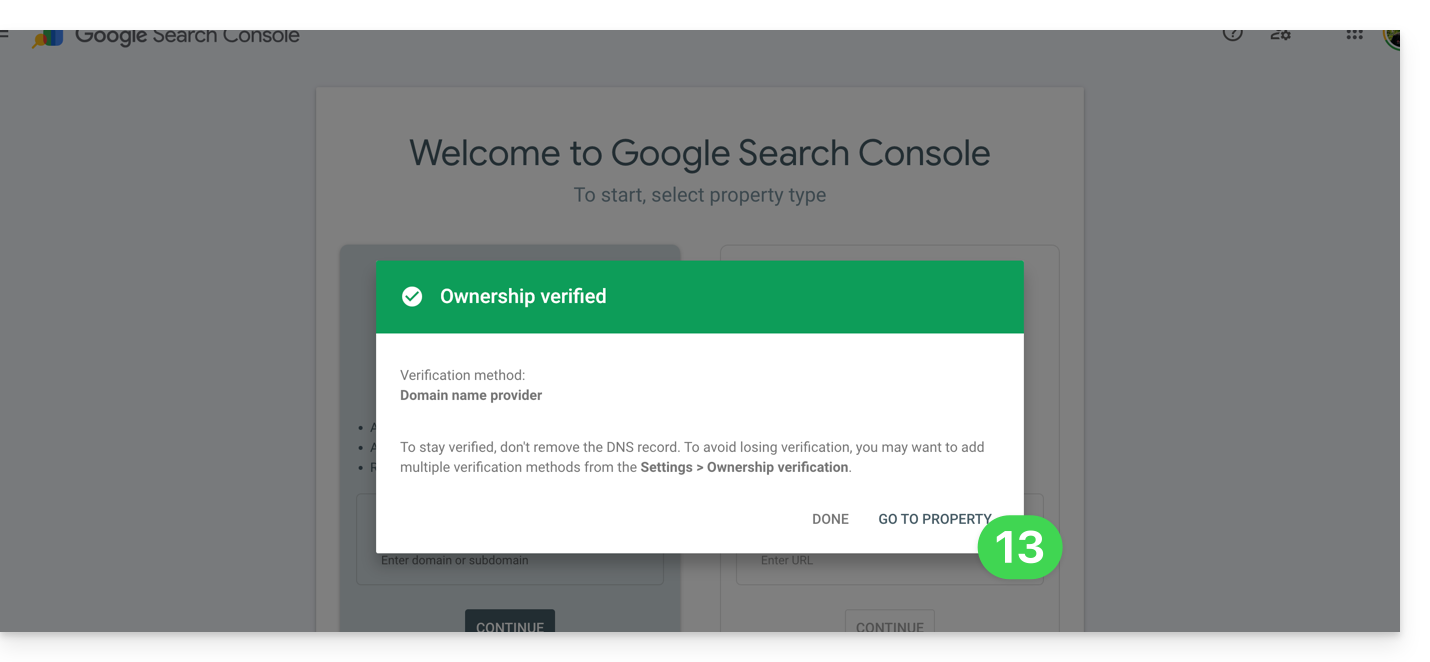
- There you go, the link between your Site Creator and the analytics console has been established; click the button to configure the property:
2. Simple method
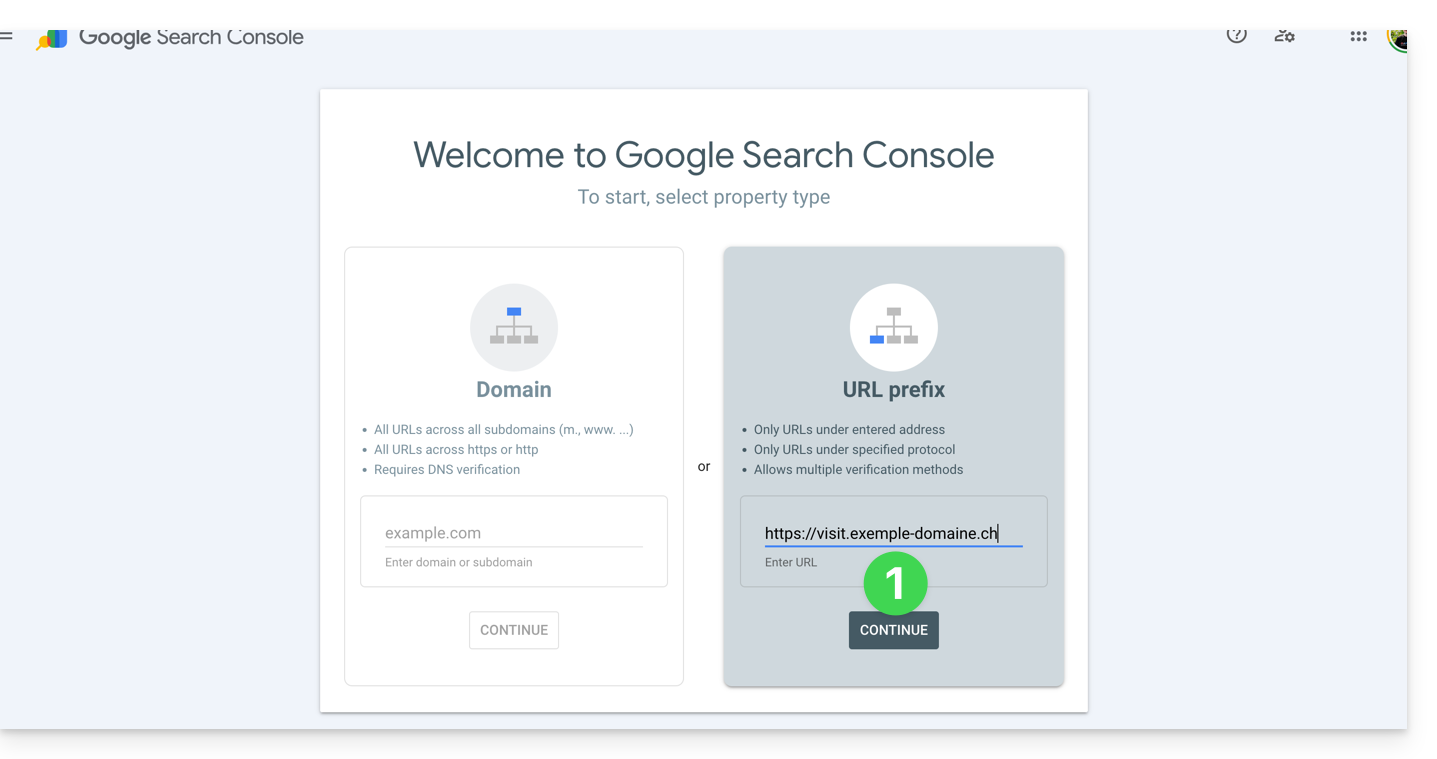
- Enter the complete URL of your Site Creator and click Continue:
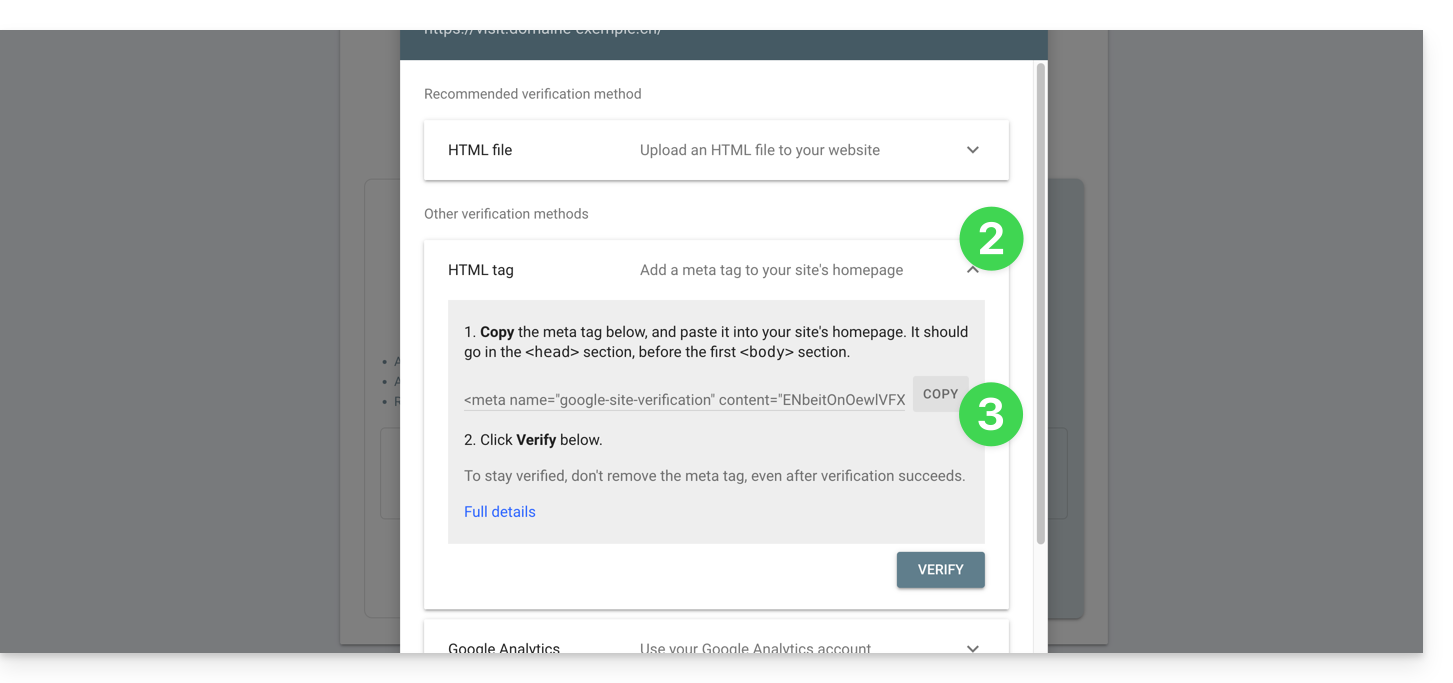
- Click on the chevron to expand the HTML TAG section, which provides the information to be copied into Site Creator to prove ownership.
- Click the COPY button:
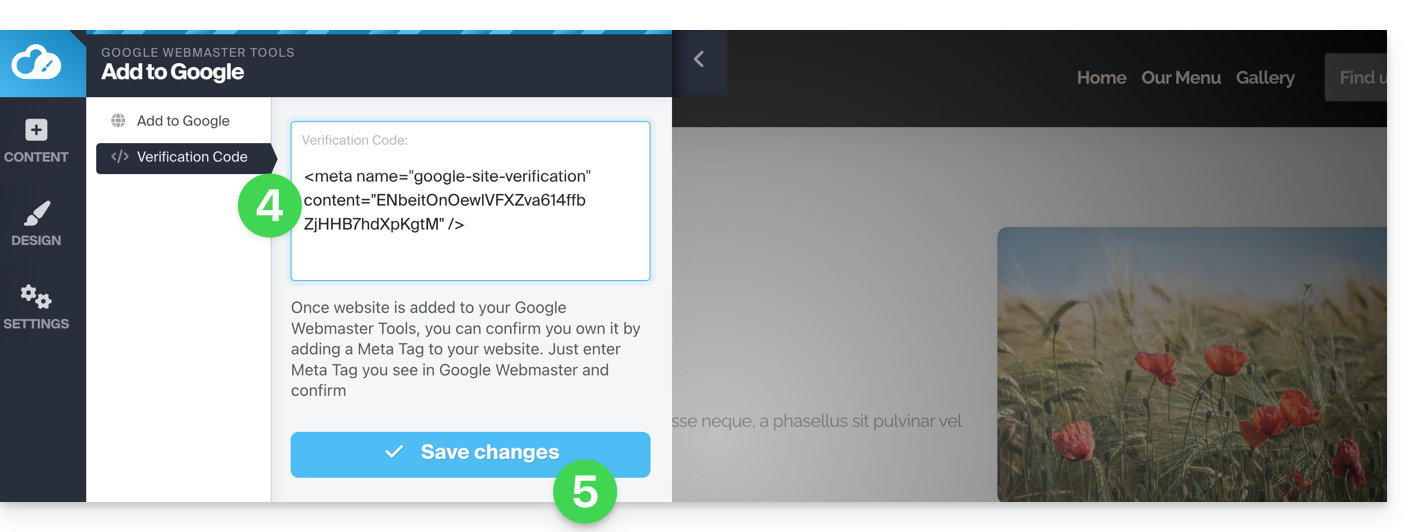
- Paste the information into the designated area in Site Creator.
- Save the changes:
- Go back to the Google tool and click Verify (wait a few minutes if the verification does not start):
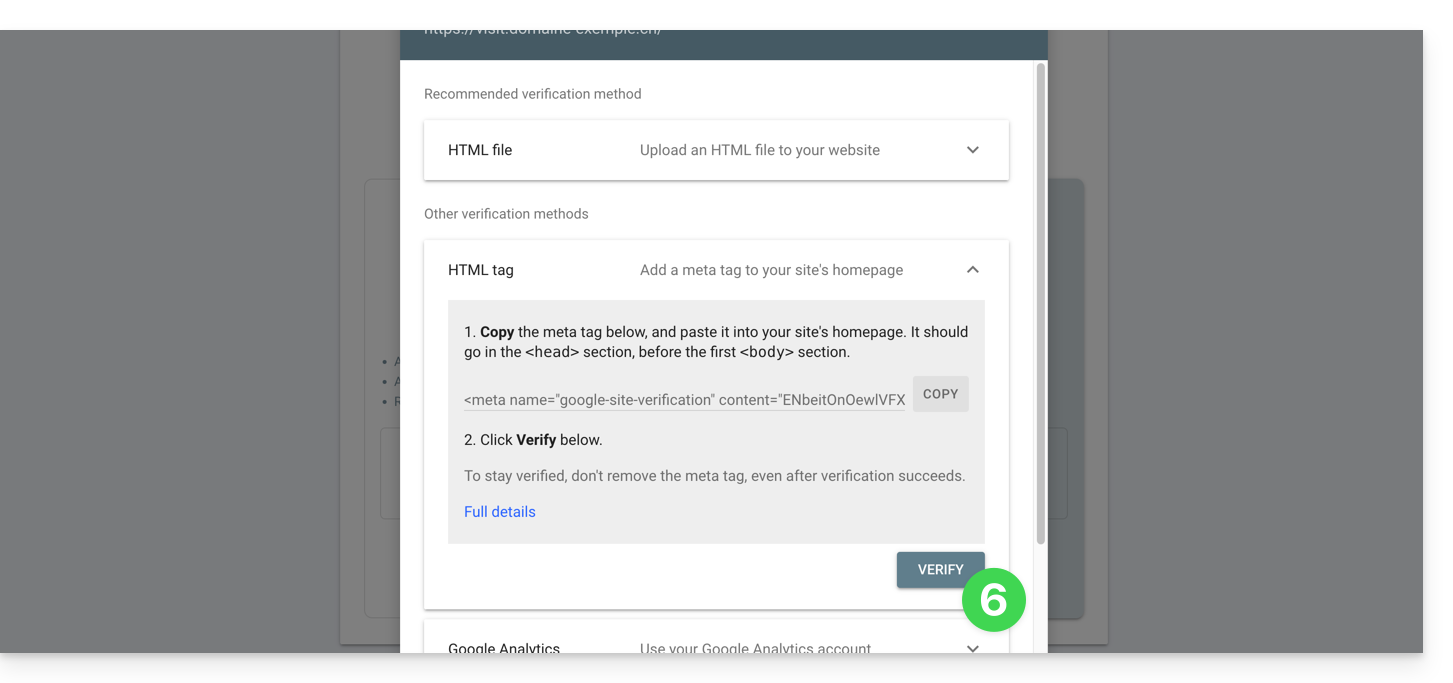
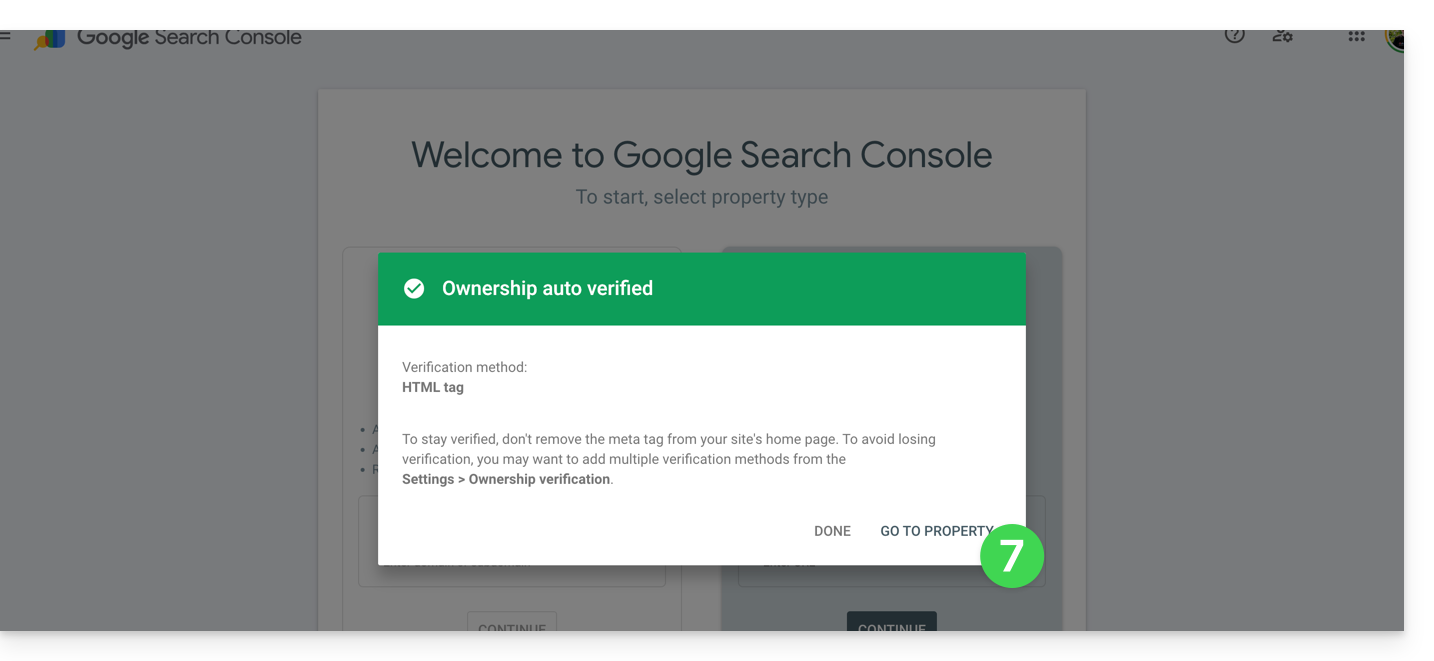
- There you go, the link between your Site Creator and the analytics console has been established; click the button to configure the property:
Define Meta Tags
Once in Site Creator:
- Click on the Settings button in the left-hand menu.
- Click on General settings.
- Click on SEO and metadata.
- Enter the title, description, and keywords for the entire site:
This is also where you can manage the robots.txt file if needed.
To define this, but for a specific page:
- Click on the Settings button in the left-hand menu.
- Click on General Settings.
- Click on Subpage Settings.
- Click on SEO & Metadata.
If you do not make any changes on this page, Site Creator will dynamically manage your tags.
You can also manage the URLs of your pages independently of the SEO title of your page (a page named "Contact" from an SEO perspective, while its URL will be, for example, "/enterprise").
What "Meta Keywords" should I use?
To enter multiple keywords, separate them with a comma or similar:
Sitemap.xml
Do not confuse this with the Sitemap module; the sitemap.xml file lists all the pages of your site to help search engines discover and index them efficiently. You can examine it to understand the site structure; replace domain.xyz with your domain name to access it (publicly) from a browser:
{{URL_31}}Submit your URL to Google Search Console (refer to the first chapter above in this guide) and other webmaster tools to improve indexing.
Insert tracking codes
Your site includes a simple Statistics module, but you can also use Google Analytics or other tracking methods (such as Facebook Pixel, Google Tag...) which require inserting a code on your site:
- Click on the Settings button in the left-hand menu.
- Click on General settings.
- Click on SEO and statistics.
- Scroll down the page and insert your tracking codes.
Link to this FAQ: https://faq.infomaniak.com/2711
Has this FAQ been helpful?