Knowledge base
1000 FAQs, 500 tutorials and instructional videos. Here, there are only solutions!
This guide provides important information when activating DNS Fast Anycast and your domain's DNS zone is not managed by Infomaniak.
Introduction
- You may be in the situation described above if your websites and email addresses are hosted elsewhere.
- For DNS Fast Anycast to work, your domain's DNS zone must be managed by Infomaniak.
- If you do not understand these instructions, please refer to this other guide or contact your webmaster or another professional.
Activating DNS Fast Anycast with an external zone
Here are the steps to follow if your services are not hosted by Infomaniak:
- Log in to your hosting provider's control panel and note all the required records (A, MX, TXT, CNAME, etc.).
- Use the Infomaniak DNS servers for your domain name.
- Enter the records noted in the first step above to link your domain with your various services (websites, email addresses, etc.).
- Any DNS addition/modification may take up to 48 hours to propagate.
Link to this FAQ: https://faq.infomaniak.com/2325
Has this FAQ been helpful?
This guide concerns the configuration of the Newsletter Infomaniak product in the case where the domain name used for sending your emails is not managed by Infomaniak.
Introduction
- To use the Newsletter tool automatically, you need to manage the domain name from which you send your newsletters (as well as its DNS zone) with Infomaniak.
- For example, if you send your newsletters from the address
news@domain.xyz, the domaindomain.xyzmust be managed with Infomaniak.
Specific DNS Configuration
To use the Newsletter tool with a domain that is not managed with Infomaniak, you will need to add specific entries to your DNS zone, as provided in your Manager: 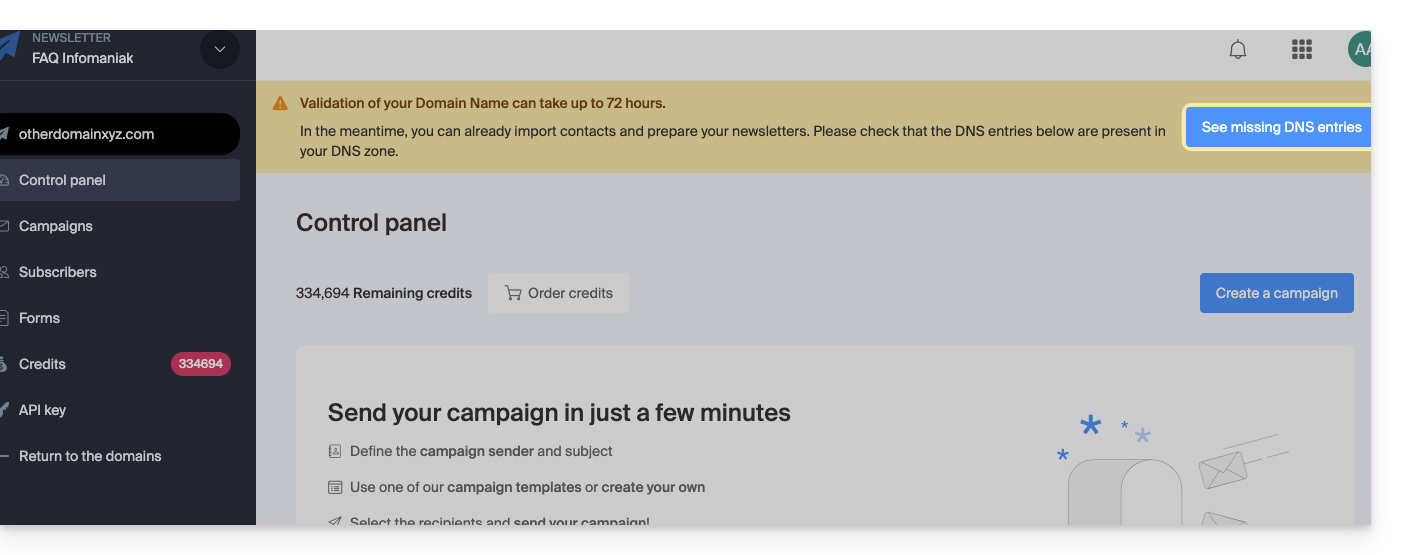
Refer to this other guide to add the DNS entries mentioning ._domainkey, ensuring that you select the DKIM type first, and then the CNAME subtype when adding the DKIM.
In case of domain transfer
If the domain name currently managed by Infomaniak (and associated with the Newsletter) is transferred to another registrar, the Newsletter tool will be deactivated within 30 days if no corresponding DNS changes are made.
Link to this FAQ: https://faq.infomaniak.com/2157
Has this FAQ been helpful?
This guide explains how to resolve access errors to your Web Hosting following an IP address change (server migration, for example).
Introduction
- To save time, your system maintains a table that maps domain names to IP addresses.
- If the website changes its "location" (IP address), your computer tries to access the old address.
- Clearing the cache forces the system to request the new address from the DNS servers.
If your computer retains the old address in its memory,clearing the DNS cache can restore the connection.
Clear the DNS cache…
… on Windows
Use the command prompt to refresh your network settings:
- Open the Start menu.
- Type cmd and press Enter.
- In the black window that opens, type the following command and press Enter:
ipconfig /flushdns
… on macOS
On recent versions of macOS, the process is done via the Terminal:
- Open the Terminal (via Spotlight or Applications > Utilities).
- Copy and paste the following command:
sudo dscacheutil -flushcache; sudo killall -HUP mDNSResponder - Enter your session password (it will not be displayed while typing) and validate.
… on Linux
Most modern distributions use systemd-resolved. Open your terminal and run:
sudo resolvectl flush-caches
Note: If you are using an older service, the commandsudo systemctl restart nscd remains valid.
Link to this FAQ: https://faq.infomaniak.com/1041
Has this FAQ been helpful?
DNS Fast Anycast replicates the DNS of your domain worldwide to reduce latency and increase the availability of your websites.
Introduction
- Thanks to DNS Fast Anycast, your domain's DNS servers are replicated across multiple Points of Presence (PoPs) worldwide (list below).
- Regardless of where your visitors are located, they are redirected to the DNS server closest to them, which on average speeds up access to your site by 34% (DNS resolution).
- Furthermore, if one of your DNS servers were to become unavailable, the closest server will automatically take over, and your visitors will continue to be able to access your site.
- DNS replication for your domain is automatic, and no changes to your code are required.
Manage Fast Anycast DNS
Prerequisites
- DNS Fast Anycast is compatible with all websites, regardless of your hosting provider.
- All you need is a domain name managed with Infomaniak.
- Transfer the management of your domain to Infomaniak if necessary.
- Consult this other guide for managing external domains.
To access the DNS Fast Anycast option:
- Click here to access your product management interface in the Infomaniak Manager (need help?).
- Click directly on the name assigned to the product in question.
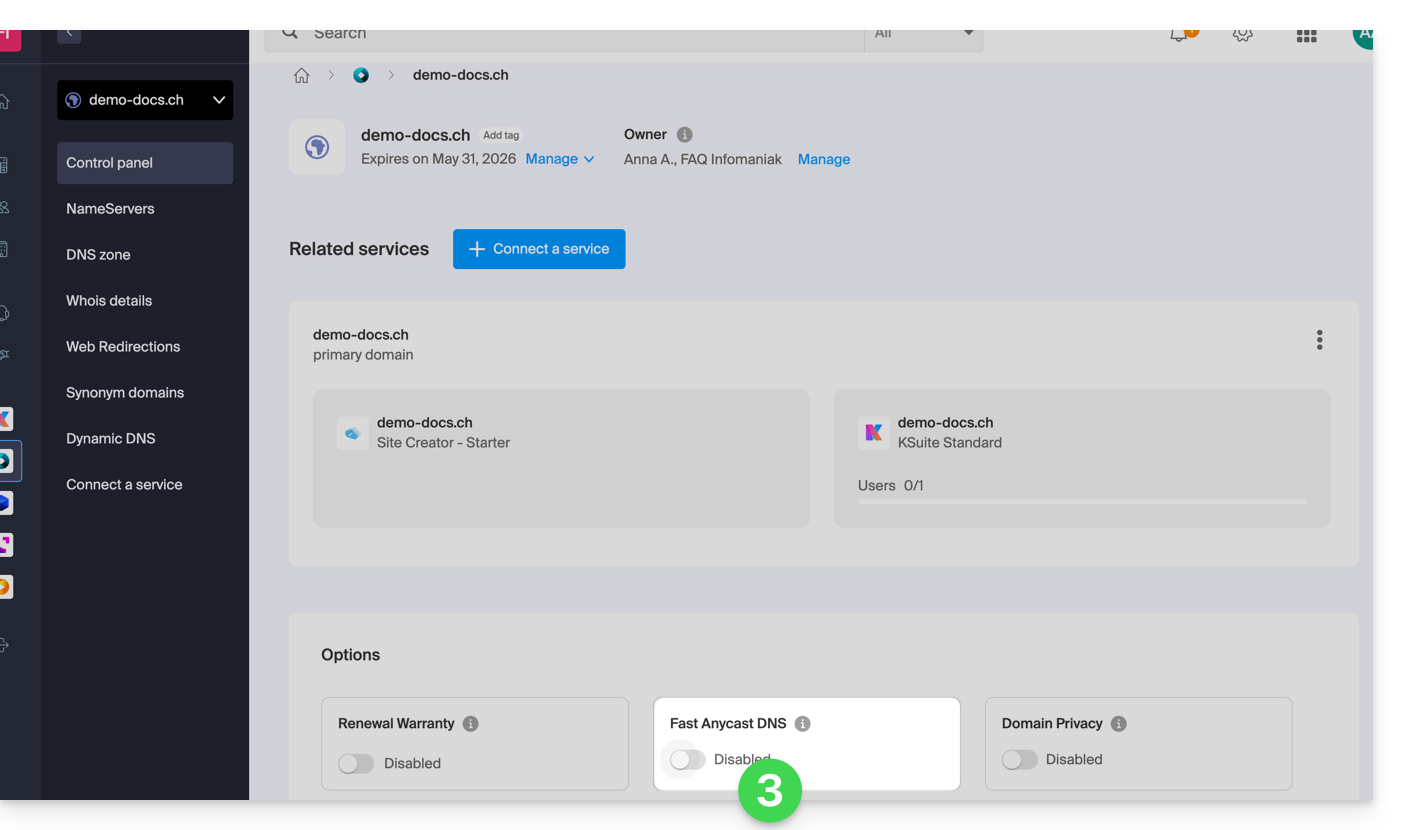
- Enable or disable the DNS Fast Anycast toggle switch on the dashboard:
POP - 'Point of Presence'
By enabling DNS Fast Anycast on your domain, your DNS records will be automatically replicated in the following points of presence:
Network 1
New York, USA (2x)
Paris, France (2x)
Warsaw, Poland (2x)
Dublin, Ireland (2x)
Singapore (2x)
Johannesburg, South Africa
Stockholm, Sweden
Vienna, Austria (2x)
Frankfurt, Germany (2x)
London, United Kingdom
Dallas, USA
Los Angeles, USA (3x)
Amsterdam, Netherlands
Sydney, Australia
São Paulo, Brazil
Miami, USA (2x)
Network 2
Hong Kong, China
San Jose, USA
Dallas, USA
Reston, USA
Chicago, USA
Seattle, USA
London, United Kingdom
Frankfurt, Germany
Amsterdam, Netherlands
Vienna, Austria
Toronto, Canada
Sydney, Australia
São Paulo, Brazil
Johannesburg, South Africa
Miami, USA
The points of presence are distributed across two networks, which are used randomly when one of your visitors accesses your website.
Link to this FAQ: https://faq.infomaniak.com/2323
Has this FAQ been helpful?
This guide explains how a domain name and a DNS zone work.
Introduction
- When you browse a website such as
https://www.abc123.xyz,abc123.xyzis the domain name. - Each domain name has DNS (Domain Name System), which indicates where the DNS zone is located (e.g., with which provider).
- The DNS zone then allows you to delegate the management of various services related to the domain name to different providers.
- For a single domain name, it is possible to delegate:
- web hosting to provider X (via an "
A" record) - and email service to provider Y (via an "
MX" record)
- web hosting to provider X (via an "
- For a single domain name, it is possible to delegate:
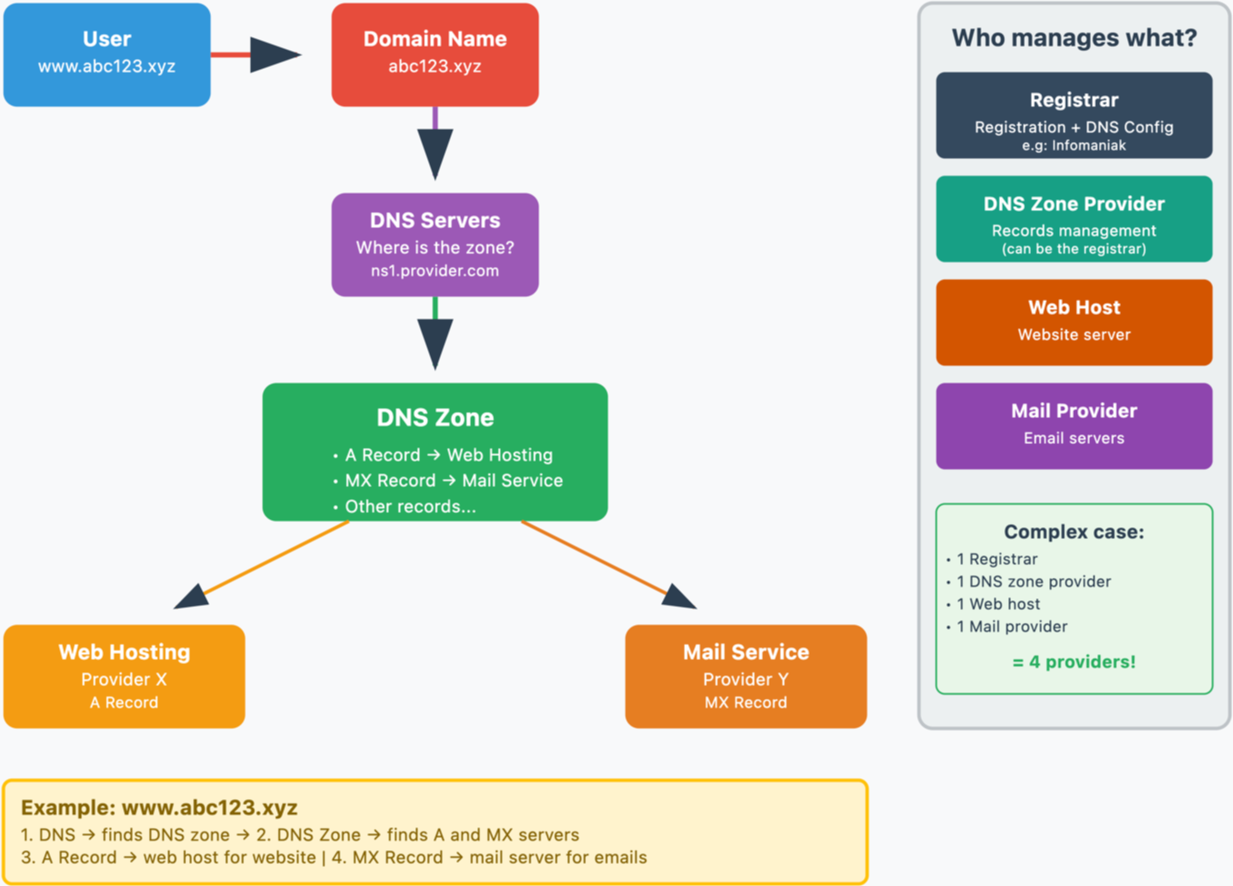
Domain name, DNS and DNS zone, then services
Who manages what?
- Each domain name is registered and managed by a registrar. For example, Infomaniak is a registrar, one of the cheapest in Switzerland.
- The DNS of a domain name is configured with the registrar that manages the domain name.
- The DNS zone can be managed by the registrar or another provider.
- Web hosting and email service can be managed by any hosting provider.
In the most complex case, it is therefore possible to have 1 different provider for the following services: domain name registration and DNS management, DNS zone management, web hosting, email service.
The following diagram summarizes these different possibilities with the involvement of different providers:
Infomaniak
As a registrar and hosting provider, Infomaniak can manage all of these services. This is the simplest solution.
- In the case of Infomaniak, the DNS servers are generally in the form nsXX.infomaniak.com and nsXX.infomaniak.com (XX being 11 or 12, for example).
- You can modify the DNS servers for your domain name, as well as modify the "internal" settings of these DNS servers, i.e., modify the DNS zone of a domain name.
And within these DNS zones, to redirect traffic to services, we distinguish:
- an MX record which allows a domain name (
domain.xyzfor example) to point to a mail server. - an A record which allows a domain name (
domain.xyzfor example) or a subdomain (example.domain.xyzfor example) to point to a web server that has a static IP address (otherwise, you would have to constantly edit the A record to enter the new IP address - see this other guide on this subject).
Possible scenarios
Examples and fictitious names
| All services are with Infomaniak | |||
|---|---|---|---|
| domain name | domain.xyz | registered with -> | Infomaniak |
| DNS of the domain name | ns1.infomaniak.com… | therefore, the DNS zone must exist with -> | Infomaniak |
| site hosted by -> | Infomaniak | therefore, the DNS zone must contain an A record | 123.45.67.8 for example |
| email hosted by -> | Infomaniak | therefore, the DNS zone must contain MX records | mx-mail.maniak for example |
| All services are with Infomaniak except email | |||
|---|---|---|---|
| domain name | domain.xyz | registered with -> | Infomaniak |
| DNS of the domain name | ns1.infomaniak.com… | therefore, the DNS zone must exist with -> | Infomaniak |
| website hosted by -> | Infomaniak | therefore, the DNS zone must contain A records | 123.45.67.8 for example |
| email hosted by -> | Medical Service | therefore, the DNS zone must contain MX records | med-mx.net for example |
| All services are with Infomaniak except the website | |||
|---|---|---|---|
| domain name | domain.xyz | registered with -> | Infomaniak |
| DNS of the domain name | ns1.infomaniak.com… | therefore, the DNS zone must exist with -> | Infomaniak |
| website hosted by -> | Clinic | therefore, the DNS zone must contain A records | 9.87.65.4 for example |
| email hosted by -> | Infomaniak | therefore, the DNS zone must contain MX records | mx-mail.maniak for example |
| All services are with Infomaniak except for the domain name | |||
|---|---|---|---|
| domain name | domain.xyz | registered with -> | GoMamie |
| Domain name DNS | ns1.infomaniak.com… | therefore the DNS zone must exist with -> | Infomaniak |
| website hosted by -> | Infomaniak | therefore the DNS zone must contain an A record | 123.45.67.8 for example |
| email hosted by -> | Infomaniak | therefore the DNS zone must contain an MX record | mx-mail.maniak for example |
| All services are with Infomaniak except for the DNS zone | |||
|---|---|---|---|
| domain name | domain.xyz | registered with -> | Infomaniak |
| Domain name DNS | ns.privateDNS.org… | therefore the DNS zone must exist with -> | Private DNS |
| website hosted by -> | Infomaniak | therefore the DNS zone must contain an A record | 123.45.67.8 for example |
| email hosted by -> | Infomaniak | therefore the DNS zone must contain an MX record | mx-mail.maniak for example |
| No service exists with Infomaniak except for the domain name | |||
|---|---|---|---|
| domain name | domain.xyz | registered with -> | Infomaniak |
| DNS of the domain name | ns.privateDNS.org… | therefore, the DNS zone must exist at -> | Private DNS |
| website hosted by -> | Clinic | therefore, the DNS zone must contain an A record | 9.87.65.4 for example |
| email hosted by -> | Medical Service | therefore, the DNS zone must contain an MX record | med-mx.net for example |
| No service exists with Infomaniak except for the DNS zone | |||
|---|---|---|---|
| domain name | domain.xyz | registered with -> | GoMamie |
| DNS of the domain name | ns1.infomaniak.com… | therefore, the DNS zone must exist at -> | Infomaniak |
| website hosted by -> | Clinic | therefore, the DNS zone must contain an A record | 9.87.65.4 for example |
| email hosted by -> | Medical Service | therefore, the DNS zone must contain an MX record | med-mx.net for example |
| No service exists with Infomaniak except for the email | |||
|---|---|---|---|
| domain name | domain.xyz | registered with -> | GoMamie |
| DNS of the domain name | ns.privateDNS.org… | therefore, the DNS zone must exist at -> | Private DNS |
| website hosted by -> | Clinic | therefore, the DNS zone must contain an A record | 9.87.65.4 for example |
| email hosted by -> | Infomaniak | therefore, the DNS zone must contain MX records | e.g., mx-mail.maniak |
etc.
Link to this FAQ: https://faq.infomaniak.com/2026
Has this FAQ been helpful?
This guide explains how to modify the DNS (Name Servers) of a domain registered with Infomaniak.
Prerequisites
- Own a domain name with Infomaniak or at least have a DNS zone.
- Understand:
- how a domain and a DNS zone work before modifying the latter.
- that any DNS addition/modification may take up to 48 hours to propagate.
DNS Modification
To modify the DNS settings of a domain name managed by Infomaniak,control the direction that web and email traffic should take:
- Click here to access your domain management in the Infomaniak Manager (need help?).
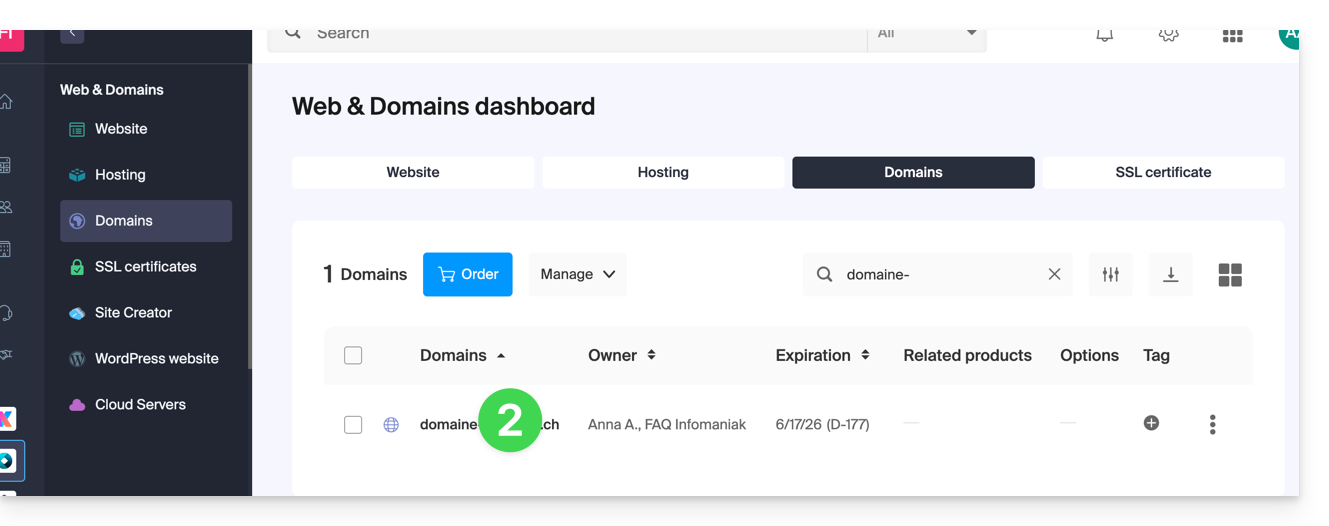
- Click directly on the name assigned to the domain in question:
- Click on DNS Servers from the left-hand menu.
- Click on the blue Edit DNS servers button:
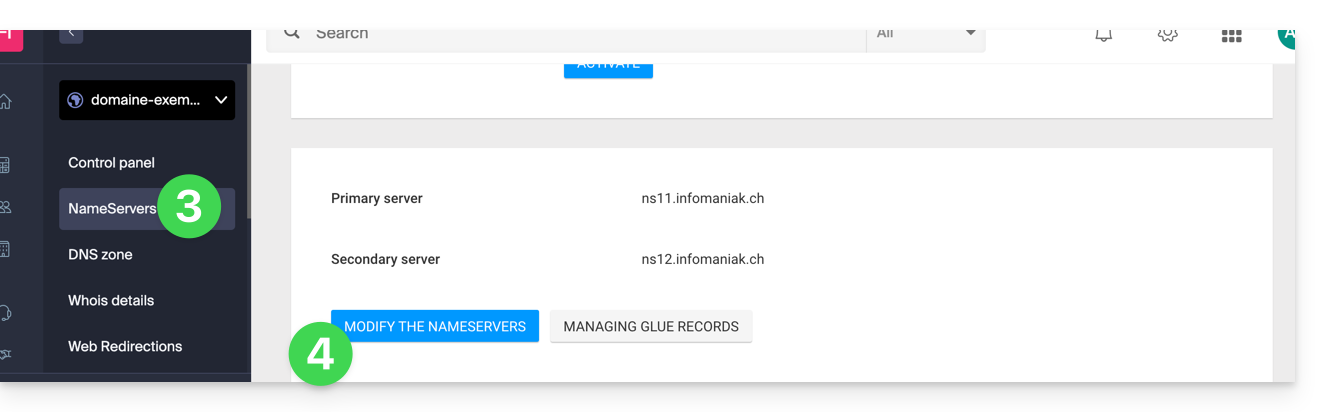
- If your website is hosted with Infomaniak, check Infomaniak name servers…
- Otherwise, check Custom name servers to enter the server names below and validate at the bottom of the page.
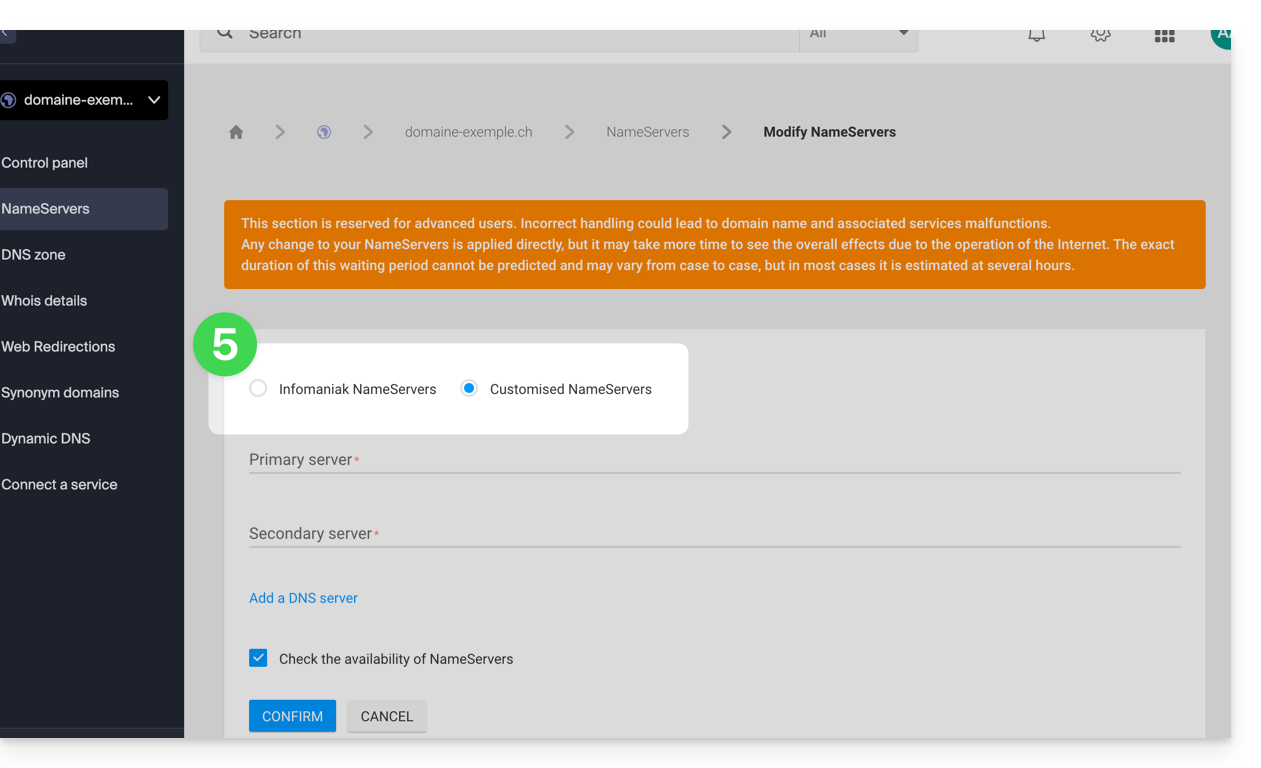
- Otherwise, check Custom name servers to enter the server names below and validate at the bottom of the page.
Batch Modification
To modify the DNS records of multiple domain names in bulk:
- Click here to access the domain management section in the Infomaniak Manager (need help?).
- Select the relevant domain names.
- Click on ⋮ at the bottom of the screen if necessary.
- Click on Edit DNS servers:
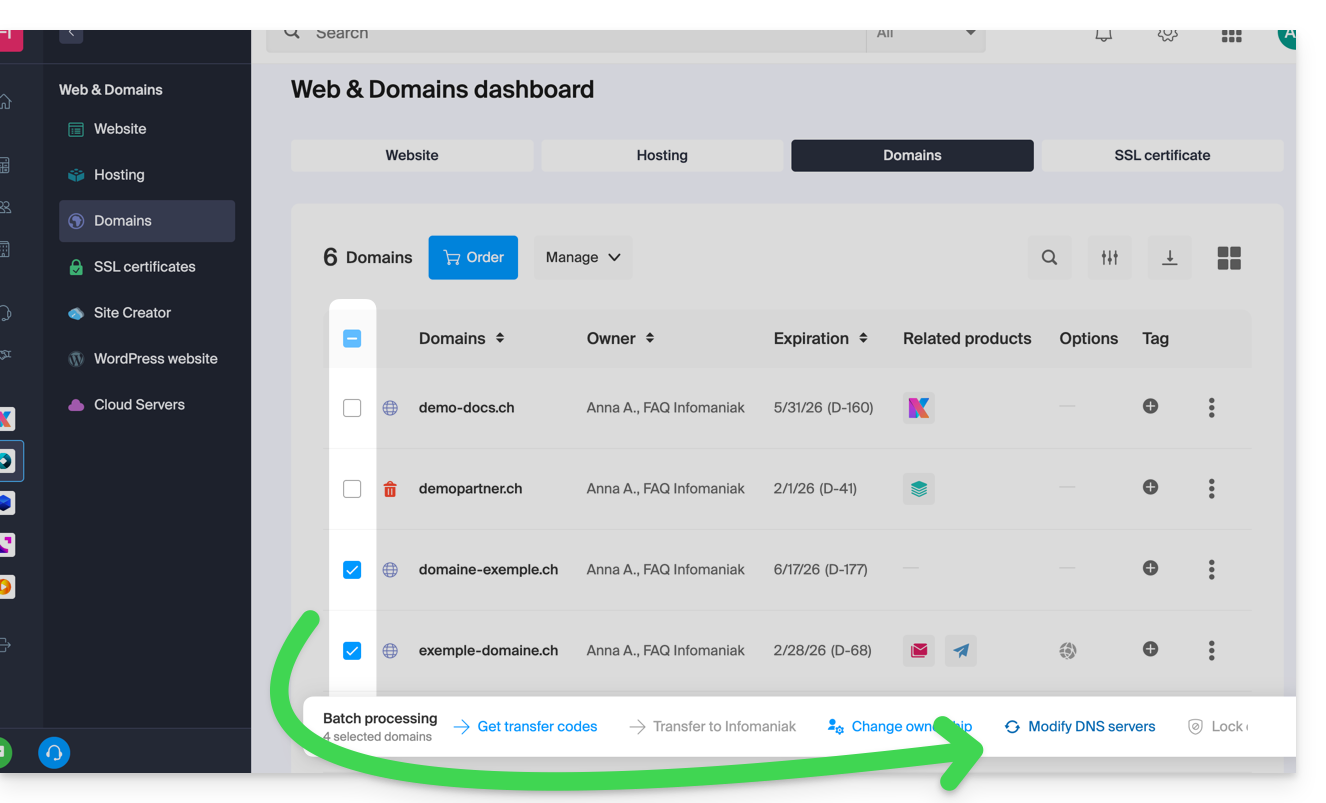
If you would prefer to modify the contents of the DNS zone and therefore change the various DNS records contained within it, please refer to this other guide.
Link to this FAQ: https://faq.infomaniak.com/1798
Has this FAQ been helpful?
This guide describes the meaning of TTL, which stands for "Time To Live," as well as the principle of DNS propagation delays, concepts that are important in the operation of domain name-related services.
Introduction
- The TTL determines how long DNS information is cached before being updated.
- This directly influences the speed at which DNS changes are propagated across servers worldwide.
- Although reducing the TTL can speed up propagation, the behavior of ISPs and their caches can introduce additional delays.
The TTL (Time to Live)
TTL (Time to Live) is a key parameter in DNS record management. It represents the duration, expressed in seconds, for which DNS information can be stored in the cache before being refreshed. When a DNS server or an Internet Service Provider (ISP) queries a DNS zone, it temporarily stores the responses obtained to reduce the load on the servers and speed up navigation for users.
For example, if the TTL is set to 24 hours (86400 seconds), the DNS information for a domain will be cached and will not be refreshed during this entire period, even if you have modified settings such as the domain's IP address. This means that DNS changes will only take effect once this period has elapsed.
You can speed up the application of changes by reducing the TTL before proceeding with updates. For example, lowering the TTL to one hour (3600 seconds) allows DNS servers to check the new information more quickly after a modification.
DNS propagation
The TTL is directly related to the DNS propagation process. DNS propagation refers to the time it takes for changes made to a DNS zone to be disseminated to all DNS servers worldwide. This delay depends not only on the configured TTL but also on how ISPs and other DNS servers manage their caches.
When you modify DNS records, DNS servers and ISPs must wait for the TTL to expire before retrieving the new information. Therefore, the shorter the TTL, the faster the changes propagate across the network. However, some ISPs sometimes ignore the TTL duration and retain the information in the cache for a longer period (e.g., 24 hours or more), which can slow down the propagation of DNS changes, even if you have configured a reduced TTL.
Link to this FAQ: https://faq.infomaniak.com/2563
Has this FAQ been helpful?
This guide explains how to order a DNS zone from Infomaniak.
Introduction
- Having your DNS zone with Infomaniak is useful if your domain name is registered elsewhere (with a third-party provider/registrar) and you want to easily link this domain to Infomaniak products.
- Indeed, simply having a
domain.xyzwebsite with Infomaniak and specifying the 2 Infomaniak DNS addresses with the domain name registrar (if it is not Infomaniak) is not enough for the website to be displayed when you typedomain.xyzin a browser. - You must add a DNS zone in the same location as your hosting to ensure your website functions correctly.
- This will also be particularly useful if the provider managing your domain name does not offer DNS zone management.
Order a DNS zone
To do this:
- Click here to access the Infomaniak domain Shop.
- Start a search with the name of the domain registered elsewhere.
- Click on the action menu ⋮ located to the right of the result.
- Select Order a DNS zone:
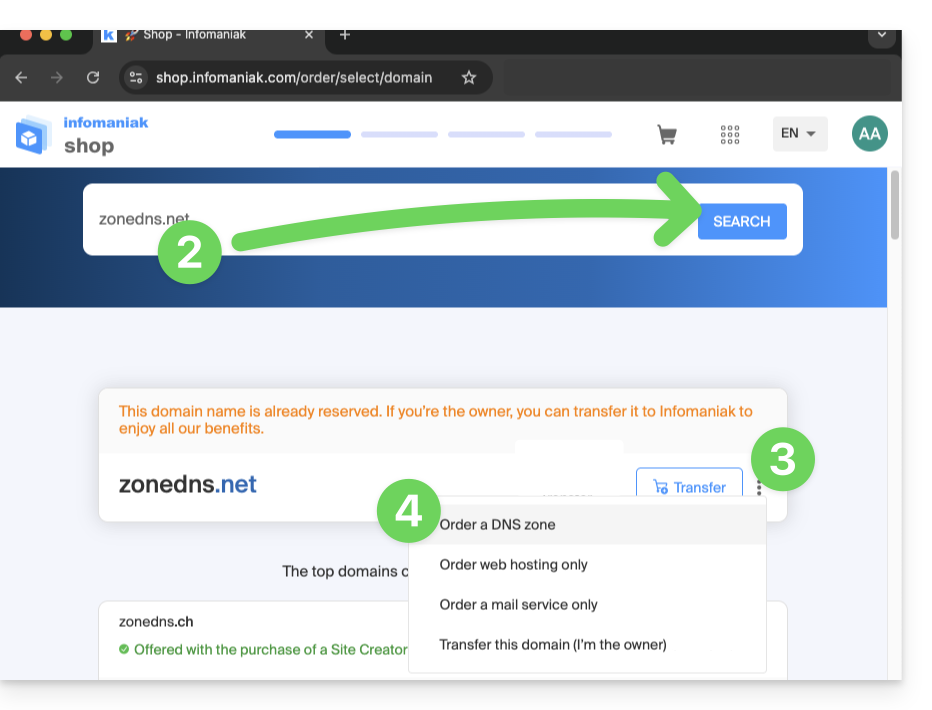
- Complete the purchase.
- Once added to your Manager, the zone can be edited.
Link to this FAQ: https://faq.infomaniak.com/1914
Has this FAQ been helpful?
This guide explains how to find and display DNS information for any domain name registered with Infomaniak (or elsewhere).
Domain with Infomaniak
To access your domain names and view the DNS servers configured:
- Click here to access your domain management in the Infomaniak Manager (need help?).
- Click directly on the name assigned to the domain in question:
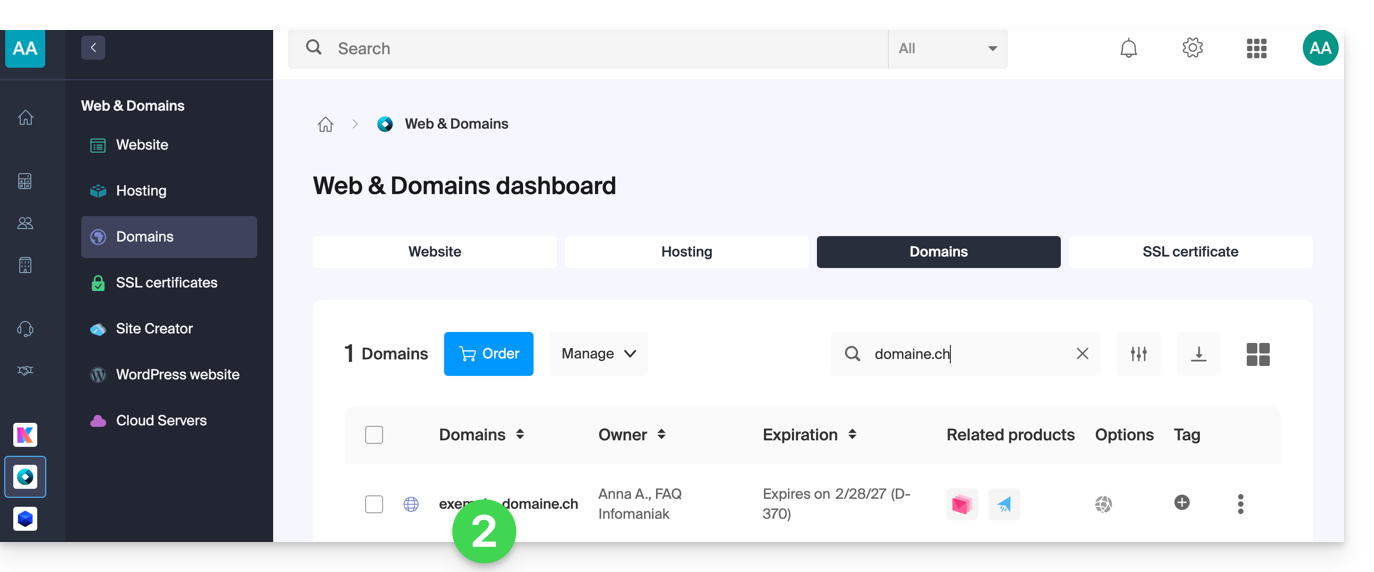
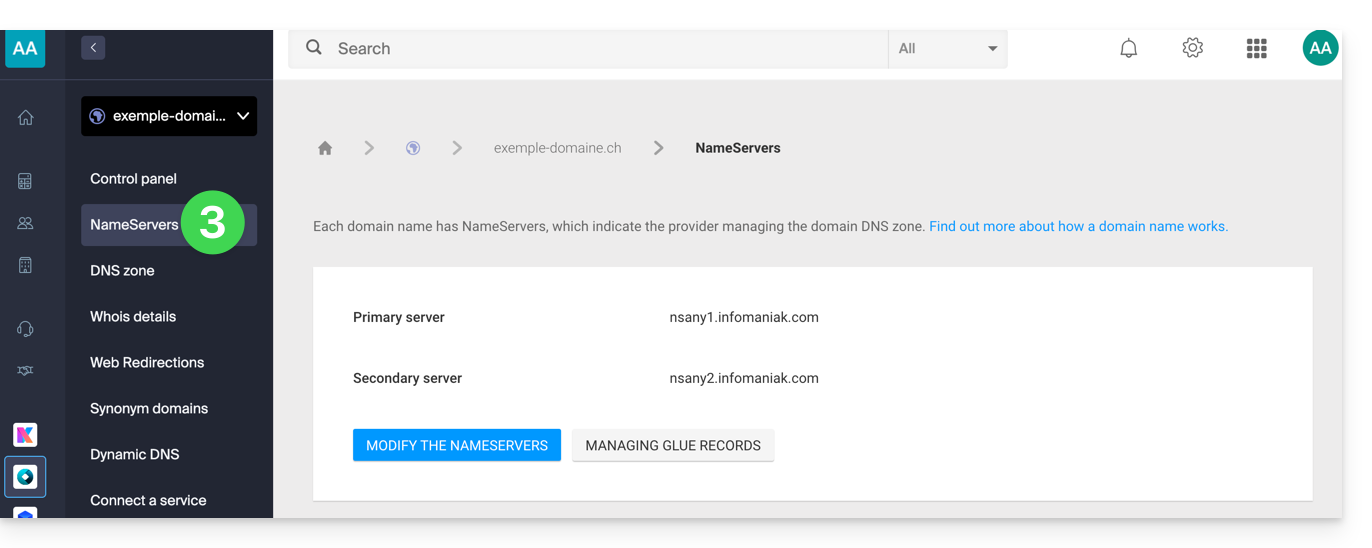
- Click on DNS Servers in the left-hand menu:
WHOIS Search
To view the DNS information of another domain name, use a WHOIS service such as https://whois.infomaniak.com/, for example, or https://who.is (be aware of the advertisements on all these third-party services).
This will provide you with a clear overview of a domain name's DNS status at a specific point in time.
DNS servers are often displayed in pairs and begin with ns..., followed by numbers and the name of the registrar or hosting provider.
Please note that the DNS records displayed may not necessarily be the ones most recently selected by the domain manager. This is because there is a propagation time that may need to be taken into account if changes are currently being made to the domain.
Link to this FAQ: https://faq.infomaniak.com/189
Has this FAQ been helpful?
This guide explains how to generate and automatically renew a wildcard certificate via a DNS challenge using Certbot and the dns-infomaniak plugin.
1. Installing the required tools
The Infomaniak DNS plugin is not included by default. To avoid the error plugin does not appear to be installed, install certbot and its extension by following the official instructions.
Make sure to select the Wildcard tab on the Certbot website after choosing your system.
2. Initial Manual Generation
Run this command to start the first certificate generation:
certbot certonly --manual \
-d *.example.com \
--preferred-challenges dns-01 \
--server {{URL_1}}
3. DNS Challenge Validation (TXT Record)
To prove that you own the domain, go to your Infomaniak Manager and create the following TXT record:
- Name:
_acme-challenge - Value: (the one provided by the Certbot command)
4. Preparing the Infomaniak API
To automate the process, generate an API token with the domain scope in your management interface. This token will allow the script to automatically update your DNS.
5. Authentication script (infomaniak-auth.sh)
Create the /root/infomaniak-auth.sh file. This script will be called by Certbot during renewal:
#!/bin/bash
# API Token for Infomaniak
INFOMANIAK_API_TOKEN="YOUR_API_TOKEN_HERE"
# Update DNS record via Infomaniak API plugin
/usr/bin/certbot \
  --authenticator dns-infomaniak \
  --server {{URL_5}} \
  -d "$CERTBOT_DOMAIN" \
  --agree-tos
Make the script executable:
chmod +x /root/infomaniak-auth.sh
6. Cleanup script (infomaniak-clean.sh)
Create the /root/infomaniak-clean.sh file to complete the procedure:
#!/bin/bash
# Optional: Cleanup operations after challenge
exit 0
Make the script executable:
chmod +x /root/infomaniak-clean.sh
7. Configuring automatic renewal
Edit or create the following configuration file: /etc/letsencrypt/renewal/example.com.conf.
cert = /etc/letsencrypt/live/example.com/cert.pem
privkey = /etc/letsencrypt/live/example.com/privkey.pem
chain = /etc/letsencrypt/live/example.com/chain.pem
fullchain = /etc/letsencrypt/live/example.com/fullchain.pem
[renewalparams]
authenticator = manual
manual_auth_hook = /root/infomaniak-auth.sh
manual_cleanup_hook = /root/infomaniak-clean.sh
server = {{URL_6}}
pref_challs = dns-01
account = YOUR_ACCOUNT_ID
key_type = rsa
8. Testing and Automation (Cron)
Before automating, verify that everything is working correctly with a simulation:
certbot renew --dry-runIf the test is successful, add this Cron task to check for renewal every X days:
0 0 */30 * * /usr/bin/certbot renew --quiet --config /etc/letsencrypt/renewal/example.com.confModify 30 days above according to the desired frequency. The cron will automatically use:
- the
domain.tld.conffile - the
infomaniak-auth.shauthentication script - the
dns-infomaniakplugin
Link to this FAQ: https://faq.infomaniak.com/1708
Has this FAQ been helpful?
This guide presents the Domain Status tool, which allows you to verify the relationships between…
- DOMAIN NAME at Infomaniak
and - WEB HOSTING with Infomaniak
… are correct, so that Web traffic is directed to the right place.
✘ UNAVAILABLE with a
website of type node.js
Introduction
- To verify, the tool checks the
A,CNAMErecords, etc. - This allows you to detect and correct certain web-related issues, especially if they are linked to DNS (technical information that essentially determines where specific web traffic should be directed) by taking action at the domain level.
- Automatic correction is only possible if the domain name is present in the same Organization as the product to which it must be linked.
- If this is not the case, then the correction must be done manually.
Troubleshooting DNS issues
To access the DNS diagnostic for your domain name:
- Click here to access your product management interface in the Infomaniak Manager (need help?).
- Click directly on the name assigned to the product in question.
- Click on Web in the left-hand menu (or on the notification, if any, to go directly to step 6):
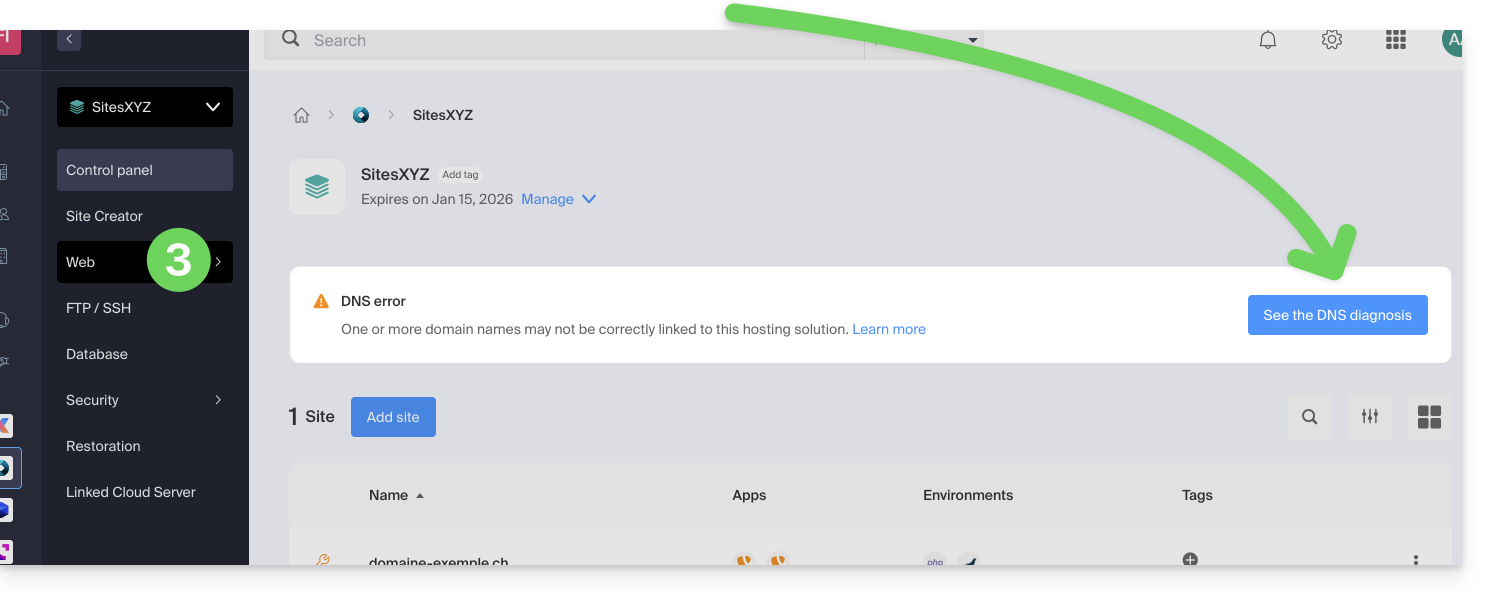
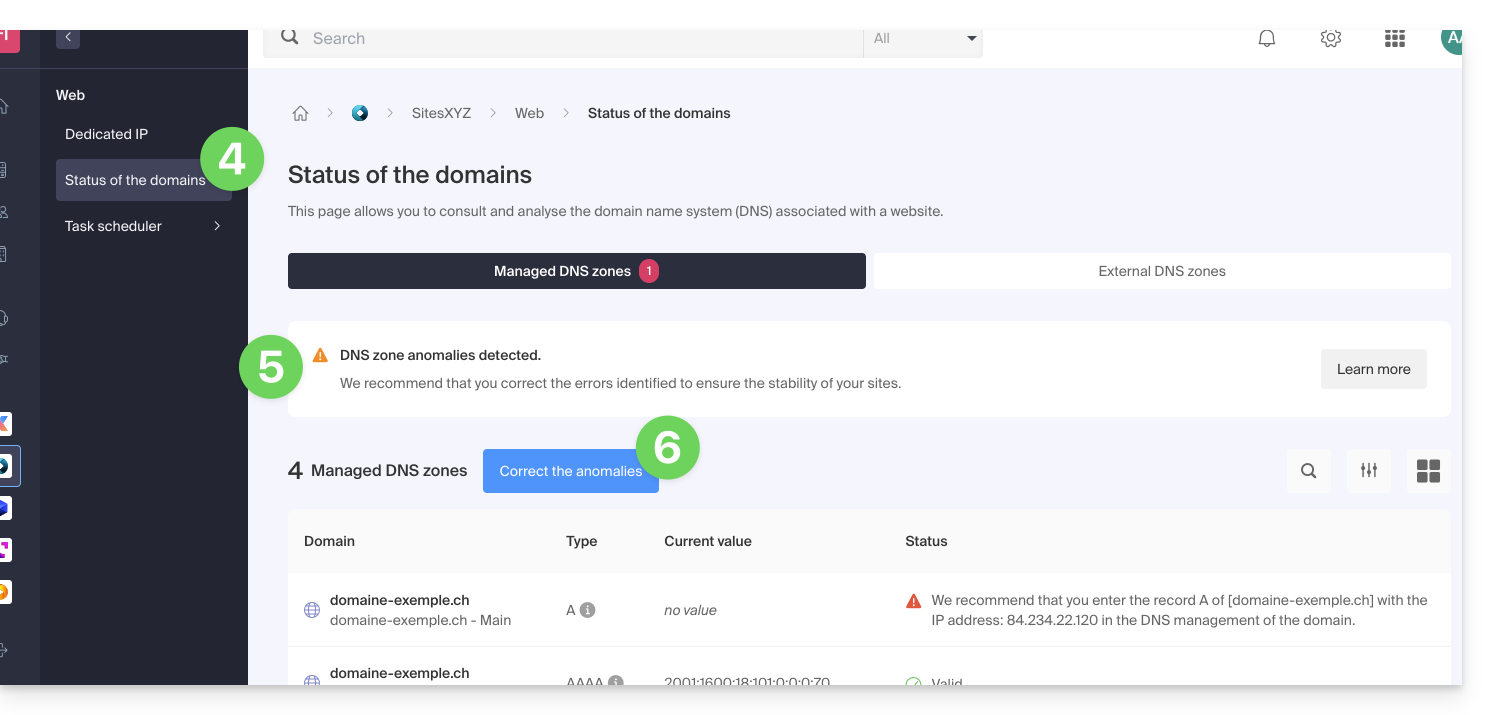
- Click on Domain Status in the left-hand menu.
- If any DNS issues are detected, they will be indicated in the table.
- Correct all errors at once by clicking on the button:
Refer to this other guide about the same automatic verification process, but for Mail Services.
Link to this FAQ: https://faq.infomaniak.com/2251
Has this FAQ been helpful?
This guide explains how to add, modify, or delete specific entries (records of type A & AAAA, MX, TXT, etc.) within the DNS zone of a domain registered with Infomaniak.
Prerequisites
- Own a domain name with Infomaniak or at least have a DNS zone.
- Understand:
- how a domain and a DNS zone work before modifying the latter.
- that the DNS zone presented here is valid and used only if the name servers are those of Infomaniak.
- that any DNS addition/modification may take up to 48 hours to propagate.
Add a record (simple mode)
To configure the services associated with the domain and enable the correct resolution of domain names to the corresponding resources (such as external websites, third-party mail servers, etc.):
- Click here to access your domain management in the Infomaniak Manager (need help?).
- Click directly on the name assigned to the domain in question.
- Click on DNS Zone in the left-hand menu.
- The currently configured entries are listed in the Simple Mode table.
- Click on the blue Add entry button:
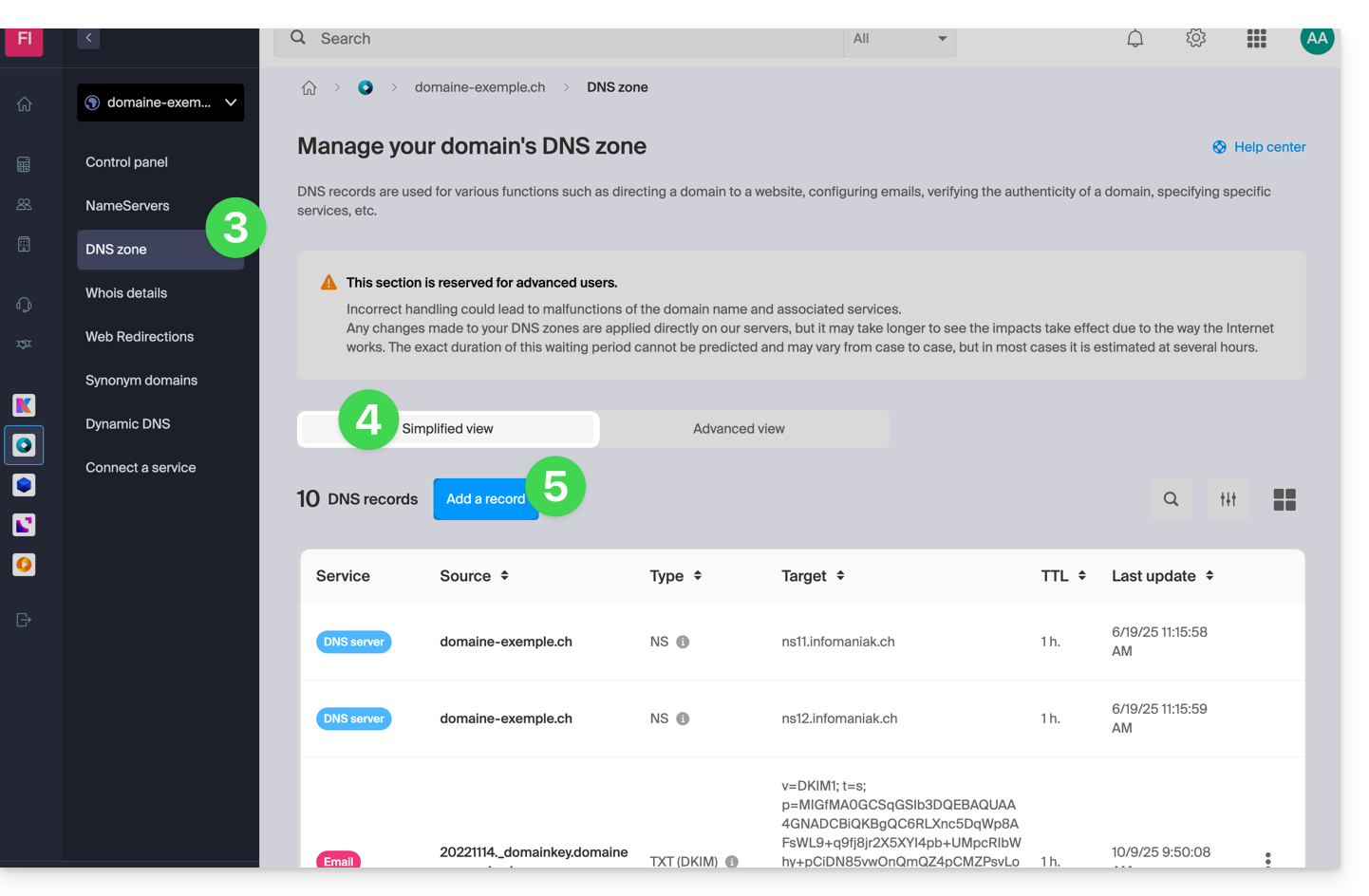
- Choose the desired record type (records of type A & AAAA, MX, TXT, etc.)
- Click on Next:
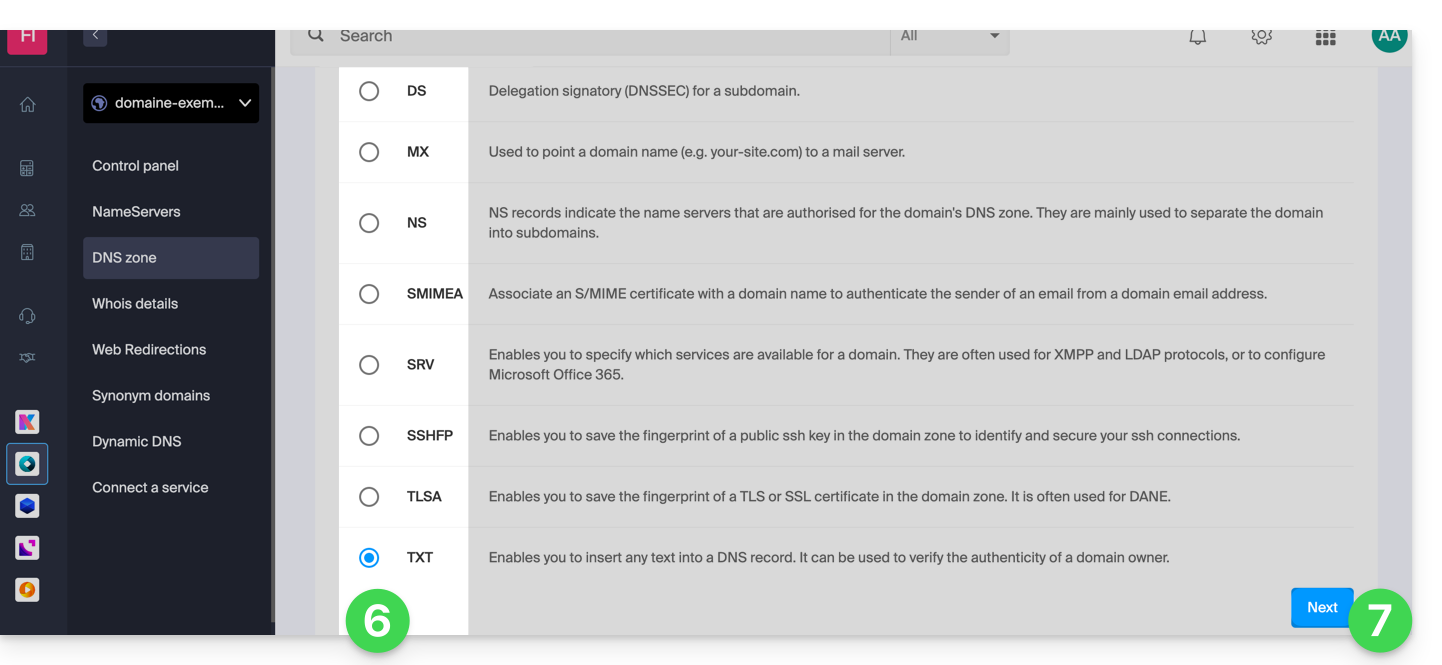
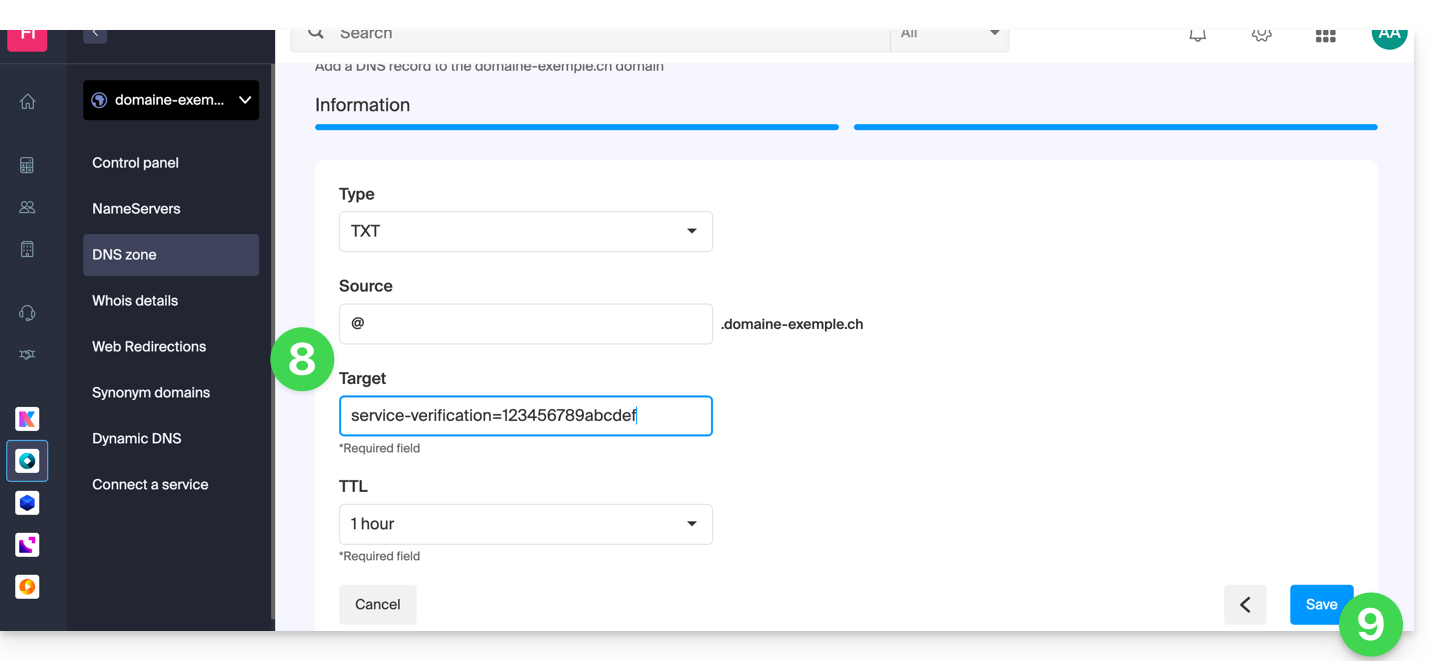
- Fill in the various fields according to your information:
- Under Source, leave the field blank or enter the relevant subdomain, if applicable.
- Under Target, enter the information obtained from your external provider or any other useful information.
- Leave the TTL as indicated.
- Save the changes you made:
Edit an existing record
To modify an existing DNS record:
- Follow steps 1 to 4 above.
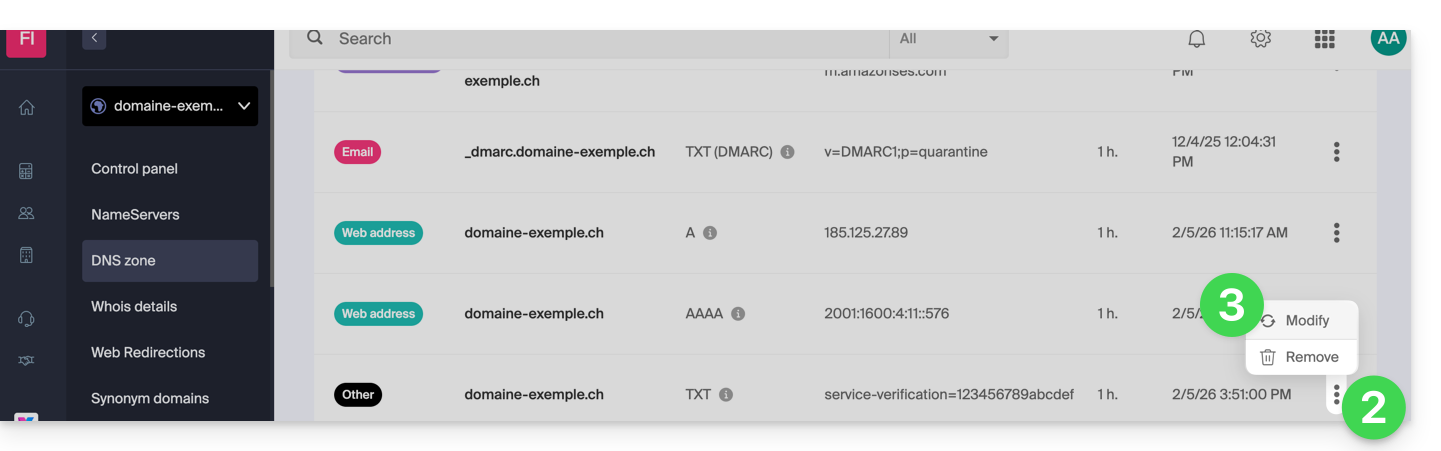
- Click on the action menu ⋮ to the right of the entry you want to modify.
- Click on Edit to access the editing page:
- Edit the desired information and then save your changes.
Delete an existing record
To delete an existing DNS record:
- Follow steps 1 to 4 above.
- Click on the action menu ⋮ to the right of the entry you want to modify.
- Click on Delete and confirm the deletion:
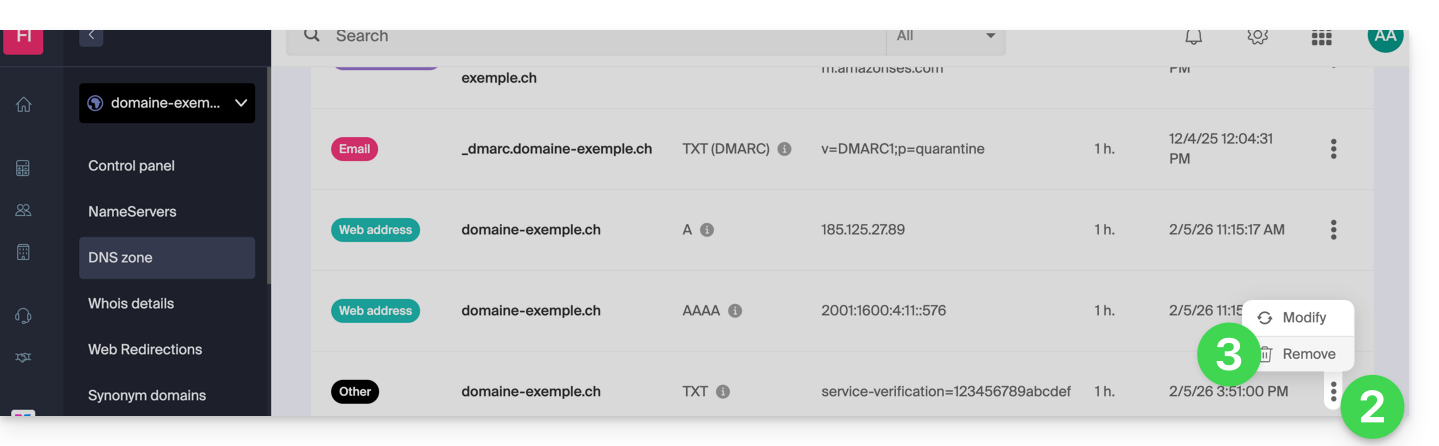
DNS Diagnostics
A tool available in your Manager allows you to easily correct certain problematic records. You can also use an external, free service like the one mentioned at the bottom of this other guide.
Expert mode
To edit the DNS zone in advanced (expert) mode, which allows you to restore a previous version of the various records, please refer to this other guide.
Link to this FAQ: https://faq.infomaniak.com/2000
Has this FAQ been helpful?
This guide presents the DNS Diagnostic tool, which allows you to verify the relationships between…
- DOMAIN NAME at Infomaniak
and - MAIL SERVICE with Infomaniak
… are correct, so that Mail traffic is directed to the right place.
Introduction
- To verify, the tool checks the MX records, SPF, etc.
- This allows you to detect and correct certain Mail issues, particularly if they are related to DNS (technical information that essentially determines where certain Mail traffic should be directed) by taking action at the domain level.
- Automatic correction is only possible when the domain name is present in the same Organization as the product to which it should be linked.
- If this is not the case, then the correction will have to be done manually.
Troubleshooting DNS issues
To access the DNS diagnostics for your domain name:
- Click here to access the management of your Mail Service in the Infomaniak Manager (need help?).
- Click directly on the name assigned to the product in question:
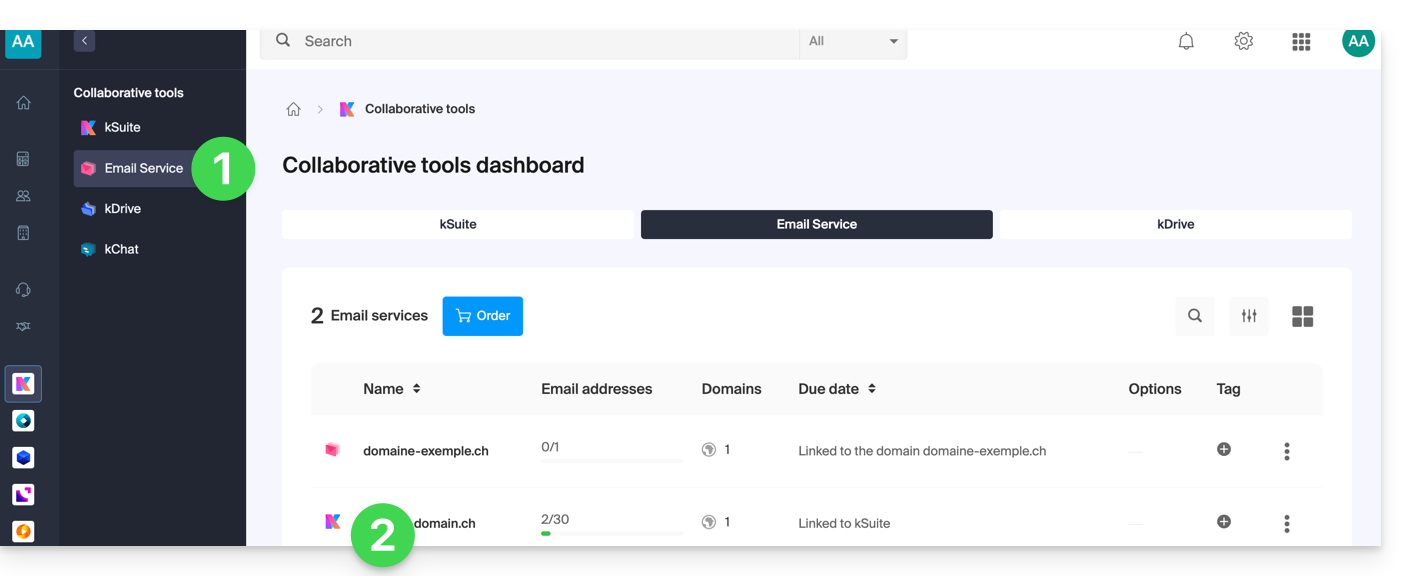
- Click on Domain Management in the left-hand menu:
- Click on DNS Diagnostics in the left-hand menu.
- Click the button if necessary to refresh the information, which should then be displayed in green.
- If DNS issues are detected, a red display in the table indicates this:
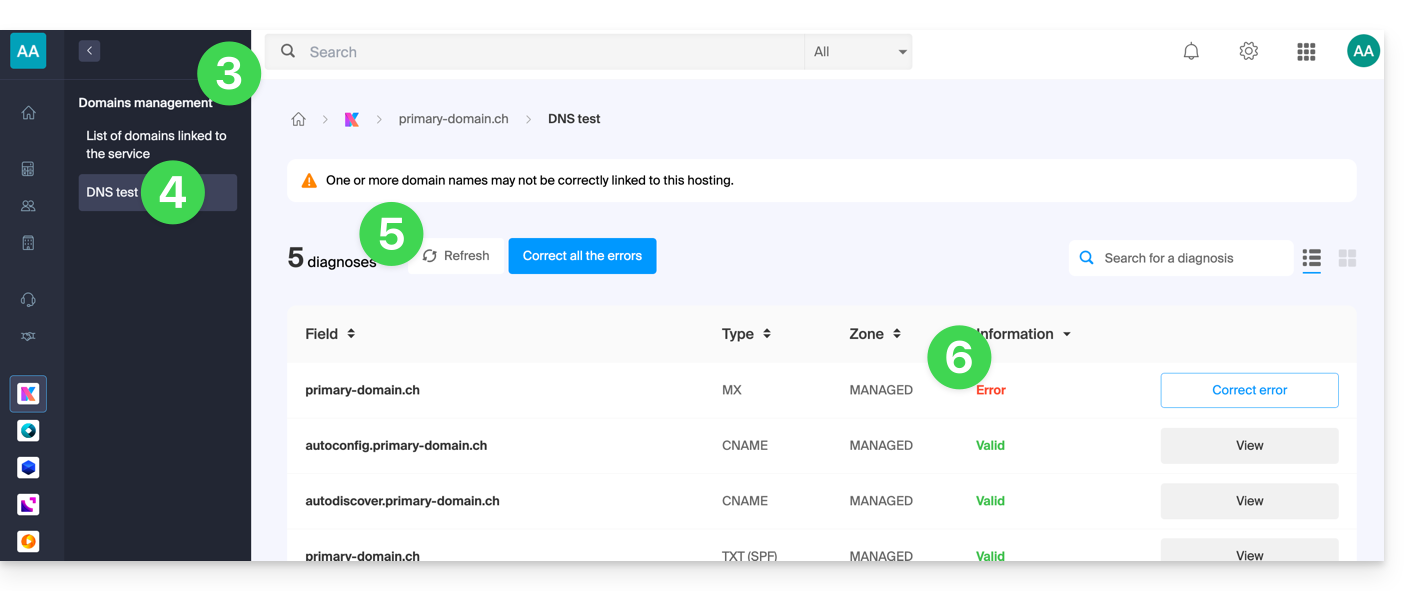
- Correct each error individually by clicking the button to the right of the item in question…
- … or correct all errors at once using the button above the table.
Refer to this other guide regarding the same automatic verification process, but for Web Hosting.
And if necessary, consult the security diagnostic related to email.
Link to this FAQ: https://faq.infomaniak.com/2124
Has this FAQ been helpful?
This guide explains how to modify specific entries (records of type A & AAAA, MX, TXT, etc.) in advanced (expert) mode within the DNS zone of a domain registered with Infomaniak.
If you are a beginner, prefer the simple mode.
Prerequisites
- You must own a domain name with Infomaniak or at least a DNS zone.
- You must understand:
- the operation of a domain and a DNS zone before modifying it…
- that the DNS zone presented here is valid and used only if the name server is that of Infomaniak…
- that any DNS addition/modification may take up to 48 hours to propagate.
Modify an existing record
To configure the services associated with the domain and enable the proper resolution of domain names to the corresponding resources (such as external websites, third-party email servers, etc.):
- Click here to access the management of your domain in the Infomaniak Manager (need help?).
- Click directly on the name assigned to the domain in question:
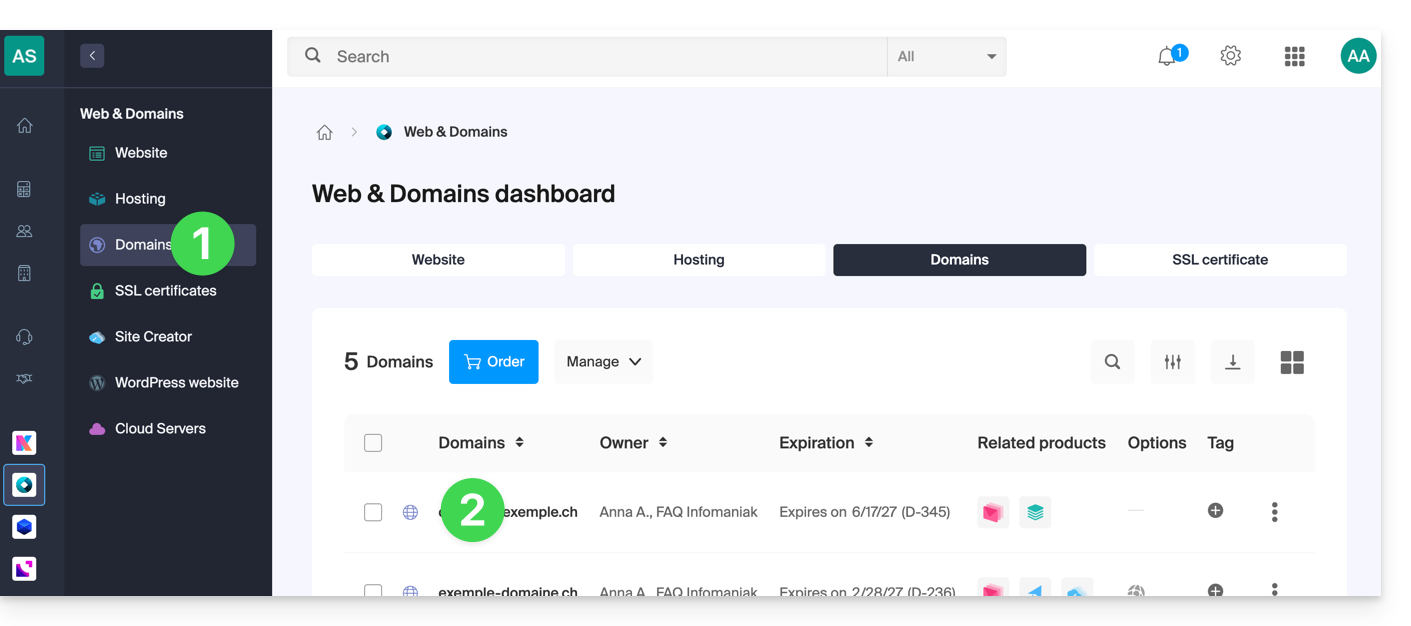
- Click on DNS Zone in the left-hand menu.
- Click on Advanced View:
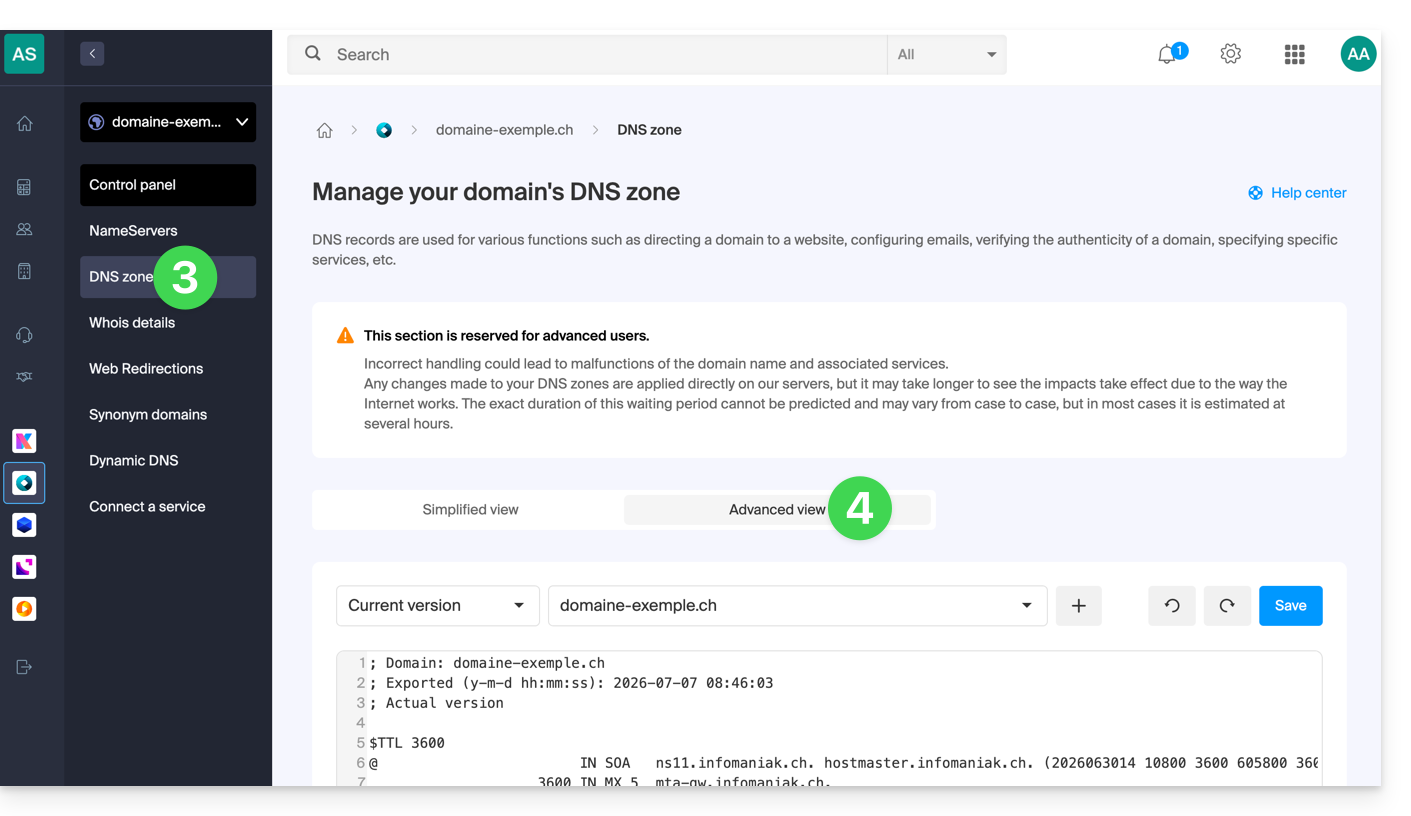
- Proceed with editing the desired information.
- The syntax is accepted in BIND format.
- Save your changes:
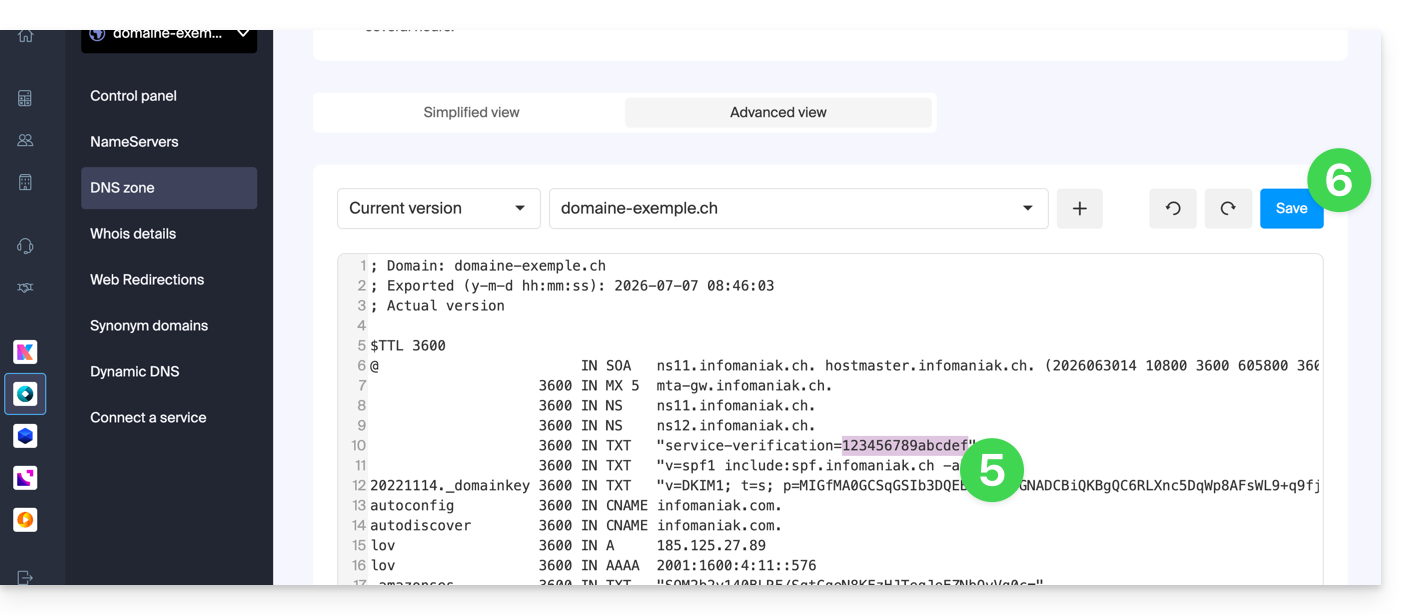
Restore a DNS zone
Thanks to Expert mode, you can use versioning to find a previous version of your domain name's DNS zone and restore it to how it was at a specific point in time:
- Once in the Advanced View tab (see above), click on Current Version to display the menu containing previous dates.
- Click on the desired date to get a preview of the changes.
- Click on the blue Save button on the right to revert to the chosen version:
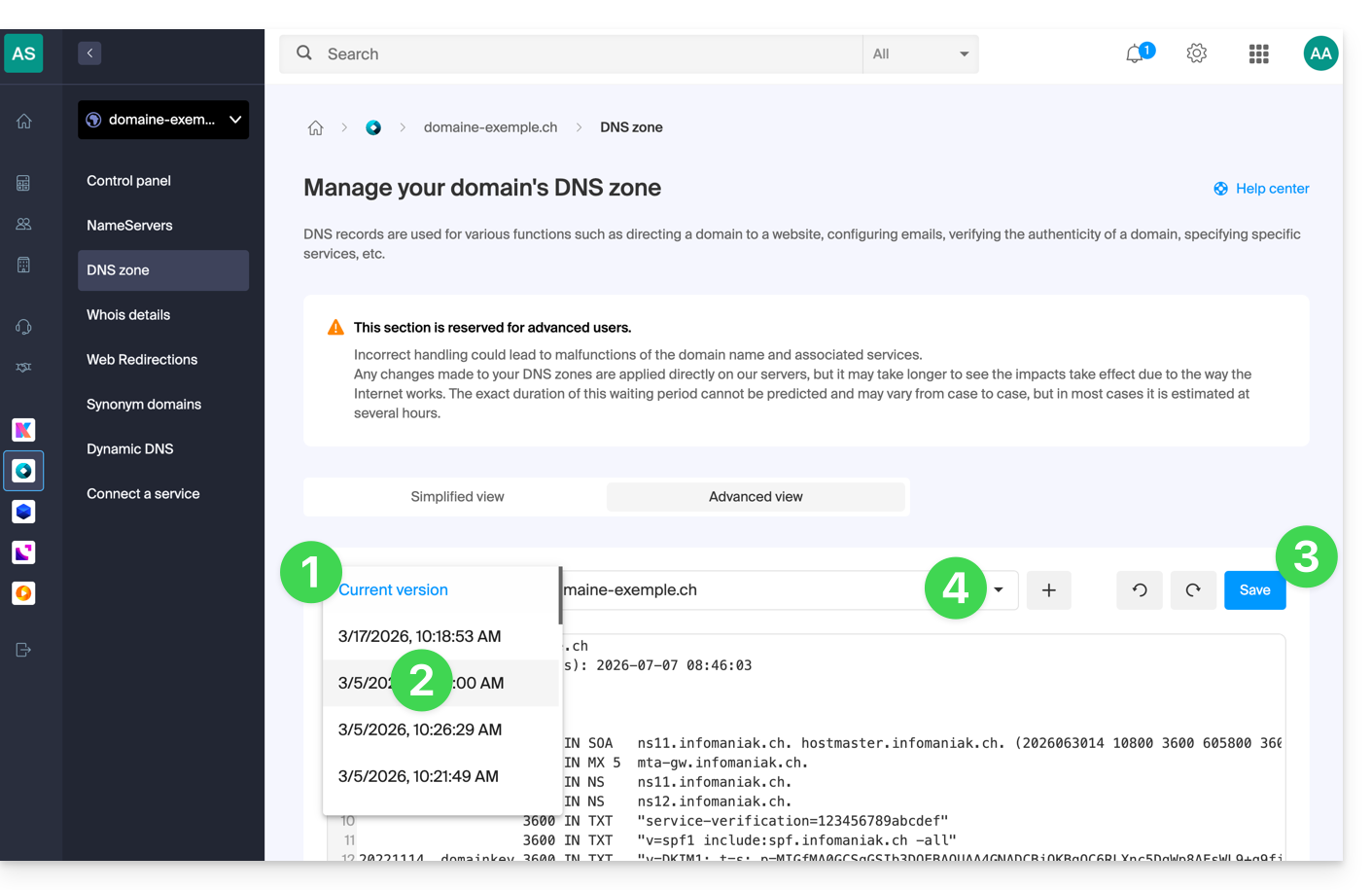
- Click on the second drop-down menu if necessary to access the restoration of the configuration of delegated subdomains.
DNS Diagnostics
A tool available in your Manager allows you to easily correct certain problematic records.
Link to this FAQ: https://faq.infomaniak.com/2051
Has this FAQ been helpful?
This guide explains how to obtain the EPP code for your domain name at Squarespace (formerly Google Domains) so that you can transfer it to Infomaniak and set up this Dynamic DNS (DDNS) service free of charge.
Introduction
- Between 2023 and 2024, all domains registered with Google Domains were transferred to Squarespace, which no longer offers DDNS (Dynamic DNS).
- The terms "
EPP", "AuthCode", "AuthInfo", "transfer code", and "authorization code" all refer to alphanumeric sequences specific to the domain, the main purpose of which is to verify the owner's authorization before a transfer between Registrars. - Consult the main guide for the rest of the transfer procedure.
- ⚠️ This involves transferring a domain name that you own with a different provider than Infomaniak, so that the future management of this domain is handled by Infomaniak; therefore, this is not an internal transfer from one account holder to another, and the code you need to obtain is not a code for an internal transfer to your current provider.
Transfer your domain name to Infomaniak
To obtain the authorization code from your current provider:
- Click here to log in to the management interface for your products at your current Registrar.
- Refer to the complete procedure provided by Squarespace to obtain the code and keep it in a safe place.
- Once you have obtained the authorization code, consult the main Infomaniak guide regarding the rest of the domain name transfer procedure.
- Once the domain has been transferred to Infomaniak, consult this Infomaniak guide to recreate the Dynamic DNS you had with Google, if necessary.
Link to this FAQ: https://faq.infomaniak.com/2416
Has this FAQ been helpful?
This guide explains how to configure DNSSEC with Cloudflare for a domain registered with Infomaniak.
Prerequisites
- The domain's DNS zone must be managed by Cloudflare.
Configure DNSSEC in Cloudflare
To do this:
- Click here to access the Cloudflare console.
- Go to the DNS tab.
- Click on Enable DNSSEC.
- Keep the information you obtained handy:
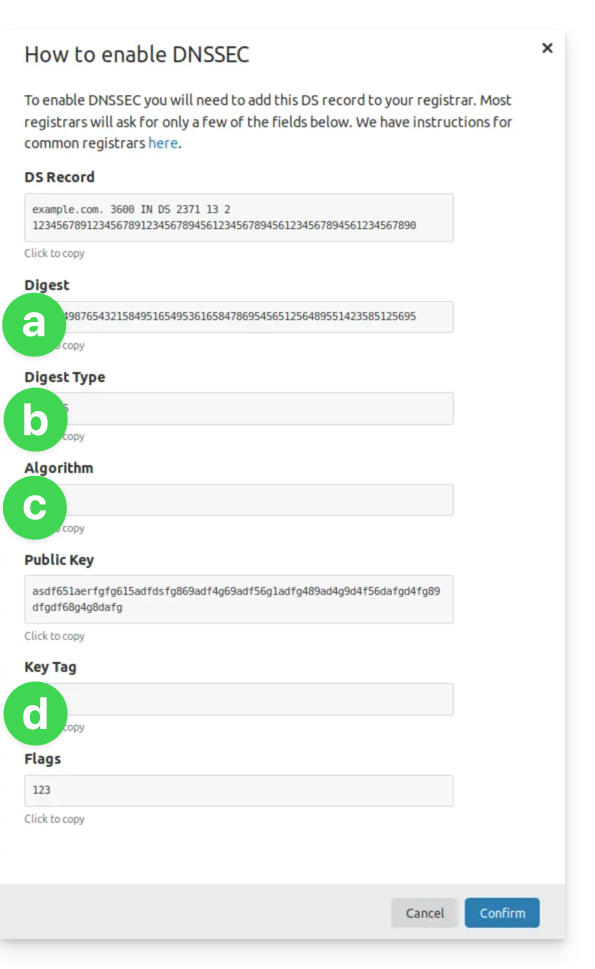
(see points 8 & 10 below)- The information under a will go under HASH
- The information under b will go under HASH TYPE
- The information under c will go under ALGORITHM
- The information under d will go under KEY
- Click here to access your domain management on the Infomaniak Manager.
- Click directly on the name assigned to the domain in question.
- Activate DNSSEC from the Dashboard:
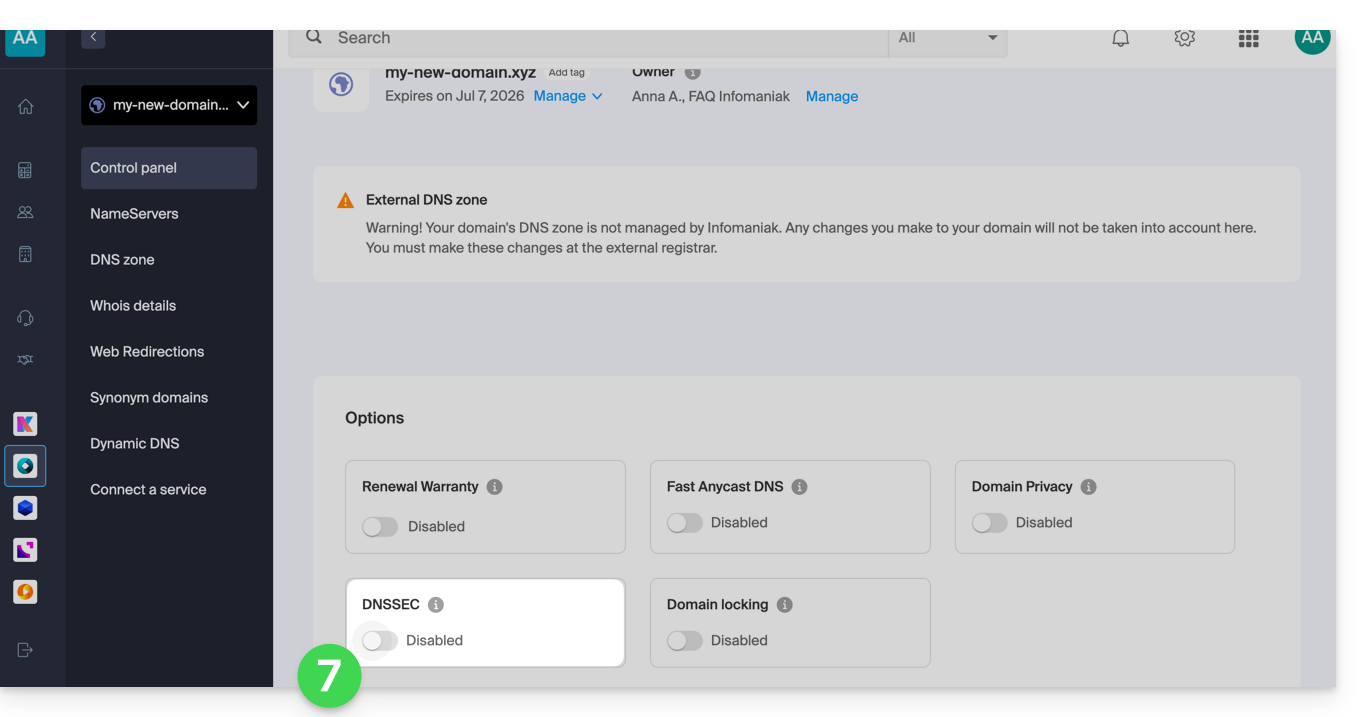
- In the window that appears, enter the requested information using the data provided by Cloudflare (see point 4 above):
- Hash = Digest
- Hash Type = Digest Type
- Algorithm = Algorithm
- Key = Key Tag
- Click on Activate:
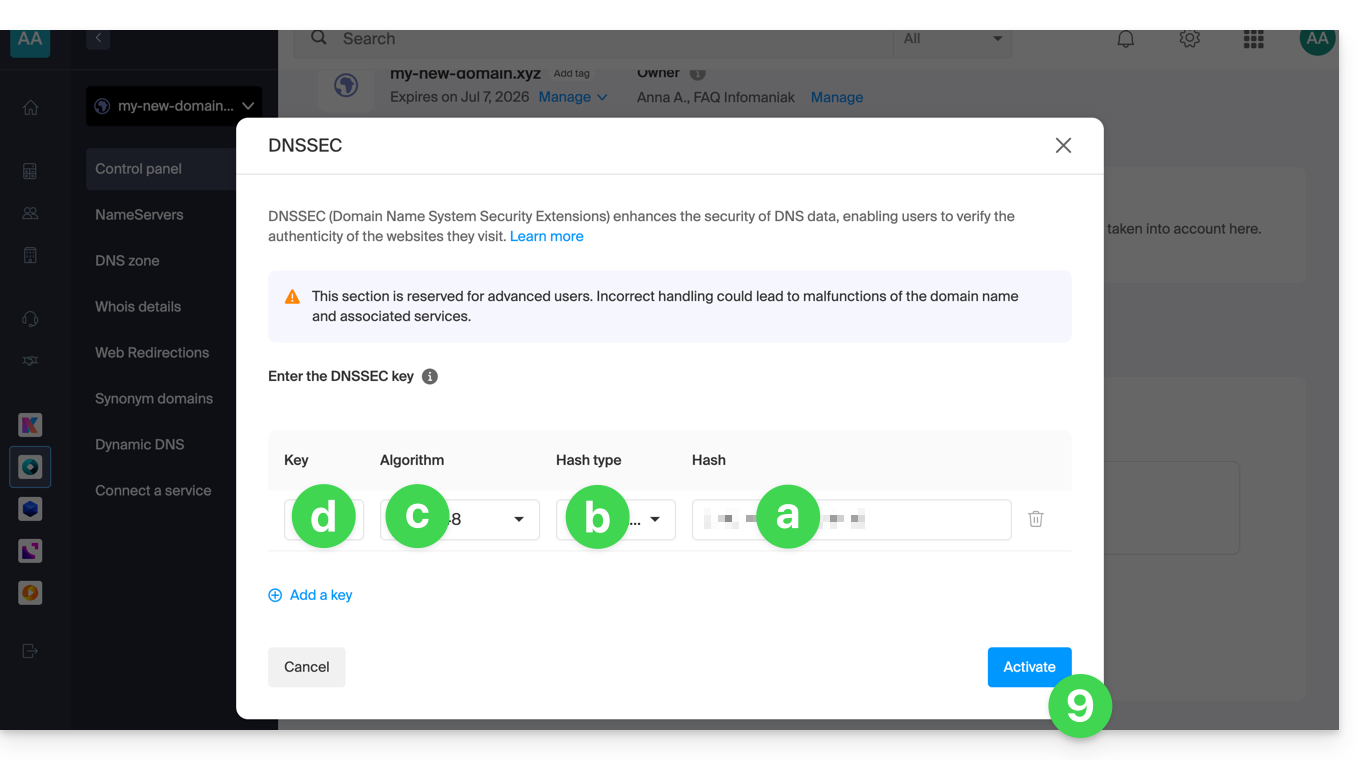
- In the case of a domain with an extension
.eu, the required information may be significantly different (see point 4 above):- The information under FLAGS should be entered under FLAGS
- The information under PUBLIC KEY should be entered under PUBLIC KEY
Link to this FAQ: https://faq.infomaniak.com/2187
Has this FAQ been helpful?
This guide explains what DNSSEC is and how this protection enhances the security of Domains at Infomaniak and the traffic they generate.
Introduction
- Each URL corresponds to an IP address, and when an internet user enters the URL of your site into their web browser, they access a DNS server whose role is to redirect them to the IP address that corresponds to the domain entered (technically, this is called DNS resolution).
- When DNSSEC is not enabled on your domain name, a malicious person could detect a flaw in a DNS server and modify the correspondence between your domain name and the IP address of your site to the IP address of their choice. In such a case, the internet user who enters the URL of your site would then be redirected to another website that does not correspond to the content of your website.
- DNSSEC secures the authenticity of the response provided by the DNS server, thus guaranteeing that internet users are accessing the website they actually intend to visit.If a hacker were to attempt to modify the IP address of your domain name in a DNS server protected by DNSSEC during resolution, the latter would reject their requests because they would not be authenticated.
- DNSSEC is therefore an additional security measure for a website's SSL certificate, ensuring that the user is directed to the website corresponding to the entered URL, and the SSL certificate then encrypts the communication between the user's web browser and the website's web server.
Enable or disable DNSSEC
To find out about the availability of DNSSEC for a specific domain, please refer to the specifications of the extensions that concern you on this page (under Frequently Asked Questions by clicking on the relevant extension first).
DNSSEC is available and already enabled upon purchase for the vast majority of domain name extensions.
If necessary, DNSSEC can be activated in a few clicks for fully managed domain names at Infomaniak:
- Click here to access the management of your product on the Infomaniak Manager (need help?).
- Click directly on the name assigned to the product in question.
- Enable or disable DNSSEC from the domain's Dashboard:
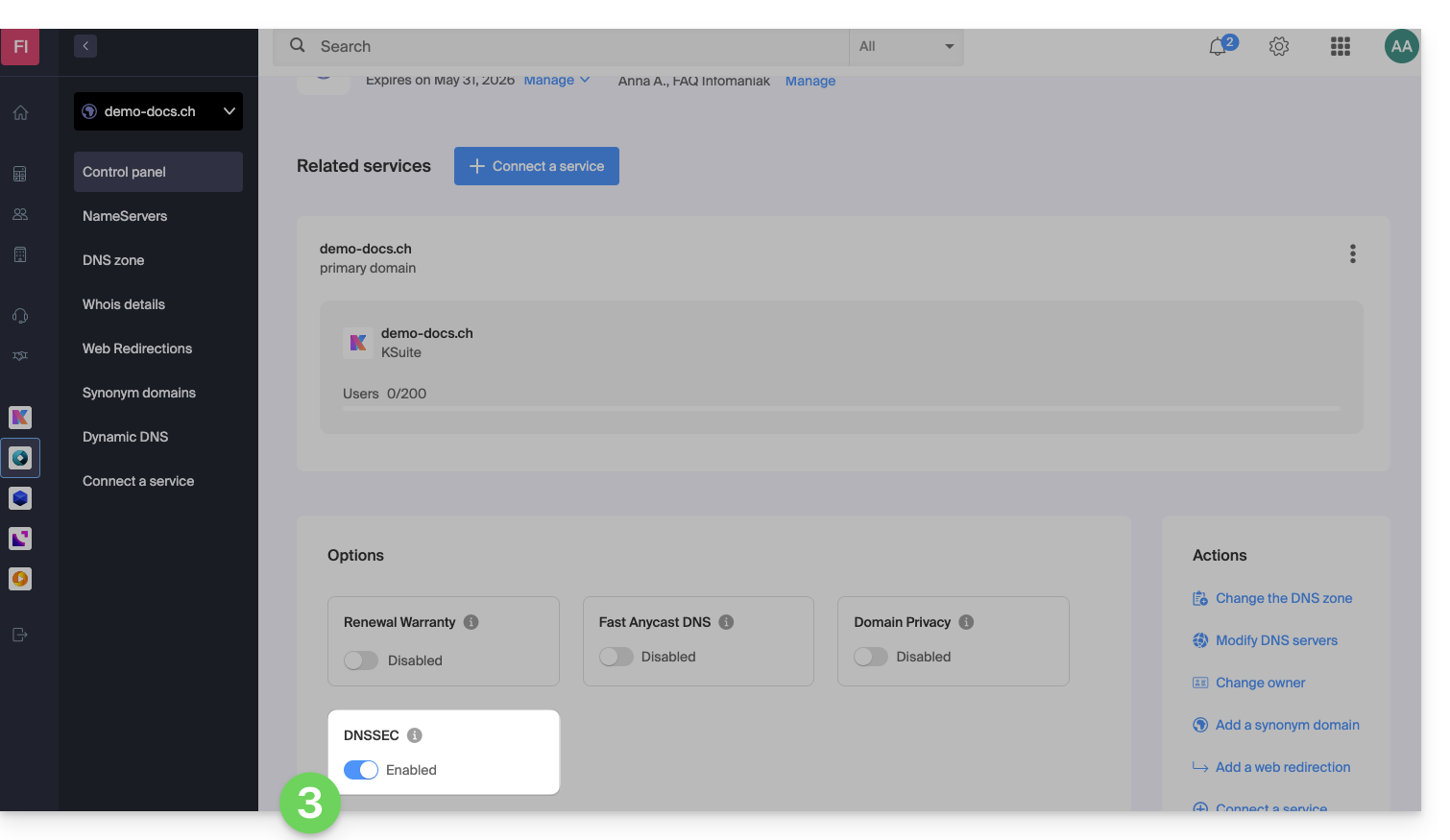
If the DNS zone for your domain is managed by another registrar, you will need to provide technical information provided by that registrar.If the information provided is incorrect, your domain name will no longer be accessible.. Therefore, it is recommended to transfer the complete management of your domain to Infomaniakbefore enabling DNSSEC if you are not familiar with these operations.
Check if DNSSEC is enabled
DNSSEC propagation to the registry may take several hours to complete.
Enter the domain name to check on this analysis site.
Specific guide
Link to this FAQ: https://faq.infomaniak.com/2208
Has this FAQ been helpful?
This guide summarizes the key steps for transferring a domain name to Infomaniak and directs you to the specific instructions for your current provider.
Introduction
- Make sure the domain has been created or transferred more than 60 days ago.
- Ensure you have access to the email address associated with the domain's administrative contact.
- Note and save your current DNS records if your hosting (websites, emails) remains temporarily with a third party.
- Retrieve the authorization code (
AuthCode/EPP- see below) and ensure that transfer protection is disabled with your current provider.
1. Obtain the authorization code according to your registrar
Select your current registrar from the list below to view the step-by-step procedure for obtaining the AuthCode and unlocking the domain:
- Amen
- EuroDNS
- Gandi
- GoDaddy
- Hostinger
- Hostpoint
- IONOS (formerly 1and1)
- Namebay
- Namecheap
- o2switch
- OVH
- PlanetHoster
- Scaleway (formerly Online SAS)
- Squarespace (formerly Google Domains)
- Swisscom
- Swizzonic (formerly Switchplus)
Specific procedures for certain extensions
2. Your provider is not on the list?
If your current registrar is not on the list above, please refer to this other comprehensive step-by-step guide to transfer a domain to Infomaniak.
3. Multiple transfers
If you need to migrate multiple domain names in a single operation, use Infomaniak's batch transfer tool directly.
Need help migrating your websites and email addresses as well? Consult the service migration guide or contact Infomaniak support.
Link to this FAQ: https://faq.infomaniak.com/1814
Has this FAQ been helpful?
This guide explains the difference between the terms synonym and alias in the context of the Domain Name service offered by Infomaniak.
Synonym domain / alias domain
Synonym domains (i.e., domains that depend entirely on the main domain, without their own DNS configuration) and alias domains (independent domains, with their own DNS configuration) can both serve as secondary domains associated with a main domain.
For example, the pomme.xyz (alias) and banane.xyz (synonym) domains can redirect to a common main domain such as fruits.xyz.
Here is the key technical distinction to remember:
- A synonym (also called a "linked domain" or "DNS mirror") directly uses the DNS servers of the main domain. It does not have its own DNS zone.
- An alias (also called a "standalone domain redirected" or "DNS alias") has its own DNS records (independent DNS zone), even though it points to the same hosting or the same services.
| pomme.xyz (alias domain – with custom DNS) ns1.personnalisable.ch ns2.personnalisable.ch | ⇢ | Dedicated DNS zone A, MX, etc. records | Web hosting Email service |
| fruits.xyz (primary domain) ns1.infomaniak.ch ns2.infomaniak.ch | } | Dedicated DNS zone A, MX, etc. records | |
| banane.xyz (synonym domain – no dedicated DNS) Automatically retrieves the DNS records from the main domain (fruits.xyz) |
Learn more
Link to this FAQ: https://faq.infomaniak.com/2020
Has this FAQ been helpful?
This guide explains how to restore backups of previous versions of your files and other web data from your Infomaniak web hosting, and how to set up an effective backup policy if the backups provided automatically and free of charge no longer meet your availability or security requirements.
Web Hosting (Starter, Shared, Cloud Server)
Consult these guides to restore automatic backups:
- of an entire hosting account (FTP + MySQL),
- of specific files on the hosting,
- of specific databases,
- a Web Application (WordPress & Apps),
- Cloud Server SSH crons.
Consult these guides for backing up and restoring:
- a hosting solution with Swiss Backup and Restic (advanced),
- WordPress with Swiss Backup,
- WordPress with an extension.
Please also refer to https://faq.infomaniak.com/snapshot.
Email / kSuite
- Restore messages from Infomaniak's automatic backups.
- Restore contacts or calendar events.
- Back up the current content of a mail account:
- by downloading the current content locally,
- by duplicating all the current content to a backup mailbox,
- by copying future emails as they arrive to a backup mailbox.
Domains / DNS Zones
- Restore deleted DNS records from Infomaniak's automatic backups.
- Restore an expired domain during the redemption period.
Link to this FAQ: https://faq.infomaniak.com/250
Has this FAQ been helpful?