Knowledge base
1000 FAQs, 500 tutorials and instructional videos. Here, there are only solutions!
This guide explains how to resolve the error message “Your device has been detected as insecure” encountered on the SwissTransfer mobile app (iOS / Android).
As a security measure, this message only blocks the creation of new transfers from the mobile app. Receiving, opening, and downloading received files remain fully accessible.
Why is this message appearing?
By default, SwissTransfer does not require the creation of a user account. To prevent abuse, fraudulent automated sending, and spam, the application relies on the official integrity mechanisms of Apple and Google (Play Integrity / DeviceCheck). If these services cannot certify the authenticity and integrity of your device, the sending of transfers is temporarily suspended.
How to bypass or resolve this limitation?
- Connect via a kSuite account (the quickest solution):if you log in to the SwissTransfer application with a kSuite account, the device integrity check is bypassed, and the limitation no longer applies.
- Use the web version: you can freely send files directly from the www.swisstransfer.com website, using the web browser on your mobile device or computer.
- Check and update your device:
- Make sure your device is not rooted or jailbroken and that no deep system modifications are active.
- Check that the operating system and official system services (such as Google Play Services on Android) are up to date and that a valid account is associated with them.
- Check the stability of your network connection and try again.
Link to this FAQ: https://faq.infomaniak.com/1575
Has this FAQ been helpful?
This guide explains how to attach files and/or images to emails sent from the Infomaniak Web Mail app (online service ksuite.infomaniak.com/mail), the complete online solution for reading and managing your emails.
Introduction
- Consult this other guide regarding email/attachment sending limits.
Attaching files from your computer to your message
To add an attachment from your computer:
- Click here to access the Infomaniak Mail web app (online service ksuite.infomaniak.com/mail).
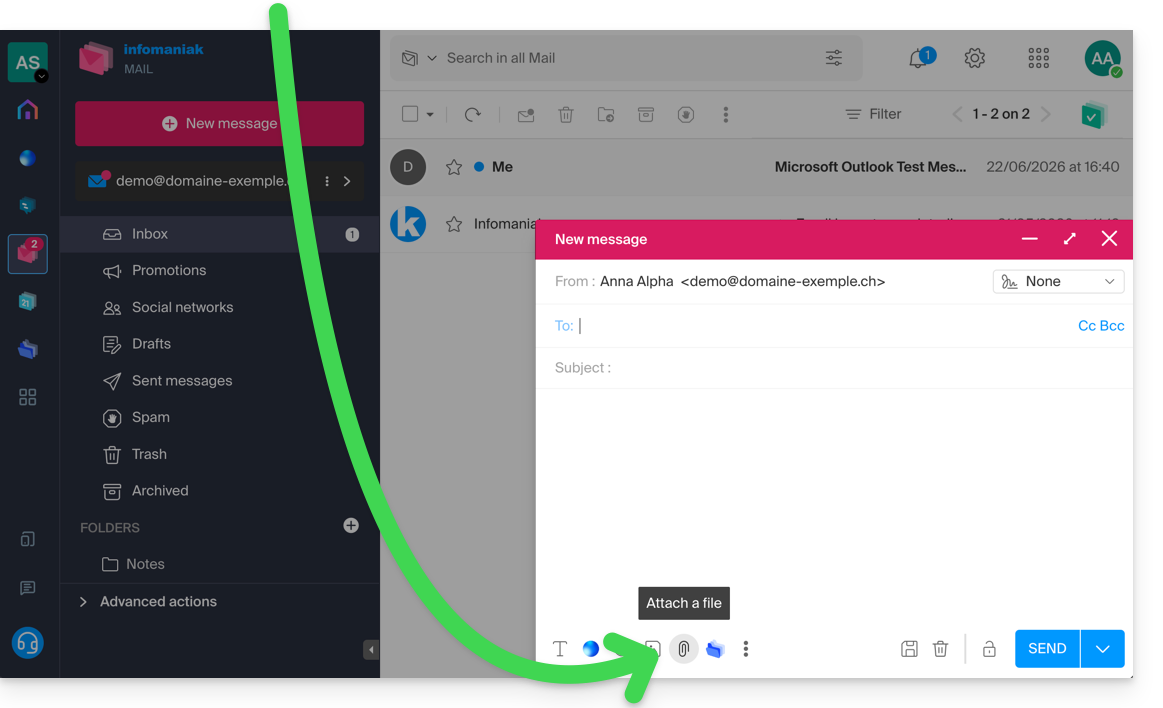
- Click on New message.
- Click on the paperclip icon Attach a file:
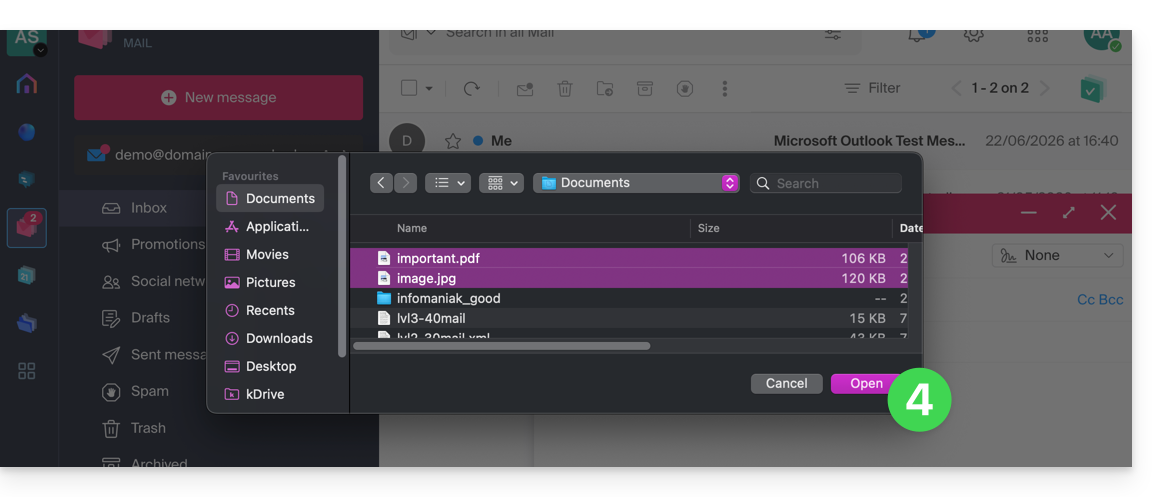
- Browse locations to select the files to attach to the message:
- With the Infomaniak Mail web app (online service ksuite.infomaniak.com/mail), the maximum size for attachments is 25 MB.
- If the size exceeds 25 MB (up to a maximum of 3 GB), a SwissTransfer link is generated and integrated into your message: the data is stored in Switzerland on Infomaniak's Cloud, and your recipients can use this link to easily download the attachments during a predefined period.
- For files larger than 3 GB (up to 50 GB), it is recommended to always use SwissTransfer for your uploads.
- With the Infomaniak Mail web app (online service ksuite.infomaniak.com/mail), the maximum size for attachments is 25 MB.
Attach kDrive files to your message
To add an existing attachment to kDrive:
- Click here to access the Infomaniak Mail web app (online service ksuite.infomaniak.com/mail).
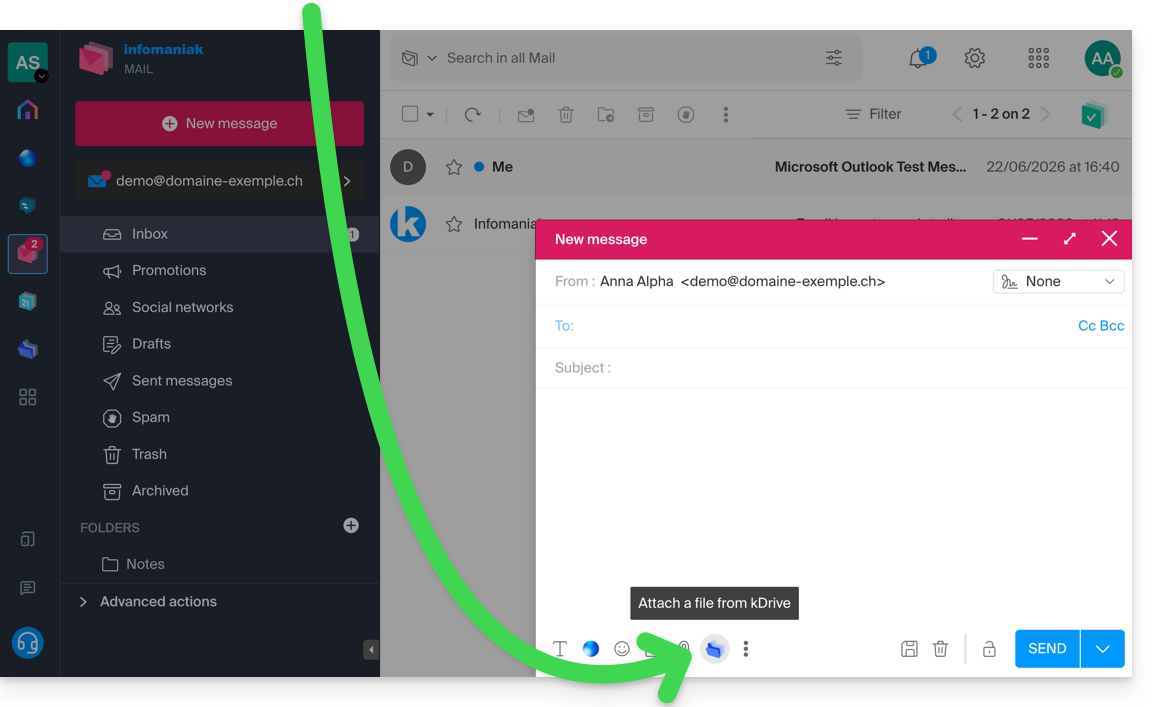
- Click on New message.
- Click on the kDrive folder icon to browse locations; select the kDrive files to attach to the message:
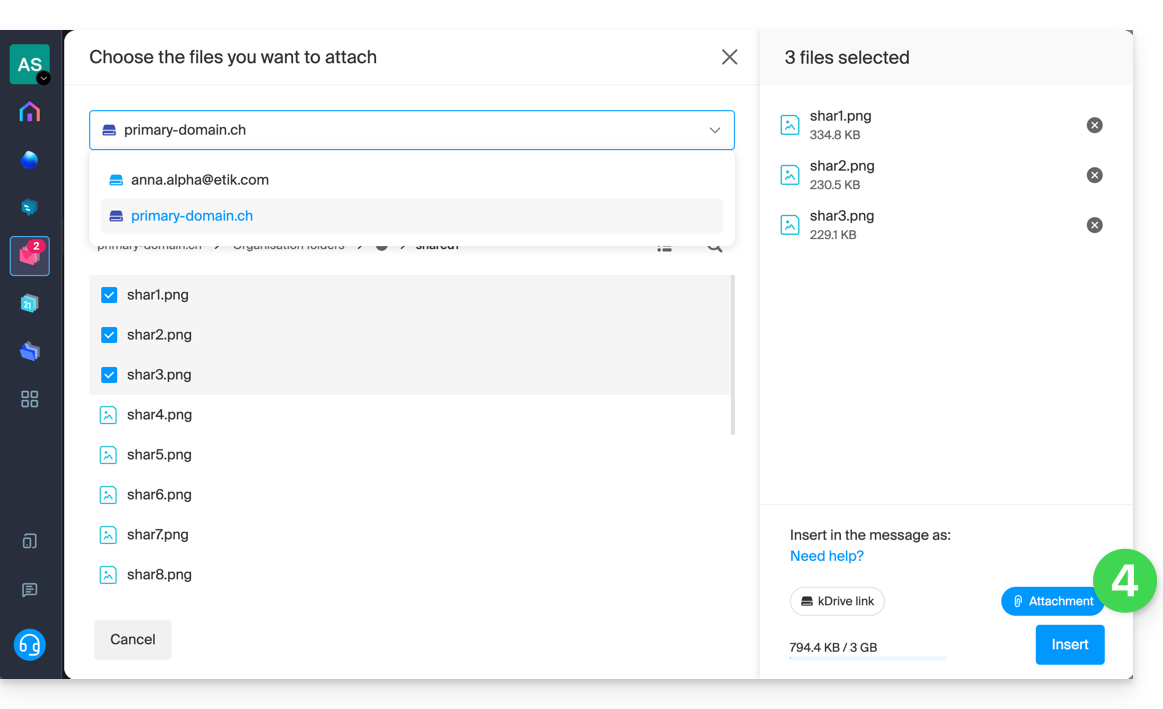
- Once the data has been found and added (if necessary, change the selected kDrive using the drop-down menu), select the Attachment option on the right (to attach the kDrive files to the message instead of sending a simple link to the files), then click the Insert button:
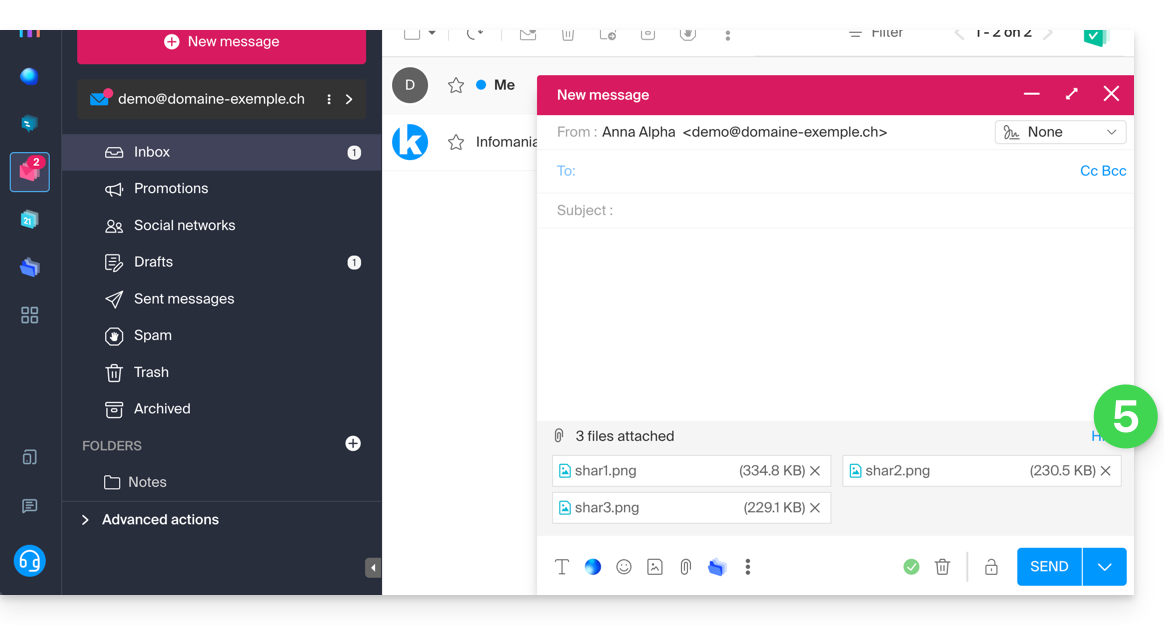
- The selected files are added to the message:
Include an image in the body of your message
To add an image to the message (e.g., in the middle of your message text), there are 2 options:
- Drag and drop the image into the input area.(Images larger than 10 MB will not be displayed but will be added as an attachment.
- … or click on the icon representing a landscape:
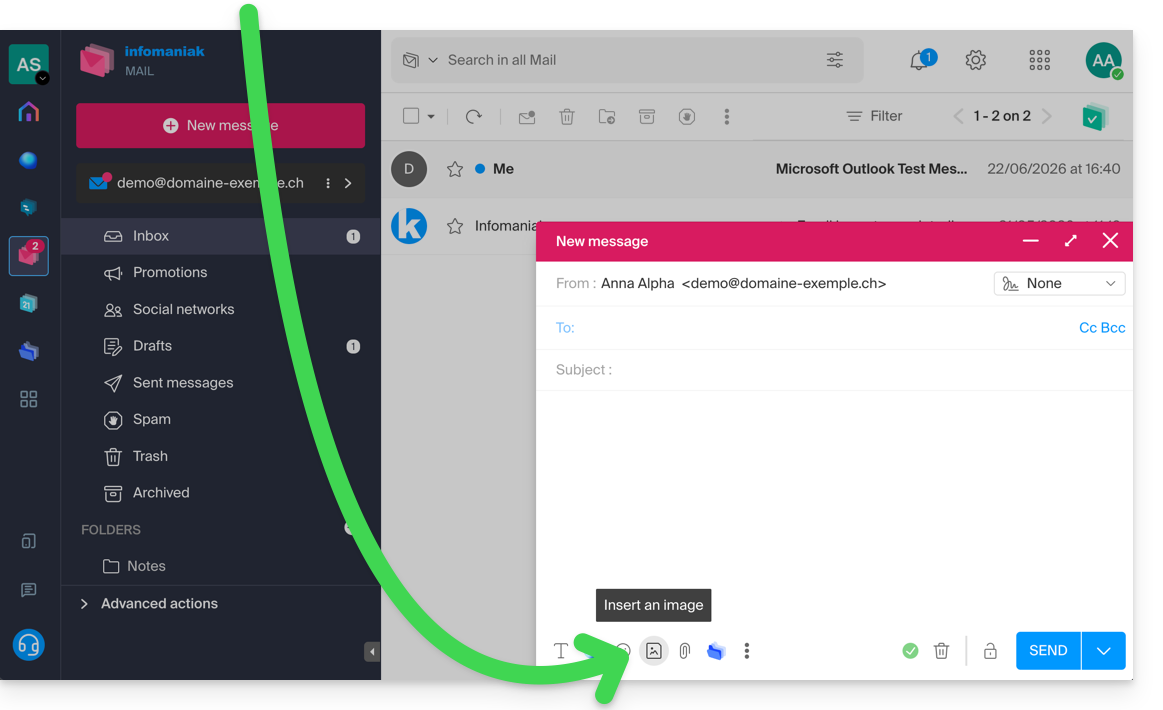
- then:
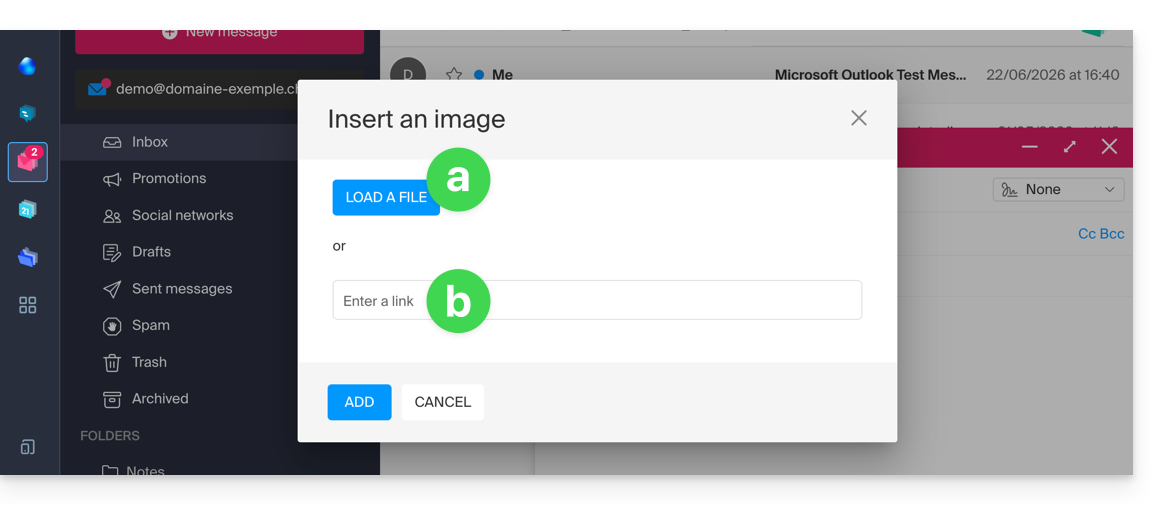
- Click on the button to upload an image (which allows you to choose its location and then insert it into the message body)…
- … or enter the URL of the image you want to include dynamically; the image must be located somewhere on the Internet (you can use Web FTP to upload your image to your hosting space if you have one) and must still be there when your recipient views the message.
- Click the button to add the image.
Link to this FAQ: https://faq.infomaniak.com/1697
Has this FAQ been helpful?
This guide details the measures implemented by Infomaniak to secure all your data via SwissTransfer, whether it is personal data (medical data, identification or login information) or even sensitive data (financial information, trade secrets, intellectual property information, research and development, etc.).
Data security and privacy
The SwissTransfer infrastructure is based on cutting-edge technology, incorporating several levels of protection for your files:
- During the transfer: your files travel through an ultra-secure tunnel (AES-GCM encryption) that prevents any interception or modification during transmission.
- Once stored: your data is "fortified" by double encryption (LUKS and AES 256 bits).
- This security standard, which is more robust than the previous one, guarantees that even in the event of physical access to the server, your files remain completely unreadable.
- Files are encrypted as soon as they arrive on Infomaniak's storage servers and are processed exclusively in Infomaniak's data centers in Switzerland. These TIER III+ data centers ensure maximum availability.
- Infomaniak continuously tests and audits the SwissTransfer infrastructure to identify and correct any vulnerabilities, thereby ensuring constant protection against the latest cyberattacks.
Learn more in this other guide about the retention of hosted data.
Link to this FAQ: https://faq.infomaniak.com/1755
Has this FAQ been helpful?
Thank you for trusting Infomaniak and SwissTransfer to securely transmit your large files to your contacts. You are helping to support a professional, reliable, and ethical solution for data exchange.
Main SwissTransfer guides
To get started with sending files:
- Use SwissTransfer quickly and without an account
- Use SwissTransfer within kSuite:
- Keep a history of transfers
- Customise the appearance of transfers with SwissTransfer Pro
- Infomaniak Mail and SwissTransfer
- Current limits based on SwissTransfer / SwissTransfer Pro plans
- Data security
- Download the mobile app: iOS / Android
- Troubleshoot a security issue with the mobile app
Limit for creating a transfer
There are no usage limitations when you receive a SwissTransfer transfer.
Regarding the creation of a SwissTransfer / SwissTransfer Pro transfer, the service is not available in these countries:
- Afghanistan
- Saudi Arabia
- Argentina
- Armenia
- Azerbaijan
- Bahrain
- Bangladesh
- Belize
- Bhutan
- Myanmar
- Bolivia
- Brunei
- Cambodia
- China
- Colombia
- North Korea
- Costa Rica
- United Arab Emirates
- Ecuador
- El Salvador
- Georgia
- Guatemala
- Guyana
- Honduras
- India
- Indonesia
- Iraq
- Iran
- Israel
- Jordan
- Kazakhstan
- Kyrgyzstan
- Kuwait
- Laos
- Lebanon
- Malaysia
- Maldives
- Mexico
- Mongolia
- Nepal
- Nicaragua
- Oman
- Uzbekistan
- Pakistan
- Palestine
- Panama
- Paraguay
- Peru
- Philippines
- Qatar
- Sri Lanka
- Suriname
- Syria
- Tajikistan
- Taiwan
- East Timor
- Turkmenistan
- Uruguay
- Venezuela
- Yemen
Any questions or feedback?
- Contact Infomaniak support
- Click here to share feedback or a suggestion about an Infomaniak product
Link to this FAQ: https://faq.infomaniak.com/2451
Has this FAQ been helpful?
This guide details how to use SwissTransfer, the free and secure platform for transferring large files.
Introduction
- SwissTransfer, powered by Infomaniak, allows you to send files up to 50 GB in a simple, efficient, and completely confidential manner, in compliance with data protection standards; however, some limitations apply (❓: help).
- You can go further by customizing your transfers and keeping a history of them using kSuite / SwissTransfer Pro (❓: help).
Transfer data quickly with SwissTransfer
To send files via SwissTransfer without an account:
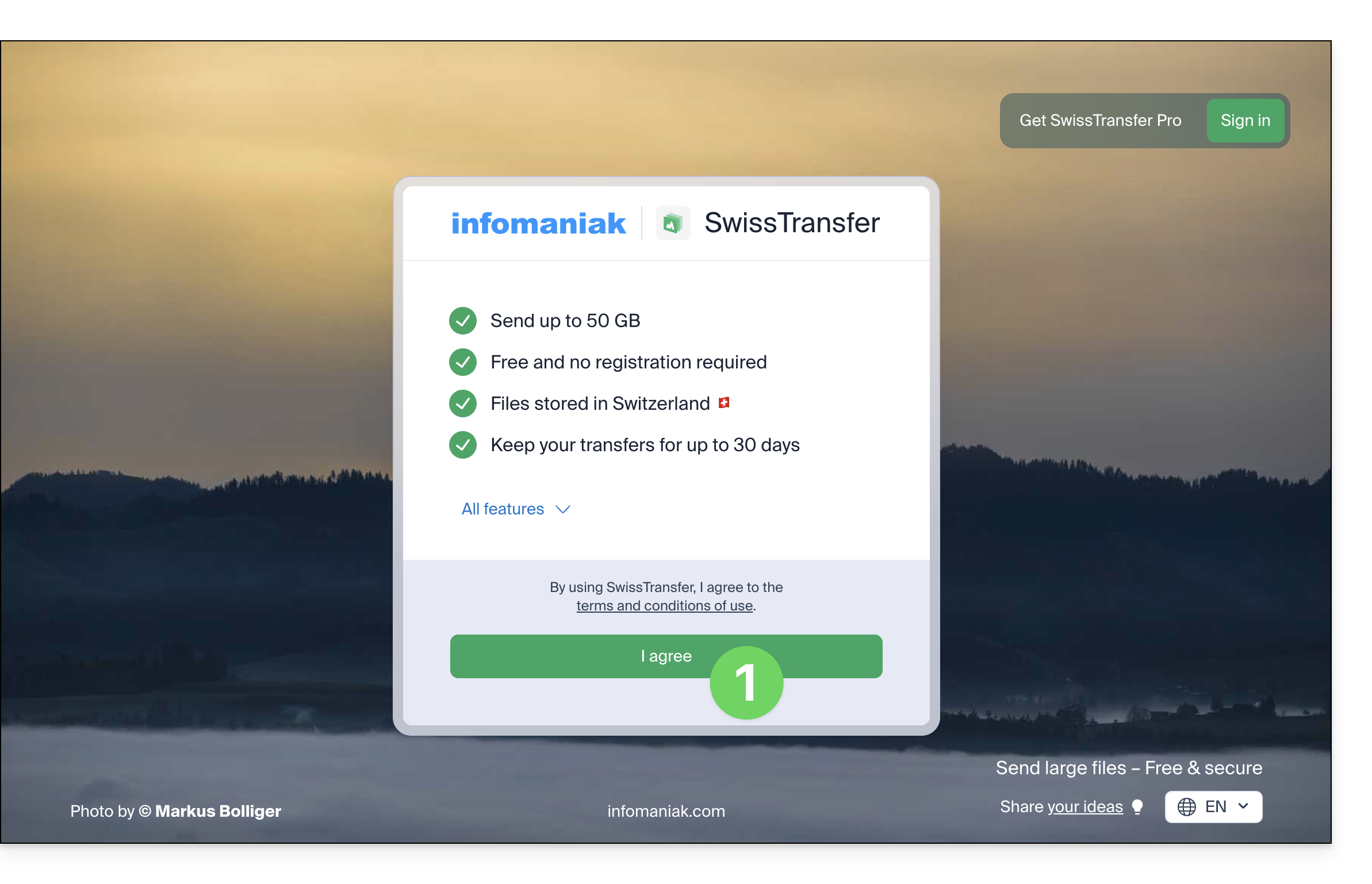
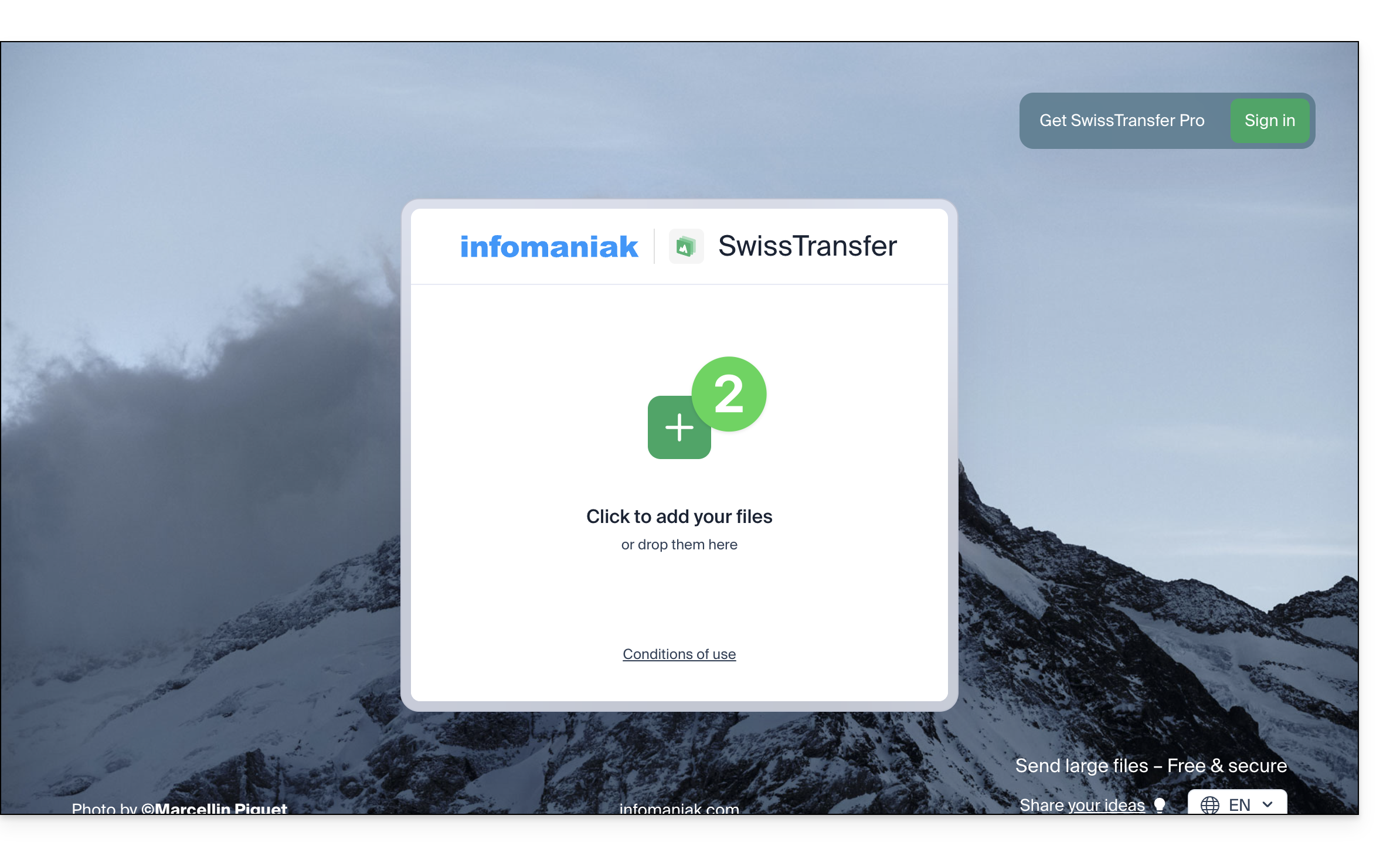
- Click here to access the Infomaniak SwissTransfer web app (online service swisstransfer.com) and accept the terms:
- Click the button to add the documents to transfer (the service accepts large files up to 50 GB); you can also drag and drop your data into this area:
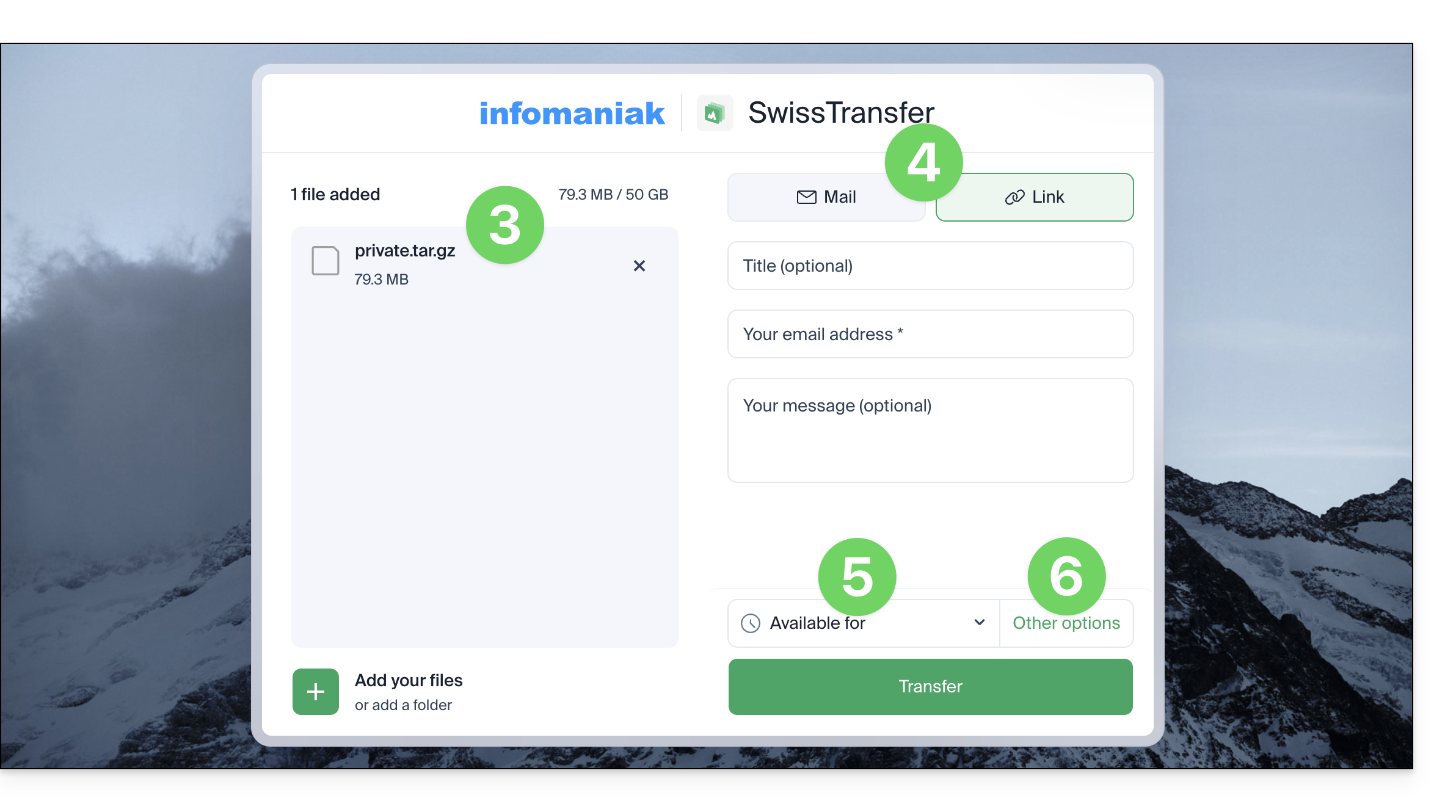
- Your files are ready to be transferred.
- Then decide if you want to create an email to the address of your choice, or get a link leading to your transfer (without sending it to anyone).
- Also, choose the duration for which your data will be available for download (between 1 and 30 days).
- In the options, you can also choose the maximum number of times your recipients can download the content (between 1 and 250) and add optional password protection:
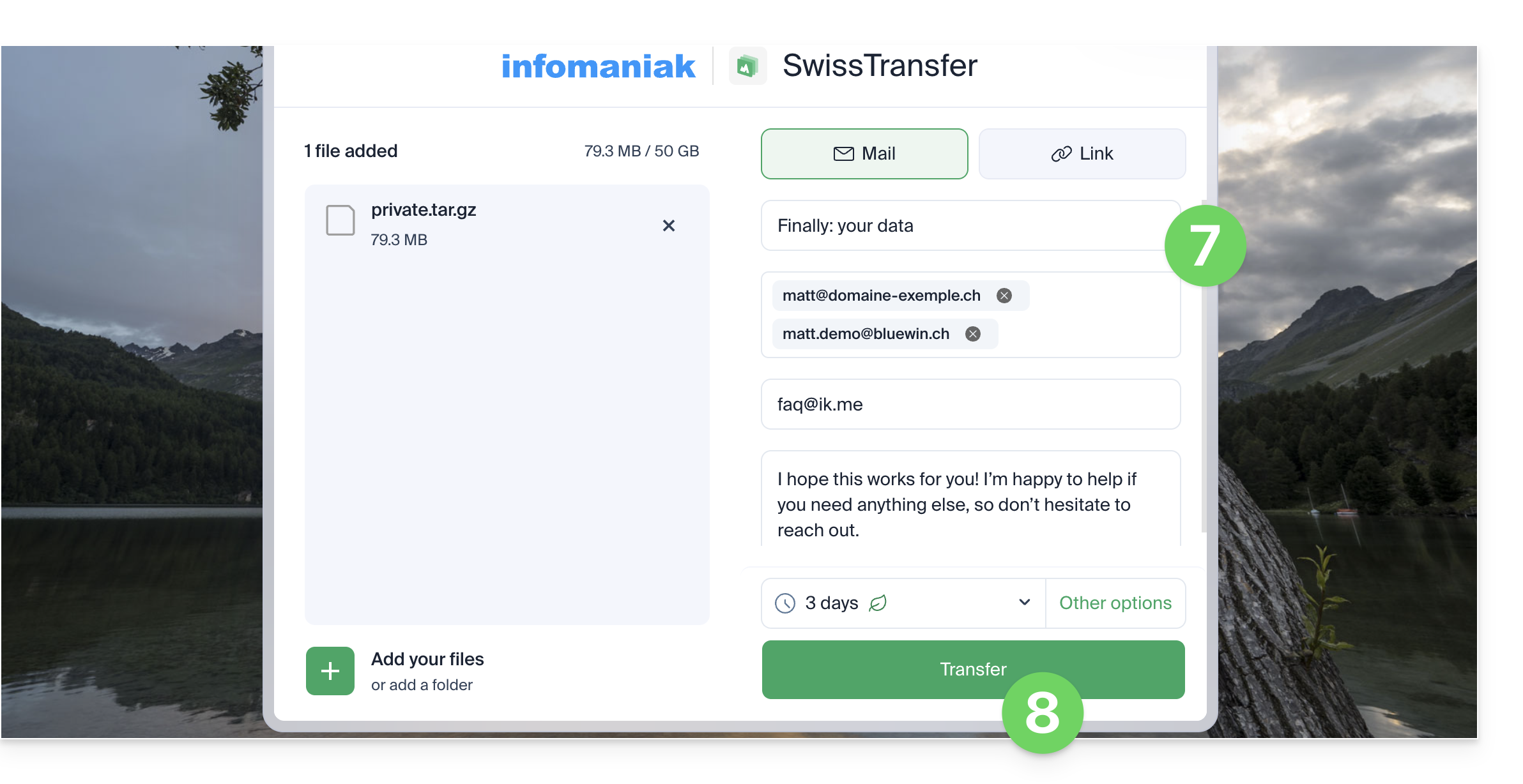
- Complete your information:
- Title, message, and your email address (which you will need to validate in the next step).
- Sending by email requires adding one or more destination email addresses.
- Click the button to Transfer:
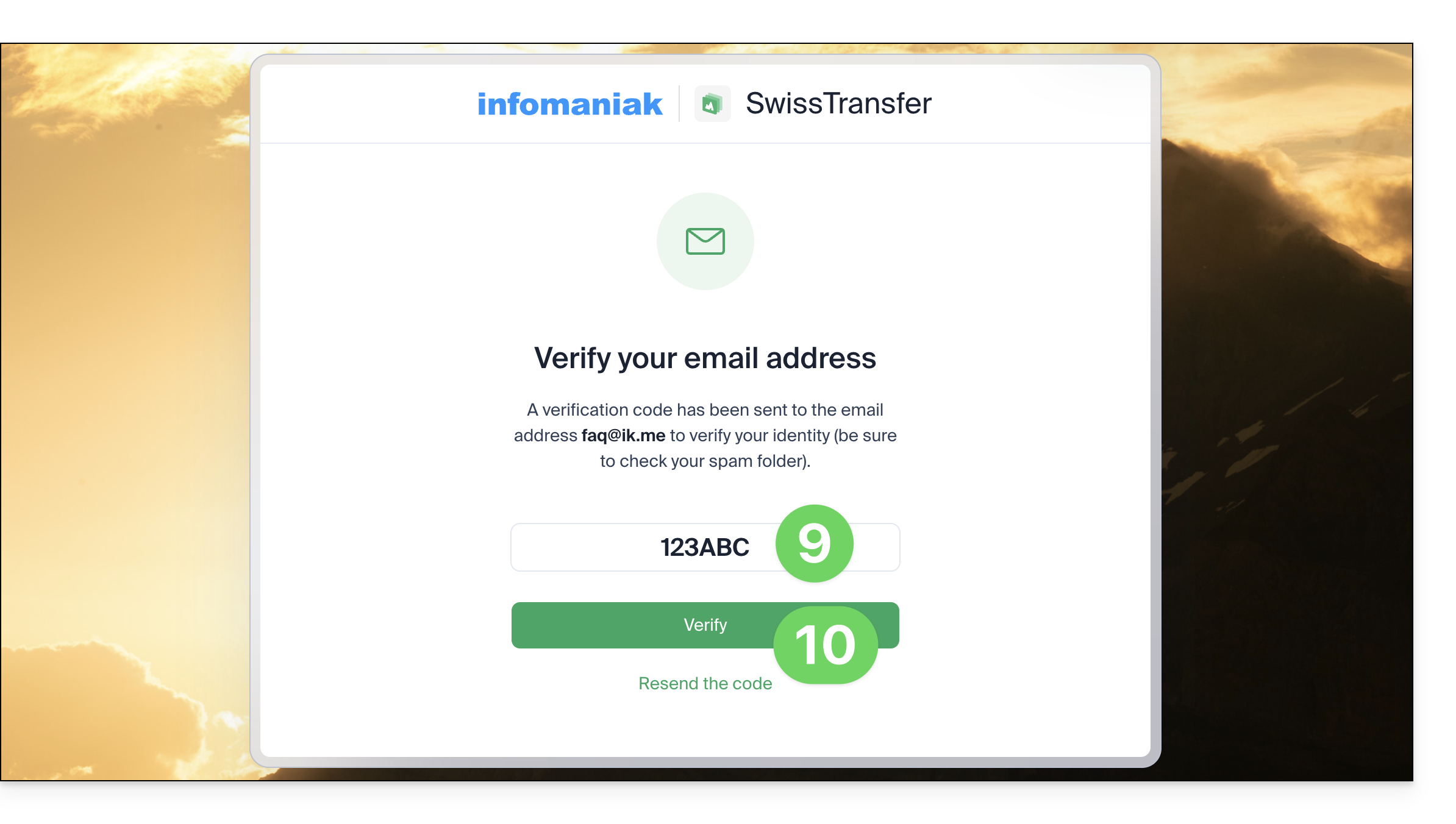
- Confirm the sender's email address by retrieving the code sent to that address:
- This verification is only performed once per device (it is saved in your browser).
- Check your SPAM folder if you haven't received anything in your inbox.
- Enter the code you received (before it expires after 15 minutes) and click the button to start the transfer:
- Do not close the browser window until you see the confirmation message:
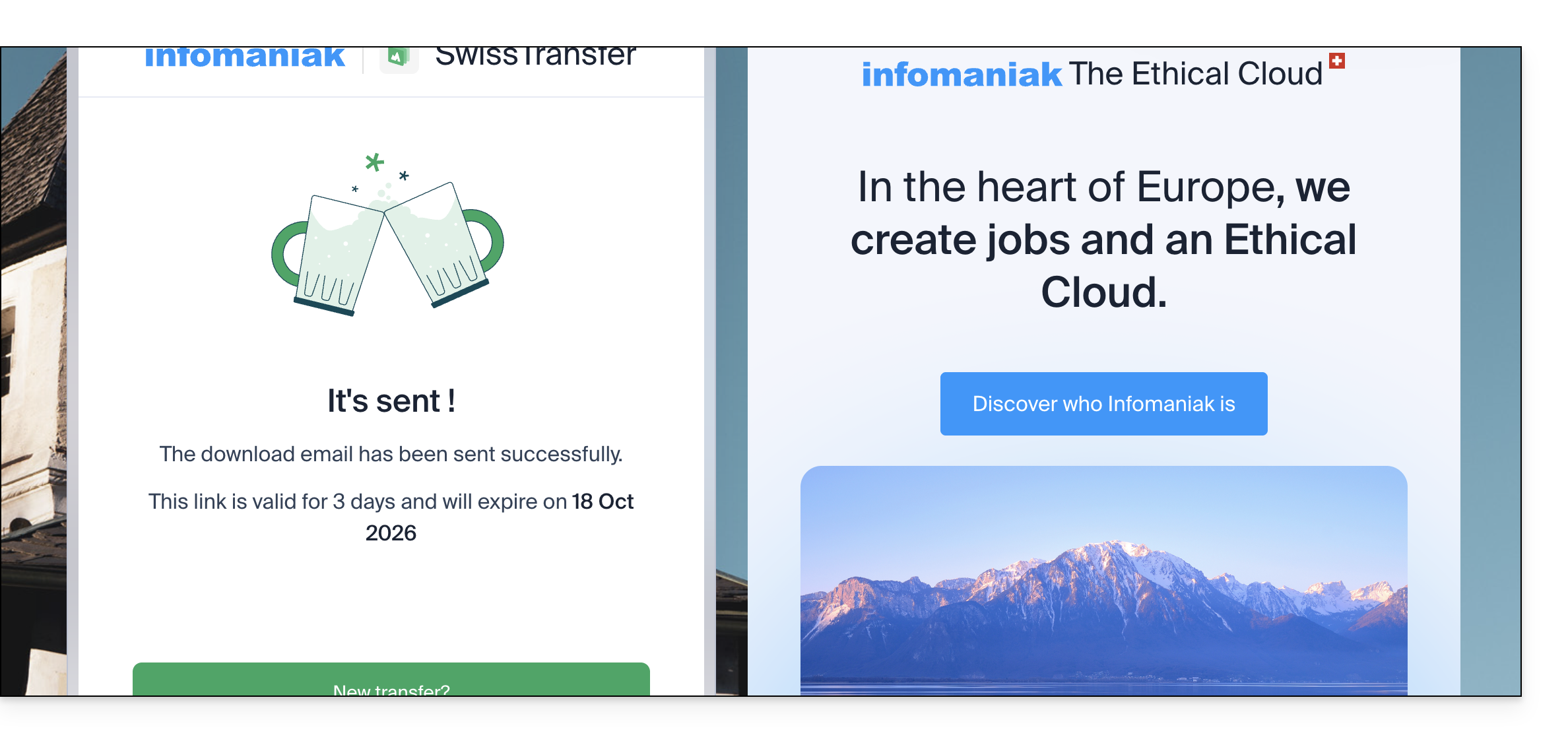
When a recipient downloads the file, an email is sent to the sender to notify them.
Optional: Compress files
You can transfer multiple files with SwissTransfer by selecting them on your device, even if the data to be sent includes folders.
- To facilitate sending, nothing is required, but it is easy to compress your files into a format such as ZIP.
- These operations will create a new compressed
.zipfolder that can be sent more quickly with SwissTransfer because the total size will generally be reduced.
macOS and Linux
- From your computer, select the folder(s) you want to send.
- Right-click on the folder(s) you want to archive.
- Choose the “Compress” option:
Windows
- From your computer, select the folder(s) you want to send.
- Right-click on the folder(s) you want to archive.
- Select the "Send to" option.
- Click on the "Compressed archive" option.
Send the compressed files
All you have to do is drag and drop your compressed file(s) to SwissTransfer:
Difference between transmission methods: LINK vs EMAIL
SwissTransfer offers you the possibility to choose between two distinct transmission methods:
- EMAIL option:
- You enter the email address(es) of the recipient(s) directly, as well as your own sender address.
- As soon as the file upload is complete, the platform automatically sends an email containing the download link to the relevant recipients.
- This method is ideal for instantly notifying your contacts in an automated way without any additional steps.
- LINK option:
- The system generates a unique direct download link (URL) as soon as your files are online.
- No email is sent automatically: you must copy this link manually and share it via your preferred channel (instant messaging application, SMS, corporate chat, social network, etc.).
- This mode is preferred if you would rather share the download link using your own communication tools.
Using the mobile app
You can also use the mobile app iOS / Android; thanks to its integration, it offers quick file sharing options for your files, photos, PDFs, etc., directly from the file explorer: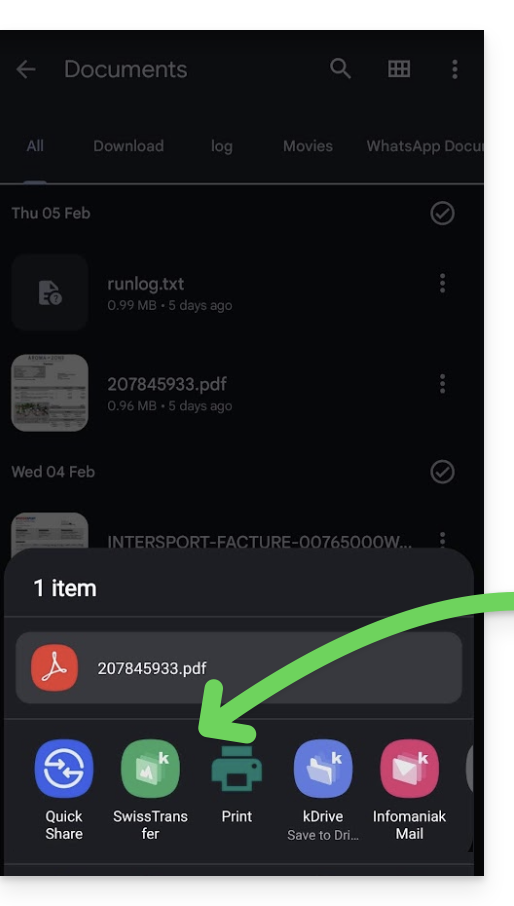
- Refer to this other guide if you encounter any issues installing the app.
Link to this FAQ: https://faq.infomaniak.com/2557
Has this FAQ been helpful?
This guide details the use of SwissTransfer Pro, the Infomaniak service that you will find within kSuite & my kSuite+, which allows you to customize the appearance of your sent files.
✘ UNAVAILABLE with
kSuite Free
my kSuite (ik.me, etik.com, ikmail.com)
Introduction
- Possible customizations:
- kSuite Standard = background (1 image)
- kSuite Business = background (5 images) + About and Social Media text
- kSuite Enterprise = background (10 images) + About and Social Media text
- my kSuite+ = background (1 image)
Customize transfers with SwissTransfer Pro
To send files while customizing the transfer's appearance:
- Click here to access the SwissTransfer Infomaniak web app (online service swisstransfer.com) and click the button to log in:
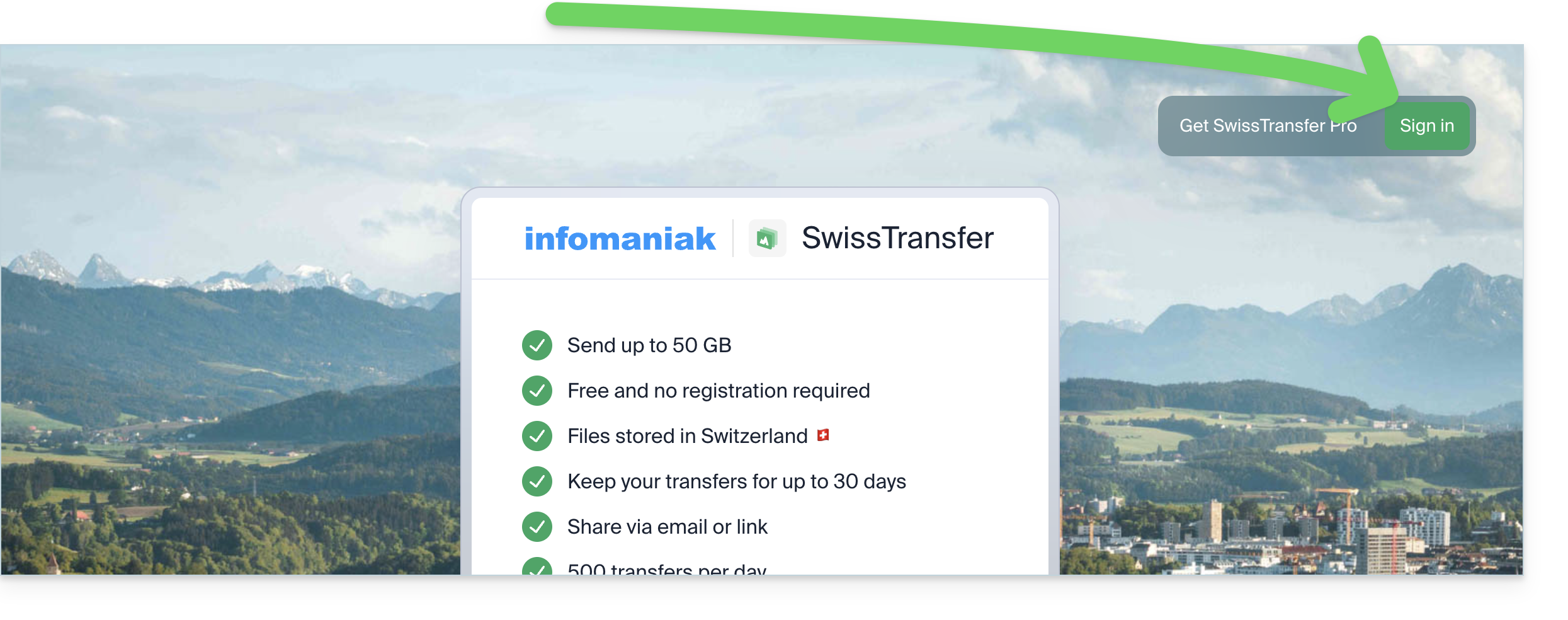
- Enter your login ID and password, and complete the two-factor authentication if required.
- Once logged in, click the button to add the documents to transfer (the service accepts large files up to 50 GB); you can also drag and drop your data into this area:
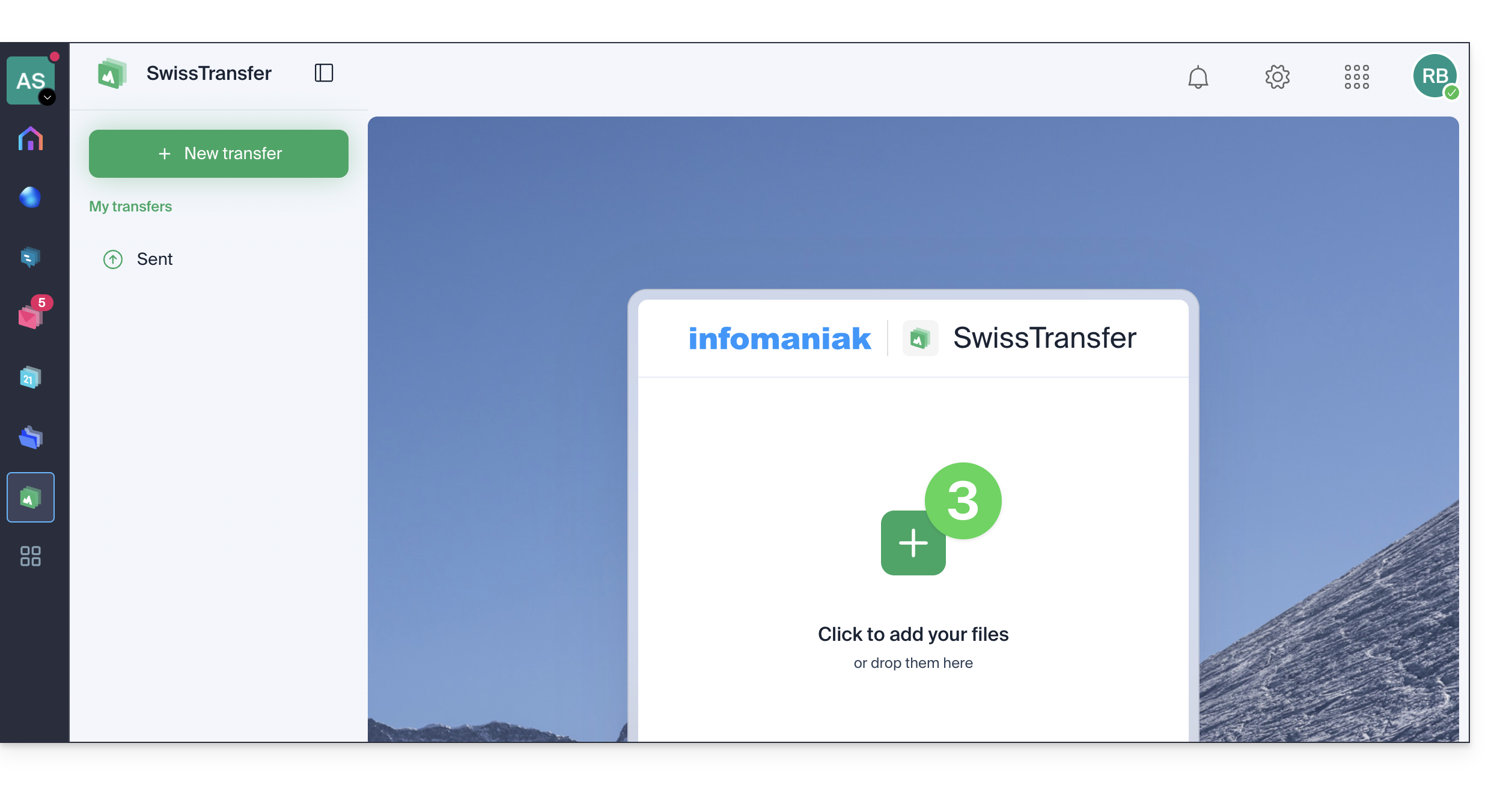
- Click on Customize below the frame:
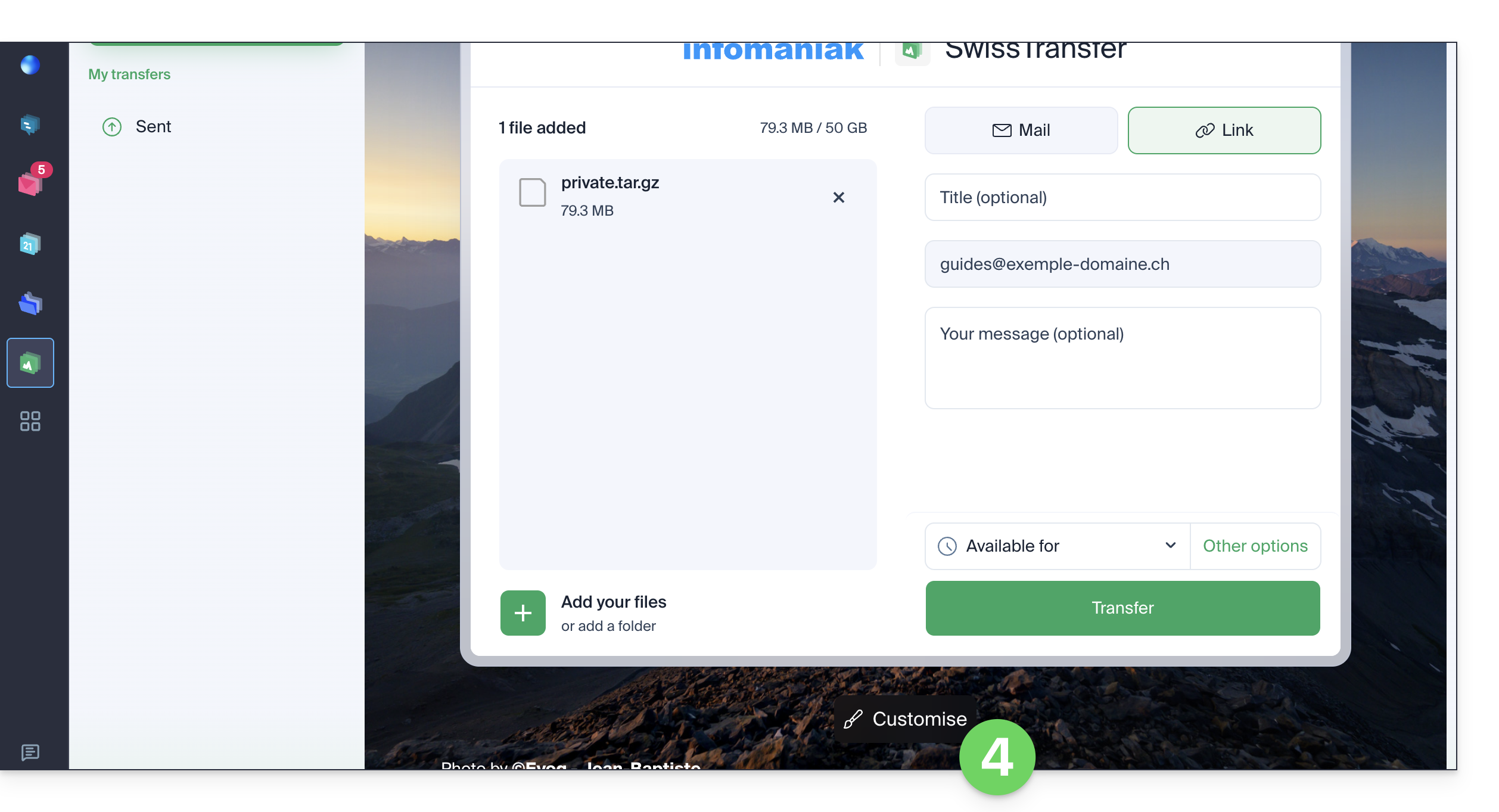
- Check or select the relevant Organization from the dropdown menu in the left sidebar.
- Enter a display name.
- Import and select a square or rectangular logo.
- Choose the background images:
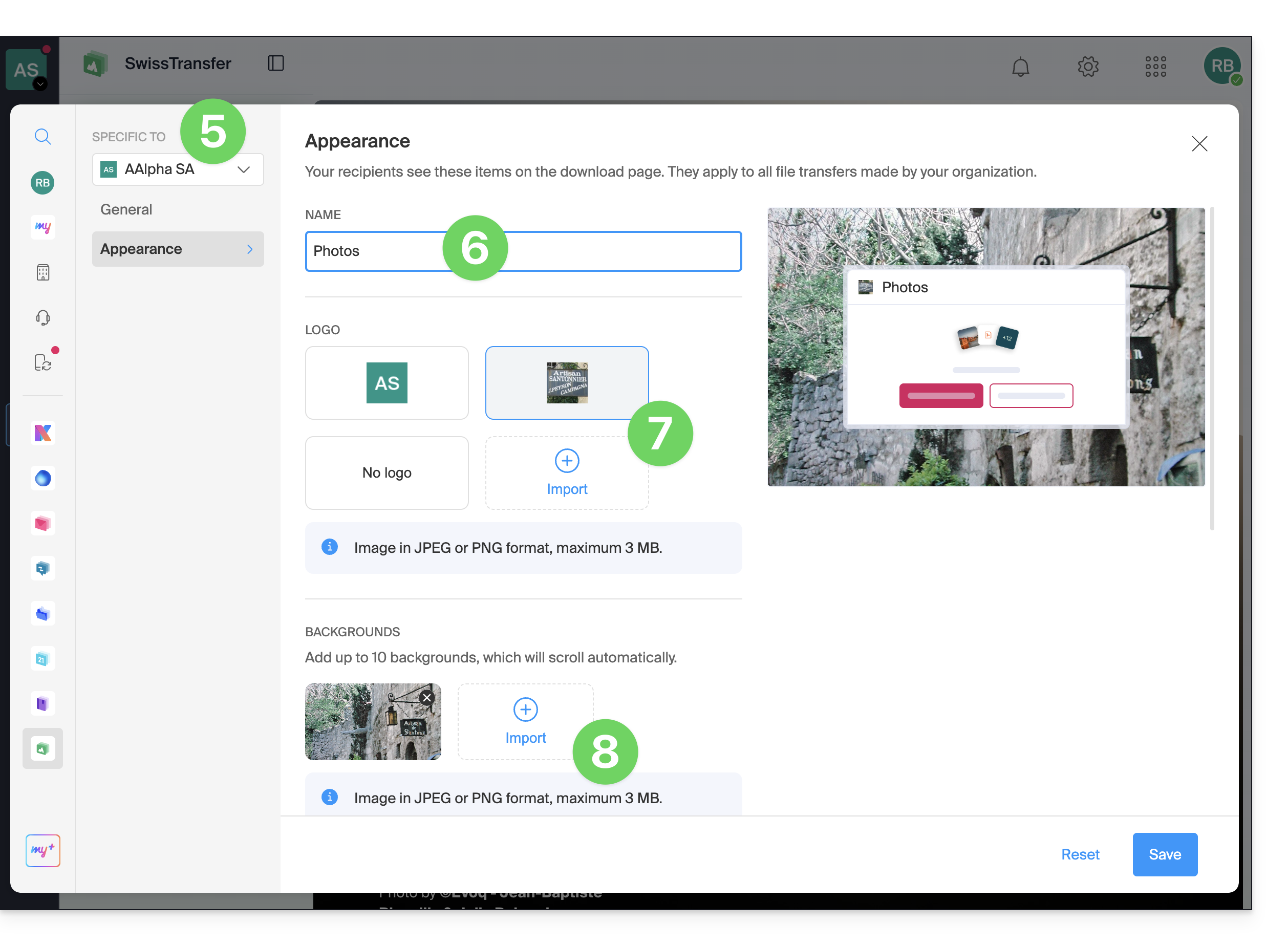
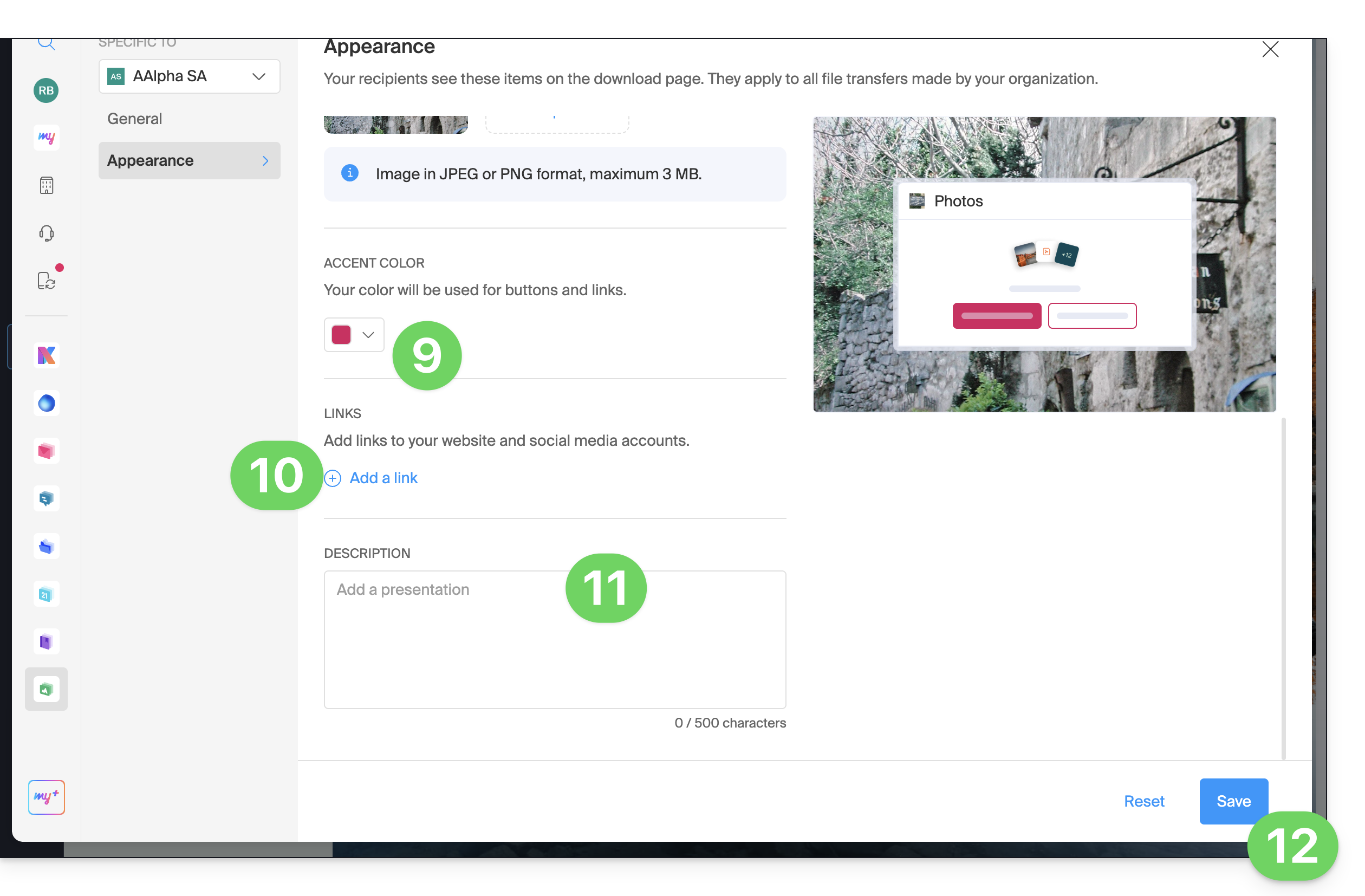
- Further down, choose the color of the buttons & links.
- Add links to your social networks.
- Enter an optional description.
- Save your preferences:
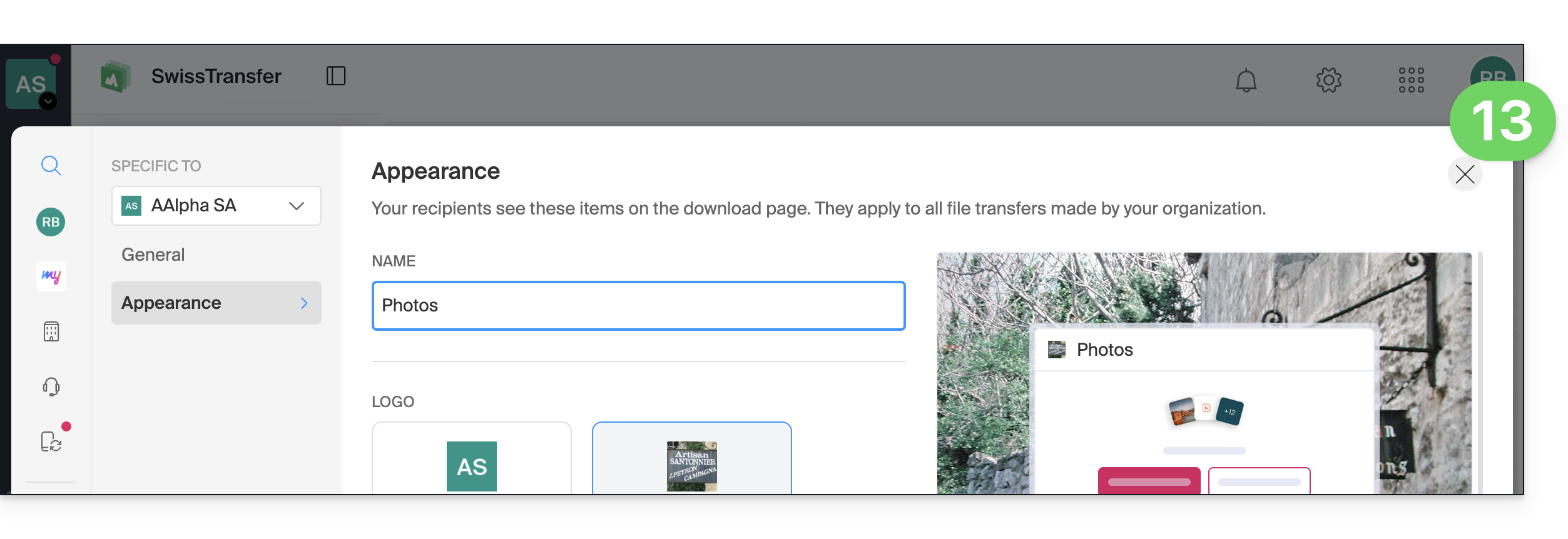
- Close the customization window:
- Then decide whether you want to create an email to the address of your choice, or get a link that leads to your transfer (without sending it to anyone).
- Also, choose the duration for which your data will be available for download (between 1 and 60 days depending on the plan).
- In the options, you can also restrict, if needed, the maximum number of times the content can be downloaded by your recipients (between 1 and 250) or leave it unlimited, add a possible password protection, and, depending on the plan, customize your sends (❓: help):
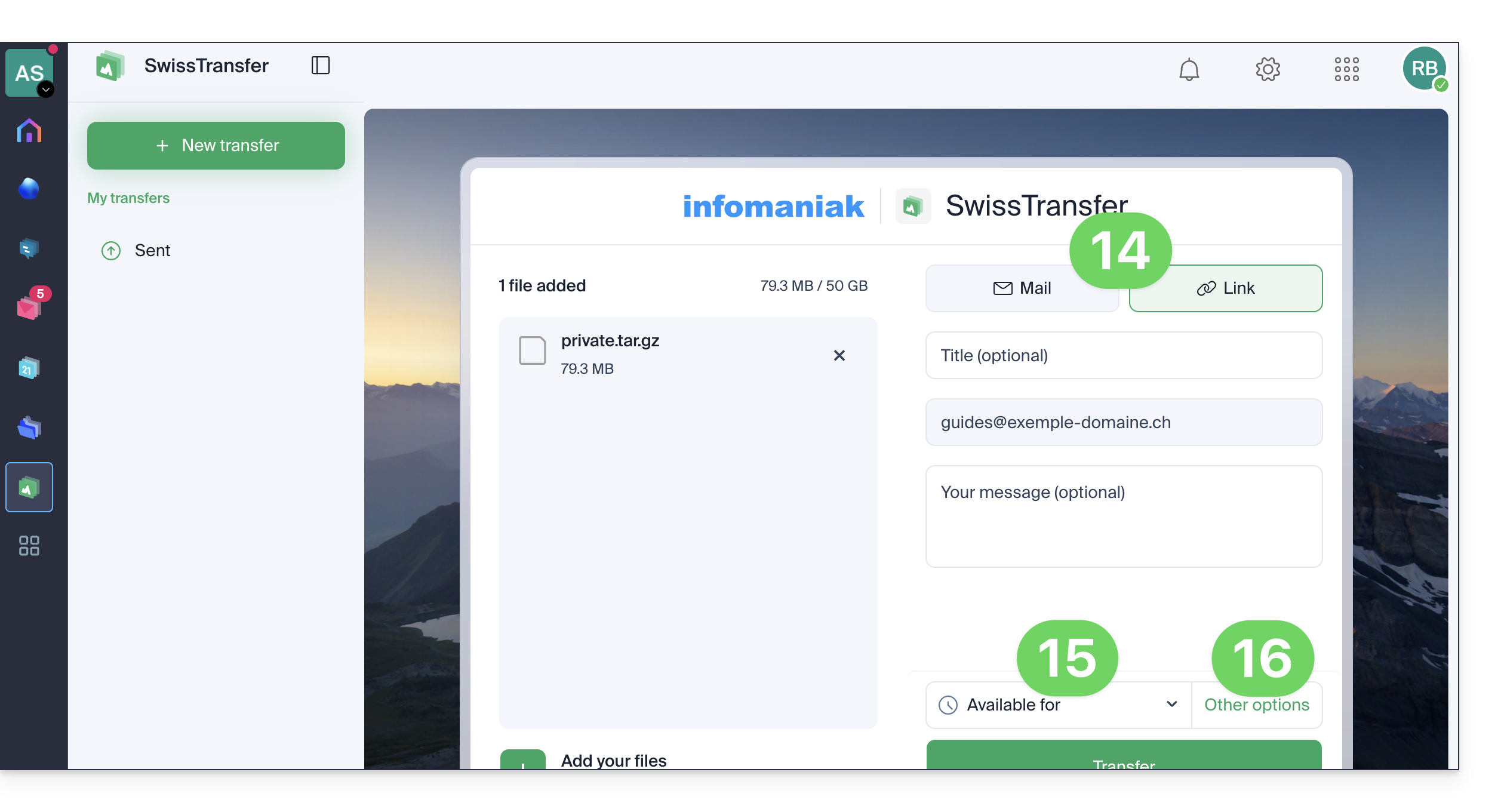
- Complete your information:
- Title and message
- Sending by email requires adding one or more destination email addresses.
- The sender is automatically taken from your login ID for the Organization.
- Click the button to Send:
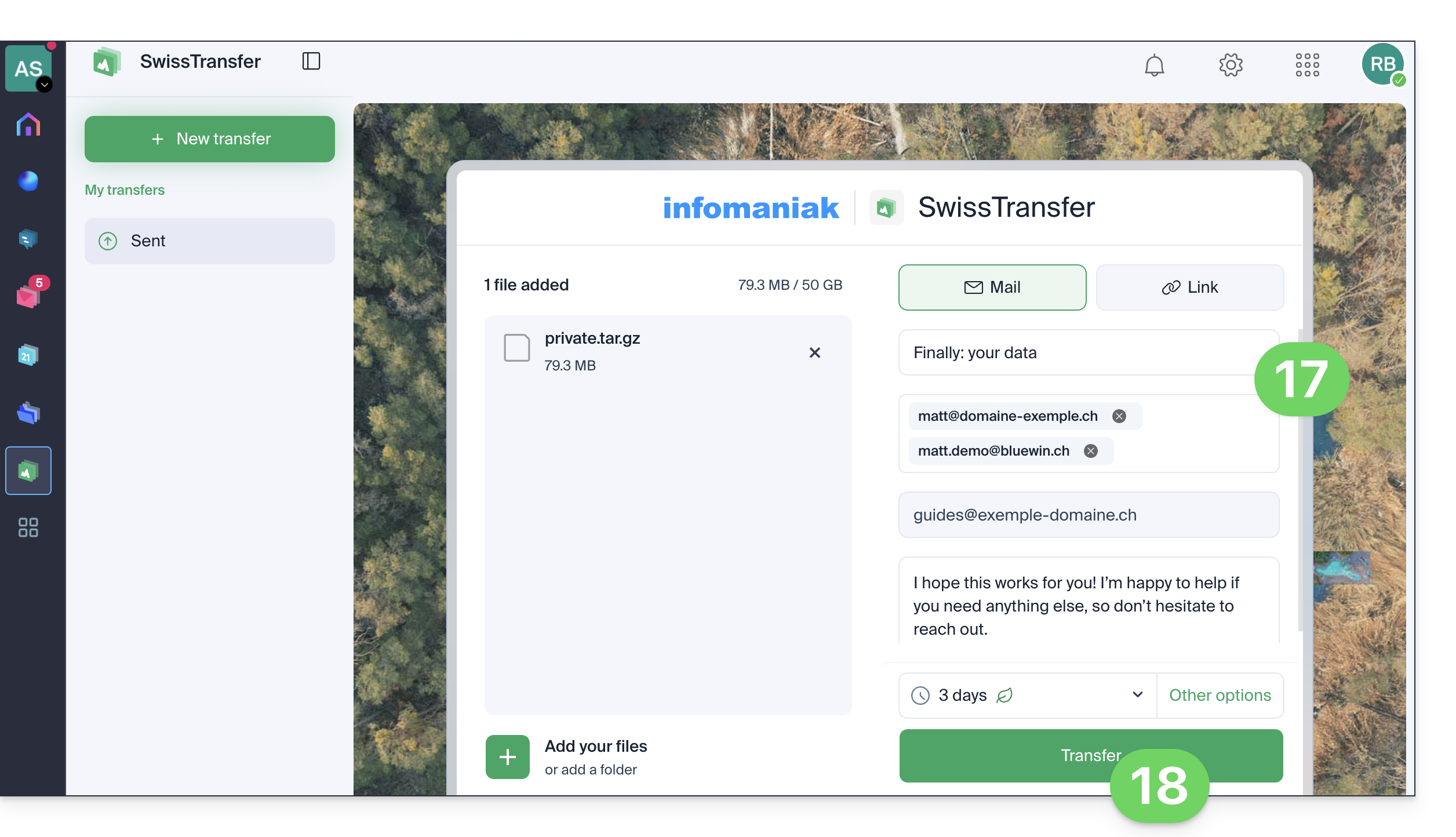
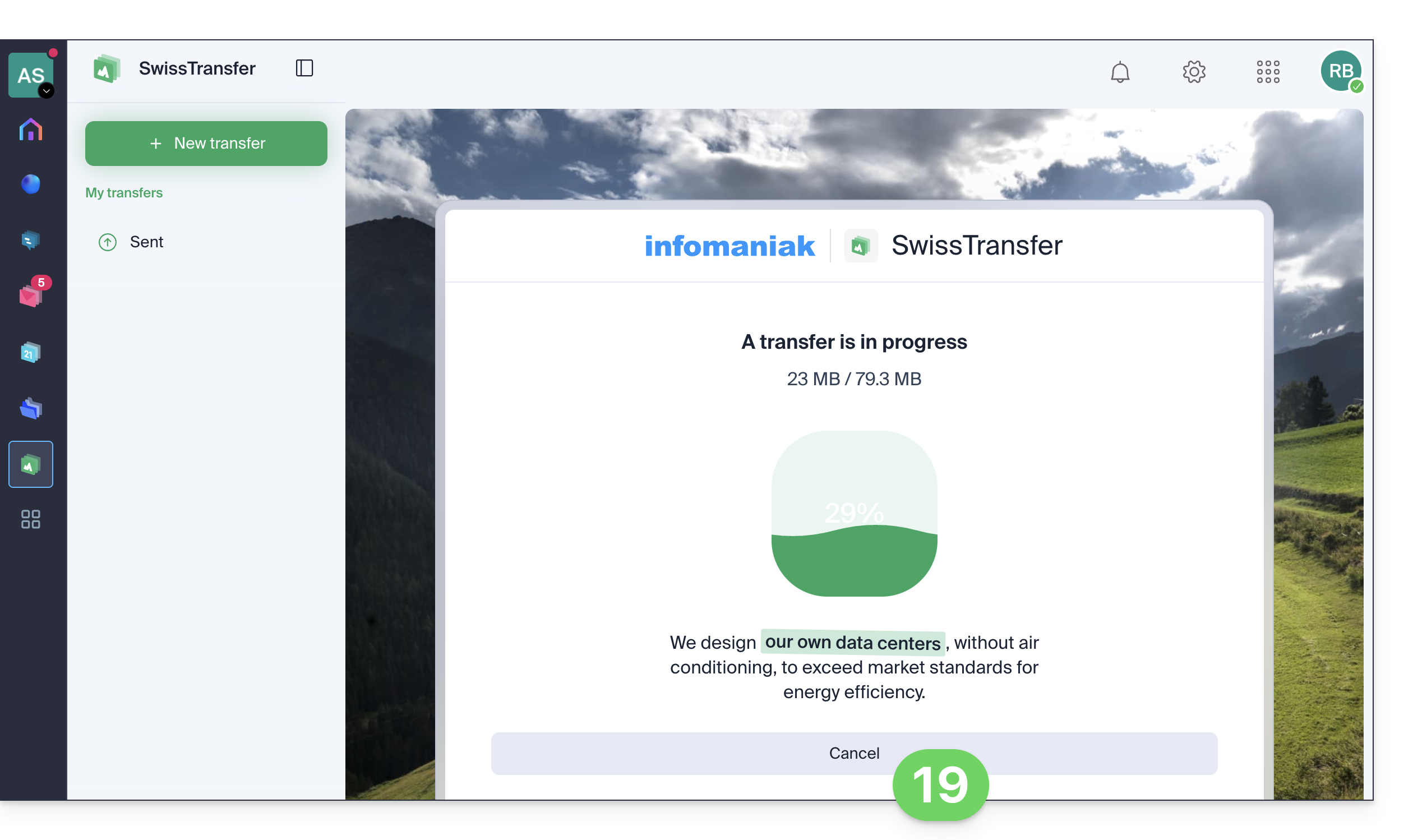
- Do not close the browser window until you see the confirmation message; if necessary, you can cancel the current sending process:
The recipient receives the email and clicks to access the data. The user can then see the details of the sending process and download the files on the interface customized by the sender: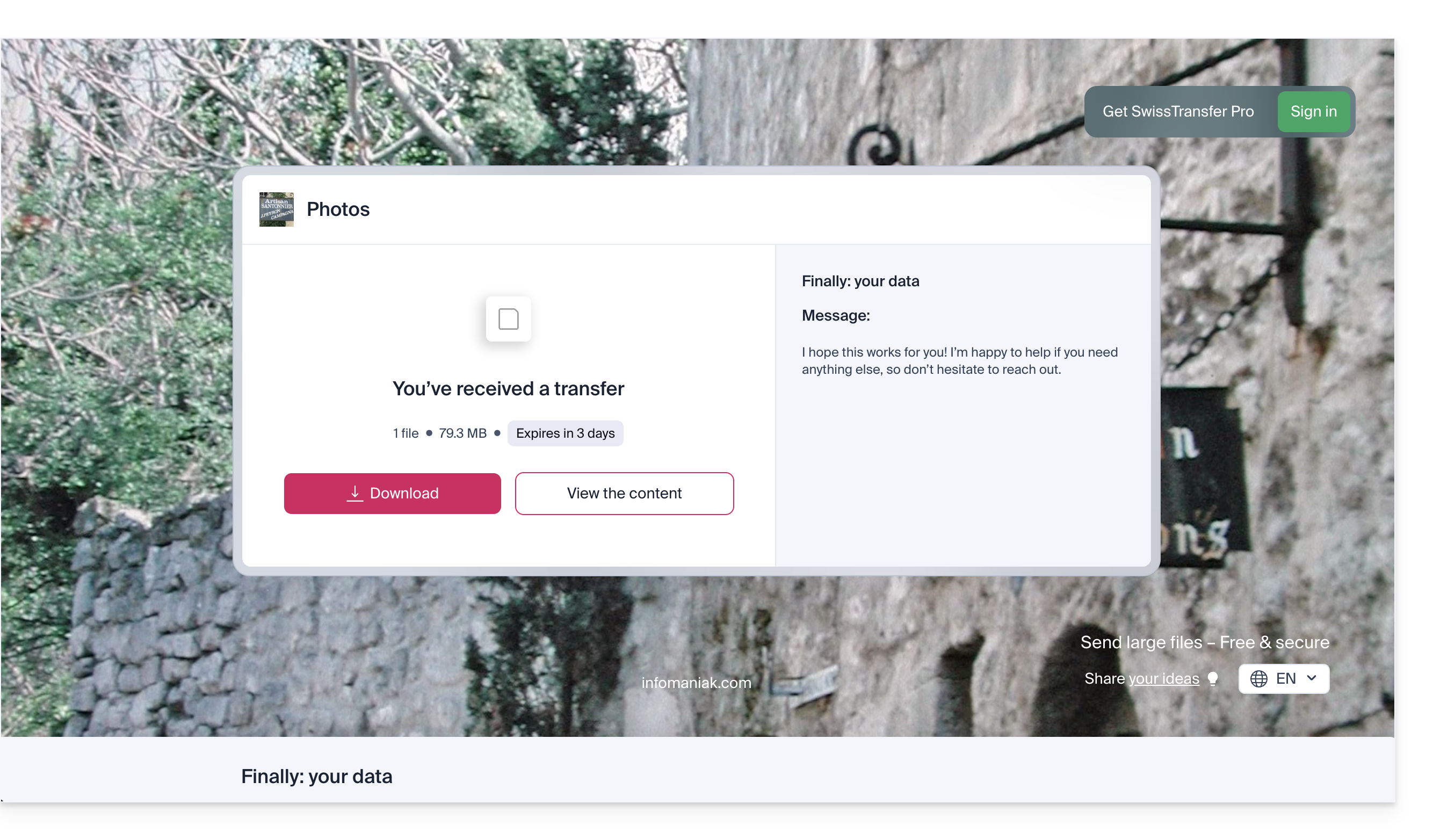
When a recipient downloads the file, an email is sent to the sender to notify them.
Link to this FAQ: https://faq.infomaniak.com/2722
Has this FAQ been helpful?
This guide details the data storage limits for SwissTransfer.
Retention period
SwissTransfer accepts files up to 50 GB in size, which is particularly useful for large files that cannot be sent as email attachments or by other traditional means.
You can choose to make them available for a maximum of:
- 1 day
- 3 days
- 7 days
- 15 days
- 30 days*
- 60 days (after subscribing to the Enterprise plan)
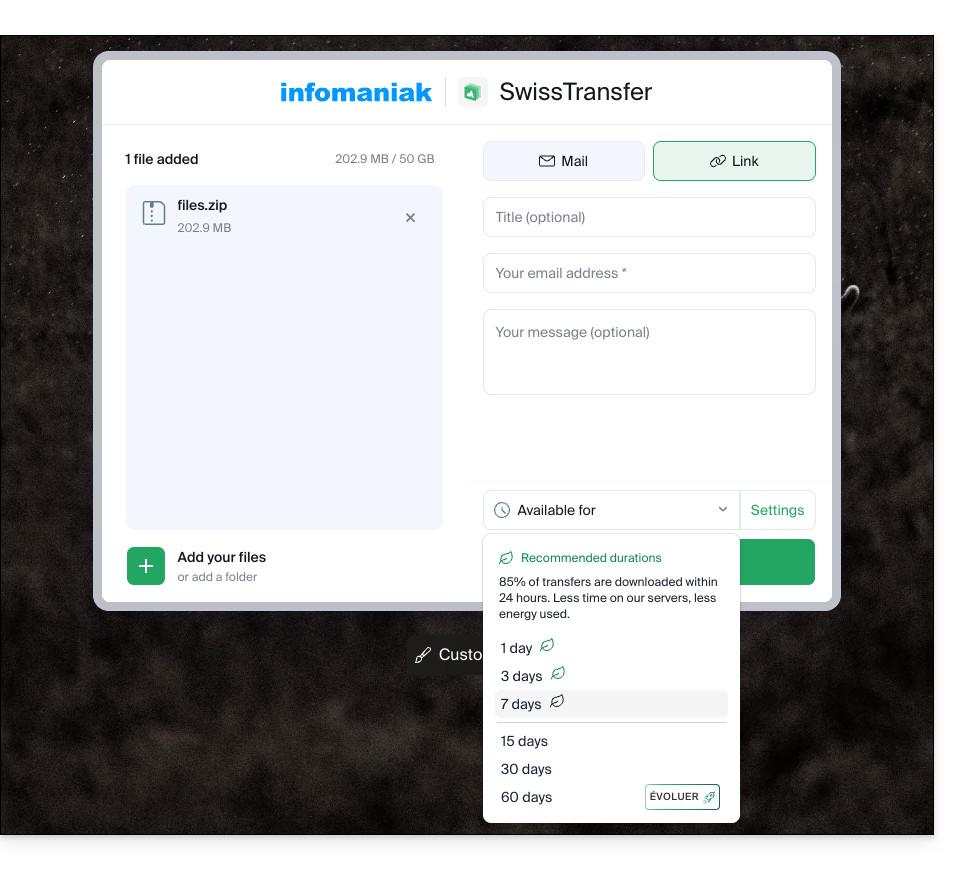
* When selecting 30 days, files are automatically deleted after 15 days, but an extension is offered by email to the sender on the 12th day, and remains available for 3 days, in order to extend the availability up to the desired 30 days.
With a SwissTransfer Pro / kSuite Pro account, the choice of the maximum number of days is final:
- kSuite Free = 30
- kSuite Standard = 30
- kSuite Business = 30
- kSuite Enterprise = 60
- my kSuite = 30
- my kSuite+ = 30
Files are automatically deleted after the chosen period. There is no need to contact Infomaniak Support: once expired, a link can unfortunately no longer be reactivated or extended.
Downloading data
When creating your SwissTransfer, you can limit the number of times recipients can download it:
- 1
- 20
- 100
- 250
- unlimited (after subscribing to a paid plan)
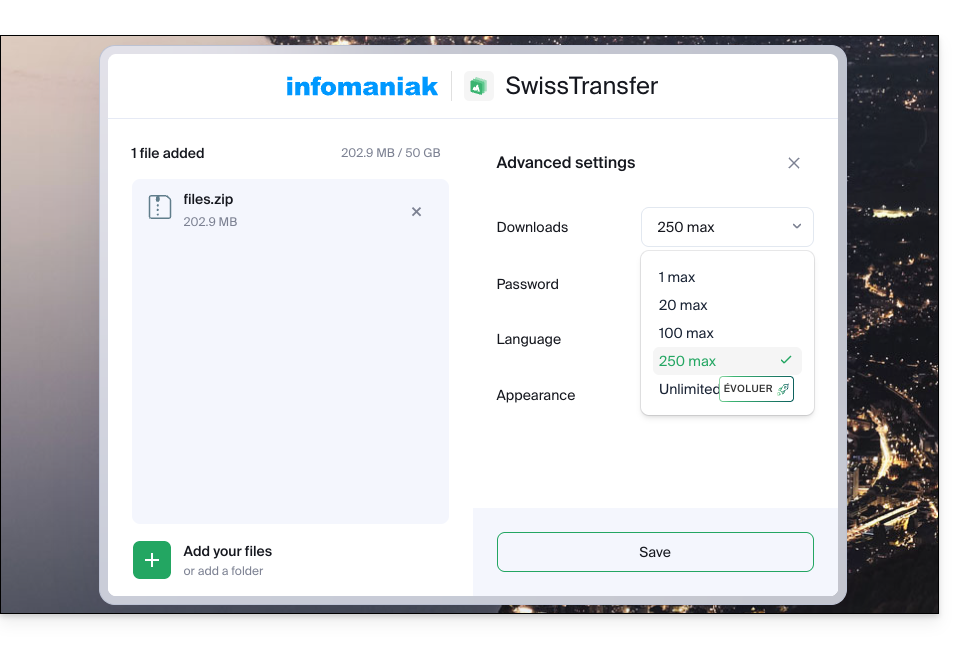
They can be downloaded by the user…
- …either one by one…
- … or by using the "Download All" button, which will create a
.ziparchive to download:- If the archive exceeds 10 GB, you will need to download the data files one by one.
- Therefore, if you need to send several large files, it is best to group them together beforehand into a zip/rar/etc. archive (see below).
Link to this FAQ: https://faq.infomaniak.com/2929
Has this FAQ been helpful?
This guide details the use of SwissTransfer / SwissTransfer Pro, the Infomaniak service that you will find within kSuite & my kSuite+.
Introduction
- Registering for SwissTransfer allows you to access the transfer history; however, some limitations apply (❓: help).
- The history is available from the registration date; transfers made before this date will not be retroactively retrieved and will therefore not appear in the history.
- An active transfer that is still in the history can be deleted so that it is no longer available for download.
- You can go even further by customizing your transfers (❓: help) with SwissTransfer Pro.
- You can also use SwissTransfer via the mobile app (application for iOS/Android smartphones or tablets); thanks to its integration, it offers quick file sharing options for your files, photos, PDFs, etc., directly from the file explorer:
Transfer data while connected to Infomaniak
To send files and keep a history of transfers:
- Click here to access the Infomaniak SwissTransfer web app (online service swisstransfer.com) and click the button to log in:
- Enter your login ID and password, and complete the two-factor authentication if necessary.
- Once logged in, click the button to add the documents to transfer (the service accepts large files up to 50 GB); you can also drag and drop your data into this area:
- Your files are ready to be transferred.
- Then decide if you want to create an email to the address of your choice, or get a link leading to your transfer (without sending it to anyone).
- Also, choose the duration for which your data will be available for download (between 1 and 60 days depending on the plan).
- In the options, you can also restrict, if needed, the maximum number of times the content can be downloaded by your recipients (between 1 and 250) or leave it unlimited, add a possible password protection, and, depending on the plan, customize your sends (❓: help):
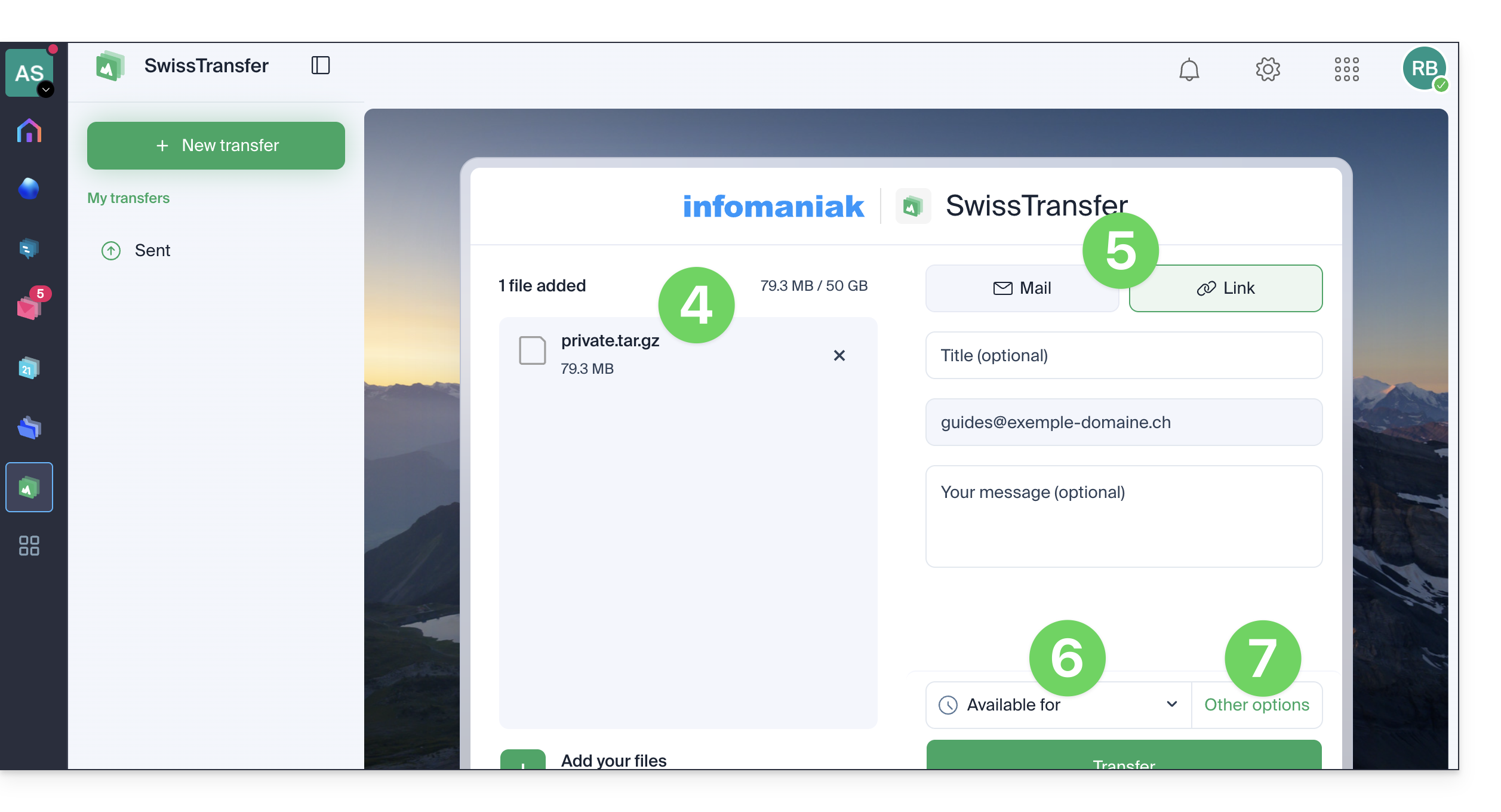
- Complete your information:
- Title and message
- Sending by email requires adding one or more destination email addresses.
- The sender is automatically taken from your login ID for the Organization.
- Click the button to Send:
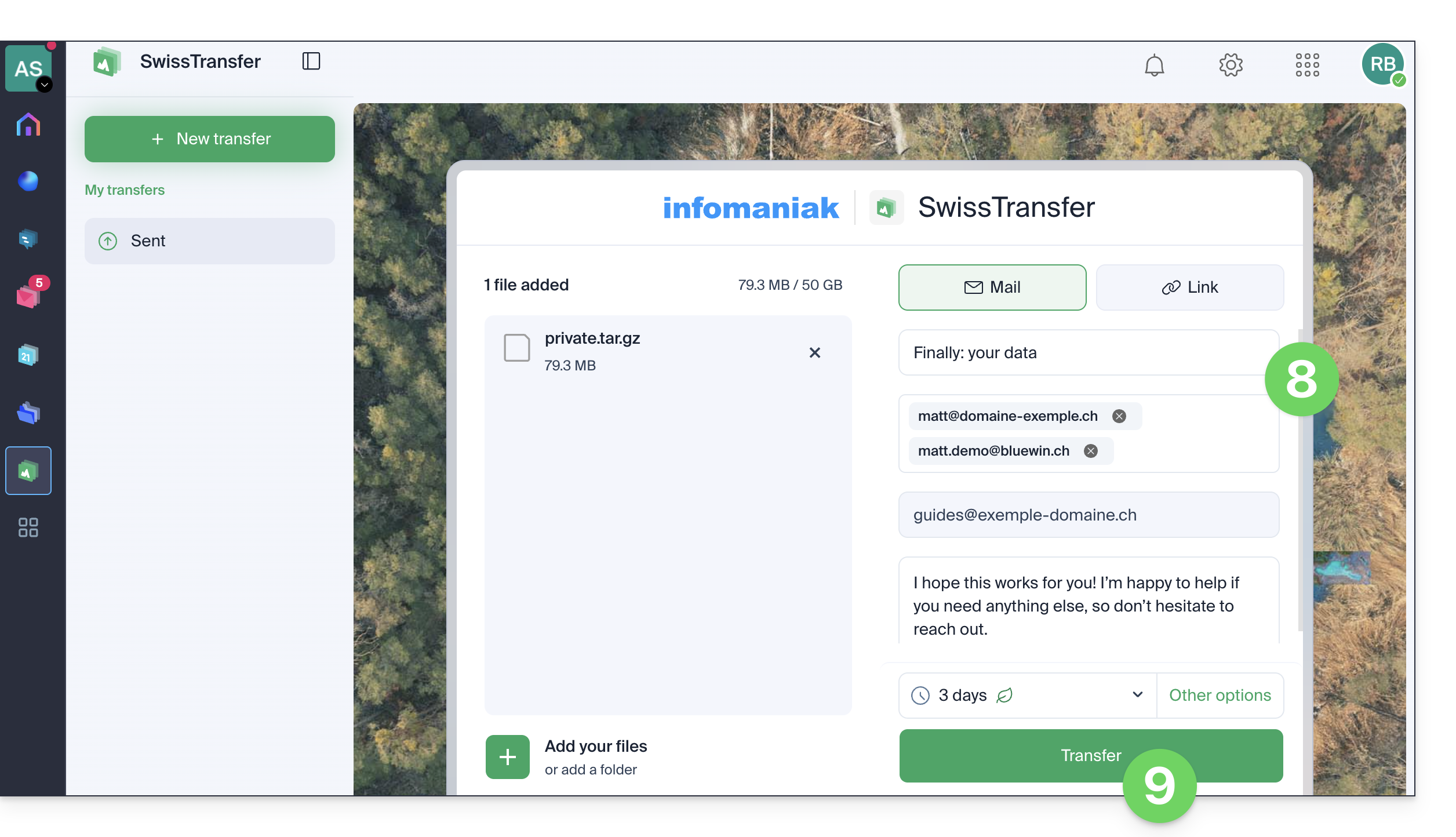
- Do not close the browser window until you see the confirmation message; if necessary, you can cancel the current upload:
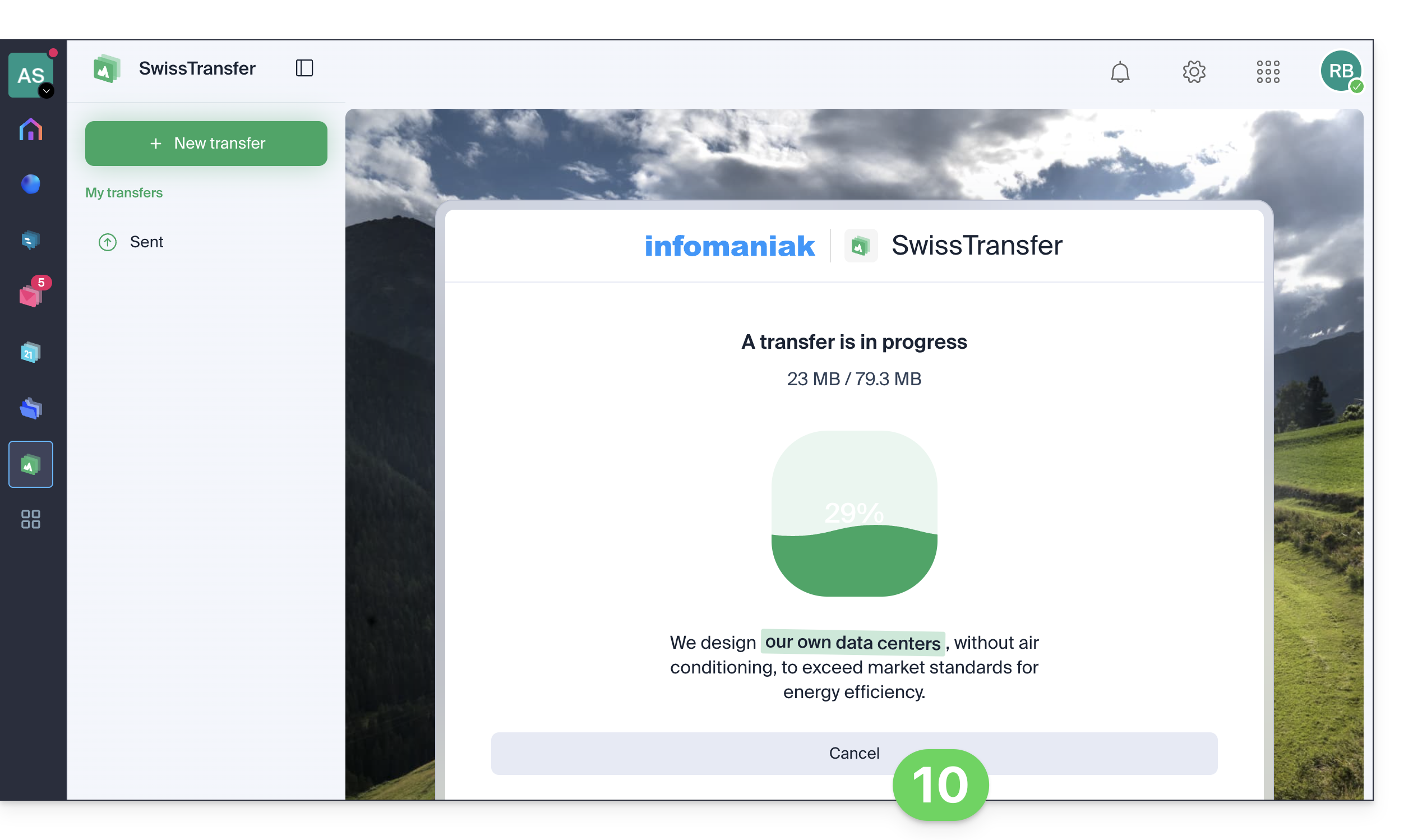
When a recipient downloads the file, an email is sent to the sender to notify them.
Manage transfer history
Keep track of your uploads and their details (including statistics):
- Access the Sent menu.
- Click on the action menu ⋮ to the right of the transfer you want to delete.
- Click on Delete to make it no longer available for download:
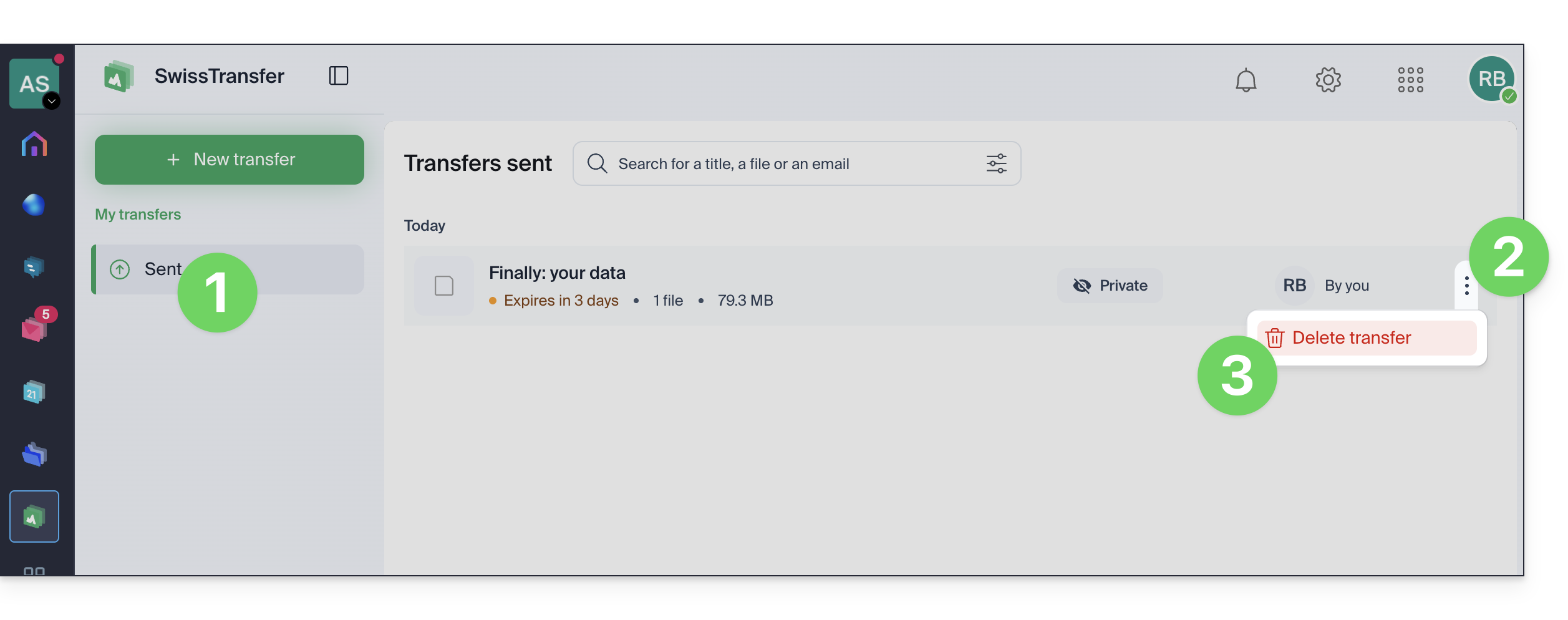
- Otherwise, click on the transfer to view details and download each file contained in the transfer.
Link to this FAQ: https://faq.infomaniak.com/2931
Has this FAQ been helpful?