Knowledge base
1000 FAQs, 500 tutorials and instructional videos. Here, there are only solutions!
This guide provides instructions for connecting to kDrive using the WebDAV connection protocol.
✘ UNAVAILABLE with
kSuite Free / kSuite Standard
my kSuite / my kSuite+ (ik.me, etik.com, ikmail.com)
⚠ WARNING ⚠
Use the WebDAV protocol on kDrive for specific and occasional use cases:
- If you want to work on your files and share them, kDrive is the ideal tool; it is recommended to install the kDrive application to avoid any file loss.
- However, to secure your data against loss or corruption and ensure business continuity, Swiss Backup is the essential and appropriate solution.
Infomaniak guarantees that its services comply with standard protocols (IMAP, S3, etc.) but does not provide additional support for external services or software, as their configuration may change depending on the provider or publisher(see:
Get your kDrive ID
To find your kDrive ID:
- Click here to access the Infomaniak kDrive web app (online service ksuite.infomaniak.com/kdrive).
- The kDrive file structure is displayed in the left-hand menu.
- The URL
https://ksuite.infomaniak.com/34567/kdrive/app/drive/123456/files/56789orhttps://ksuite.infomaniak.com/all/kdrive/app/drive/123456/displayed at the top of your browser contains a number: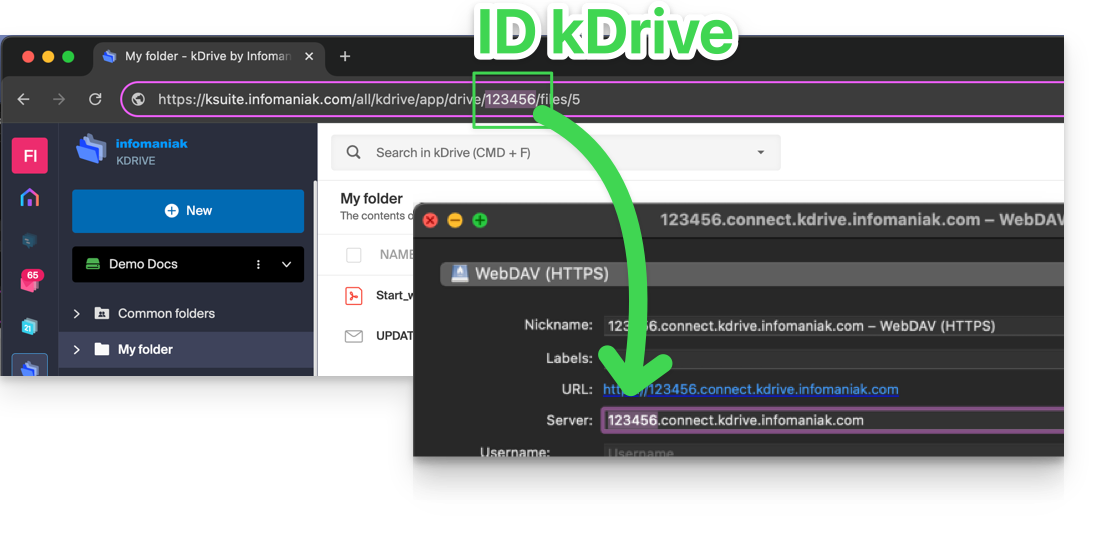
- In some cases, particularly when the Organization ID is mentioned in the URL, there may be several sets of numbers, but the principle remains the same: you need to take the number displayed after the term "/drive/":
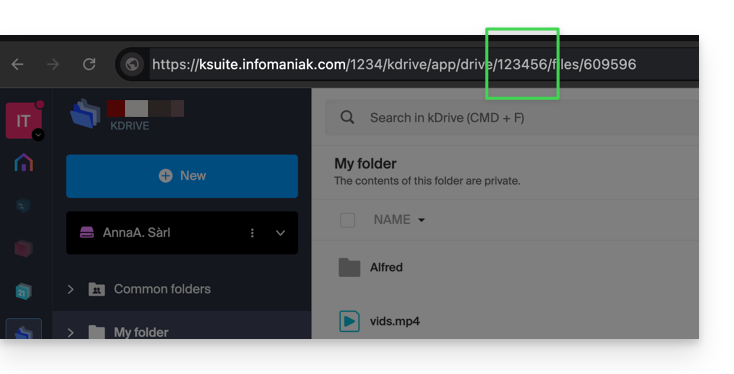
This number (in the example 123456) is your kDrive identifier (IDkDrive).
You will therefore need to enter https://IDkDrive.connect.kdrive.infomaniak.com whenever necessary (e.g. https://123456.connect.kdrive.infomaniak.com as your WebDAV address).
Specific WebDAV Guides
Examples of synchronization via WebDAV:
Direct WebDAV connection URL to a specific folder
To facilitate a direct connection via WebDAV to a specific folder, you can use the following URL (replacing 123456 as shown above):
{{URL_20}} documents/folder-nameThis simple method allows you to quickly access the desired folder without manually navigating through the directory structure. Simply replace "folder-name" with the exact name of the target folder to establish a direct and secure connection via WebDAV.
Link to this FAQ: https://faq.infomaniak.com/2409
Has this FAQ been helpful?
This guide explains how to synchronize your Obsidian vault on your Infomaniak kDrive via the WebDAV protocol. This way, you can keep your notes safe in a storage medium located in Switzerland.
✘ UNAVAILABLE with
kSuite Free / kSuite Standard
my kSuite / my kSuite+ (ik.me, etik.com, ikmail.com)
Introduction
- Obsidian is a powerful and extensible note-taking tool that uses local Markdown files to organize your knowledge.
- To avoid cluttering your kDrive directories, it is strongly recommended to create a dedicated folder in your personal kDrive directory, with a simple folder name such as "
obsidian" for example, and then specify it at the end of the WebDAV link in step 7 below: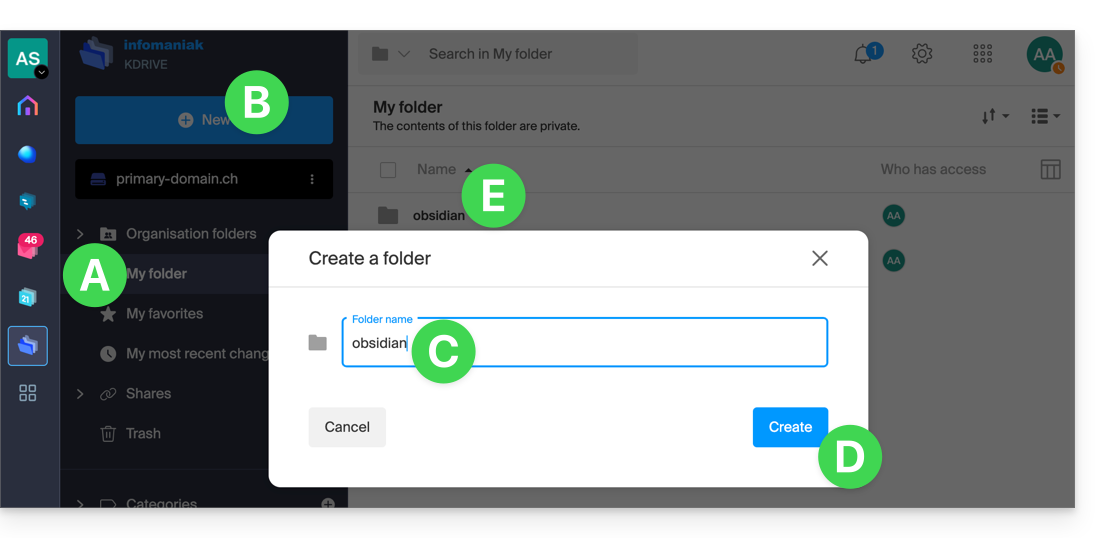
Configure Obsidian to use kDrive via WebDAV
Prerequisites
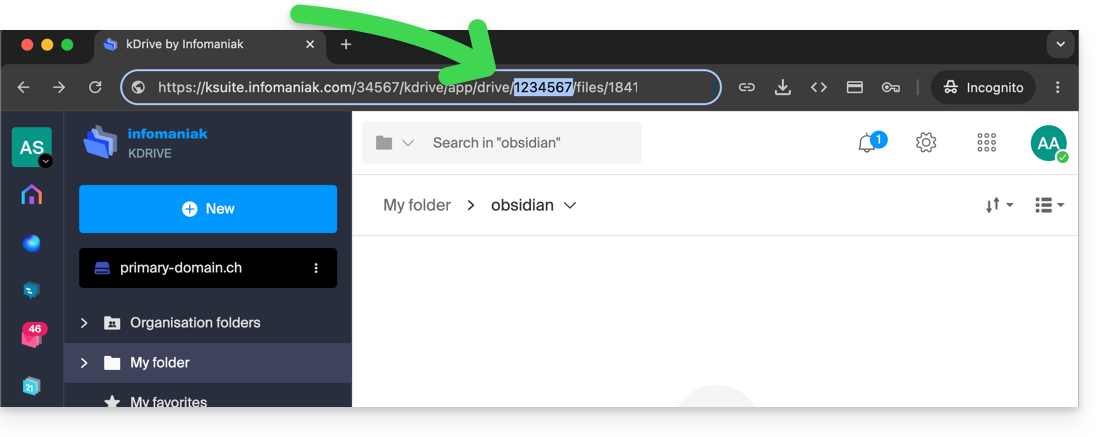
The integration is based on the community plugin WebDAV Sync, which ensures two-way synchronization:
- Open your vault in the Obsidian application.
- Go to Settings.
- Go to Community plugins.
- Enable them:
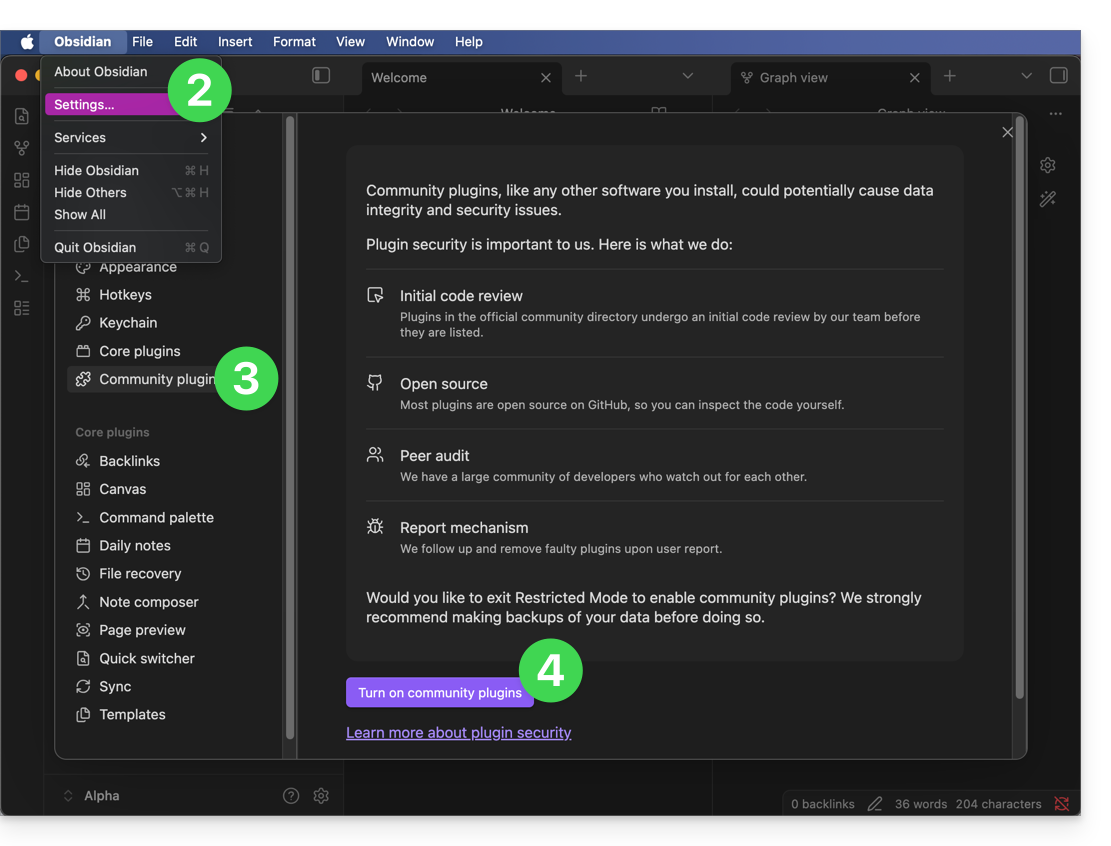
- Click on Browse:
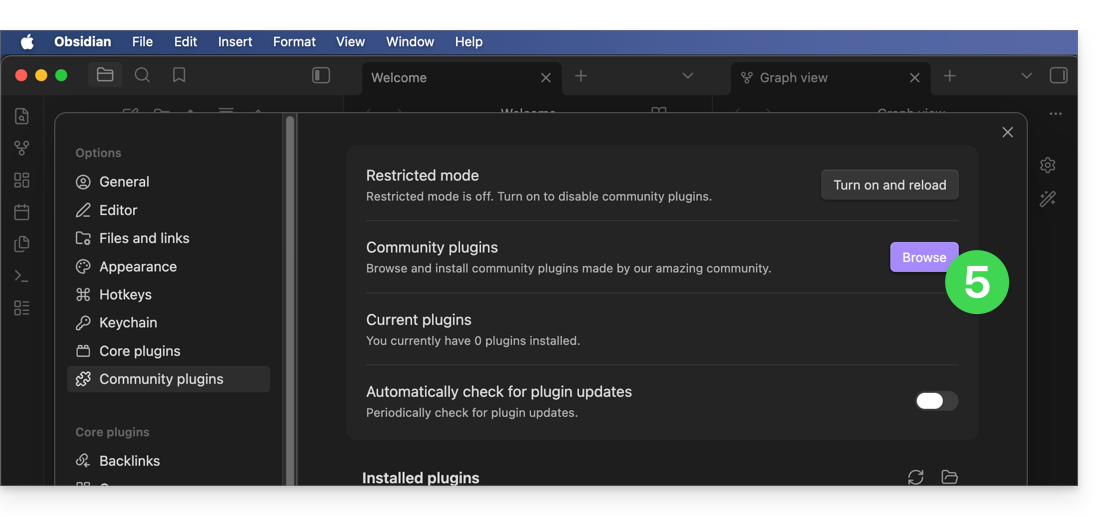
- Find the WebDAV Sync plugin, install it, and activate it:
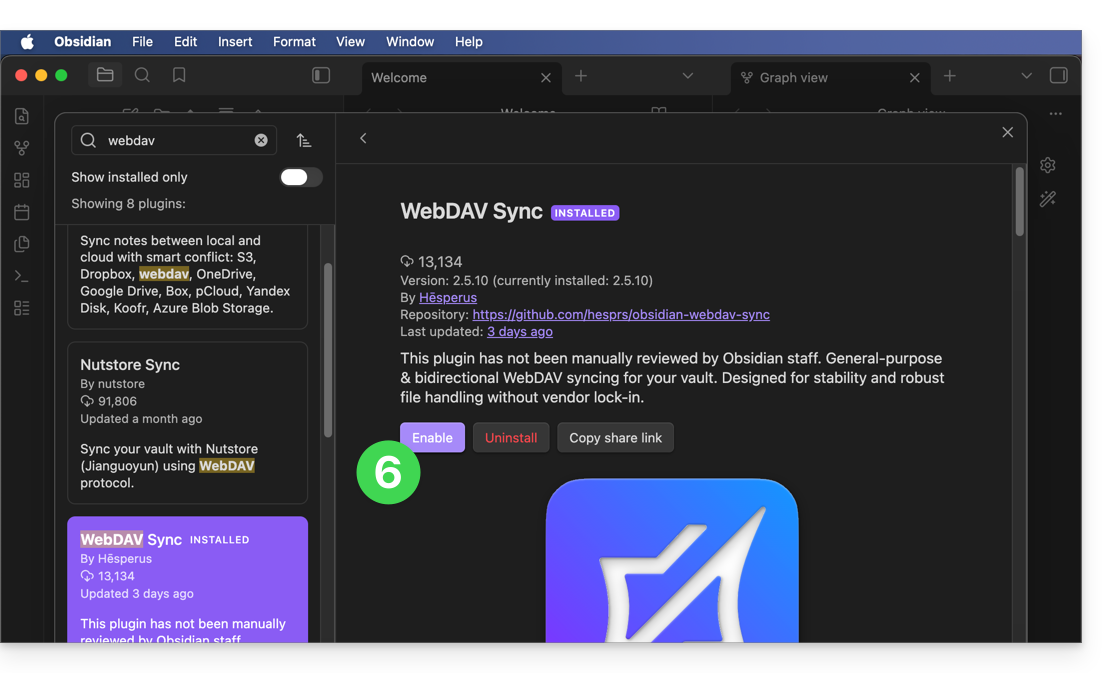
- Access the plugin settings to enter the WebDAV account parameters:
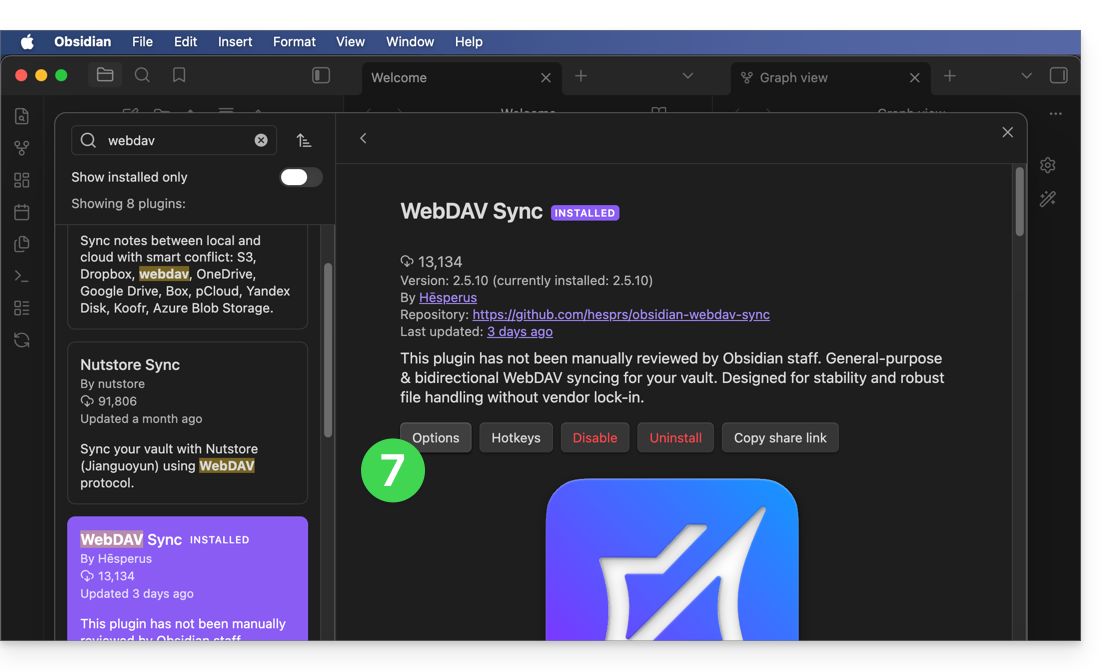
- Server address:
https://IDkDrive.connect.kdrive.infomaniak.com(see prerequisites) - Username: email address used to log in to your Infomaniak account
- Password: application password if two-factor authentication is enabled or your Infomaniak user account password if you have not enabled 2FA
- Name of the personal folder on kDrive, for example
/obsidian/or /folder name/ (see the introduction above)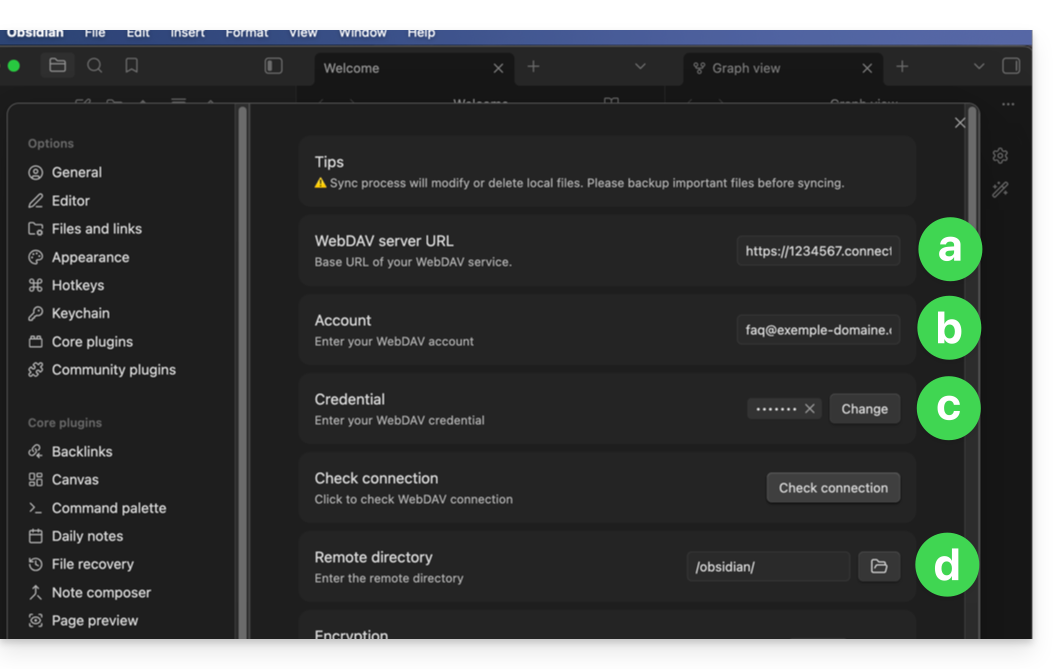
- Server address:
- Configure the plugin's behavior according to your preferences (synchronization on startup, scheduled, or in real time) and validate.
- Start a first synchronization test to validate proper communication with kDrive:
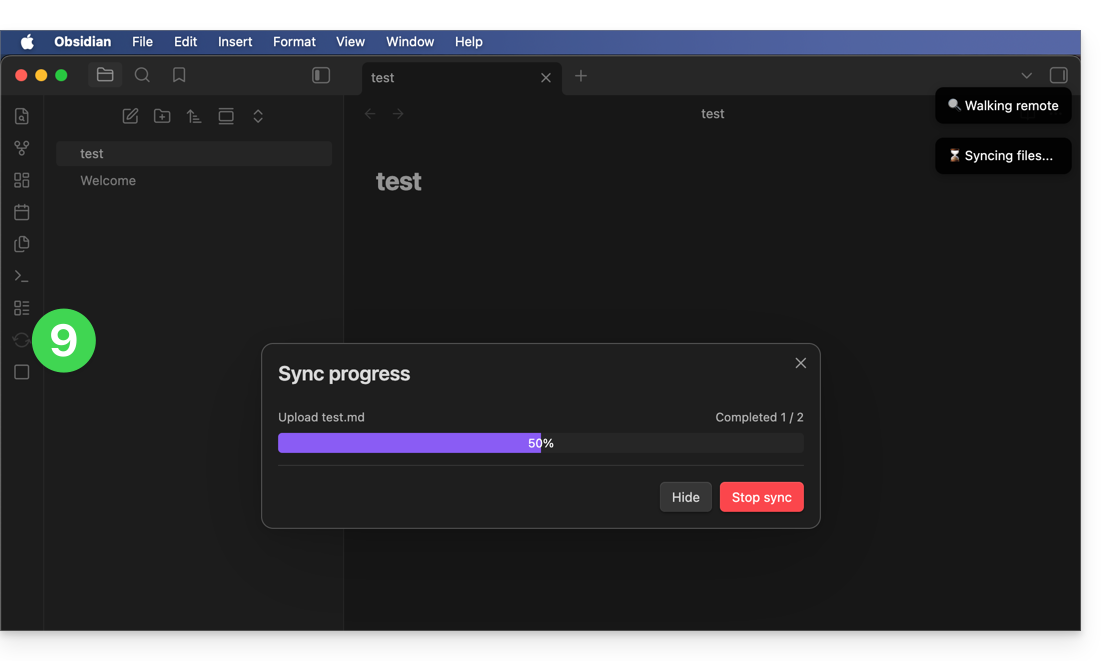
- Once the confirmation is validated, the synchronization will run in the background to protect the integrity of your notes:
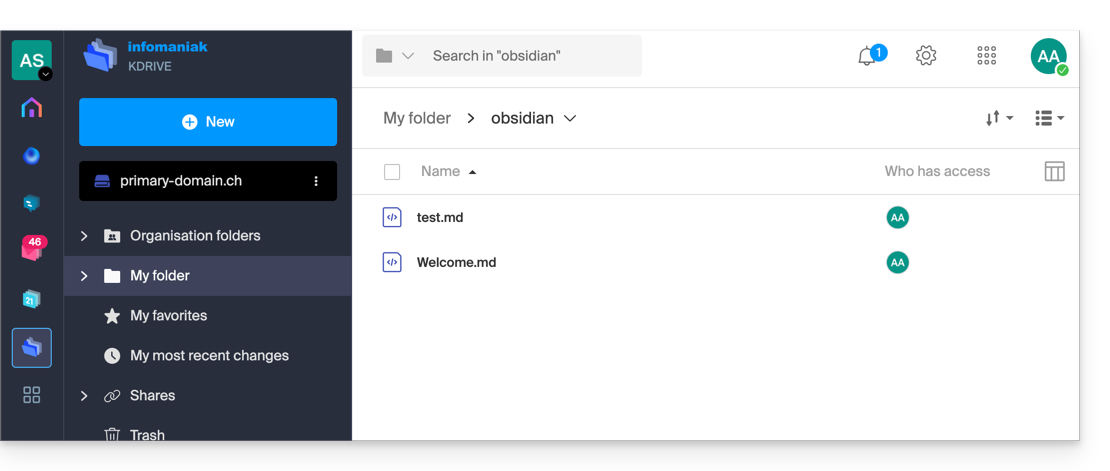
Link to this FAQ: https://faq.infomaniak.com/2910
Has this FAQ been helpful?
This guide explains how to store the database for Joplin on your Infomaniak kDrive and connect your various devices to it via the WebDAV protocol. This way, you can keep your notes safe and secure in a storage solution located in Switzerland.
✘ UNAVAILABLE with
kSuite Free / kSuite Standard
my kSuite / my kSuite+ (ik.me, etik.com, ikmail.com)
Introduction
- Joplin is a free and open-source note-taking tool that allows you to organize all your notes into folders and access them from any device (computer, mobile device, etc.).
- Joplin will store several of its configuration files, so to avoid cluttering your kDrive directories, it is recommended to create a dedicated folder in your personal directory on kDrive, with a simple folder name such as "
joplin" for example, and then specify it at the end of the WebDAV link in step 6 below: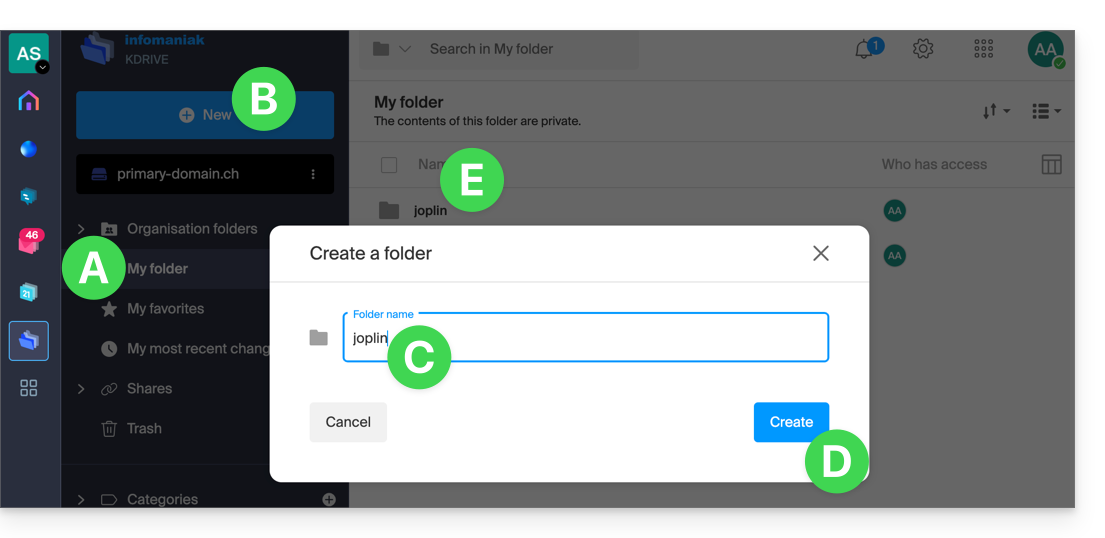
Configure Joplin to use kDrive via WebDAV
Prerequisites
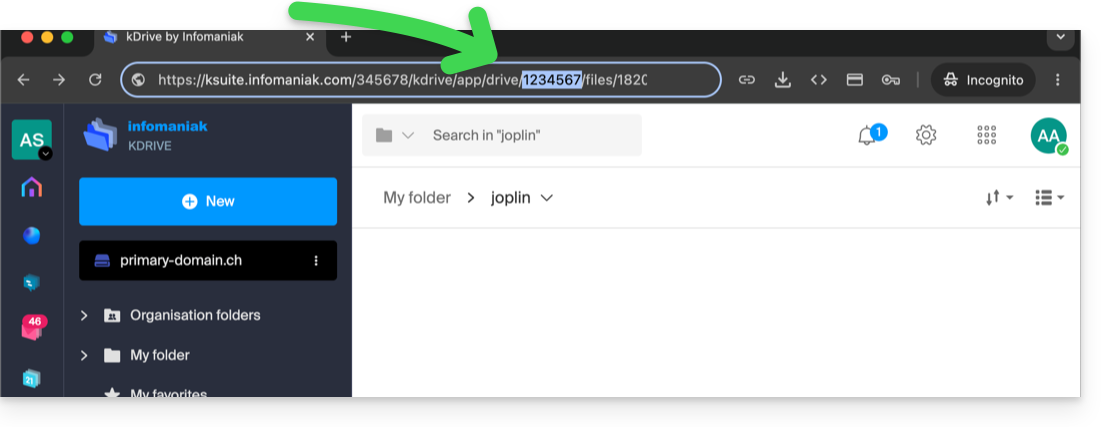
The example below is virtually identical across all versions of Joplin:
- Open the Joplin application.
- Go to the application's settings:
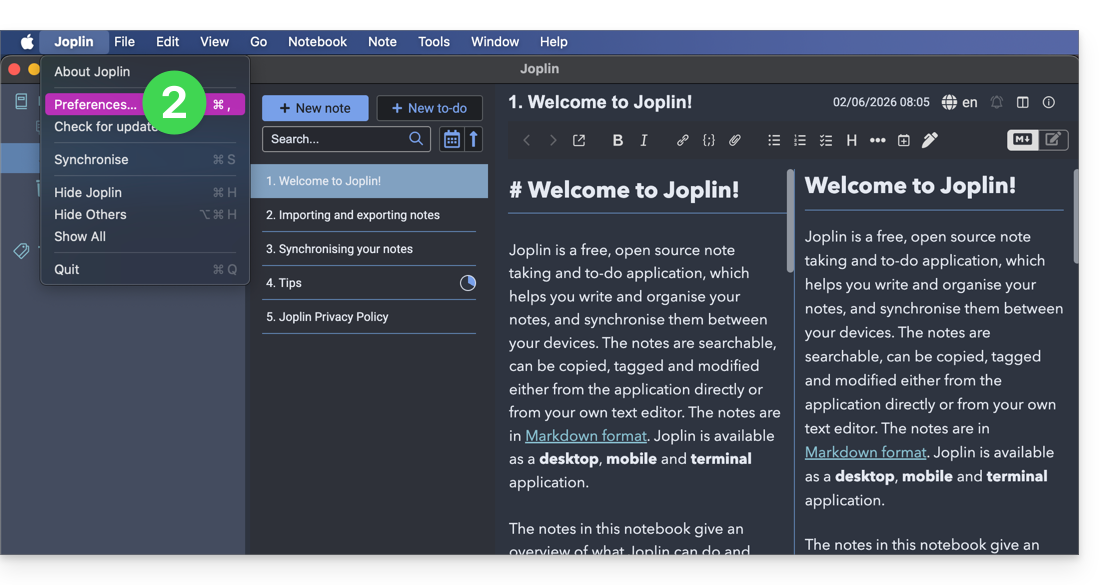
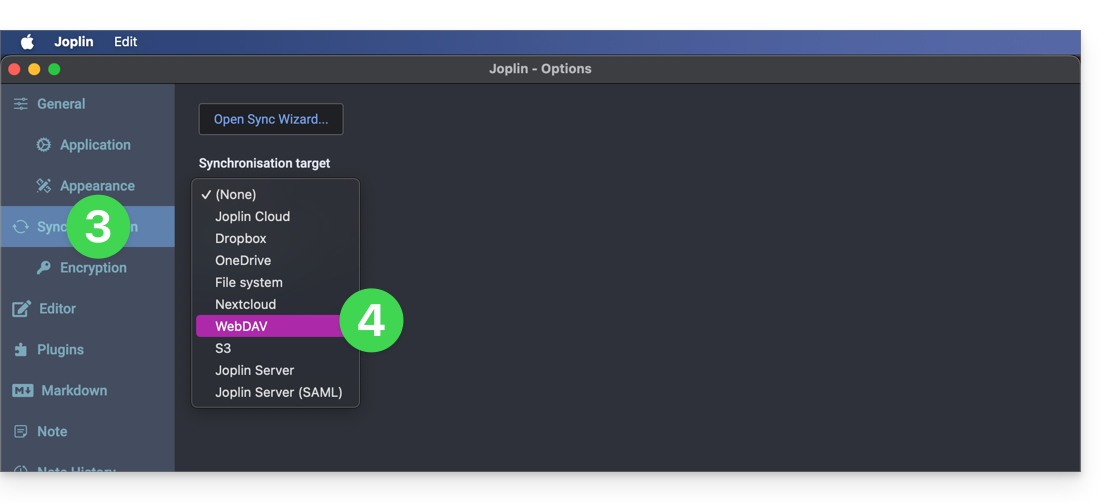
- Tap Sync.
- Tap the menu to select a target.
- Choose the WebDAV mode:
- For account settings, use the following information:
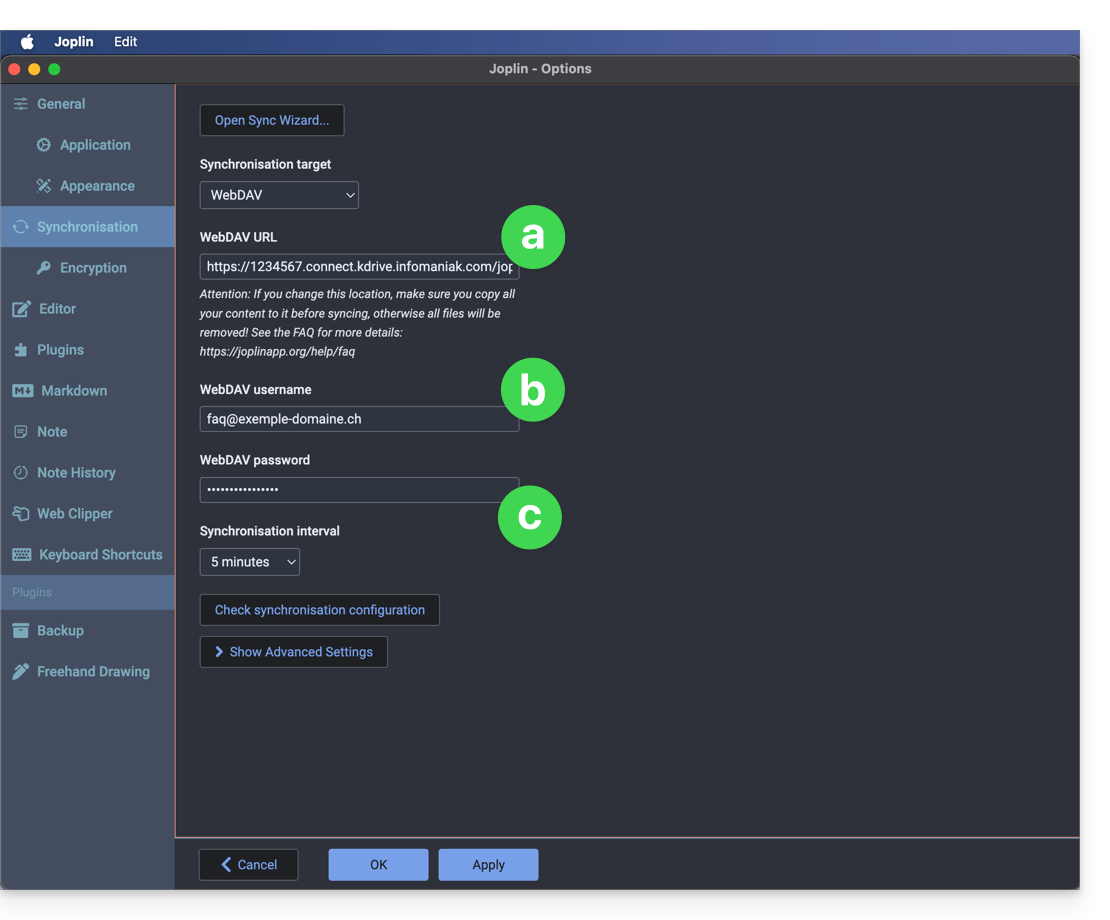
- Server address:
https://IDkDrive.connect.kdrive.infomaniak.com(see prerequisites) followed by/joplinor /folder name (see the introduction above) - Username: email address used to log in to your Infomaniak account
- Password: application password if two-factor authentication is enabled or your Infomaniak user account password if you have not enabled 2FA
- Server address:
- Click on the synchronization test below and wait for the connection confirmation.
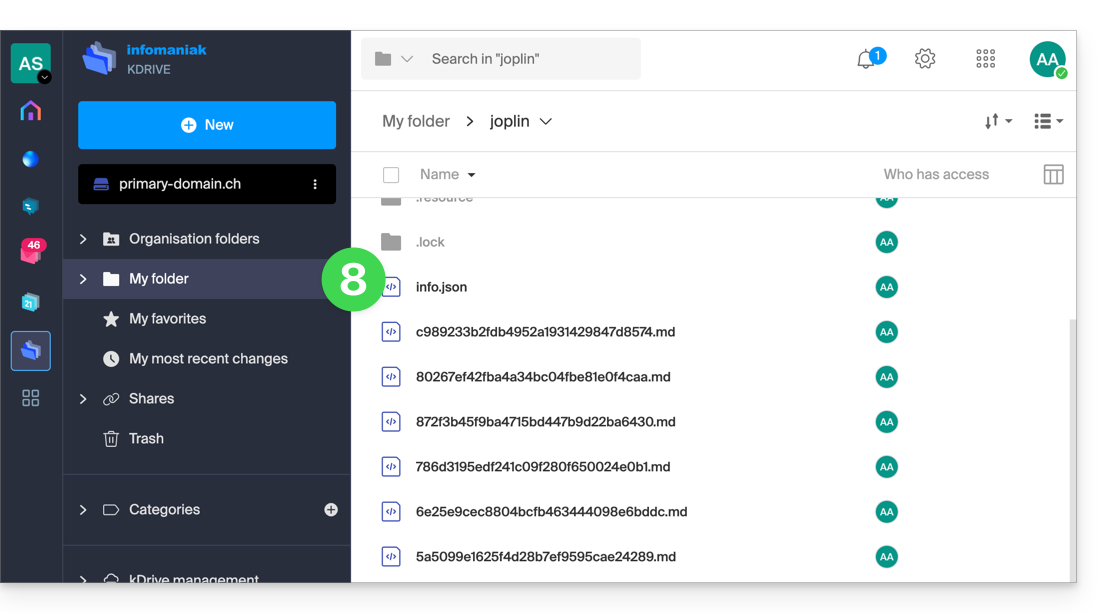
- Check in your kDrive folder that the Joplin files have been written correctly:
- Go back to the notes to start working.
Link to this FAQ: https://faq.infomaniak.com/1800
Has this FAQ been helpful?
This guide provides instructions for synchronizing kDrive with Linux using the WebDAV connection protocol.
✘ UNAVAILABLE with
kSuite Free / kSuite Standard
my kSuite / my kSuite+ (ik.me, etik.com, ikmail.com)
Introduction
- Most recent software supporting the WebDAV protocol is compatible with kDrive offers that also support WebDAV. Infomaniak cannot guarantee the compatibility of the service with external applications and does not provide support for this protocol.
- It is recommended toinstall the kDrive application to prevent any file loss.
Connect to kDrive via WebDAV on Linux (Gnome)
To do this:
- Open Files.
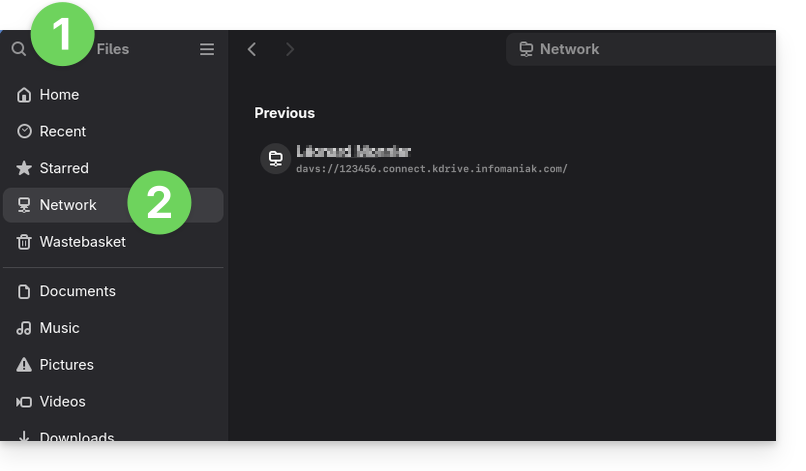
- In the sidebar, click on Network:
- Enter the server address:
davs://IDkDrive.connect.kdrive.infomaniak.com(need help?). - Click on Connect.
- For the account settings, use the following information:
- Username: the email address you use to log in to your Infomaniak account.
- Password: create an application password for this specific use.
- Click on Log in.
Link to this FAQ: https://faq.infomaniak.com/2894
Has this FAQ been helpful?
This guide provides instructions for synchronizing kDrive with Windows using the WebDAV connection protocol.
✘ UNAVAILABLE with
kSuite Free / kSuite Standard
my kSuite / my kSuite+ (ik.me, etik.com, ikmail.com)
⚠ WARNING ⚠
Use the WebDAV protocol on kDrive for specific and occasional use cases:
- If you want to work on your files and share them, kDrive is the ideal tool; it is recommended to install the kDrive application to avoid any file loss.
- However, to secure your data against loss or corruption and ensure the continuity of your business, Swiss Backup is the essential and appropriate solution.
Infomaniak guarantees that its services comply with standard protocols (IMAP, S3, etc.) but does not provide additional support for external services or software, as their configuration may change depending on the provider or publisher(see:
Connect to kDrive via WebDAV on Windows
For a Windows PC:
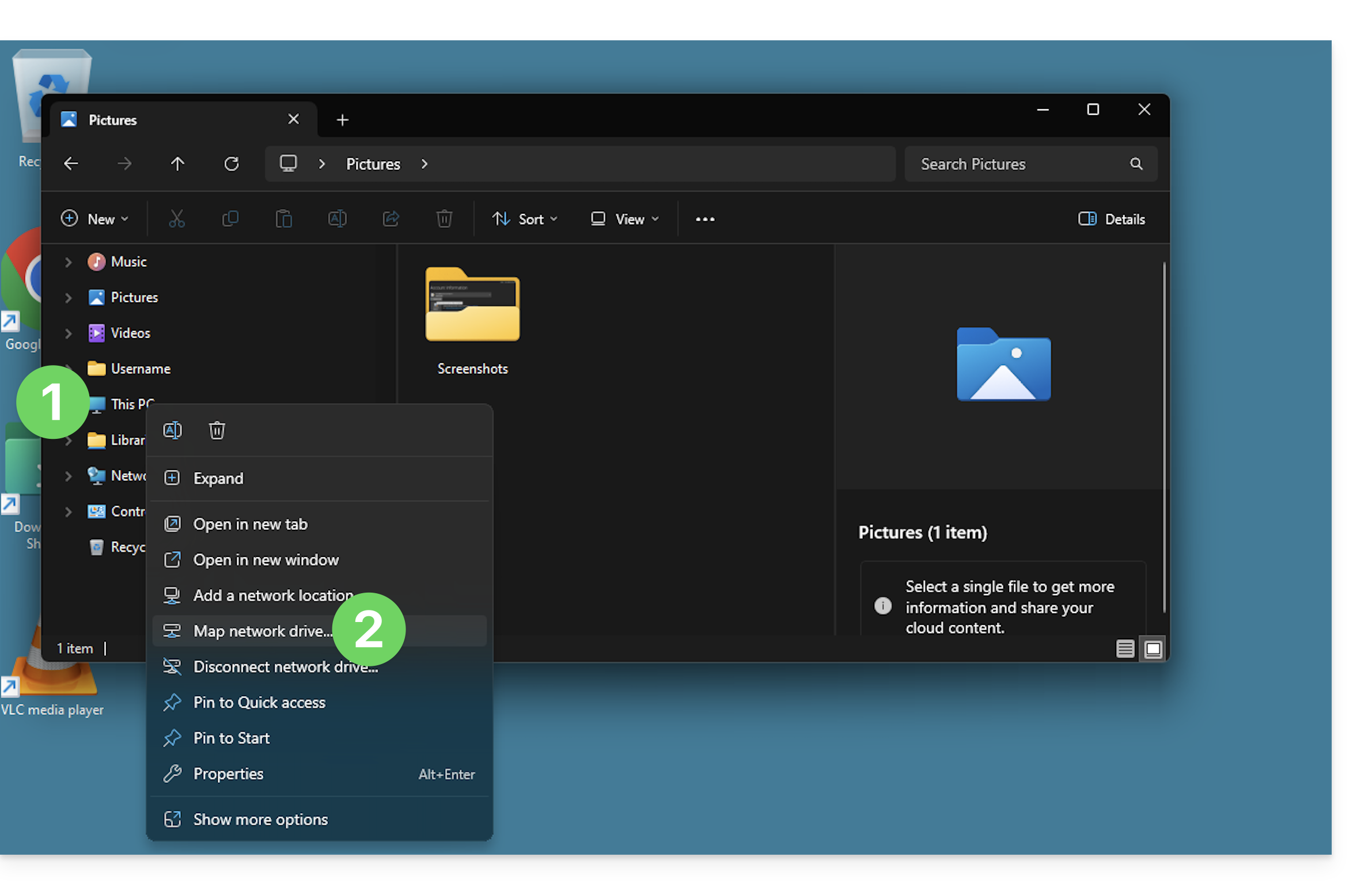
- Right-click on This PC (formerly “My Computer”) in File Explorer or the Start menu.
- Click on Connect a network drive:
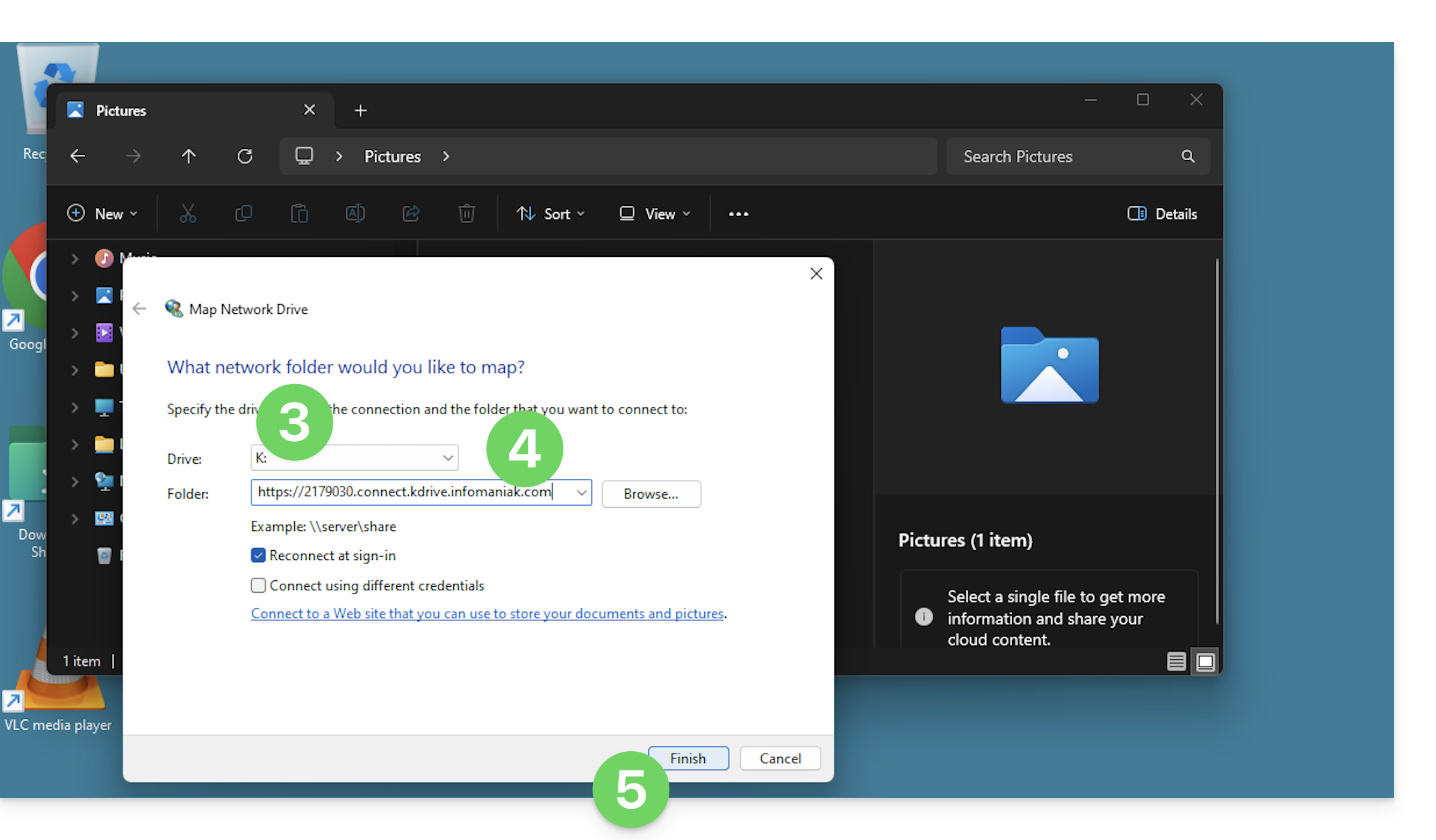
- Enter a letter to designate the kDrive virtual drive.
- Enter the server address:
https://IDkDrive.connect.kdrive.infomaniak.com(need help?). - Click on Finish to log in:
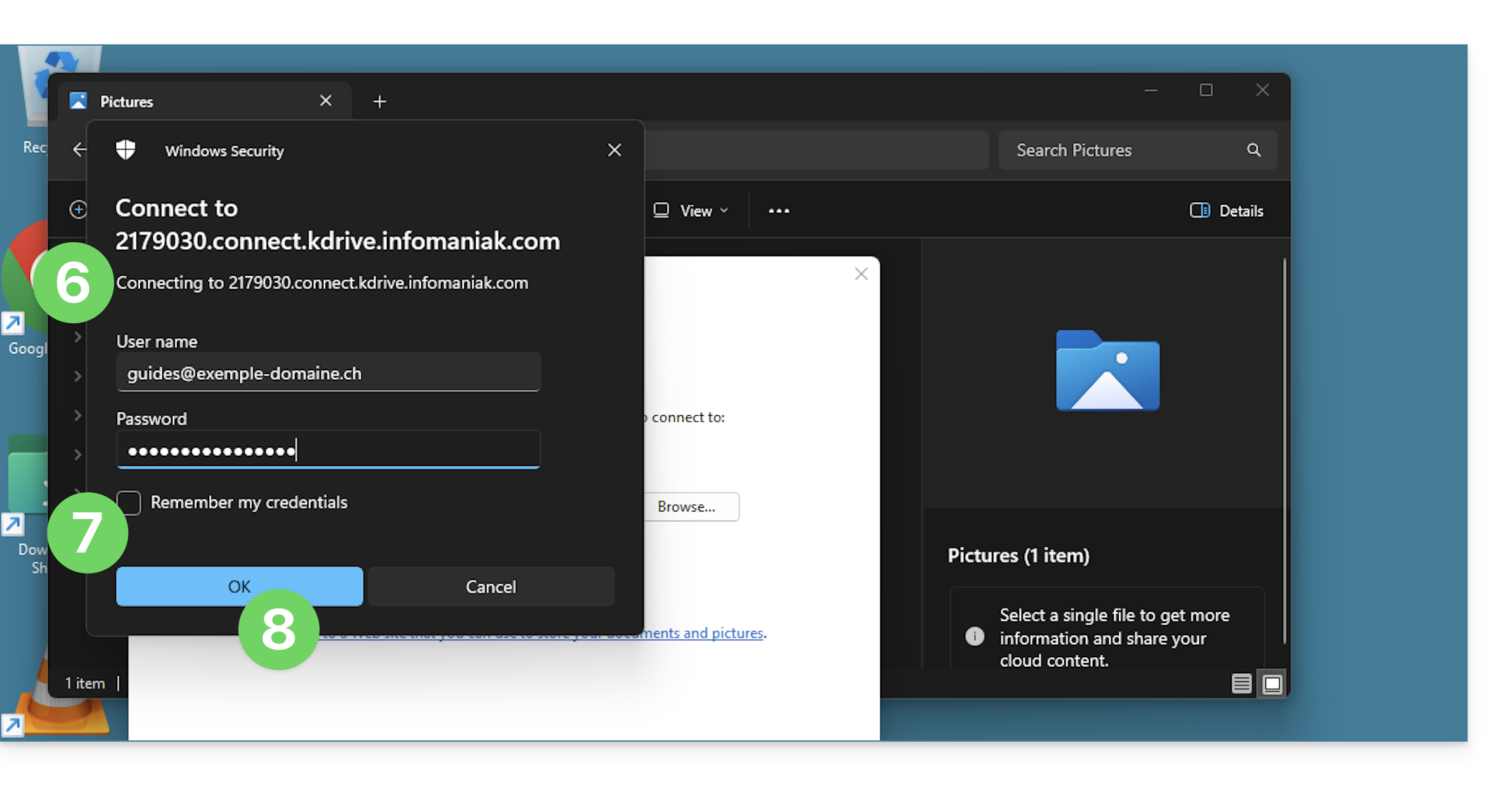
- Enter the following information:
- Username: the email address you use to log in to your Infomaniak account.
- Password: create an application password for this specific use.
- If desired, click the box to save the login information.
- Confirm the connection by clicking the button:
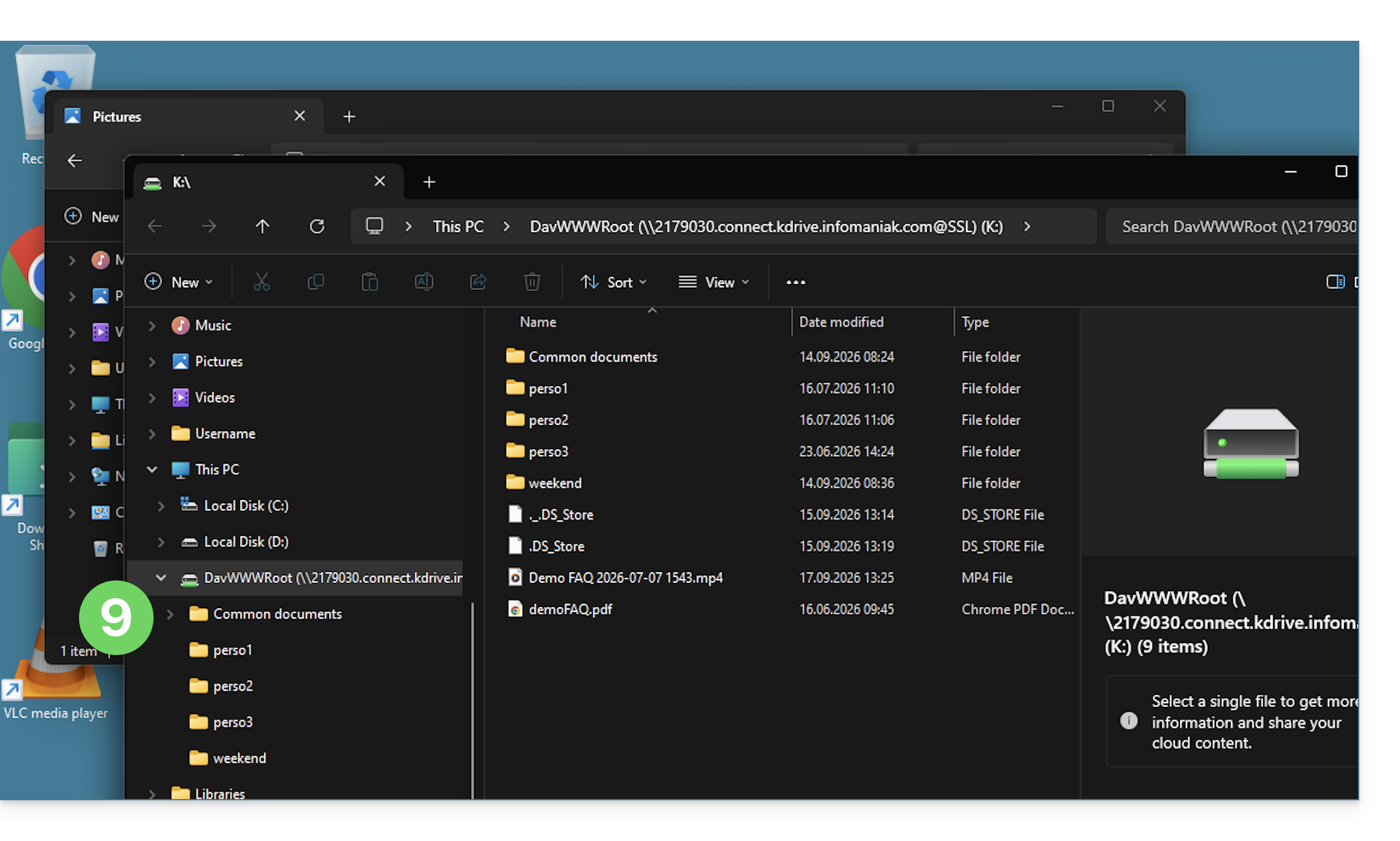
- The kDrive content is now displayed in the file explorer, just like it is accessible in kDrive for your Infomaniak user:
The Mountain Duck alternative
Using the same principle and with the same information, you can also consider connecting via a WebDAV software/client such as Mountain Duck:
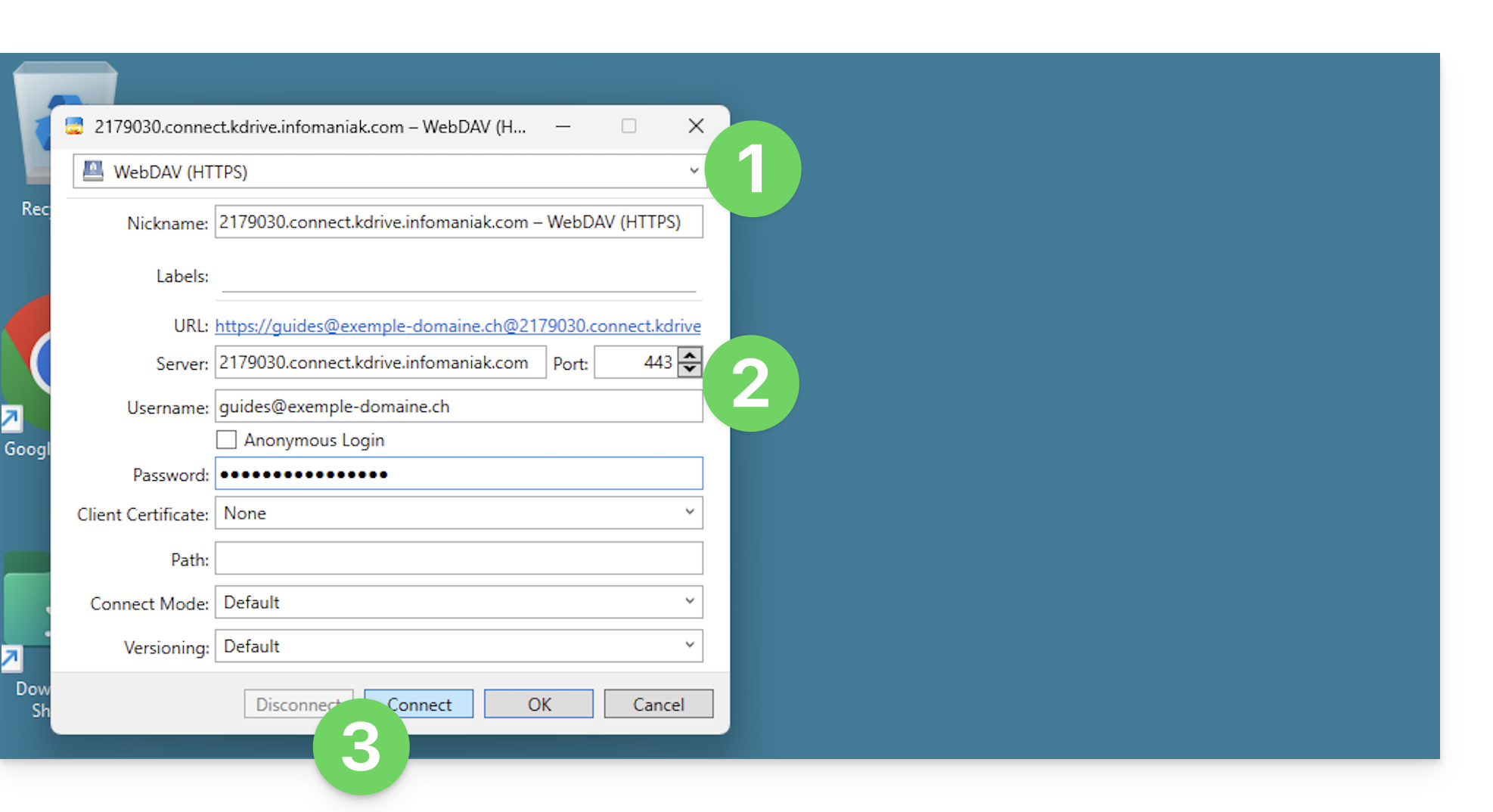
- Create a new WebDAV connection in Mountain Duck.
- Enter the appropriate information.
- Click on Log in:
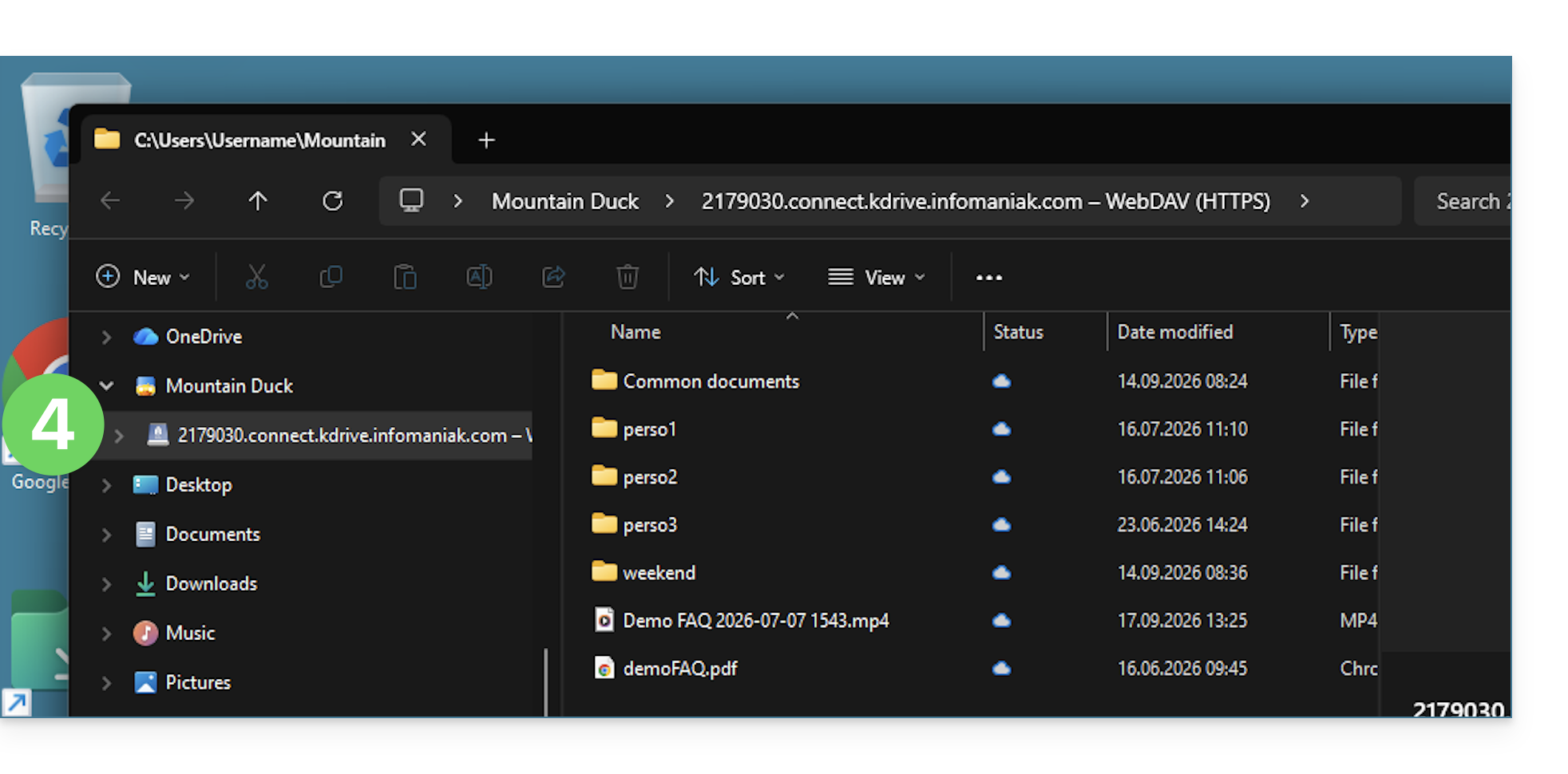
- There you go, the kDrive content is now displayed in the file explorer, just like what is accessible on kDrive for your Infomaniak user:
Link to this FAQ: https://faq.infomaniak.com/2419
Has this FAQ been helpful?
This guide provides instructions for synchronizing kDrive with macOS using the WebDAV connection protocol.
✘ UNAVAILABLE with
kSuite Free / kSuite Standard
my kSuite / my kSuite+ (ik.me, etik.com, ikmail.com)
⚠ WARNING ⚠
Use the WebDAV protocol on kDrive for specific and occasional use cases:
- If you want to work on your files and share them, kDrive is the ideal tool; it is recommended to install the kDrive application to avoid any file loss.
- However, to secure your data against loss or corruption and ensure the continuity of your business, Swiss Backup is the essential and appropriate solution.
Infomaniak guarantees that its services comply with standard protocols (IMAP, S3, etc.) but does not provide additional support for external services or software, as their configuration may change depending on the provider or publisher(see:
Connect to kDrive via WebDAV on macOS
For a macOS computer, follow the Apple instructions, which may look like this:
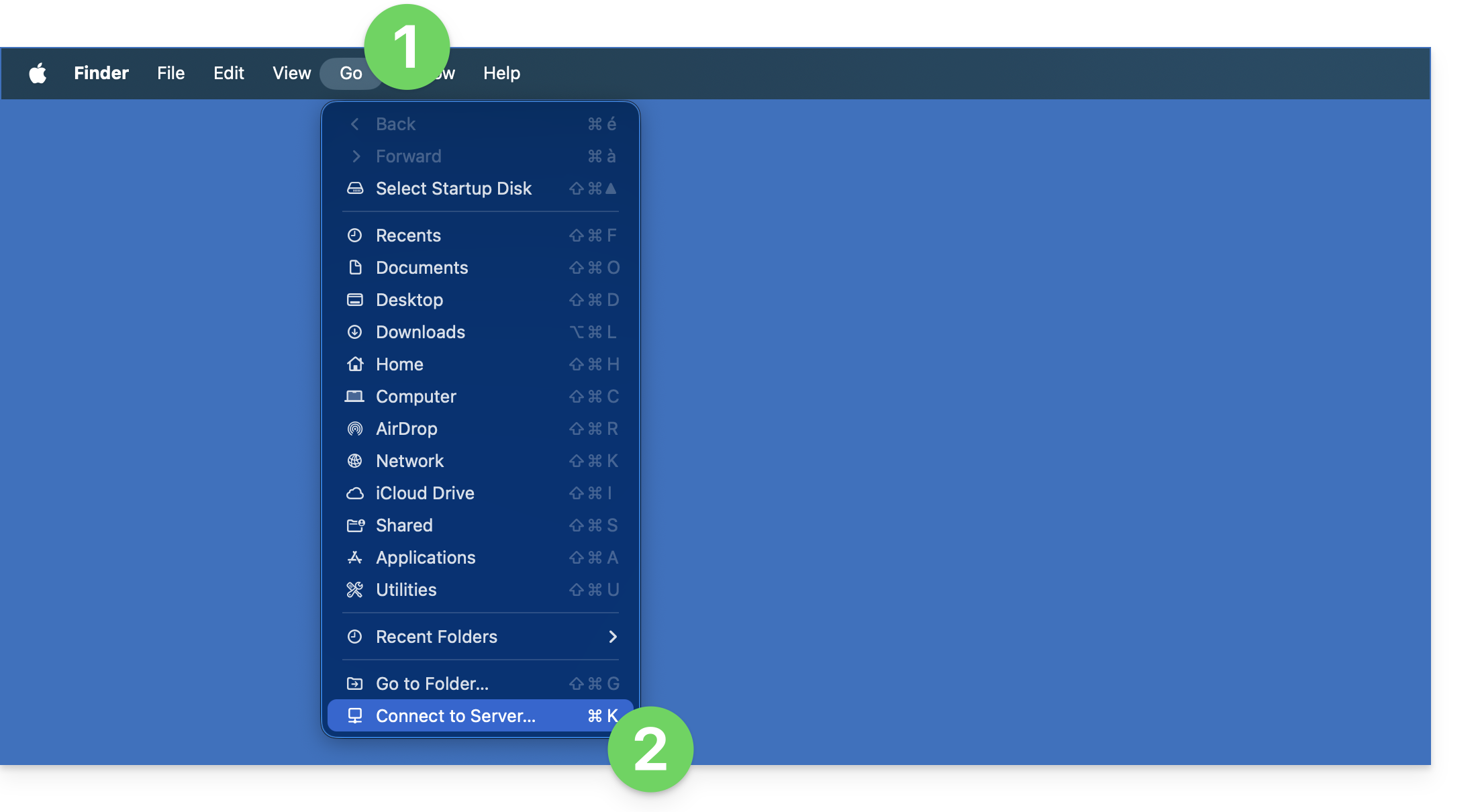
- Click on the Go menu in Finder.
- Click on Connect to Server:
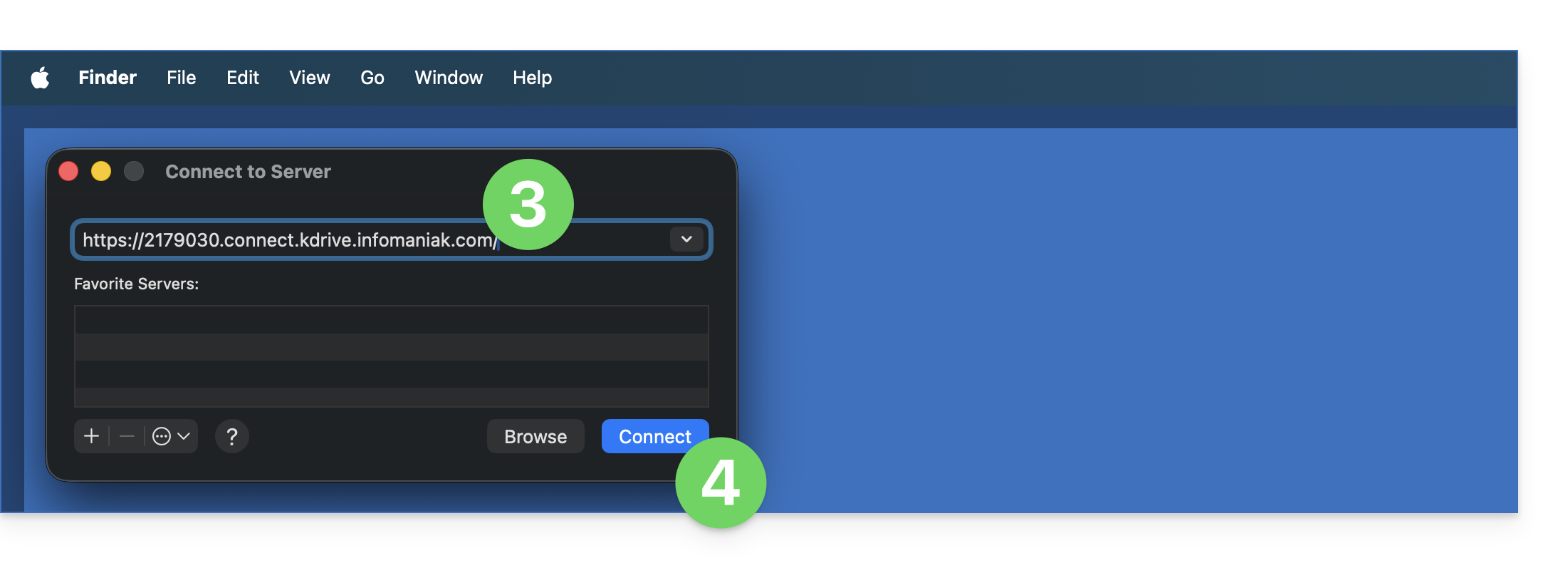
- Enter the server address:
https://IDkDrive.connect.kdrive.infomaniak.com(need help?). - Click on Connect:
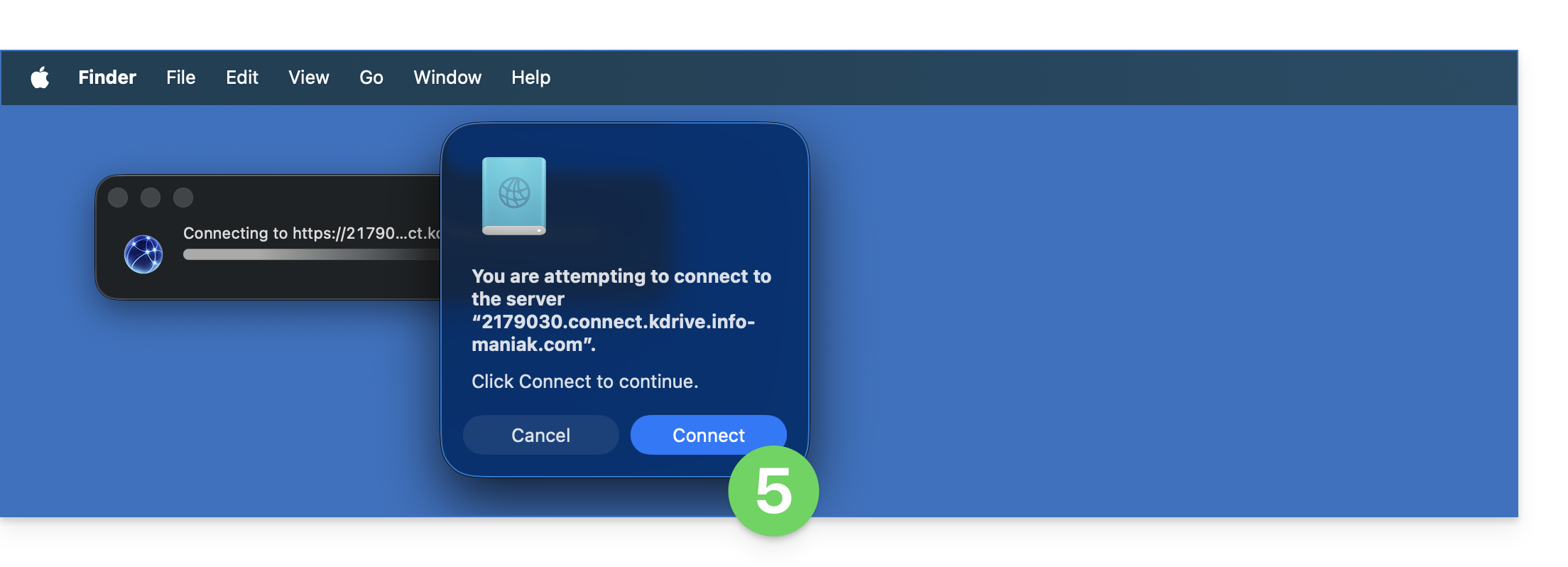
- Confirm the connection by clicking on the blue button:
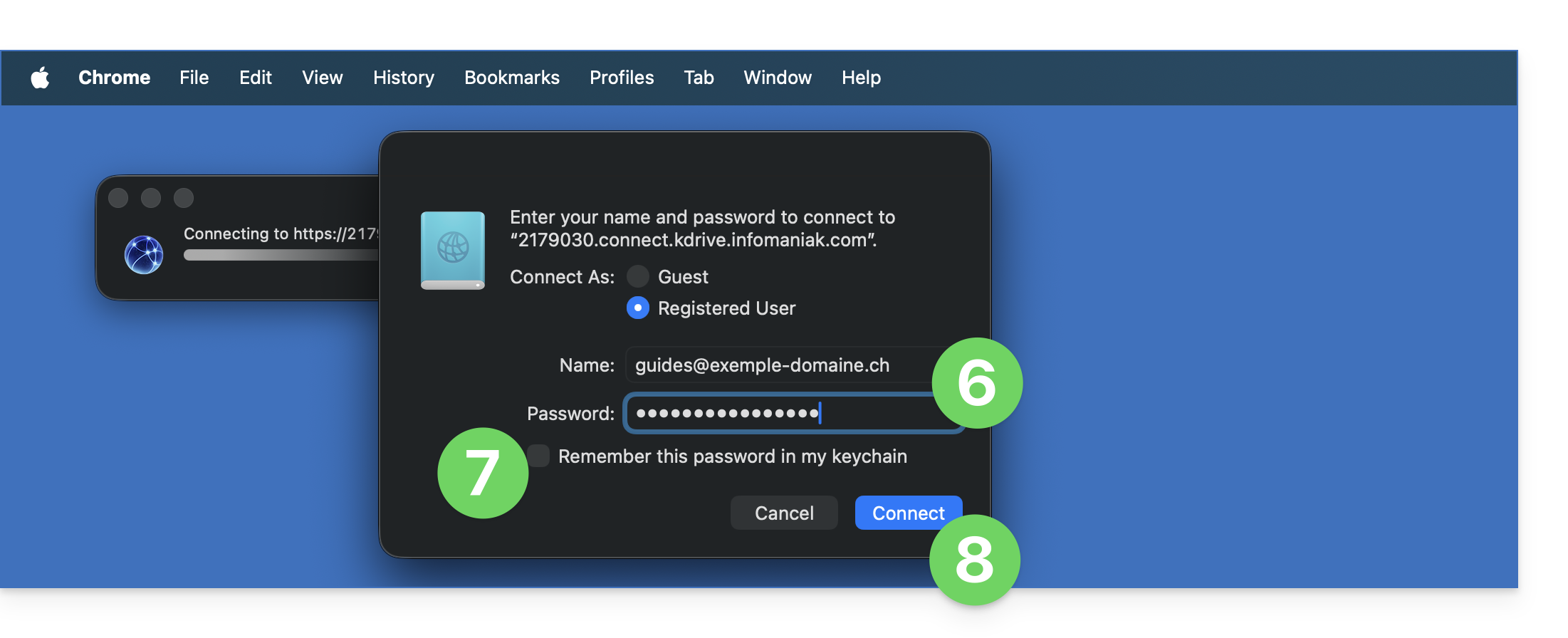
- Enter the following information:
- Username: the email address you use to log in to your Infomaniak account.
- Password: create an application password for this specific use.
- If desired, click the box to save your login information.
- Click the blue button to log in:
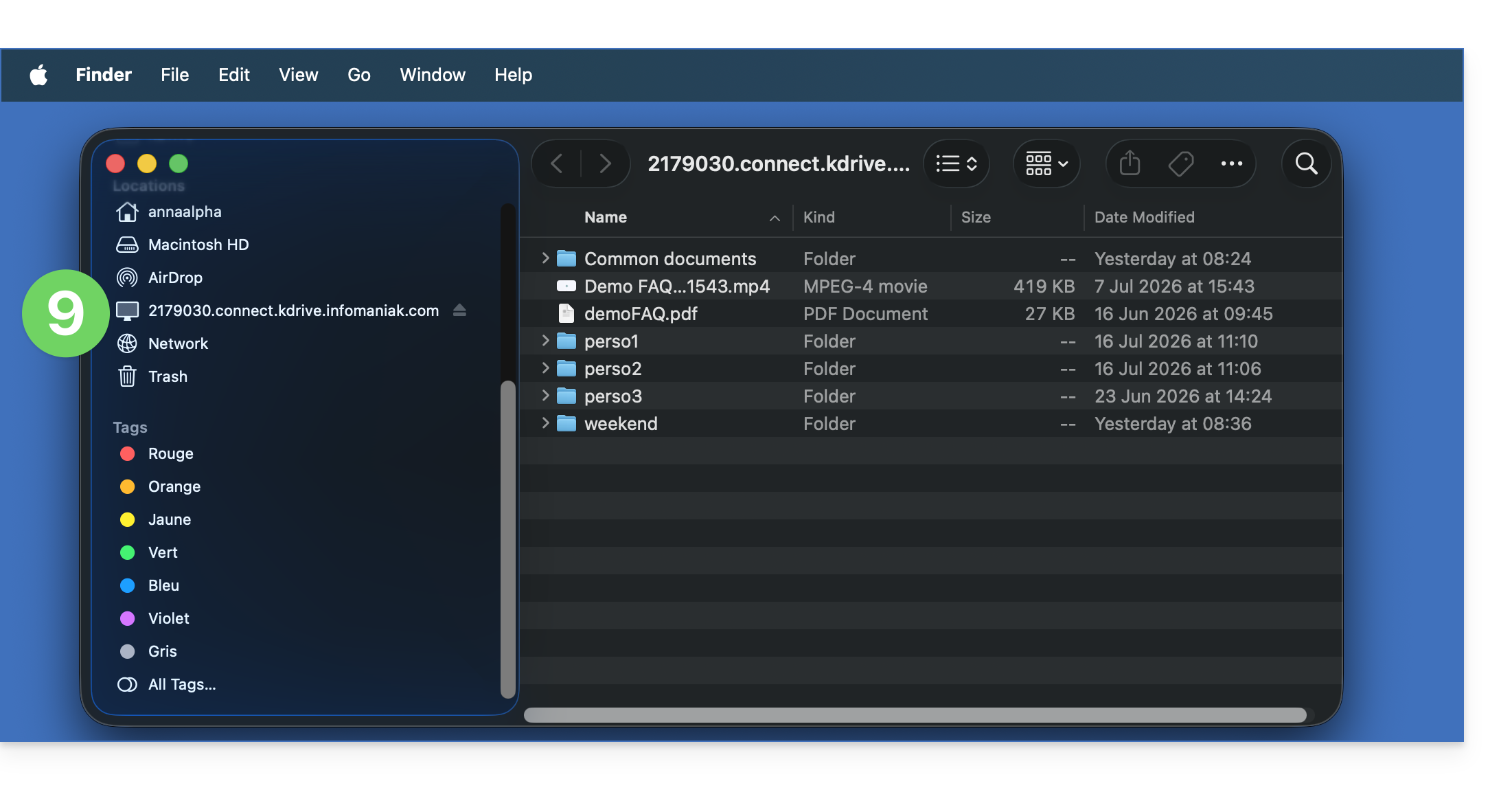
- The kDrive content is now displayed in Finder, just like the content accessible on kDrive for your Infomaniak user:
The Mountain Duck alternative
Using the same principle and with the same information, you can also consider connecting via a WebDAV software/client such as Mountain Duck:
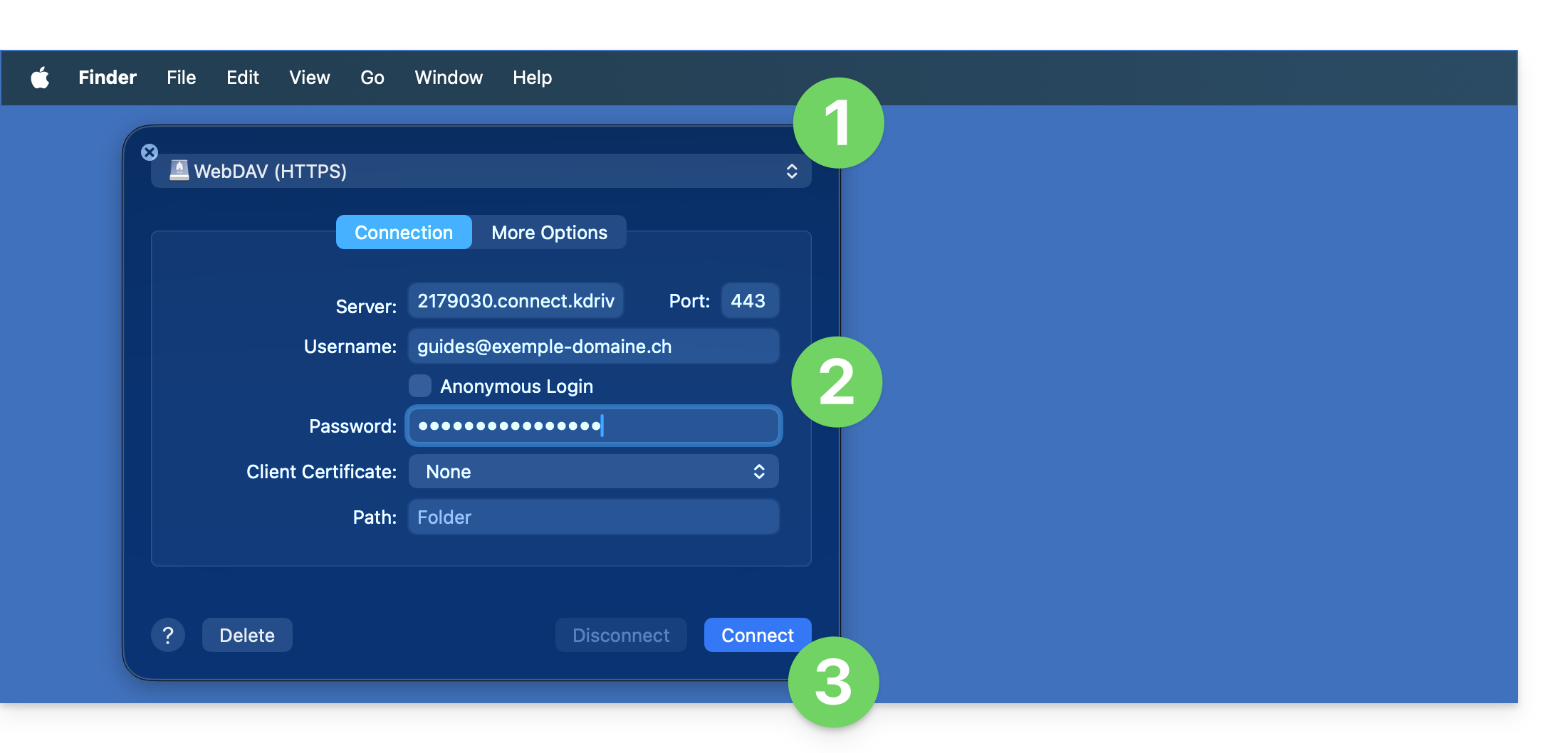
- Create a new WebDAV connection in Mountain Duck.
- Enter the appropriate information.
- Click on Log in:
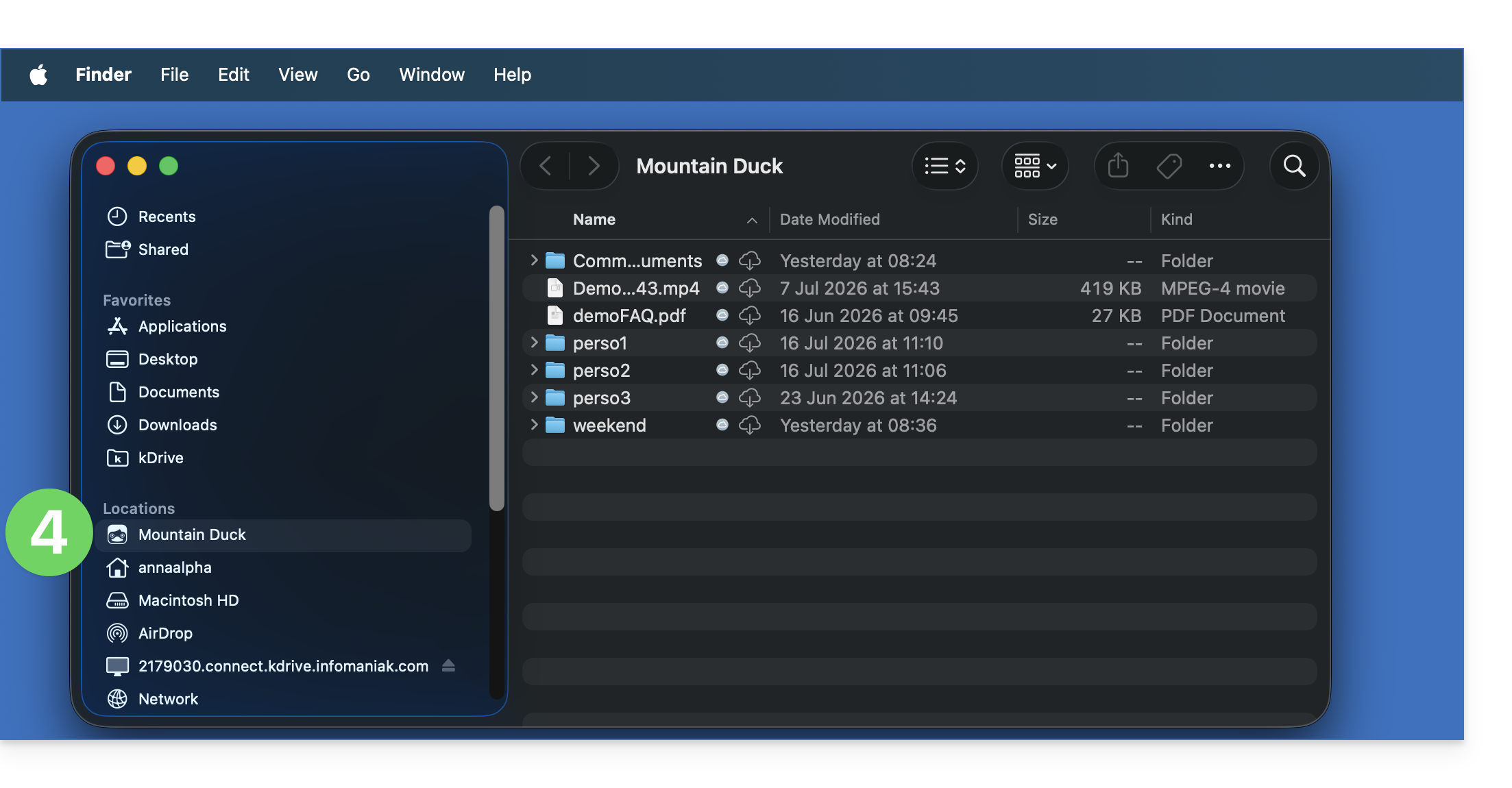
- There you go, the kDrive content is now displayed in Finder, just like what is accessible on kDrive for your Infomaniak user:
Link to this FAQ: https://faq.infomaniak.com/2504
Has this FAQ been helpful?
This guide provides instructions for synchronizing kDrive with a QNAP NAS (or vice versa) via the WebDAV protocol, which can be found in the HBS 3 Hybrid Backup Sync application.
✘ UNAVAILABLE with
kSuite Free / kSuite Standard
my kSuite / my kSuite+ (ik.me, etik.com, ikmail.com)
Prerequisites
- You must have a Qnap NAS that is accessible from the internet.
- Know your kDrive ID (kDrive ID).
Synchronize kDrive and Qnap via HBS 3
To do this:
- Log in to the Qnap NAS administration interface (QTS).
- If necessary, download and install the HBS 3 Hybrid Backup Sync app.
- Open HBS 3.
- Go to Sync from the menu on the left.
- Create a synchronization task (Two-way Sync Job).
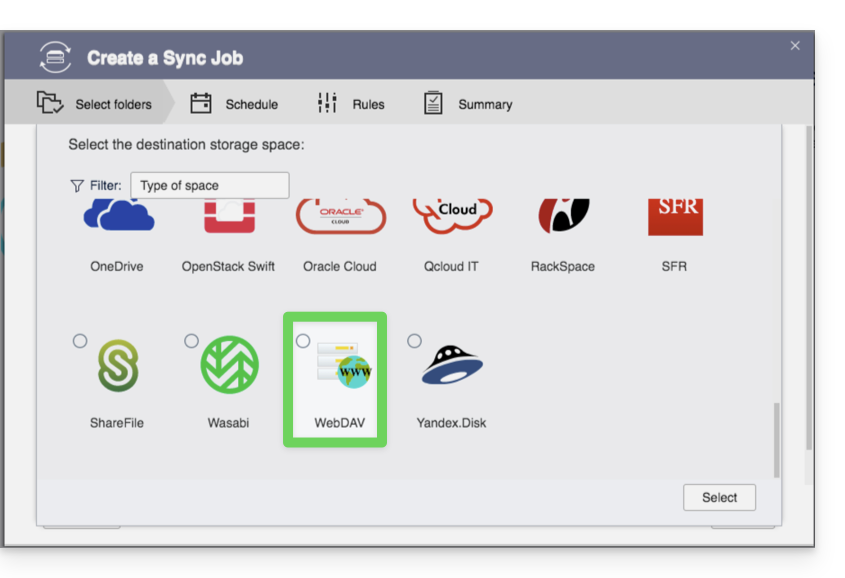
- Choose WebDAV from the list of Cloud providers:
- For the account settings, use the following information:
- Server address:
https://IDkDrive.connect.kdrive.infomaniak.com(see prerequisites) - Username: the email address used to log in to your Infomaniak account
- Password: create an application password for this specific use.
- Server address:
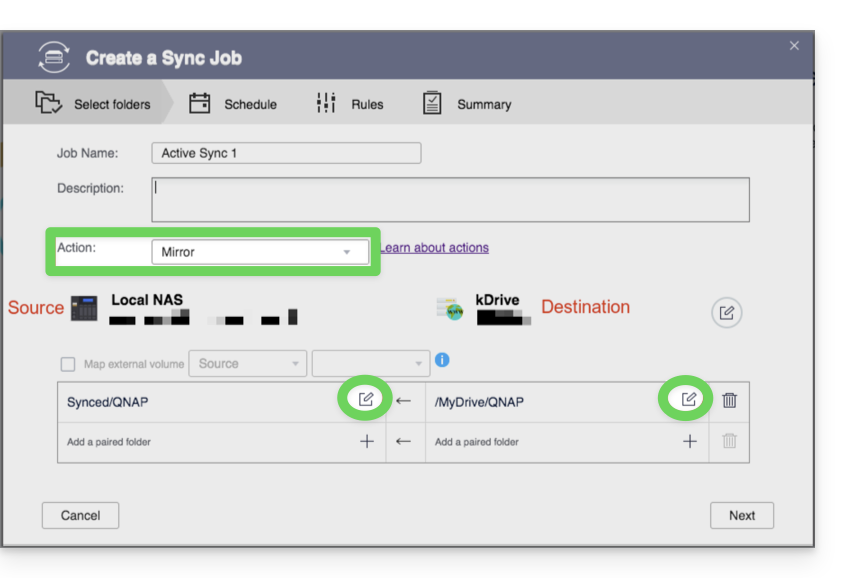
- Choose the local source and destination folder:
- Customize the task frequency.
- Complete the wizard.
Link to this FAQ: https://faq.infomaniak.com/2405
Has this FAQ been helpful?
This guide provides instructions for synchronizing kDrive with a Synology NAS (or vice versa) via the WebDAV protocol, which can be found in the Cloud Sync application.
✘ UNAVAILABLE with
kSuite Free / kSuite Standard
my kSuite / my kSuite+ (ik.me, etik.com, ikmail.com)
Prerequisites
- You must have a Synology NAS that is accessible from the internet.
- Find out your kDrive ID (kDrive ID).
Synchronize kDrive and Synology via Cloud Sync
To do this:
- Log in to the Synology DiskStation Manager (DSM).
- If necessary, download and install the Cloud Sync app from the Package Center.
- Open Cloud Sync.
- Click on the + at the bottom left to add a Cloud.
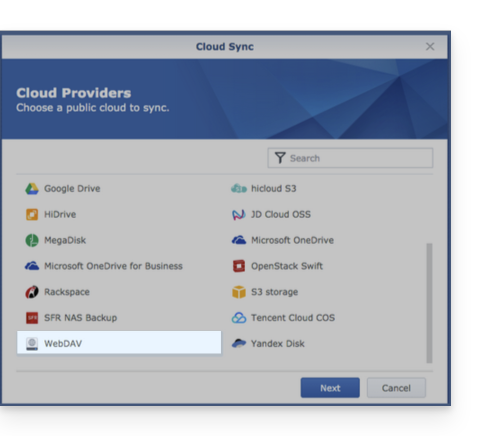
- Choose WebDAV at the bottom of the list of available Clouds:
- For account settings, use the following information:
- Server address:
https://IDkDrive.connect.kdrive.infomaniak.com(see prerequisites) - Username: the email address used to log in to your Infomaniak account
- Password: create an application password for this specific use.
- Server address:
- Choose the local folder, the destination folder, and the desired synchronization type:
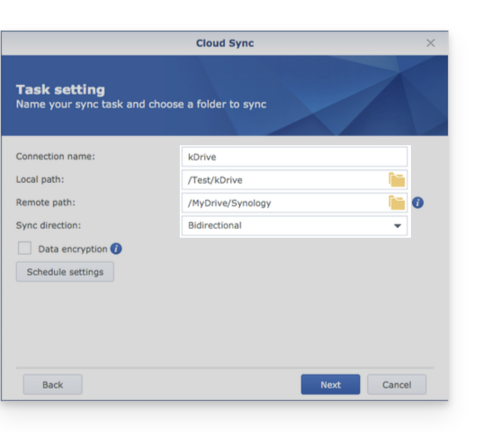
- Bidirectional: changes will be reflected in both directions.
- Download only remote changes: ideal for backing up a kDrive to your NAS.
- Download only local changes: ideal for backing up data from your NAS to a kDrive.
Link to this FAQ: https://faq.infomaniak.com/2404
Has this FAQ been helpful?
This guide provides instructions for synchronizing kDrive with a VPS (or vice versa) via the WebDAV protocol, which can be found in the rClone application.
✘ UNAVAILABLE with
kSuite Free / kSuite Standard
my kSuite / my kSuite+ (ik.me, etik.com, ikmail.com)
Prerequisites
- You must have a VPS.
- Know your kDrive ID (kDrive ID).
Synchronize kDrive and VPS via rClone
This process allows you to retrieve files and folders from kDrive in real time and read, create, or modify these files from your VPS, while ensuring that they are synchronized again on the kDrive server. An rClone mount point can be created with a folder on your VPS to allow you to manage these kDrive files.
Refer to the rClone documentation if you are looking for information about the available options:
- Example rClone command:
rclone mount kdrive:/My_kDrive_Folder_Path /home/ubuntu/Target_Folder_Path --vfs-cache-mode full --vfs-cache-max-age 24h --vfs-cache-max-size 10G --cache-dir /home/ubuntu/rclone/cache --daemon --allow-other --dir-cache-time 1h --log-file /home/ubuntu/rclone/rclone.log --log-level INFO- The
--daemonattribute in this command allows you to run the synchronization in the background, because without it, this sync will end each time you disconnect from the VPS…
- Example rClone configuration file:
[kdrive] type = webdav url = {{URL_3}} vendor = other user = *** pass = ***- Server address:
https://IDkDrive.connect.kdrive.infomaniak.com(see prerequisites) - Username: the email address used to log in to your Infomaniak account
- Password: create an application password for this specific use.
Link to this FAQ: https://faq.infomaniak.com/2636
Has this FAQ been helpful?
This guide explains how to import (once only) data (files, folders, etc.) from an external cloud, such as that of your previous provider (e.g., Dropbox or Microsoft), into kDrive.
Prerequisites
- Have a kDrive or kSuite plan.
- Have sufficient permissions within kDrive or kSuite.
- Do not change your passwords until the import is complete!
Specific guides
Click on the link corresponding to your current hosting provider:
- Google Photos: complete guide for migrating photos from Google Photos to Infomaniak
- Google Drive
- Apple iCloud
- ⚠️ For security reasons, importing is no longer possible via WebDAV, or from ownCloud / Nextcloud; perform a manual import or use the kDrive app
Guide for any other external Cloud provider
For example:
- Another kDrive to which your user account has access (except for "external" access).
- Dropbox
- OneDrive
Data not imported
- The data that was shared with you has not been imported.
- Only the data that actually belongs to you will be imported.
- Google documents such as Gdocs, Sheets, Slides, etc. …
- … are not imported during a Dropbox import.
- … are converted by Google when these files are downloaded from Google Drive to macOS/Windows.
- … are not converted when they are copied from the local Google Drive directory to the local kDrive directory. Therefore, it is essential to download the files from the web version of Google Drive.
- Dropbox Paper documents.
- Dropbox sharing links, viewable here.
- Individually shared Dropbox files, viewable here(however, shared folders and shared documents will be imported).
To proceed with the data import:
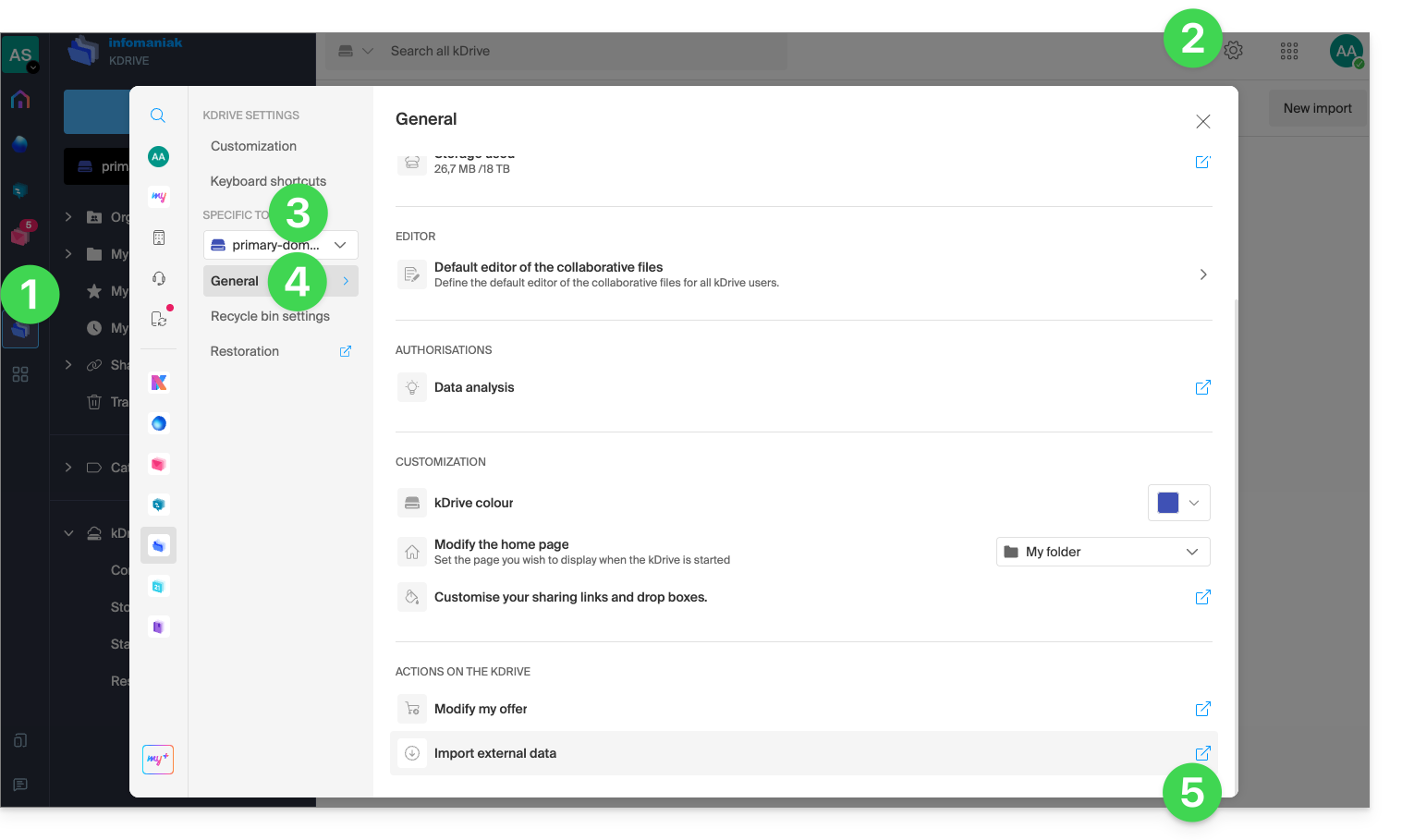
- Click here to access the Infomaniak kDrive web app (online service ksuite.infomaniak.com/kdrive).
- Click on Settings in the top right corner.
- Check or select the relevant kDrive from the dropdown menu in the left-hand sidebar.
- Click on General in the left-hand sidebar.
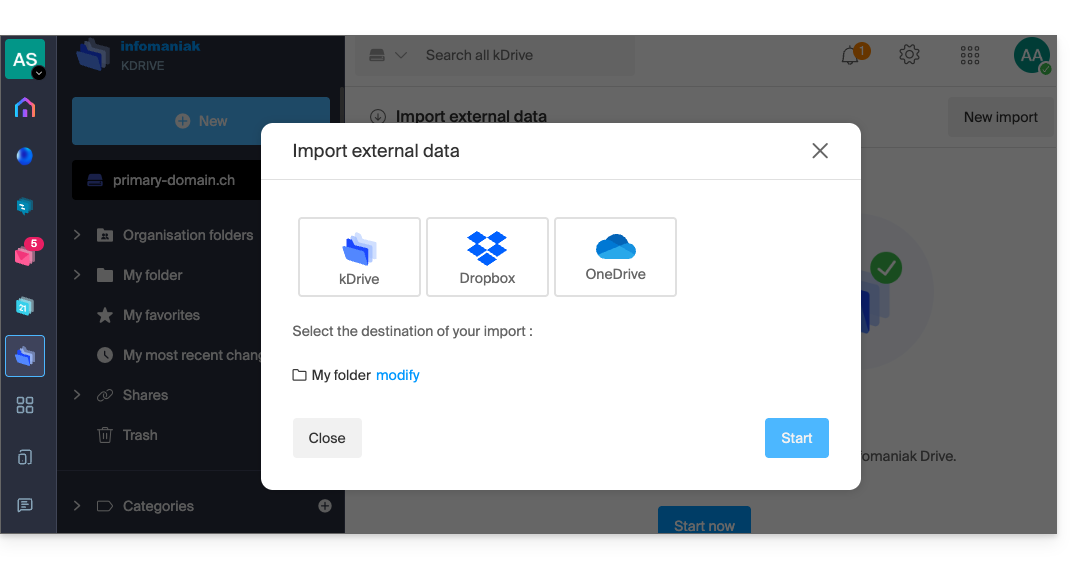
- Click on Import external data:
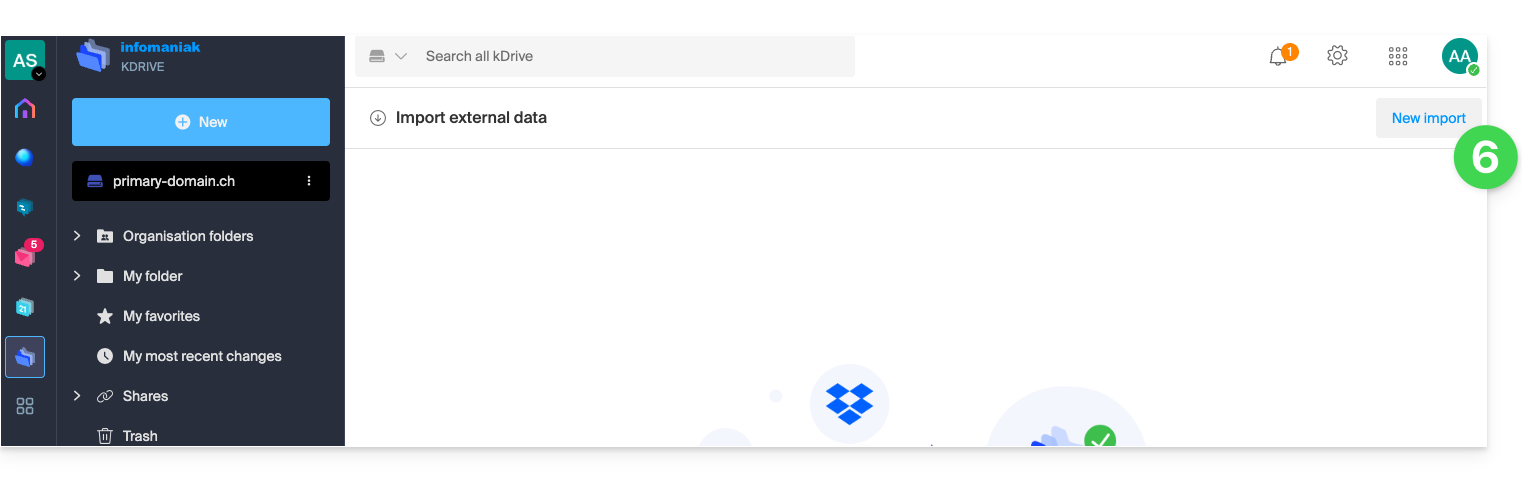
- Click on Start or New import at the top:
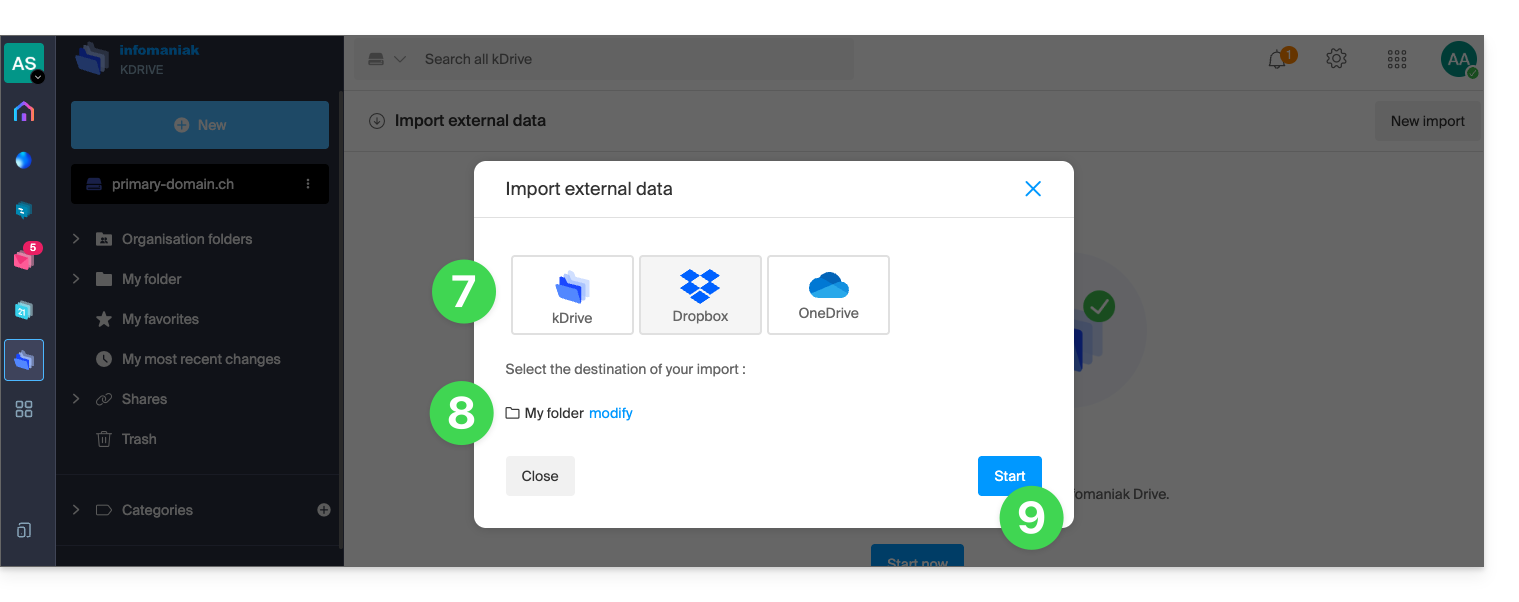
- Select the service in question.
- Choose the location where the imported files will be stored.
- Click on the Start button:
- Complete the required information (a new window may open in the background) and click on the blue Continue button.
- Complete the wizard.
- Wait for the data to be imported.
Manage the ongoing import
To monitor ongoing imports, return to the page mentioned in point 6 above at any time.
To stop an import in progress, click on the action menu to the right of the import listed on the page and choose to cancel it (if the import is interrupted voluntarily, a report will be sent to the administrator by email).
A second consecutive import would re-import all the data (to a different directory in kDrive); this is not a differential synchronization, and there is no duplicate management.
Be sure to check your imported data immediately after the operation.
Link to this FAQ: https://faq.infomaniak.com/2406
Has this FAQ been helpful?
This guide details how to import data from Google Drive using rClone to kDrive Infomaniak.
✘ UNAVAILABLE with
kSuite Free / kSuite Standard
my kSuite / my kSuite+ (ik.me, etik.com, ikmail.com)
⚠ ATTENTION ⚠
Infomaniak guarantees that its services comply with standard protocols (IMAP, S3, etc.), but does not provide additional support for external services or software, as their configuration may change depending on the provider or publisher(see:
1. Configure rclone for drive access
Install rclone on your computer
There is a version of rclone with a graphical interface (GUI), but it is also possible to do this using the command line (CLI):
- Install rclone from a
Terminal-type application on your device by typing the following command:sudo -v ; curl https://rclone.org/install.sh | sudo bash - Enter the password for your session on your computer to begin the installation:

- If necessary, consult the official installation guide.
Configuring the remote disk (Google Drive) in rclone
- Once rclone is installed, enter the command
rclone config.- If necessary, consult the official configuration guide.
- Then, choose to configure a new remote import by answering
nforNew remote. - Name the remote disk, for example
gdrive:
- Then, choose the type of disk to import by entering
drive, which corresponds to Google Drive among the options provided.
Next, you need to authorize the connection to Google Drive from a browser such as Brave, Chrome, Edge, Firefox, Opera, Safari…
By default, rclone uses a client ID shared among all users, which can lead to request limitations imposed by Google. It is strongly recommended to use your own client ID to avoid these restrictions.
- Access the Google API Console with your Google account.
- Create or select a project.
- Enable the Google Drive API by clicking the "Enable APIs and services" button/link.
- Search for the keyword
Driveand click onGoogle Drive API:
- Click the Activate button.
- Click Credentials in the left-hand menu (and not on a similar button).
- Click on Configure OAuth consent screen (if you haven't already):
- Enter a name, for example
rclone. - Select "External" (or "Internal" if you are a Google Workspace user).
- Under “Data access”, add the necessary scopes:
https://www.googleapis.com/auth/docs,https://www.googleapis.com/auth/drive,https://www.googleapis.com/auth/drive.metadata.readonly;
- Save.
- Add your email account as a test user under "Audience".
- Go back to the "Google Auth Platform" section.
- Enter a name, for example
- Create OAuth credentials:
- Click on "Create credentials / OAuth client ID".
- Choose "Desktop app" and leave the default name, then click the Create button.
- Keep the displayed
client IDandclient secret code.
- If "External" was chosen in step 7 above, go back to “Audience” in the left-hand menu and click on “Publish the application”.
Due to the "enhanced security" recently introduced by Google, you are theoretically supposed to "submit your application for verification" and wait several weeks for their response.
In practice, you can directly use the client ID and client secret with rclone (see the rest of the guide). The only consequence will be a very intimidating confirmation screen when you connect via your browser to allow rclone to obtain its token ID. However, since this only occurs during the initial configuration of the remote storage, it is not a major problem.
It is also possible to leave the application in "Test" mode, but in this case, any authorization will expire after a week, which may be inconvenient to renew frequently. If a short validity period is not a problem for your use case, then keeping the application in test mode may be sufficient.
Go back to rclone in the terminal:
- Tell rclone the
client_idby copying and pasting theClient IDobtained in step 8 above, and do the same for the secret phrase. - Next, select
scope#1:
- Press the “
Enter” key to leave theservice_account_filequestion blank. - Answer “No”
nto the question about “advanced configuration”. - Answer “Yes”
yto the question about connecting via a browser:
- An Internet page opens in your browser, allowing you to connect to Google and authorize the application you created in step 9 above.
- Once the permissions are granted, you should receive the following message:

- In the terminal, answer “No”
nto the question about “Shared Drive (Team Drive)”. - Answer “Yes”
yto the last question:
Configuring the destination disk (kDrive) in rclone
You can directly modify the rclone configuration file by pasting your kDrive configuration into it, for example:
[kdrive]
type = webdav
url = {{URL_19}}
vendor = other
user = user@email.com
pass = PASSWORD_HERE_OR_APP_PASSWORD_IF_2FA
Here's how to proceed step by step, just like with the previous configuration:
- Still on the terminal, enter
nfor a new disk configuration and enter the namekDriveto identify your destination disk:
- Next, choose the type of disk to import by entering
webdav, which corresponds to a WebDAV configuration among the options provided. - Enter the following information:
url= the direct access to kDrive (refer to this other guide regarding the kDrive ID for the connection URL)vendor= rclone (option no. 6)user= the email address used to log in to your Infomaniak user account
- Answer “Yes”
yto the password question, then enter the password:- application password if two-factor authentication is enabled or your Infomaniak user account password if you have not enabled 2FA.
- Leave the
bearer_tokenfield blank and answer “No”nto the question about “advanced configuration”. - Answer “Yes”
yto the last question, and your 2 disks will be displayed:
2. Copy data from Google Drive to kDrive
kDrive supports rclone's streaming upload via WebDAV with automatic error handling if the limit is exceeded without prior size specification via Content-Length.
Prerequisites
- Consult the available options in the official guide before starting an import, including these important commands:
--drive-skip-shortcutsto avoid infinite import loops--drive-shared-with-meto retrieve shared files--drive-acknowledge-abuseto force the download of files blocked by Google
Example command to start a copy of your Google Drive to the root of your kDrive:
sudo rclone copy gdrive:
kDrive:
This will immediately start copying your folders, subfolders, and content from Google Drive to the personal folder of your Infomaniak kDrive!
Google Docs files, such as Gdocs, Sheets, and Slides, are converted to Office formats like .docx and .xlsx, and can be read directly in kDrive.
Link to this FAQ: https://faq.infomaniak.com/2408
Has this FAQ been helpful?
This guide explains how to import data from iCloud Drive or iCloud Photos to kDrive Infomaniak using rclone.
✘ UNAVAILABLE with
kSuite Free / kSuite Standard
my kSuite / my kSuite+ (ik.me, etik.com, ikmail.com)
Introduction
- This method is intended for experienced users who want to transfer iCloud data to kDrive without manually copying files one by one.
- rclone allows you to configure an iCloud Drive or iCloud Photos source, and then a kDrive destination via WebDAV.
- Accessing iCloud with rclone requires the usual Apple ID password and two-factor Apple authentication. Apple application passwords are not accepted for this configuration.
- iCloud authentication may need to be renewed periodically using
rclone reconnectorrclone config. - The
rclone copycommand copies files to kDrive without deleting them from the source iCloud.
1. Install rclone
rclone can be installed via the command line. On macOS, Linux, or BSD, open the Terminal application and run the following command:
sudo -v ; curl
{{URL_1}} | sudo bash
If necessary, consult the official rclone installation guide, especially for Windows or for a manual installation.
Once the installation is complete, verify that rclone is responding correctly:
rclone version
2. Configure the iCloud source in rclone
In Terminal, start the rclone configuration:
rclone config- Choose
nto create a new remote disk. Give this source an explicit name, for example:
iCloudDrive- Choose the
iclouddrivestorage type. - To import documents stored in iCloud Drive, keep the default
driveservice. - To import items from iCloud Photos, choose the
photosservice or create a second dedicated remote drive, for exampleiCloudPhotos. - Enter your Apple ID, which is usually an email address.
- Choose to enter your own password, then enter your usual Apple ID password.
- Answer
nto advanced configuration, unless you have a specific need. - Confirm the connection from your trusted Apple device, then enter the two-factor authentication code when rclone prompts you.
- When the summary is correct, answer
yto save the configuration.
Check that the iCloud source is accessible:
rclone lsd iCloudDrive:If you have configured a dedicated source for iCloud Photos, check it as well:
rclone lsd iCloudPhotos:
3. Configure the kDrive destination in rclone
kDrive must be configured in rclone as a WebDAV storage.
Restart the configuration if you are no longer in the rclone menu:
rclone config- Choose
nto create a new remote disk. Give the destination an explicit name, for example:
kDrive- Choose the
webdavstorage type. For the URL, enter the direct WebDAV access to your kDrive:
{{URL_3}};
- Replace
ID_KDRIVEwith your kDrive ID; refer to this other guide if needed.
- Replace
- For the WebDAV provider (
vendor), chooseother. - For the user (
user), enter the email address used to log in to the Infomaniak user account. - For the password, enter:
- an application password if two-factor authentication is enabled on the Infomaniak account;
- the password for the Infomaniak user account if two-factor authentication is not enabled.
- Leave the
bearer_tokenfield blank. - Answer
nto the advanced configuration prompt, unless you have a specific need. - If the summary is correct, answer
yto save the configuration.
The resulting configuration will look like this in the rclone configuration file:
[kDrive]
type = webdav
url = {{URL_6}}
vendor = other
user = user@example.com
pass = PASSWORD_STORED_BY_RCLONE
The password displayed in the rclone configuration file is not stored in plain text when the configuration is created using rclone config. If you modify this file manually, generate the value for the pass field using the rclone obscure command.
Verify that the kDrive destination is accessible:
rclone lsd kDrive:
4. Copy data from iCloud to kDrive
Do not use sudo for the copy commands if the rclone configuration was created with your usual user session. Otherwise, rclone may look for a different configuration and fail to find the previously created access credentials.
Before launching a full copy, list the available folders on the source:
rclone lsd iCloudDrive:It is recommended to perform a test without actual transfer using --dry-run:
rclone copy iCloudDrive:
kDrive:iCloudDrive --dry-run --progress
If the result is correct, start the copy:
rclone copy iCloudDrive:
kDrive:iCloudDrive --progress --transfers 4 --checkers 8 --retries 5
--low-level-retries 10 --log-level INFO --log-file
"$HOME/Desktop/rclone-kdrive-import.log"
This command copies the folders, subfolders, and files from the source iCloudDrive: to the iCloudDrive folder in your kDrive.
If the connection or computer is interrupted, restart the same command. rclone will resume the comparison and avoid copying files that are already present when their size and available information match.
To verify the consistency of the copied volume, you can compare the source and destination by size:
rclone check iCloudDrive:
kDrive:iCloudDrive --size-only --one-way --progress
Copy iCloud Photos
If you have configured a source dedicated to iCloud Photos, first list the available libraries and folders:
rclone lsd iCloudPhotos:Then, adjust the source path according to the directory structure displayed by rclone. Example:
rclone copy iCloudPhotos:
kDrive:iCloudPhotos --dry-run --progress
Then, start the copy if the test result is correct:
rclone copy iCloudPhotos:
kDrive:iCloudPhotos --progress --transfers 4 --checkers 8 --retries 5
--low-level-retries 10 --log-level INFO --log-file
"$HOME/Desktop/rclone-kdrive-photos.log"
5. Correct the dates of the photos if necessary
After exporting or copying photos, the system dates of the files may no longer match the original date the photos were taken. If the chronological display is not correct, you can correct the dates on a local copy of the files before sending them permanently to kDrive.
Always work on a local copy of the files before running a correction script. The script below does not run directly on a remote rclone source: it processes a folder located on your computer.
To prepare a local folder for correction, copy the photos, for example, into a temporary folder on your desktop:
rclone copy iCloudPhotos:
"$HOME/Desktop/iCloud-Photos" --progress
Next, install ExifTool from https://exiftool.org/index.html, then run the script below on macOS from the Terminal application.
The script searches for a date in the file's metadata, and then in its name. The corrected files are listed in DateFound.txt, and the files without a usable date are listed in DateError.txt, on the desktop.
The script to copy and paste:
/bin/bash <<'BASH'
#!/bin/bash
set -u
ROOT="$(osascript -e 'POSIX path of (choose folder with prompt "Select
the folder containing the files to update")')" || exit 0
DESKTOP="$HOME/Desktop"
LOG_FOUND="$DESKTOP/DateFound.txt"
LOG_ERROR="$DESKTOP/DateError.txt"
: > "$LOG_FOUND"
: > "$LOG_ERROR"
find_exiftool() {
    if command -v exiftool >/dev/null 2>&1; then
        command -v exiftool
        return 0
    fi
    if [ -x "/usr/local/bin/exiftool" ]; then
        printf '%s\n' "/usr/local/bin/exiftool"
        return 0
    fi
    if [ -x "/opt/homebrew/bin/exiftool" ]; then
        printf '%s\n' "/opt/homebrew/bin/exiftool"
        return 0
    fi
    return 1
}
EXIFTOOL="$(find_exiftool)" || {
    printf '%s\n' "ExifTool not found. Install it, then run the script
again." >> "$LOG_ERROR"
    printf '%s\n' "ExifTool not found. Check DateError.txt on the desktop."
    exit 1
}
if [ ! -d "$ROOT" ]; then
    printf 'Invalid folder: %s\n' "$ROOT" >> "$LOG_ERROR"
    printf '%s\n' "Invalid folder. Check DateError.txt on the desktop."
    exit 1
fi
get_exif_date() {
    "$EXIFTOOL" -s3 -d "%Y:%m:%d %H:%M:%S" -DateTimeOriginal
-CreateDate -MediaCreateDate -TrackCreateDate -CreationDate
-ModifyDate -- "$1" 2>/dev/null | awk '/^[0-9]{4}:[0-9]{2}:[0-9]{2}
[0-9]{2}:[0-9]{2}:[0-9]{2}/ { print substr($0, 1, 19); exit }'
}
get_name_date() {
    local name
    name="$(basename "$1")"
    if [[ "$name" =~
([12][0-9]{3})[-_]?([01][0-9])[-_]?([0-3][0-9])([_\
-]?([0-2][0-9])[-_\.]?([0-5][0-9])[-_\.]?([0-5][0-9]))? ]]; then
        local year="${BASH_REMATCH[1]}"
        local month="${BASH_REMATCH[2]}"
        local day="${BASH_REMATCH[3]}"
        local hour="12"
        local minute="00"
        local second="00"
        if [ -n "${BASH_REMATCH[5]:-}" ]; then
            hour="${BASH_REMATCH[5]}"
            minute="${BASH_REMATCH[6]}"
            second="${BASH_REMATCH[7]}"
        fi
        printf '%s:%s:%s %s:%s:%s\n' "$year" "$month" "$day" "$hour"
"$minute" "$second"
        return 0
    fi
    return 1
}
is_valid_date() {
    date -j -f "%Y:%m:%d %H:%M:%S" "$1" "+%Y:%m:%d %H:%M:%S"
 /dev/null 2>&1
 }
to_touch_date() {
    printf '%s' "$1" | sed -E 's/^([0-9]{4}):([0-9]{2}):([0-9]{2})
([0-9]{2}):([0-9]{2}):([0-9]{2})$/\1\2\3\4\5.\6/'
}
write_metadata() {
    local file="$1"
    local date_value="$2"
    "$EXIFTOOL" -overwrite_original "-DateTimeOriginal=$date_value"
"-CreateDate=$date_value" "-ModifyDate=$date_value" -- "$file"
 /dev/null 2>&1 || true
 }
process_file() {
    local file="$1"
    local date_value=""
    local source=""
    date_value="$(get_exif_date "$file")"
    if [ -n "$date_value" ]; then
        source="EXIF"
    else
        date_value="$(get_name_date "$file")"
        if [ -n "$date_value" ]; then
            source="file name"
        fi
    fi
    if [ -n "$date_value" ] && is_valid_date "$date_value"; then
        local touch_value
        touch_value="$(to_touch_date "$date_value")"
        if [ "$source" != "EXIF" ]; then
            write_metadata "$file" "$date_value"
        fi
        if touch -t "$touch_value" "$file" 2>/dev/null; then
            printf '%s | %s | %s\n' "$source" "$date_value" "$file"
  "$LOG_FOUND"
         else
            printf 'Unable to update file date: %s\n' "$file" >>
"$LOG_ERROR"
        fi
    else
        printf 'No valid date found: %s\n' "$file" >> "$LOG_ERROR"
    fi
}
while IFS= read -r -d '' file; do
    case "$file" in
        *.json|*_original) continue ;;
    esac
    process_file "$file"
done < <(find "$ROOT" -type f -print0)
printf '%s\n' "Done. Check DateFound.txt and DateError.txt on the desktop."
BASH
After correction, send the corrected local folder to kDrive:
rclone copy
"$HOME/Desktop/iCloud-Photos" kDrive:iCloudPhotos --progress
--transfers 4 --checkers 8 --retries 5 --low-level-retries
10
6. Accessing data from kDrive
Once the copy is complete, your data is accessible from the kDrive web app, the kDrive mobile apps, and devices synchronized with the kDrive desktop app.
If you are also using the kDrive desktop app, wait for the local synchronization to complete before moving or renaming the imported folders.
Link to this FAQ: https://faq.infomaniak.com/2515
Has this FAQ been helpful?