Knowledge base
1000 FAQs, 500 tutorials and instructional videos. Here, there are only solutions!
This guide details the security measures implemented as part of Infomaniak's email services to detect abusive and abnormal use of an email address. These measures protect you from malicious use of your computer or account.
Number of recipients per email sent
Regardless of the email plan you choose, whether free or paid, the total number of recipients listed on an email is limited to 100.
This restriction applies regardless of the field used to enter the email addresses of the recipients (To, CC, or BCC).
For sending emails to a large number of recipients, it is strongly recommended to use a Newsletter tool such as the one offered by Infomaniak.
Other email limits
Link to this FAQ: https://faq.infomaniak.com/580
Has this FAQ been helpful?
This guide details how to disable the SMTP protocol, thereby preventing a specific user from sending emails from a specific email address.
Introduction
- Removing an user’s sending permission will prevent them from sending a message (new, reply, reaction, etc.) from the Infomaniak Mail web app (online service ksuite.infomaniak.com/mail) and the mobile app.
- If the user in question is also specified in the connected devices, sending will also be impossible from a software/email client such as Outlook, Apple Mail, Thunderbird, etc.
- There is a specific permission regarding out-of-office messages if you also want to prevent this type of message from being sent.
Prevent a user from sending messages from a specific email address
New user
Do you want to allow a new colleague to view a mail address (be able to read incoming emails) but without allowing them to send new messages?
- Click here to access the management of your Mail Service in the Infomaniak Manager (need help?).
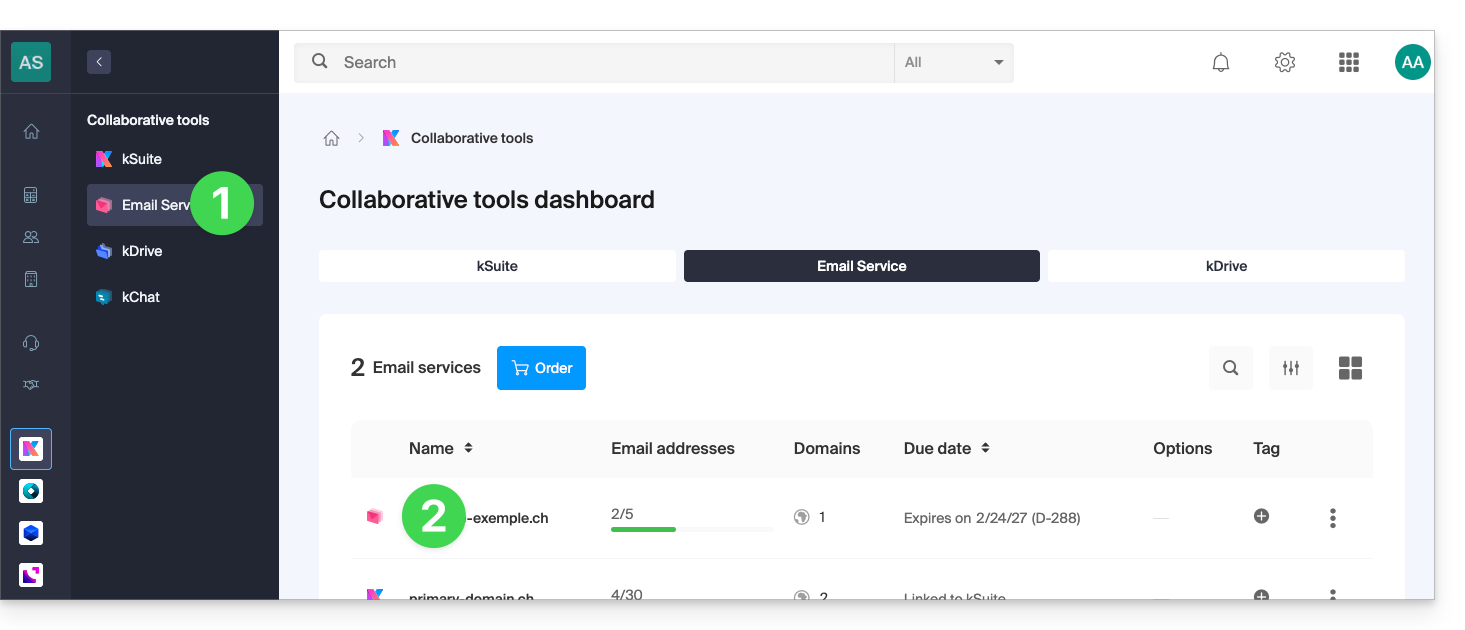
- Click directly on the name assigned to the Mail Service in question:
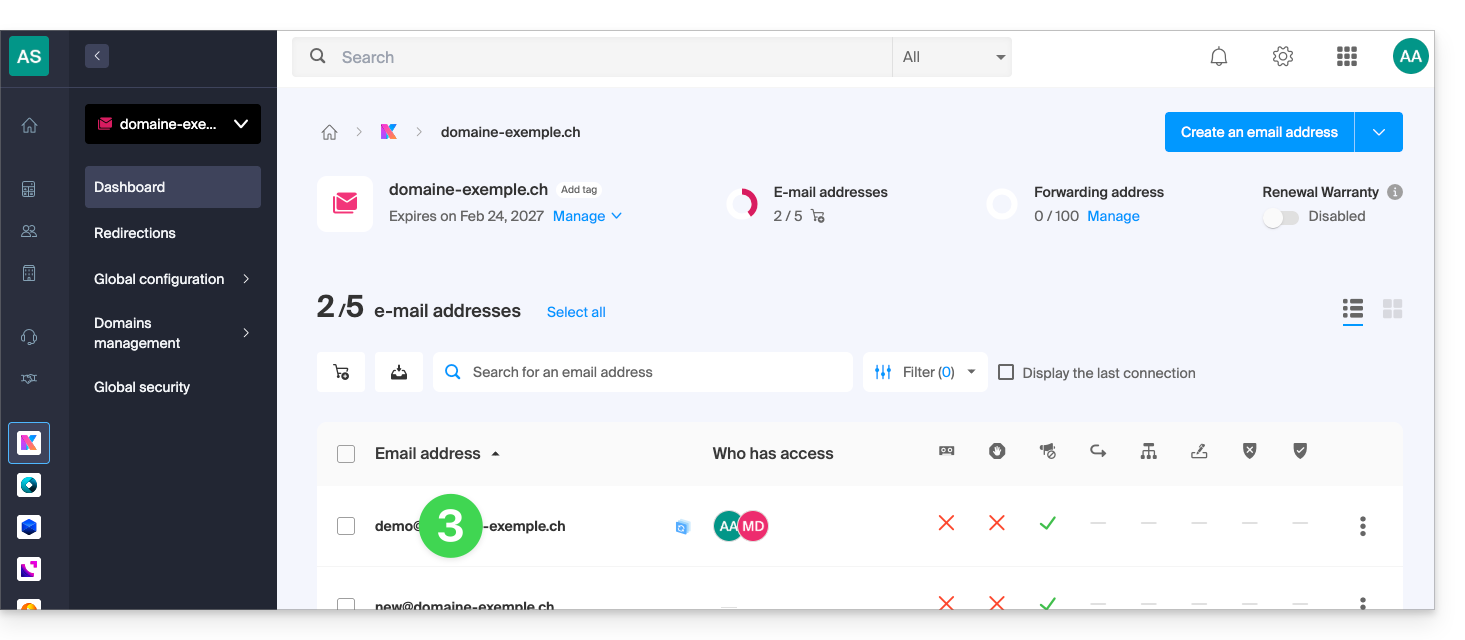
- Click on the relevant email address in the table that appears:
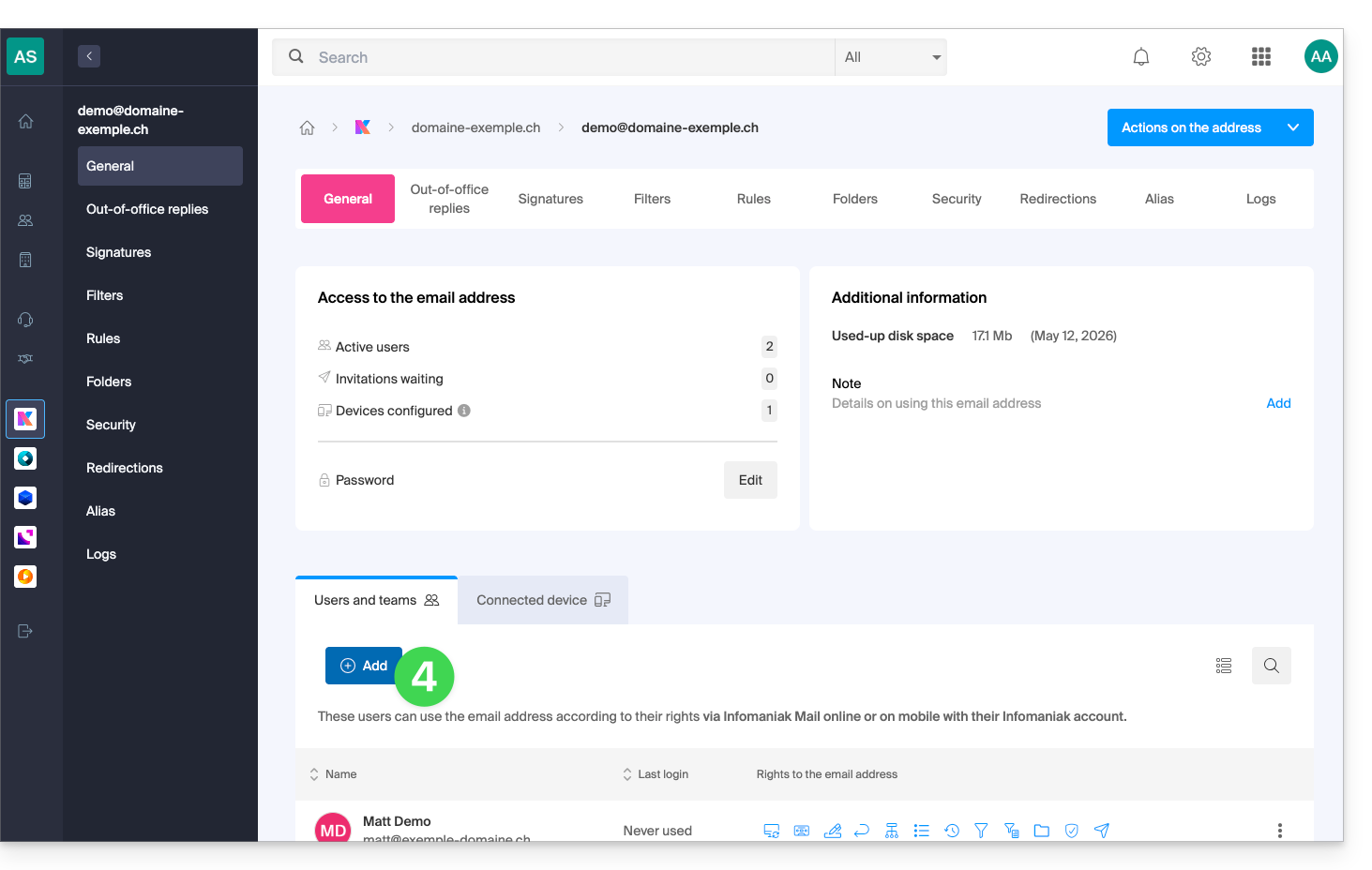
- Click to Add a new user:
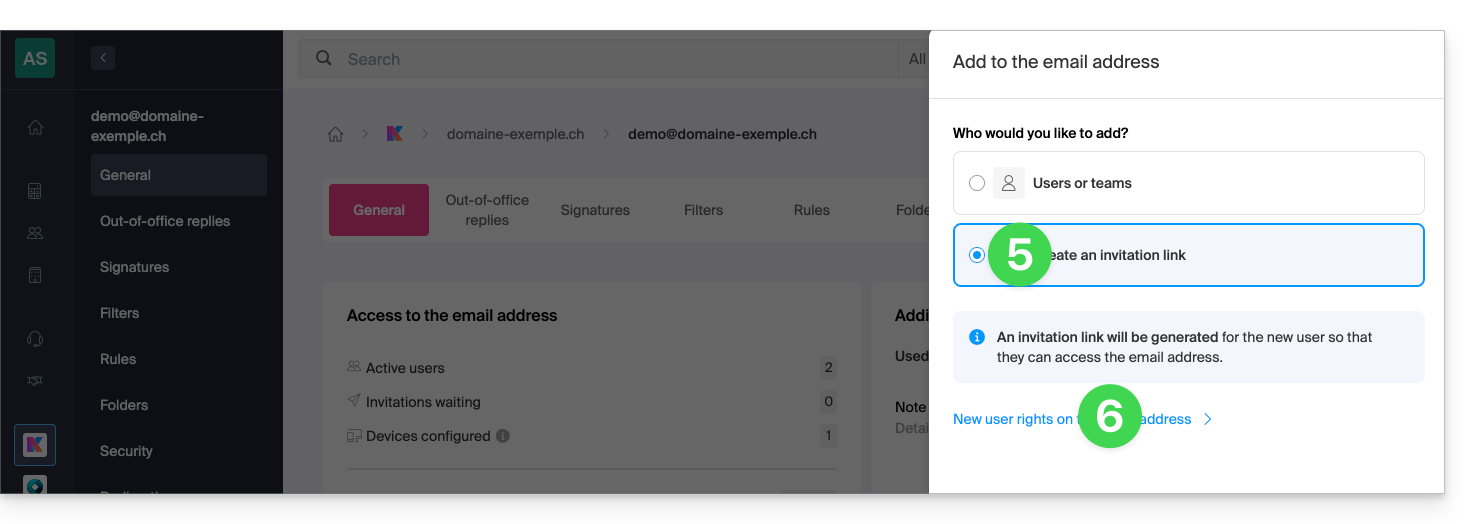
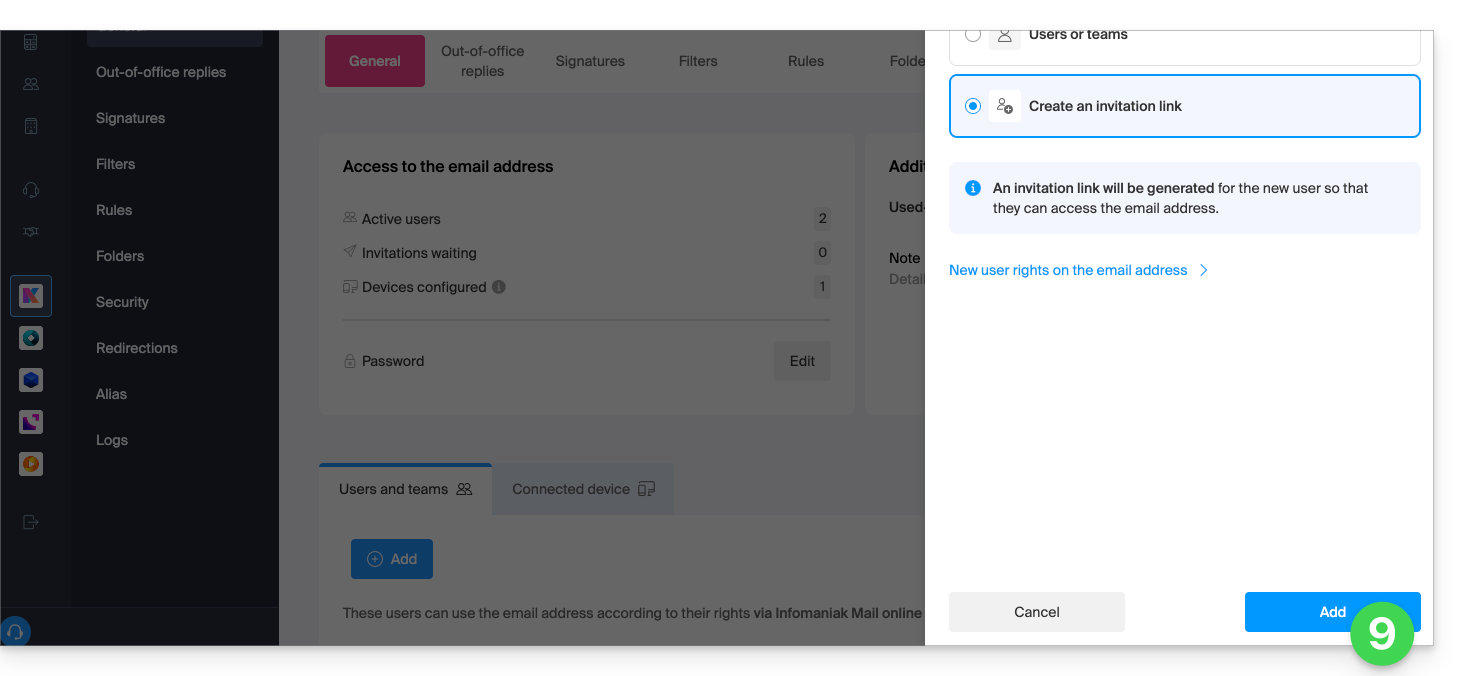
- In this example, the collaborator is external, so click to Create an invitation link.
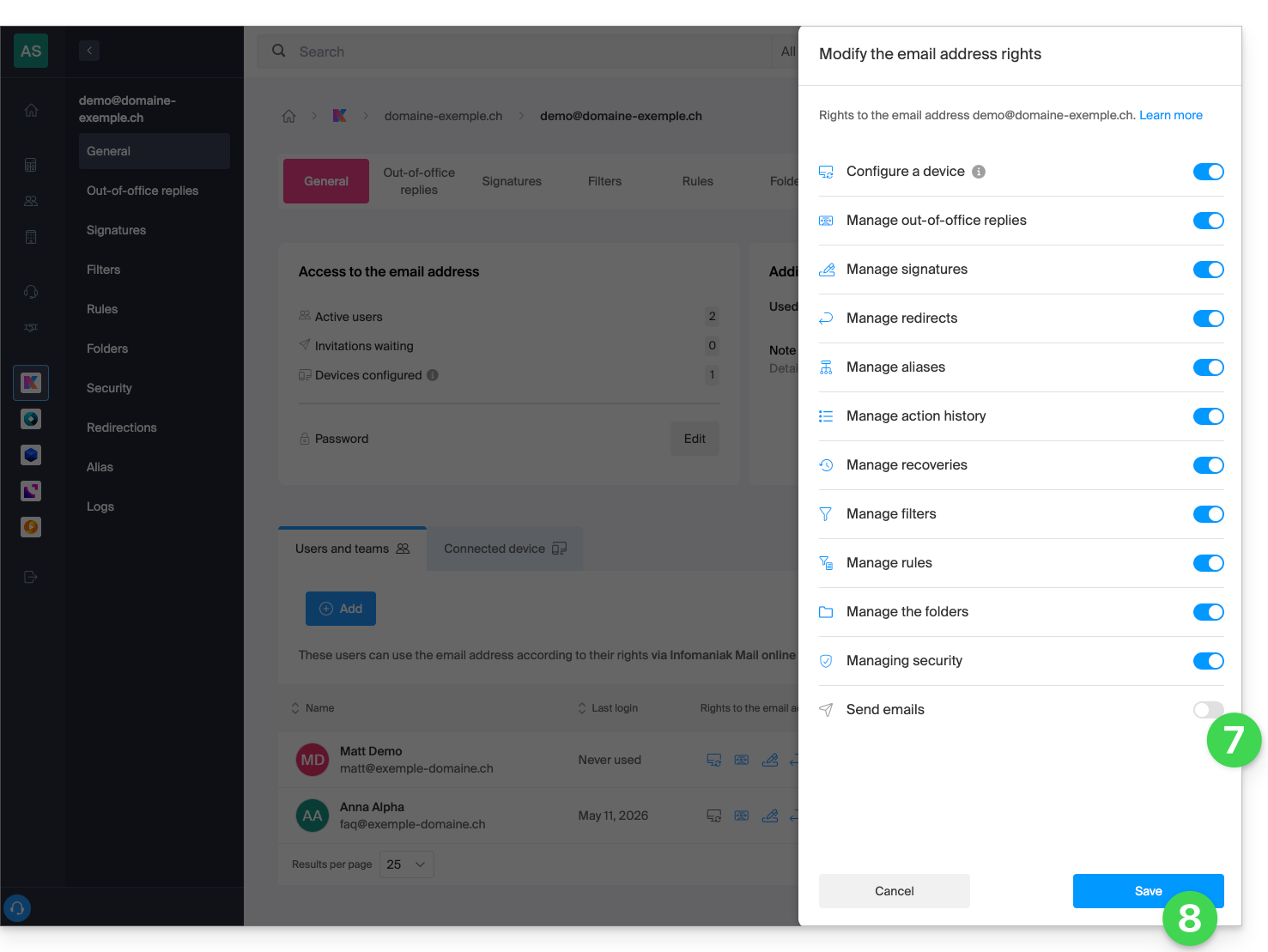
- Click to manage the permissions for this user on the relevant email address:
- Click on Email Sending to revoke their sending privileges.
- Save the change:
- Click Add to complete the invitation:
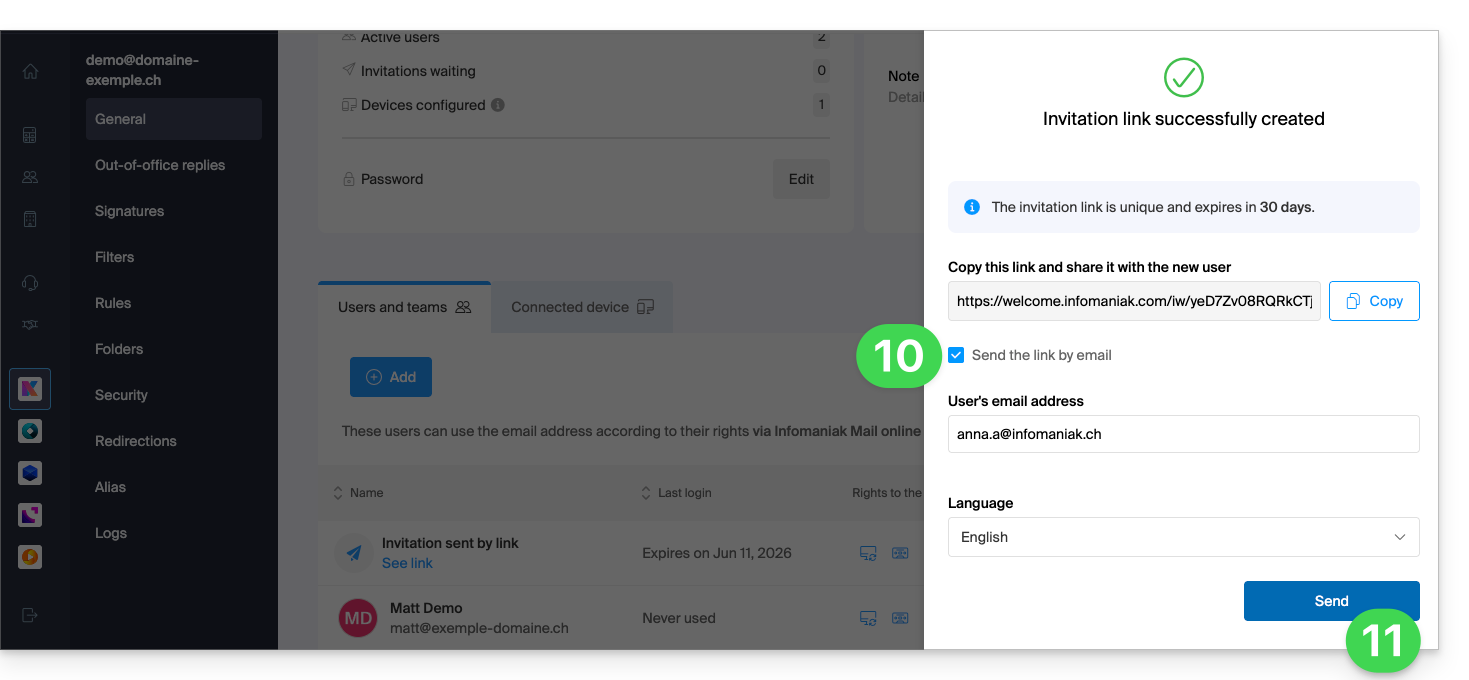
- Enter the email address to which the invitation should be sent.
- Click on Send:
The invited user accepts the invitation: they can then access the email address and its messages, but the button to compose a new message will remain grayed out, preventing them from drafting an email (or even replying, reacting, etc., as these buttons will also be grayed out/disabled):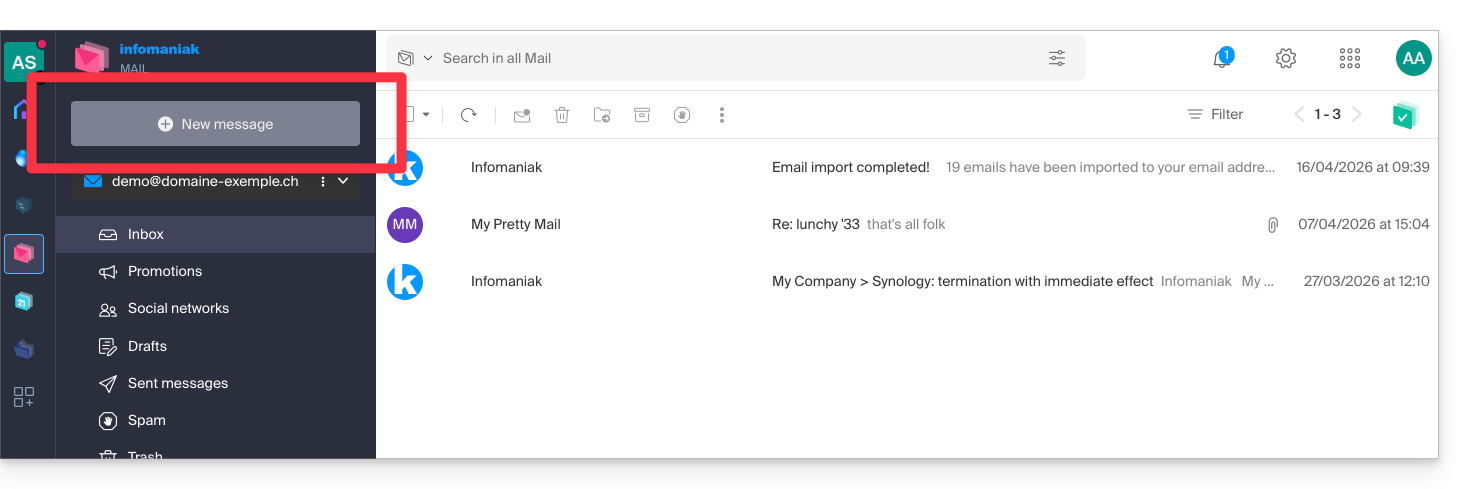
Prevent sending to an existing user
Do you want to allow collaborators to continue viewing a mail address (i.e., be able to read incoming emails) but prevent them from sending new messages?
- Click here to access the management of your Mail Service in the Infomaniak Manager (need help?).
- Click directly on the name assigned to the Mail Service in question:
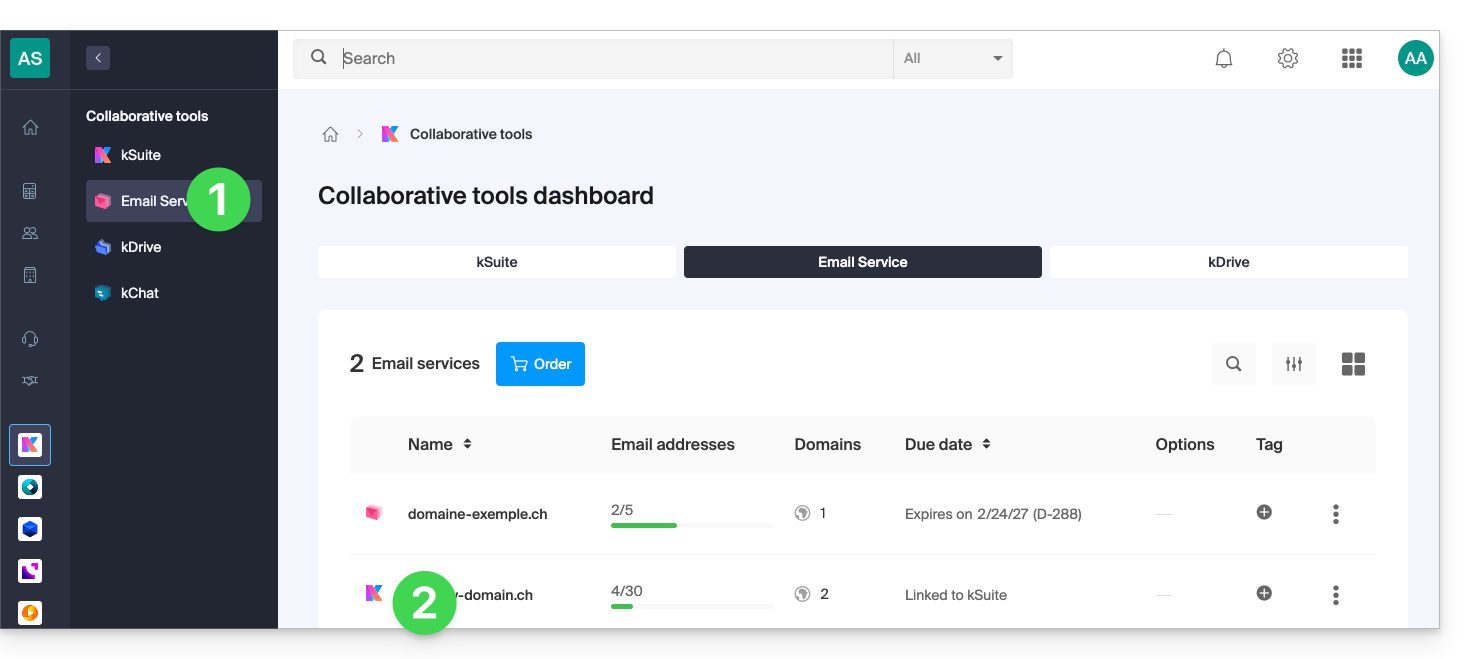
- Click on the email address in the table that appears:
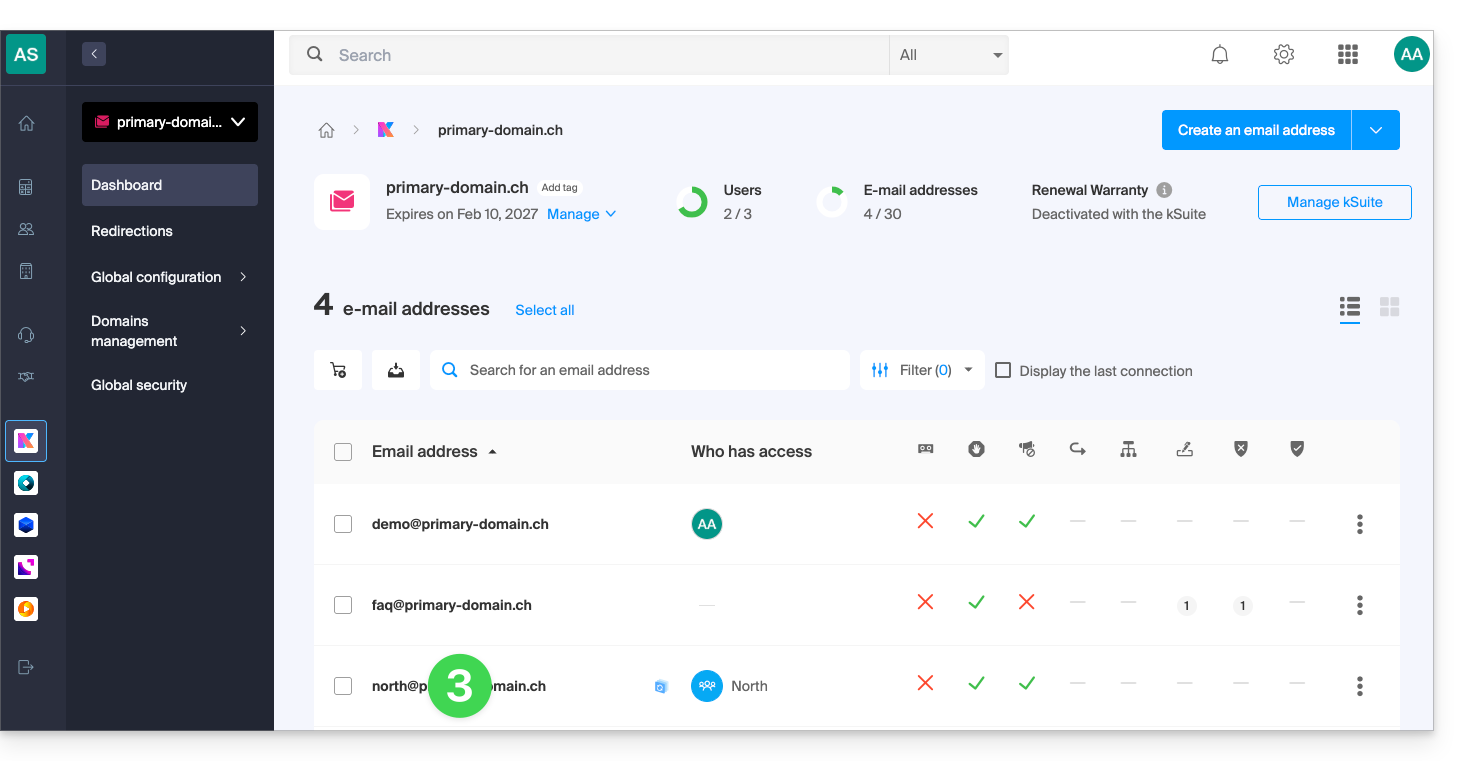
- Click on Sending emails to remove the sending permission:
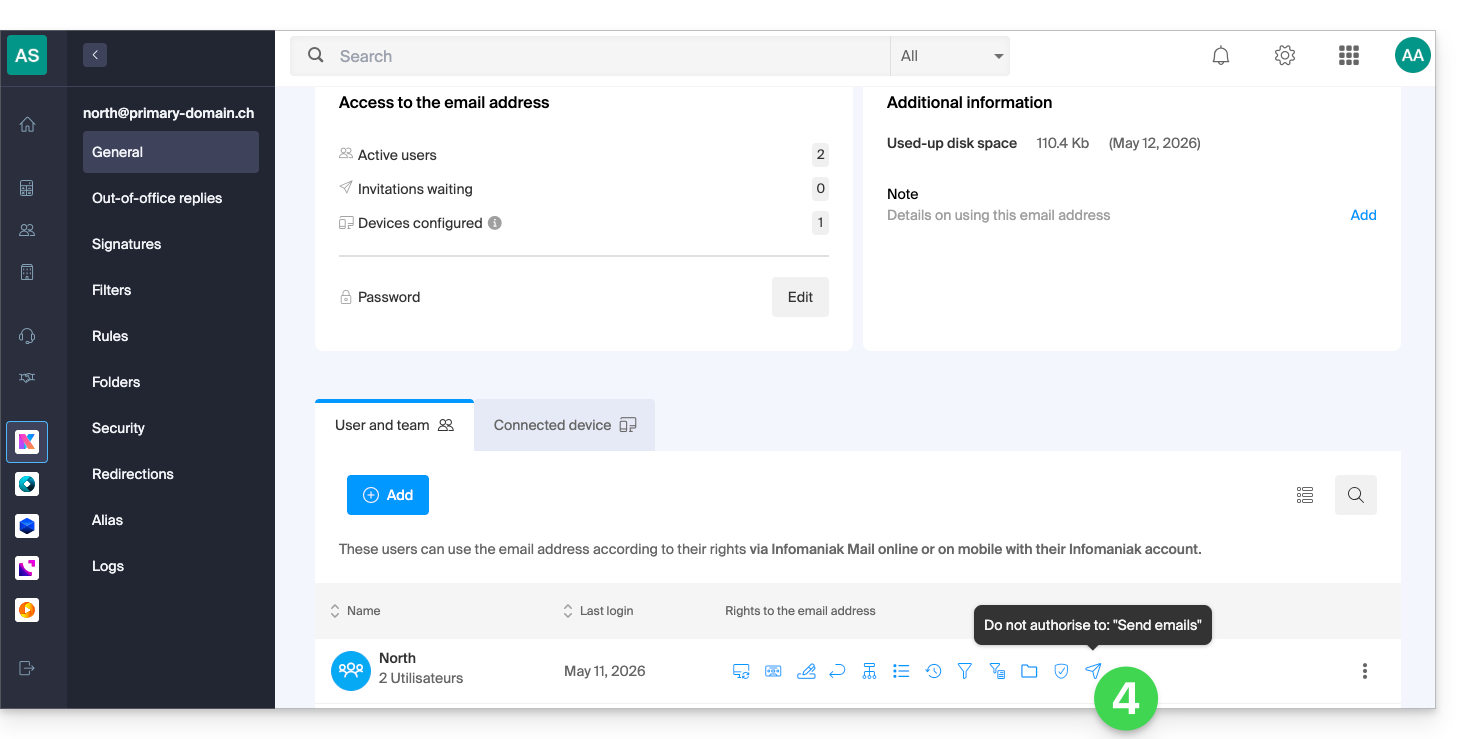
The user can then access the email address and its messages, but the button to compose a new message will remain grayed out, preventing them from drafting an email (or even replying, reacting, etc., as these buttons will also be grayed out/disabled):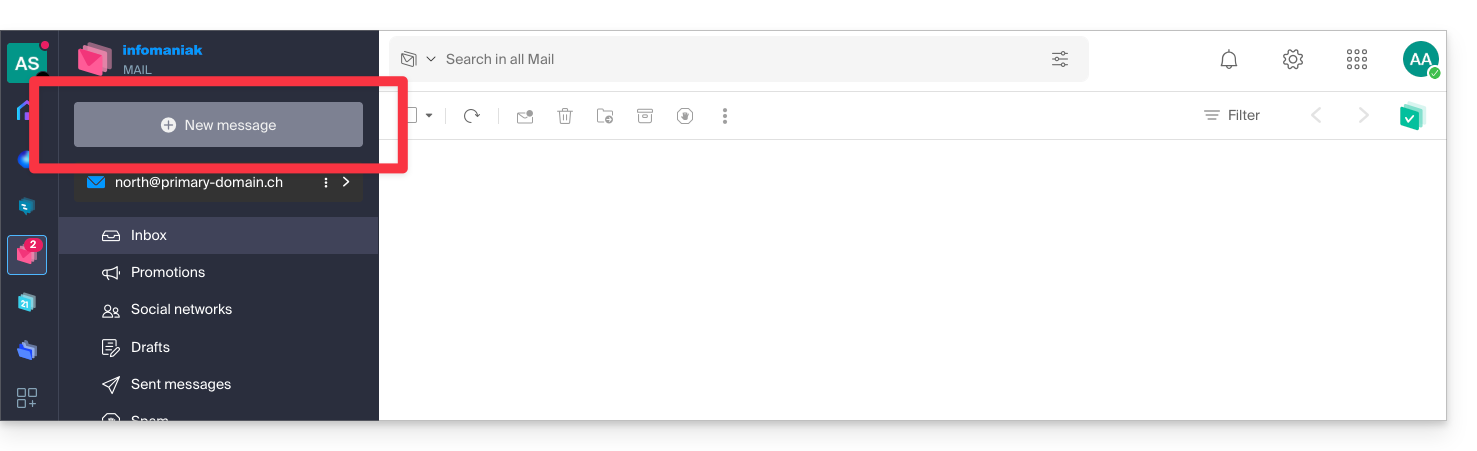
Prevent sending from an SMTP email client/software
If you want to prevent a user from sending emails from a mail client or any fixed or mobile device containing an SMTP email app, start by following the steps above.
You will then need to create a password (= "connected device") linked to this user (therefore, in step 8 of this other guide, instead of “No user”, you will need to specify the ID of the relevant collaborator, who has already been added in the users tab):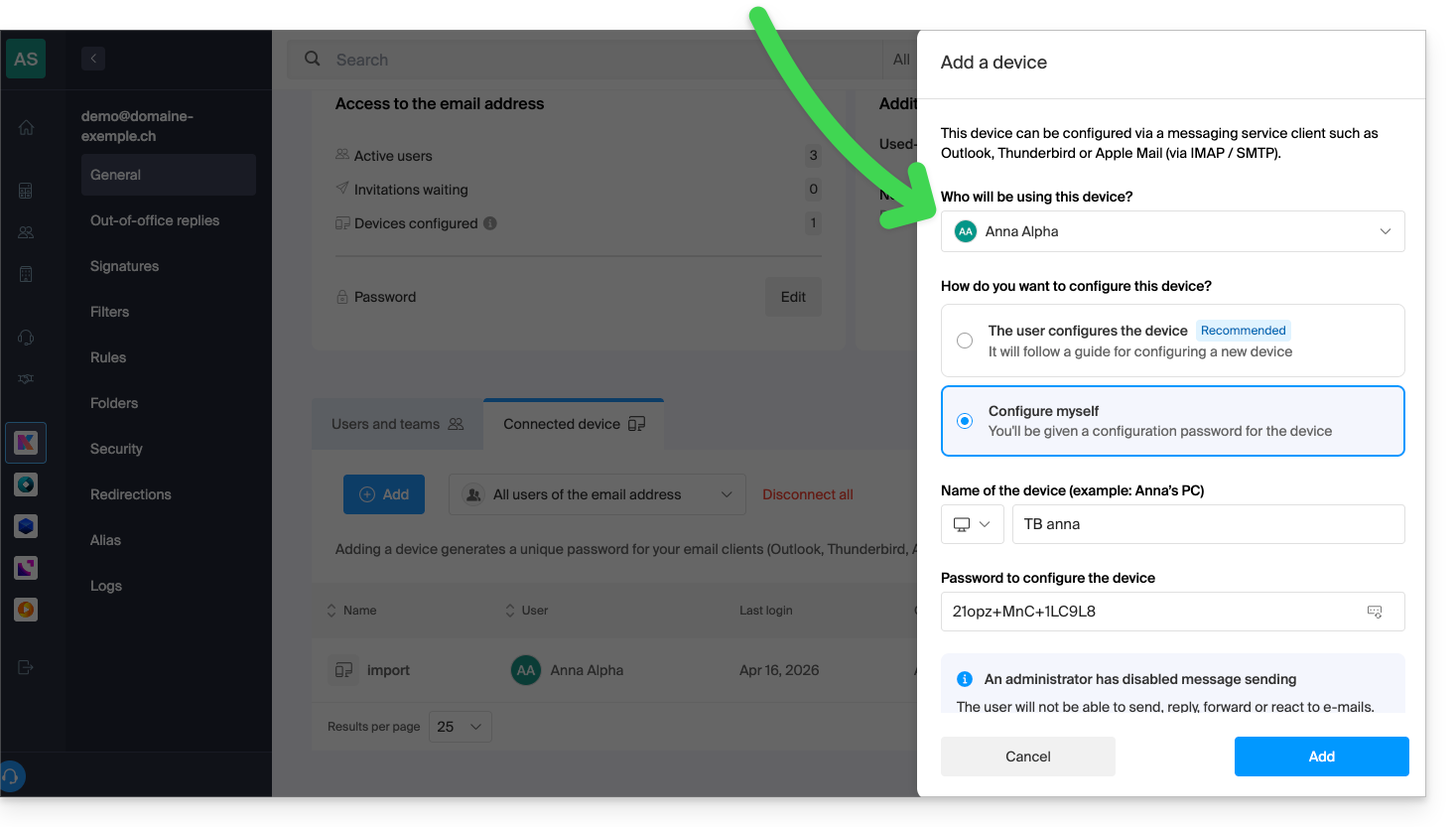
This will configure the software/email client to receive emails but will prevent it from sending any, continuously causing an error (password request) if the user insists on sending an email: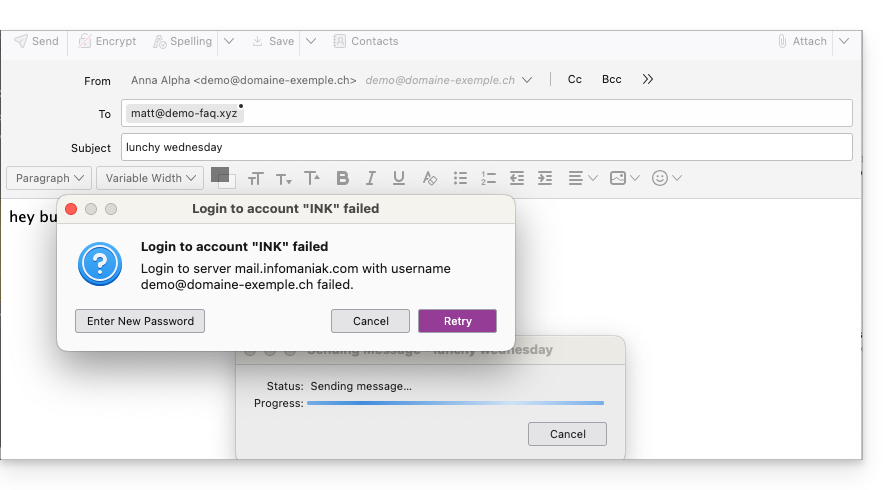
Link to this FAQ: https://faq.infomaniak.com/593
Has this FAQ been helpful?
This guide explains how to transfer to Infomaniak email addresses currently hosted by Yahoo, using an IMAP import tool.
Introduction
- This operation does not affect the data already present in the destination address, nor the data in the source address.
- The entire external mailbox will be imported.
- Once the import process has started, it is no longer possible to interrupt it.
- Any duplicates will be handled: identical content will only be copied once.
- Consult this other guide if you are looking for alternatives to this IMAP process.
Import your entire email history
1. Yahoo Prerequisites
- To allow the Infomaniak assistant to access your Yahoo account, click on https://login.yahoo.com/account/security#other-apps and configure an application password, which is automatically generated by Yahoo.
- You will need to copy it and then paste it in place of your password in the Infomaniak wizard for copying your emails; to generate it:
- Log in to your Yahoo account.
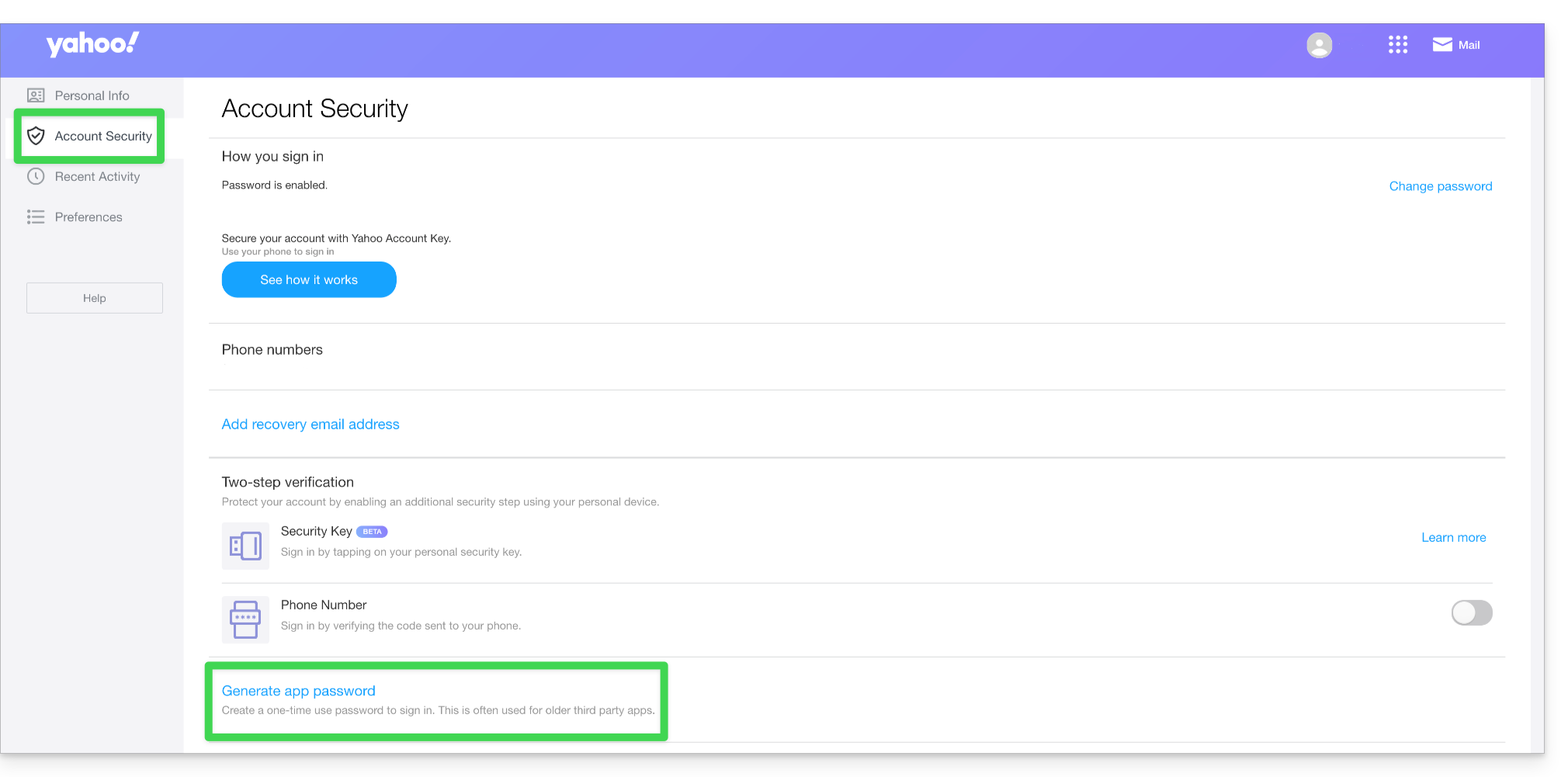
- Go to the Account Security tab.
- Click on Generate an app password:
- Choose Other app:
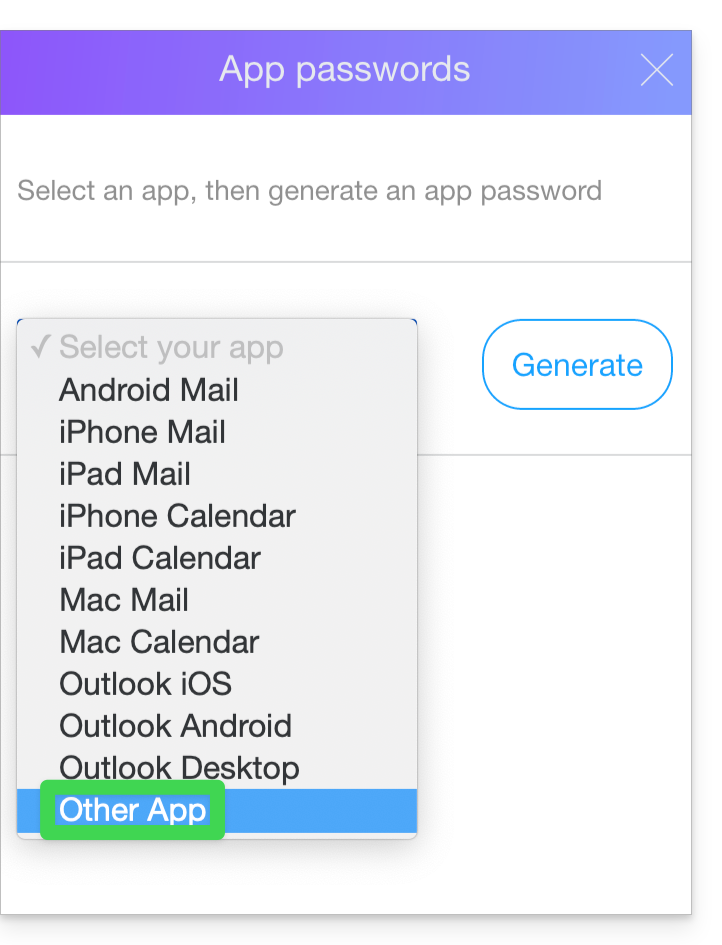
- Enter an app name, for example Infomaniak, and click on Generate:
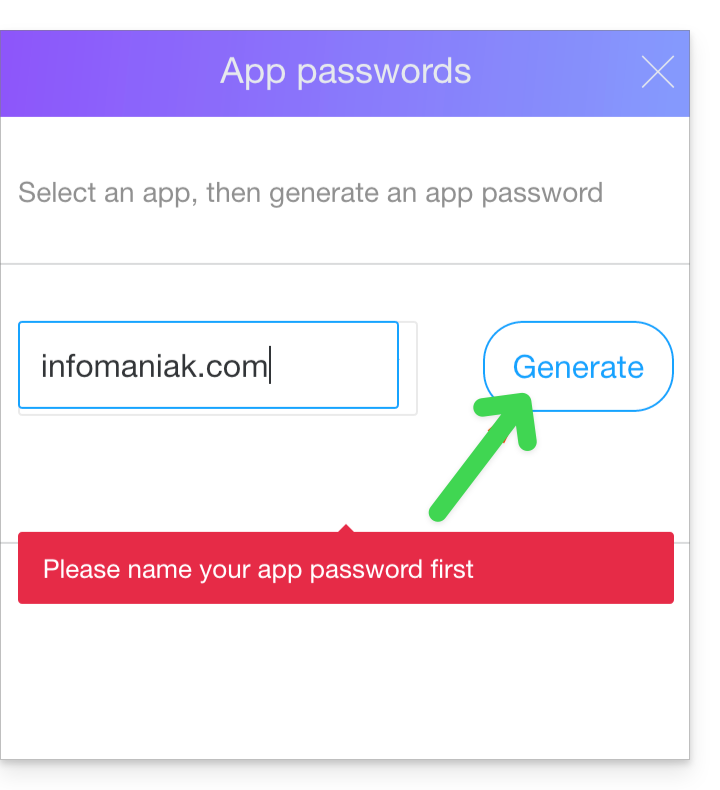
- Copy the app password.
2. Infomaniak Prerequisites
- Have a Mail service on your Infomaniak Manager.
- Have a available address quota or adjust it beforehand if necessary.
- Make sure your email is properly secured
- Create one or more addresses on this Mail service.
- If you have many (10+) email addresses to create, please refer to this other guide on bulk creation.
- The destination email address must be linked to the user (= the Infomaniak account) you are using.
3. Import email content from Yahoo to Infomaniak
- Click here to access the import tool (online service https://import-email.infomaniak.com).
- If necessary, log in to your Infomaniak account for the relevant organisation; the import will be done to one of the email addresses associated with the Infomaniak Mail web interface (online service ksuite.infomaniak.com/mail) of the Infomaniak account you are using.
- Click on IMAP import.
- Click on one-time import.
- Fill in the field on the left with your source email address (the content of which you want to copy).
- Fill in the field on the right with the password for that same source email address (see requirements).
- Click on Confirm.
- If necessary, enter a second email address to be imported at the same time.
- Choose the email address from which to import emails; the drop-down menu lists the email addresses currently associated with your Infomaniak Web Mail interface (online service ksuite.infomaniak.com/mail) of the Infomaniak account you are logged into.
- After selecting the desired destination address from the list, click the blue Import emails button.
- The copy process has started. You can wait and view the result on the page once the import is complete, or close the window (the import will continue in the background, and progress can be tracked - see below).
- A confirmation email will be automatically sent to all email addresses involved in the operation once the import is complete, indicating the number of messages copied.
- Tracking is available in the settings of the destination email address, and only on the web app Mail (online service ksuite.infomaniak.com/mail).
- Tracking allows you to view the import history for the address in question.
4. Adjust application settings
If necessary, once you have completed the steps to ensure that the domain name associated with your email account works with Infomaniak, modify the settings of the email software/clients you use so that they connect correctly to the Infomaniak servers: follow the configuration wizard.
Link to this FAQ: https://faq.infomaniak.com/611
Has this FAQ been helpful?
This guide presents commands that can be executed to test a connection or network and thus further identify the possible source of the error.
Perform a Telnet…
TELNET allows you to test the connection to a server without taking into account all the additional settings of a mail or FTP application, in order to determine the source of a problem. For example, if the connection fails on an SMTP server, you will need to check whether your firewall is blocking port 587 or 465.
… on macOS
- Search for Network Utility.
- Go to the
Ping,Lookup, orTraceroutetab, depending on what you want to test. - You can also use a
Terminalapplication (command-line interface,CLI) on your device and, depending on what you want to test, enter:traceroute [server]nc [server] [port]
Replace[server]with the server name or its IP address, and do the same for[port]…
… on Windows
Enable Telnet beforehand if necessary.
- Use a
Terminalapplication (command-line interface,CLI) on your device, for example by typing Run thencmd. - In the window that opens, depending on what you want to test, type:
tracert [server]telnet [server] [port]
Example:telnet mail.infomaniak.com 587(this allows you to test the SMTP port if your software/email client does not allow you to send emails)…
… on Android
- Use the Simple Telnet Client app, which allows you to easily test by filling in two fields (for example,
mail.infomaniak.comand port143or993)…
Perform a PING
PING allows you to determine if a machine is accessible via the Internet. You can also use this tool to verify that you are connecting to the correct machine, for example, after a DNS change, by checking the IP address obtained. It is possible to perform a ping on a domain name, a hostname, or an IP address.
PING is definitely blocked on Infomaniak shared hosting plans.
Link to this FAQ: https://faq.infomaniak.com/727
Has this FAQ been helpful?
This guide explains how email behaves when redirection is enabled for an email address managed with Infomaniak, and the destination is a Gmail address.
Message not displayed in Gmail
If you send an email…
- … from
abc@gmail.com… - … to
xyz@domain.xyz(a domain you have with Infomaniak)…
… and that this email address xyz@domain.xyz with Infomaniak has automatic forwarding enabled…
- … to
abc@gmail.com…
… then abc@gmail.com will never display your email as a new message in the inbox. Absolutely nothing will happen on Gmail.
Why?
The problem isn't that the redirection doesn't work: it's more of a peculiarity of Gmail: an email from Gmail to an email address at Infomaniak that is redirected to the same Gmail address as the sender's, will cause problems on the Gmail side, in the way it handles the messaging.
Your message will never be delivered (because, in reality, it already thinks the message is in the recipient's sent items folder). In this case, you need to remove the email forwarding rule.
Link to this FAQ: https://faq.infomaniak.com/760
Has this FAQ been helpful?
This guide details the differences between the IMAP and POP3 protocols in an email client (Outlook, Microsoft 365, Thunderbird, Apple Mail, eM Client, etc.) and explains why it is crucial not to use them simultaneously for the same email address managed by Infomaniak.
IMAP (recommended)
IMAP is the synchronization protocol. Messages remain on the server and can be accessed from anywhere.
- Multi-device access: your emails are synchronized between your computer, your mobile device, and the Infomaniak Web Mail app.
- Collaborative work: ideal for shared mailboxes. If a user moves or deletes a message, the change is visible to everyone.
- Security: in the event of a computer failure, your messages remain saved on the server.
POP3 (specific use)
POP3 is a download protocol. Messages are retrieved to your computer and generally deleted from the server.
- Offline access: messages are stored locally on your hard drive.
- Major drawback: once downloaded, messages are no longer visible on the Infomaniak Mail web app or on your other devices.
- Risks: if you use the "keep a copy of messages on the server" option, you may experience duplicate downloads and synchronization errors.
Important: Never mix POP and IMAP
Using both of these protocols simultaneously for the same address causes major technical conflicts:
- Messages inexplicably disappear on certain devices.
- Repeated downloads of old messages that have already been read (especially on Outlook).
- Unnecessary saturation of storage space.
Tip:we recommend using IMAP with all your email software/clients.
Refer to these other guides to configure an account in IMAP or to switch from POP to IMAP.
Link to this FAQ: https://faq.infomaniak.com/787
Has this FAQ been helpful?
This guide explains how to copy the content of one or more external email addresses (all email messages, folders, subfolders, in short, the entire structure of your existing email account with other providers) to one or more of your existing addresses at Infomaniak, thanks to the Infomaniak import tool!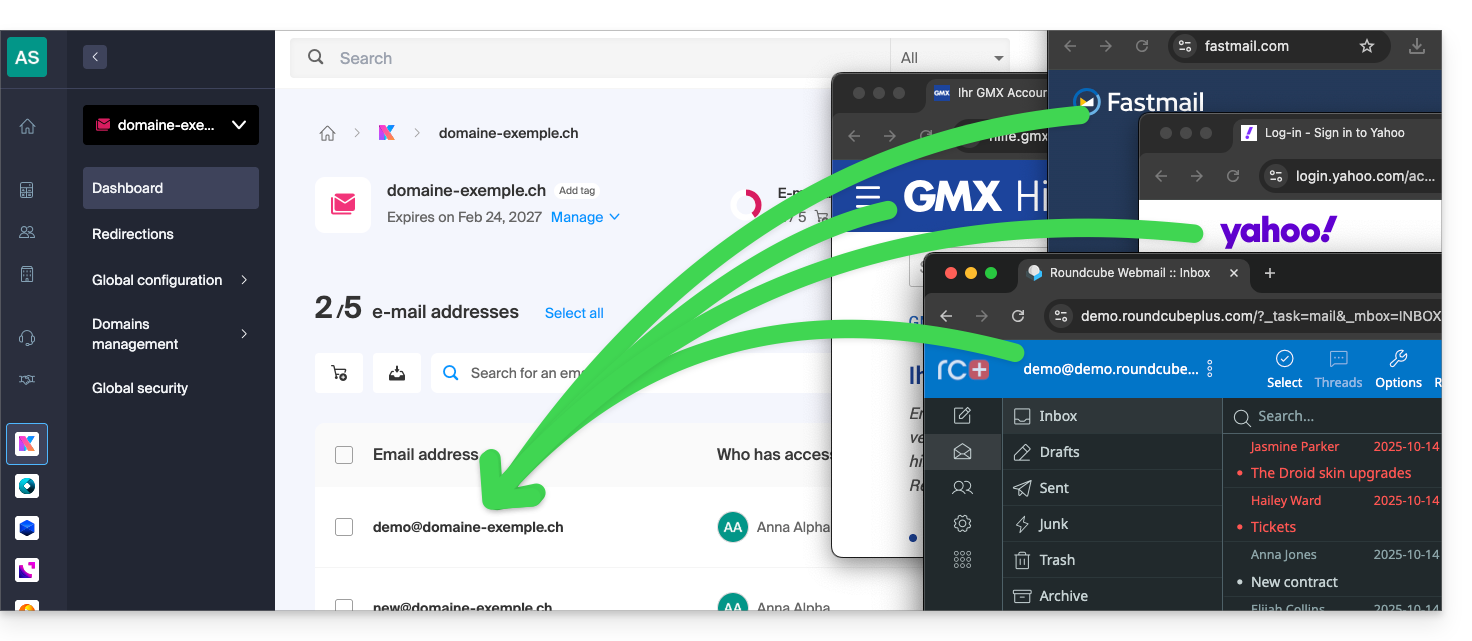
Introduction
- It's easy to migrate your entire email tree to Infomaniak – discover the offers.
- This operation does not affect the data already present in the destination address, nor the data in the source address.
- The entire external mailbox will be imported as a copy.
- Once the import process has started, it is no longer possible to interrupt it.
- Any potential duplicates are handled: identical content will only be copied once.
Start copying to an Infomaniak email address
Several options are available for importing emails:
- You want to copy emails already present in Infomaniak (e.g. @ik.me) to another mailbox also hosted at Infomaniak?
- Refer to this other guide to copy email content internally.
- You have a file/archive in MBOX format and want to import it directly into an existing address on Infomaniak?
- Refer to this other guide to import the content of the
.mboxfile and thus import your emails, regardless of their origin, into Infomaniak. - This is ideal for easily transferring content from Google, as an MBOX file can be easily obtained via Google Takeout.
- Refer to this other guide to import the content of the
- If you were unable to obtain an MBOX file of your emails, you can copy emails from an external provider using the IMAP import tool; click on the link corresponding to the email provider you want to import:
- addresses @ Bluewin
- addresses @ Gmail or custom Google domain
- addresses @ GMX
- addresses @ custom Microsoft 365 domain
- addresses @ Orange
- addresses @ custom Swisscom domain
- addresses @ Yahoo
- Any other email provider, such as Gandi, Hotmail, Hostinger, Sunrise, etc.
- You can also simply set up an email redirect, but this will only take effect on future emails that arrive in your inbox.
Link to this FAQ: https://faq.infomaniak.com/837
Has this FAQ been helpful?
This guide explains how to add or modify a DKIM record in a DNS zone (domain name/subdomain) managed in the Infomaniak Manager.
Introduction
- The DKIM (Domain Keys Identified Mail) protocol authenticates your emails with a unique digital signature.
- It guarantees that your messages have not been altered during their transmission and certifies the sender's identity, thus preventing spoofing by spammers.
- DKIM is enabled by default for all Mail Services whose DNS zone is managed with Infomaniak.
- All your emails are automatically signed, whether they are sent from the Mail Infomaniak app or the email software/client of your choice.
Check DKIM registration
If you have a Mail service with Infomaniak, the easiest way is to go to the Global Security tool to easily check and correct certain problematic records.
And when your domain name is managed elsewhere, you will find the DKIM record to add to the DNS zone: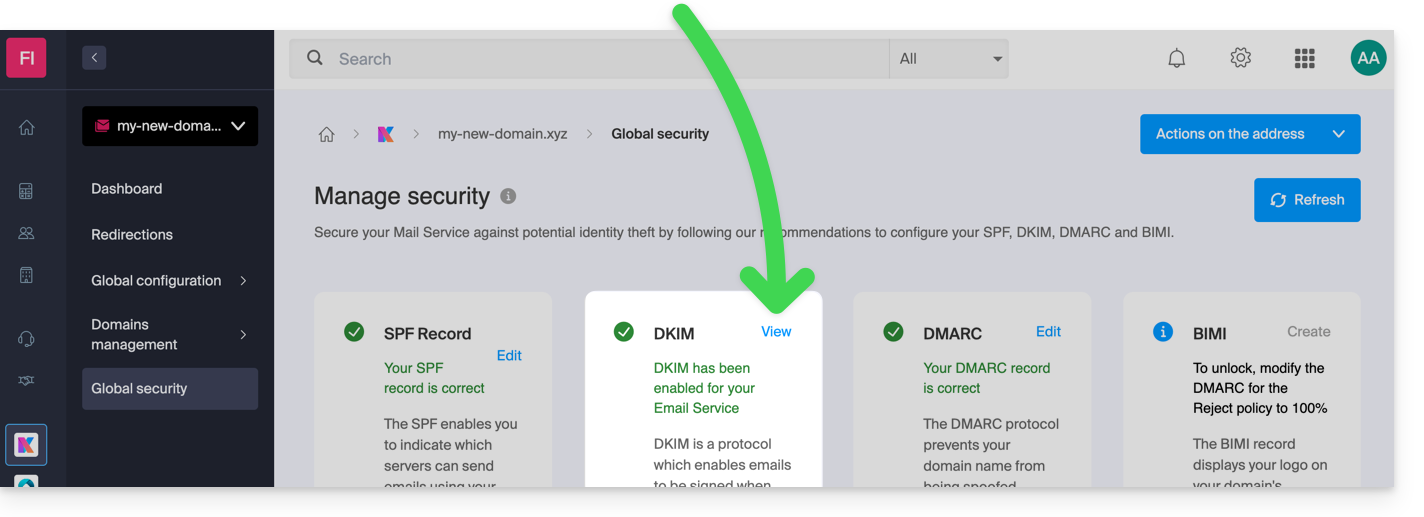
Manually modify the DNS zone (not recommended)
To manage this type of record in a DNS zone:
- Click here to access your domain management in the Infomaniak Manager (need help?).
- Click directly on the name assigned to the domain in question.
- Click on DNS Zone in the left-hand menu.
- Click the button to add a record:
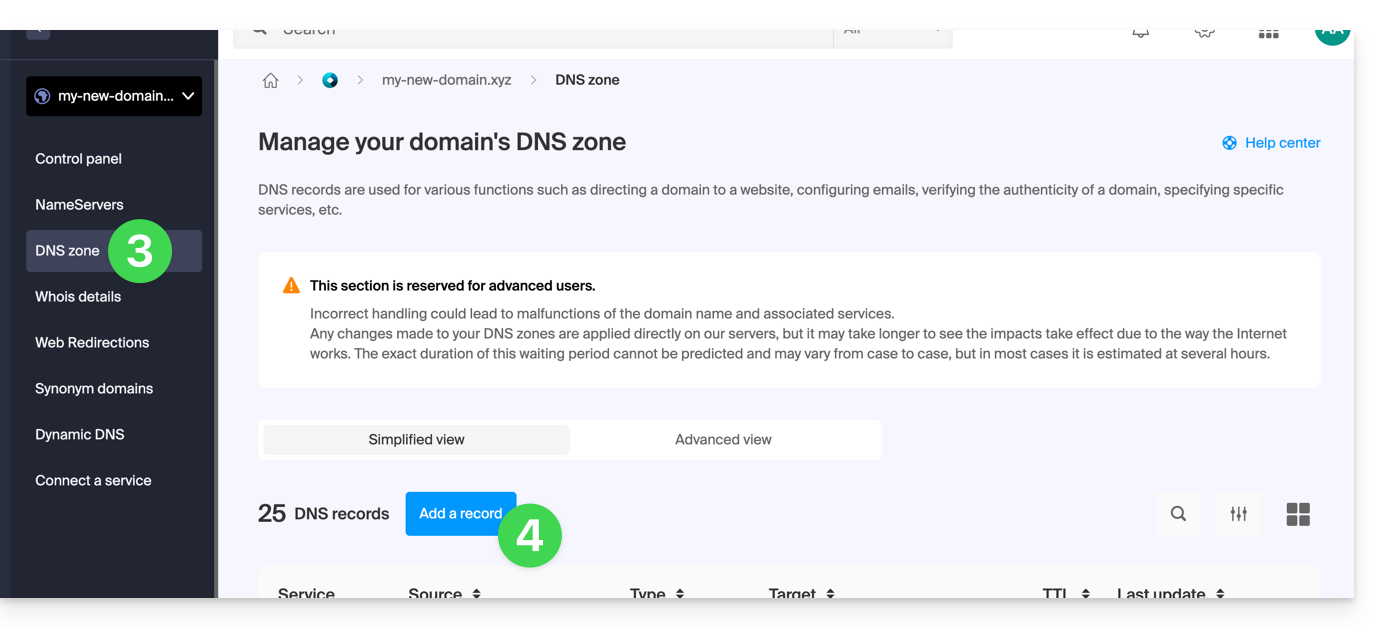
- Click the DKIM radio button to add a record.
- Click the Next button:
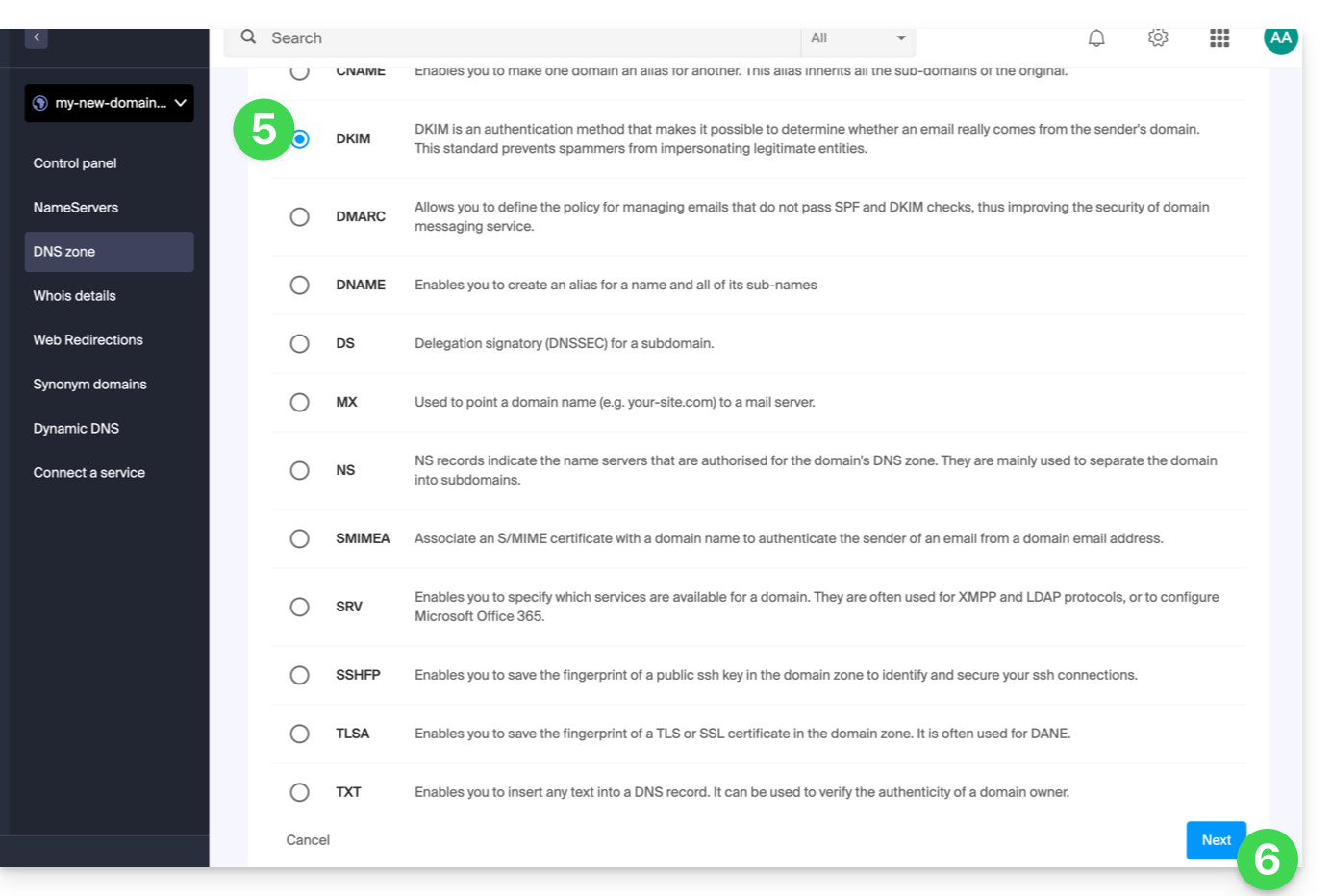
- Enter the DKIM values required for your DNS zone.
- Leave the default value for the TTL.
- Click on the Save button:
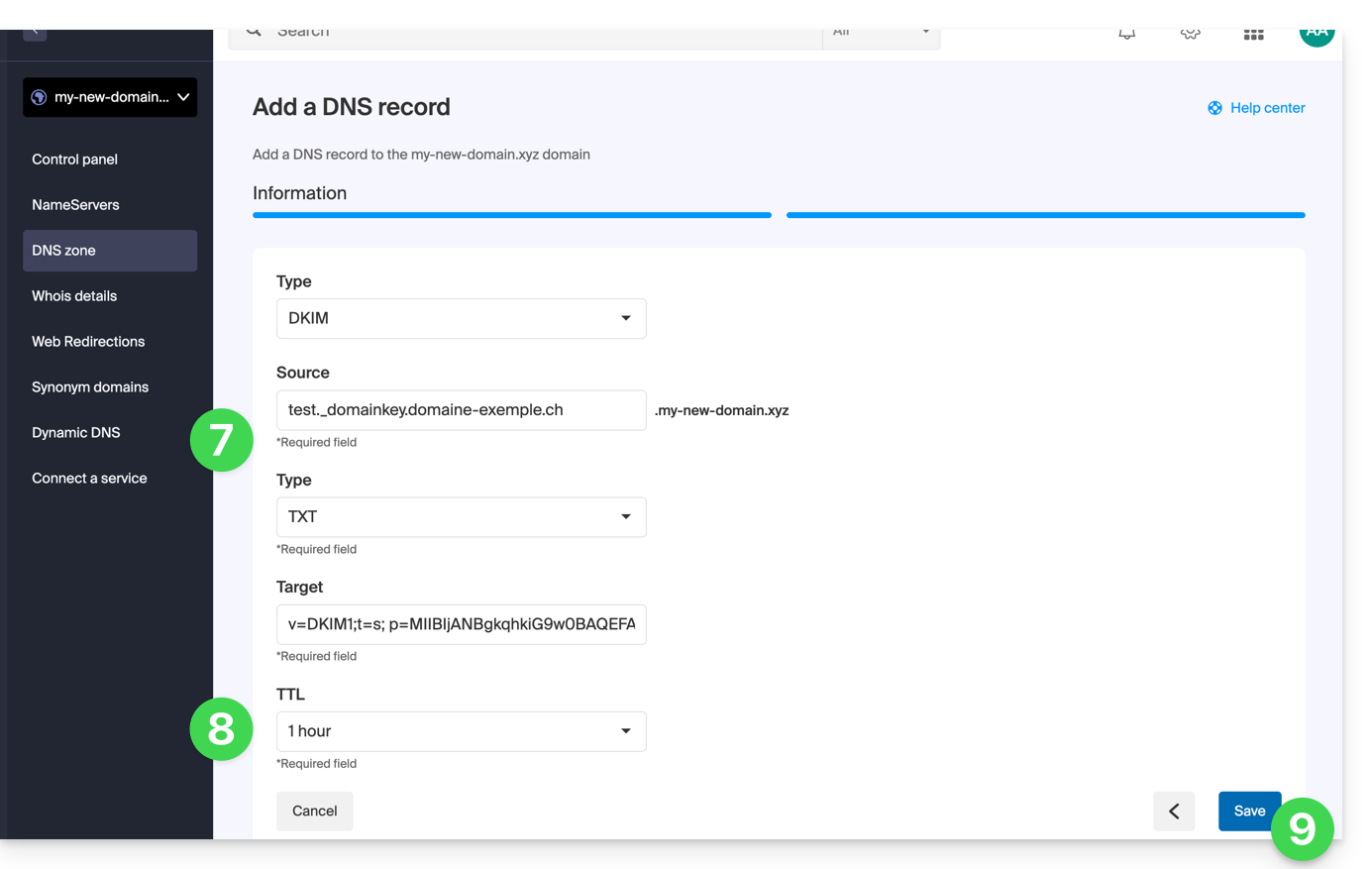
Add multiple DKIM records
You can have multiple DKIM records on your domain/subdomainwithout any limit, unlike DMARC or SPF, as long as your DNS host allows it.
If you use multiple third-party email providers, such as the Odoo ERP, it is necessary to add a DKIM for Odoo in addition to the one for Infomaniak.
Use unique DKIM selectors to avoid conflicts with existing records.
Link to this FAQ: https://faq.infomaniak.com/841
Has this FAQ been helpful?
This guide explains how to set certain parameters so that they are automatically applied by default to new email addresses (and users) added to the Mail Service in the future.
Introduction
To apply settings to existing email addresses instead, please refer to this other guide.
Accessing the Global Configuration of the Mail Service
To do this:
- Click here to access the management of your Mail Service on the Infomaniak Manager (need help?).
- Click directly on the name assigned to the Mail Service in question:
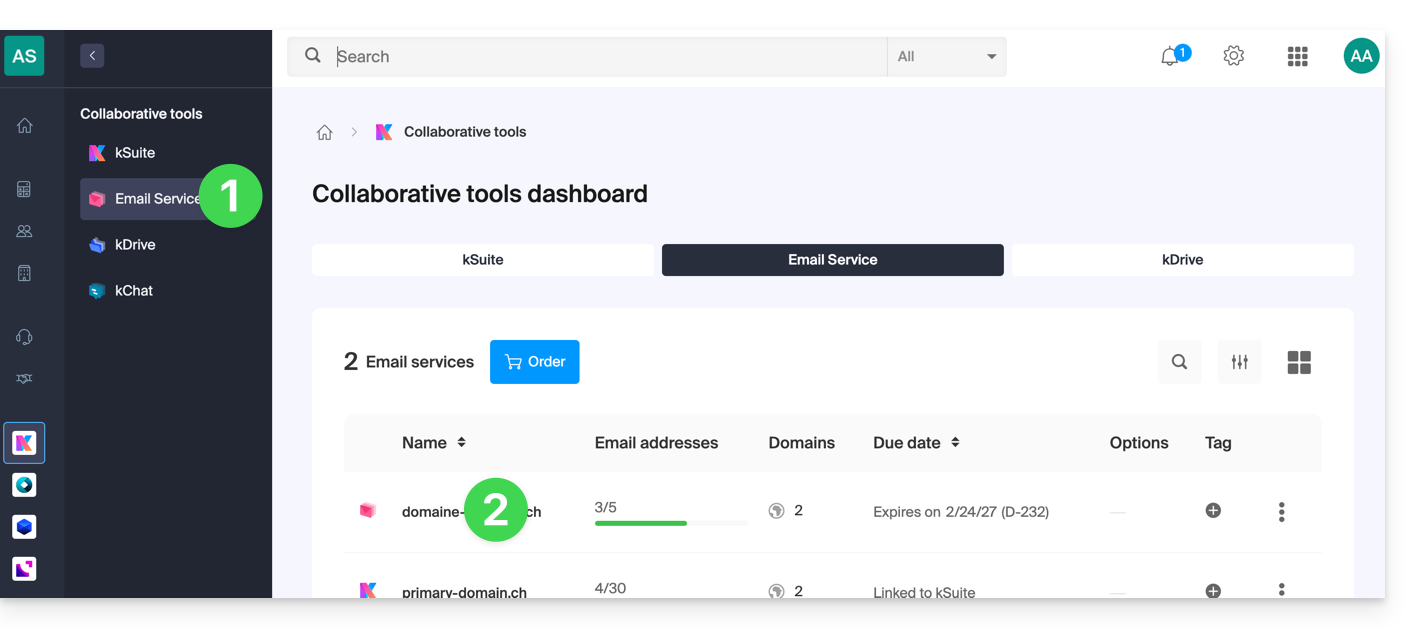
Click on Global Configuration in the left-hand menu:
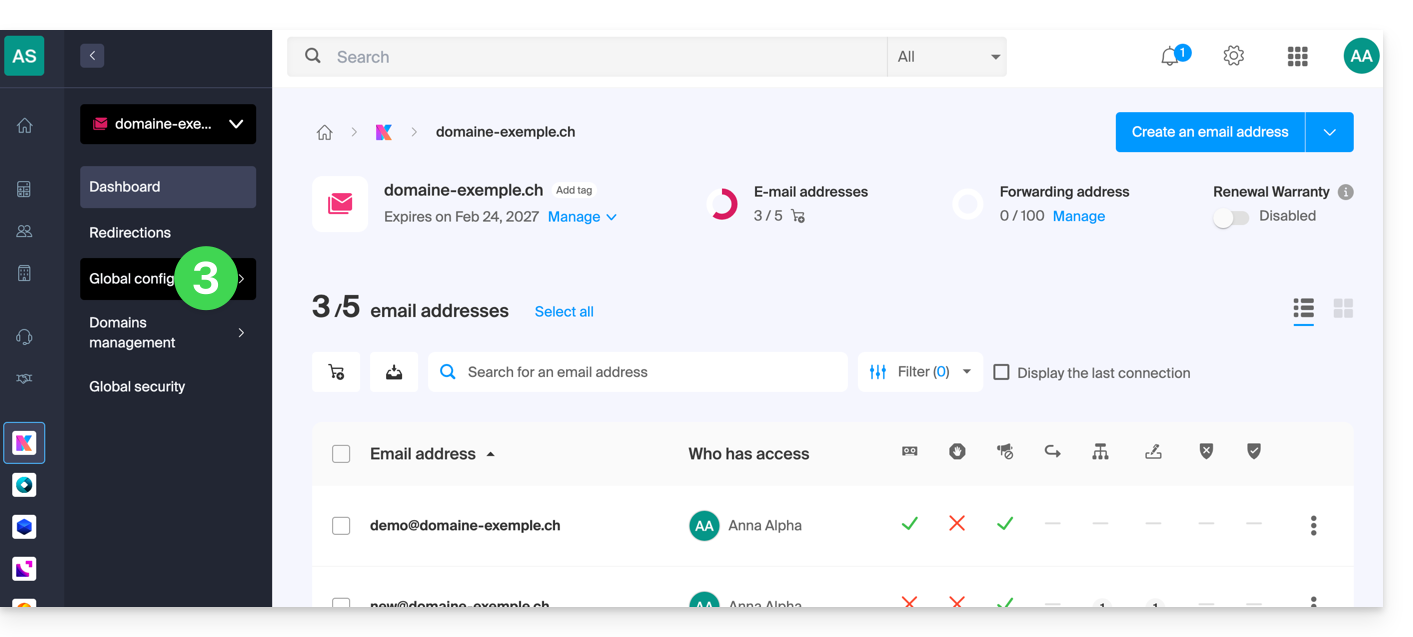
You can then choose from 5 sections the parameters that you want to enable or disable by default:
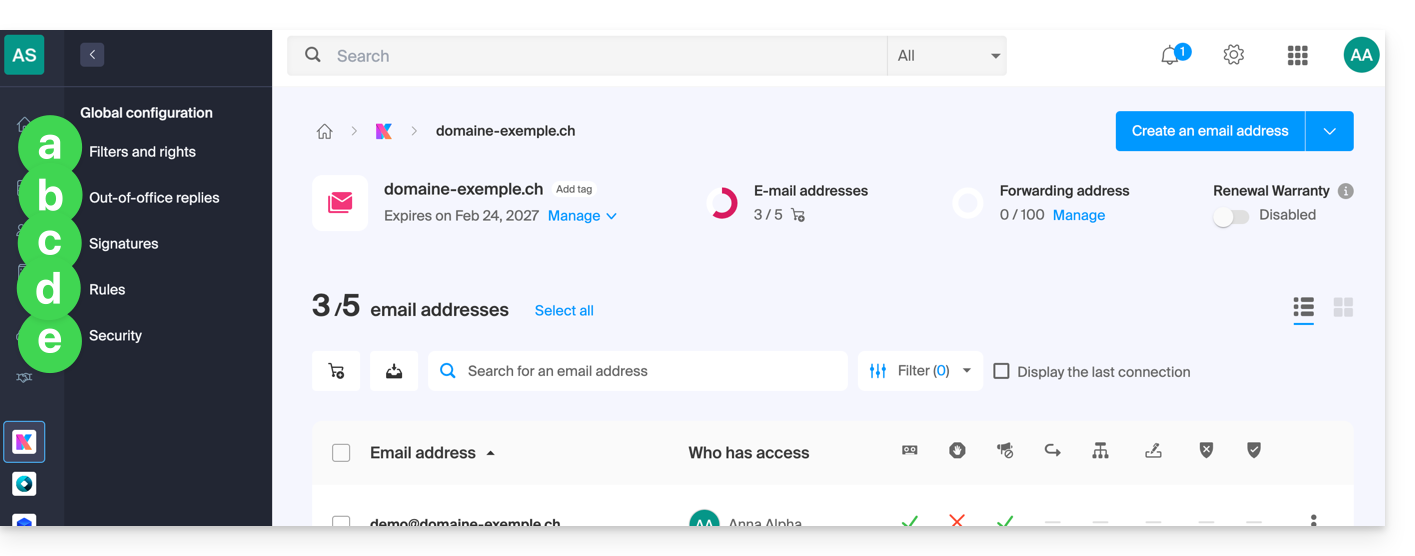
a. Filters and permissions
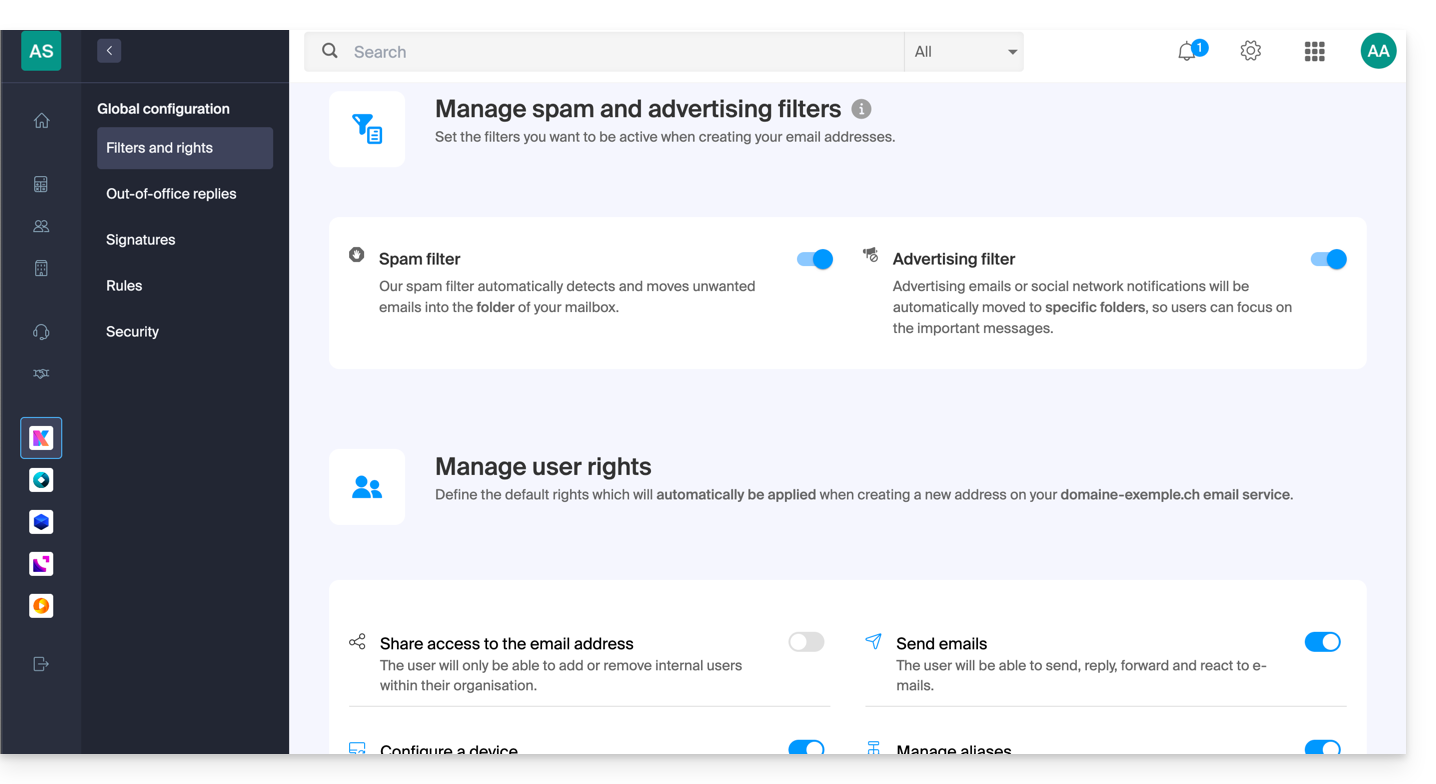
You can choose to enable or disable the anti-spam filter when a new address is created on the Mail Service.
The same applies to the advertising filter.
You can also manage the default permissions that a user will have for the email address.
b. Auto-replies
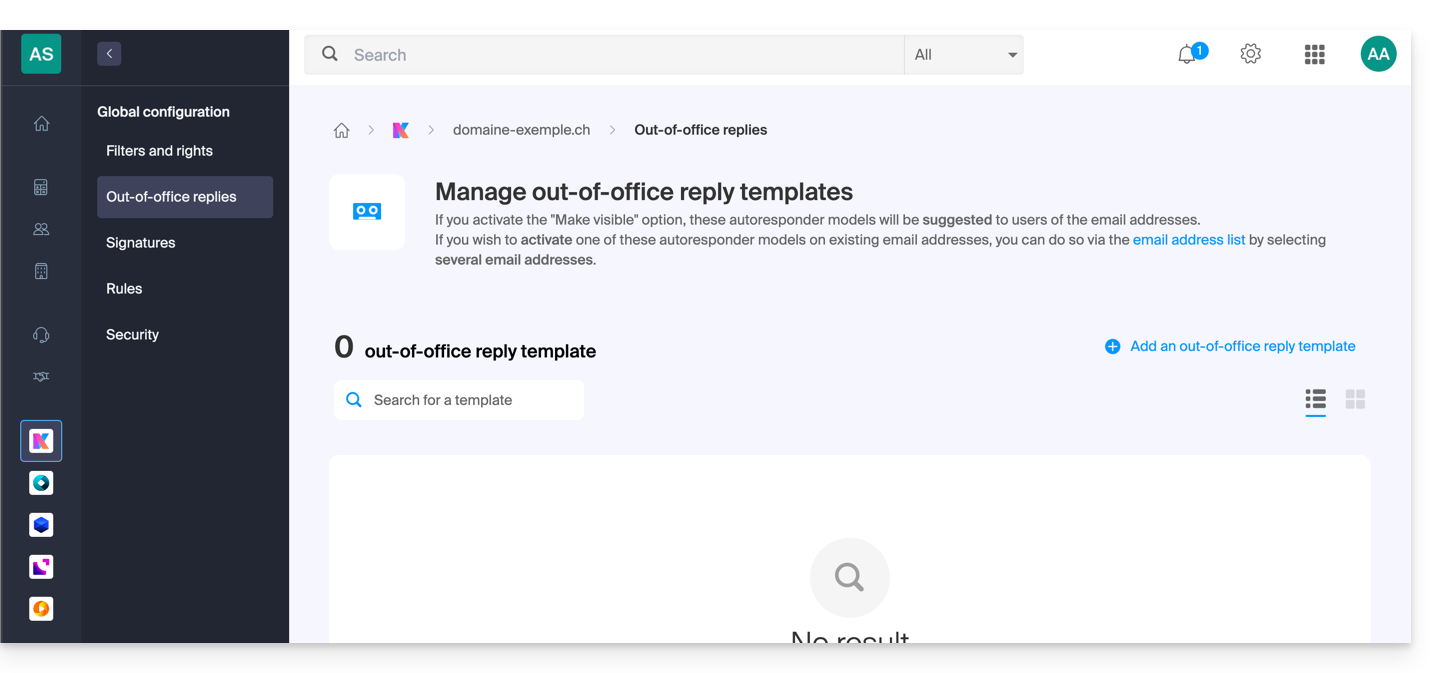
- You can manage the auto-reply templates that can then be customized by email address users.
c. Signatures
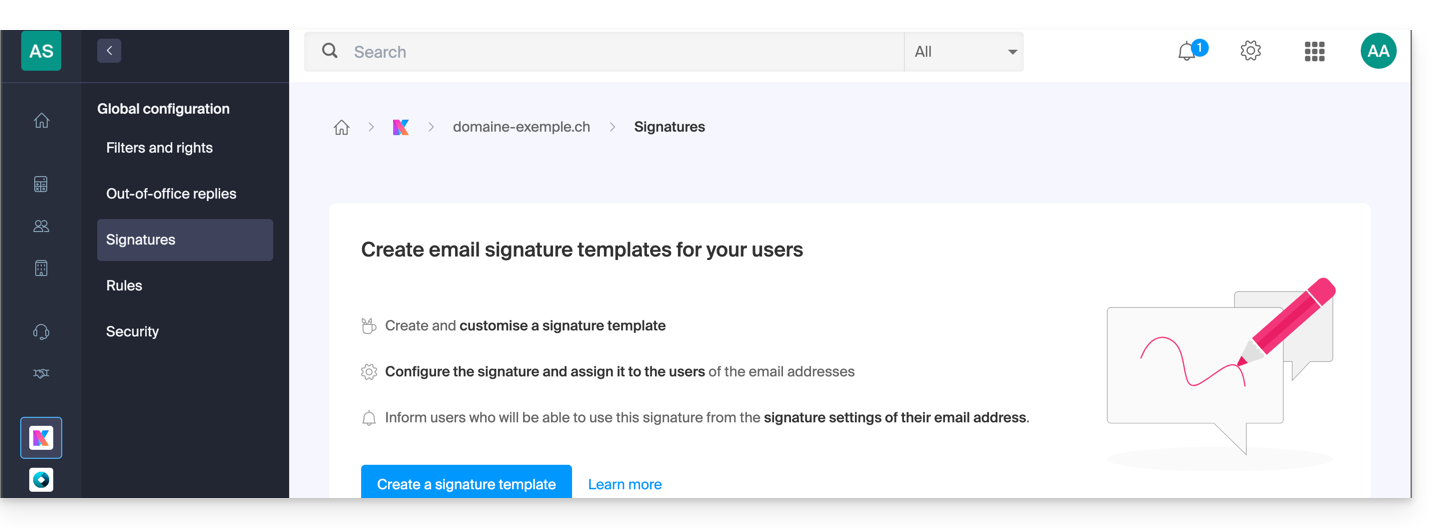
- You can manage the signature templates that can then be customized by email address users.
d. Rules
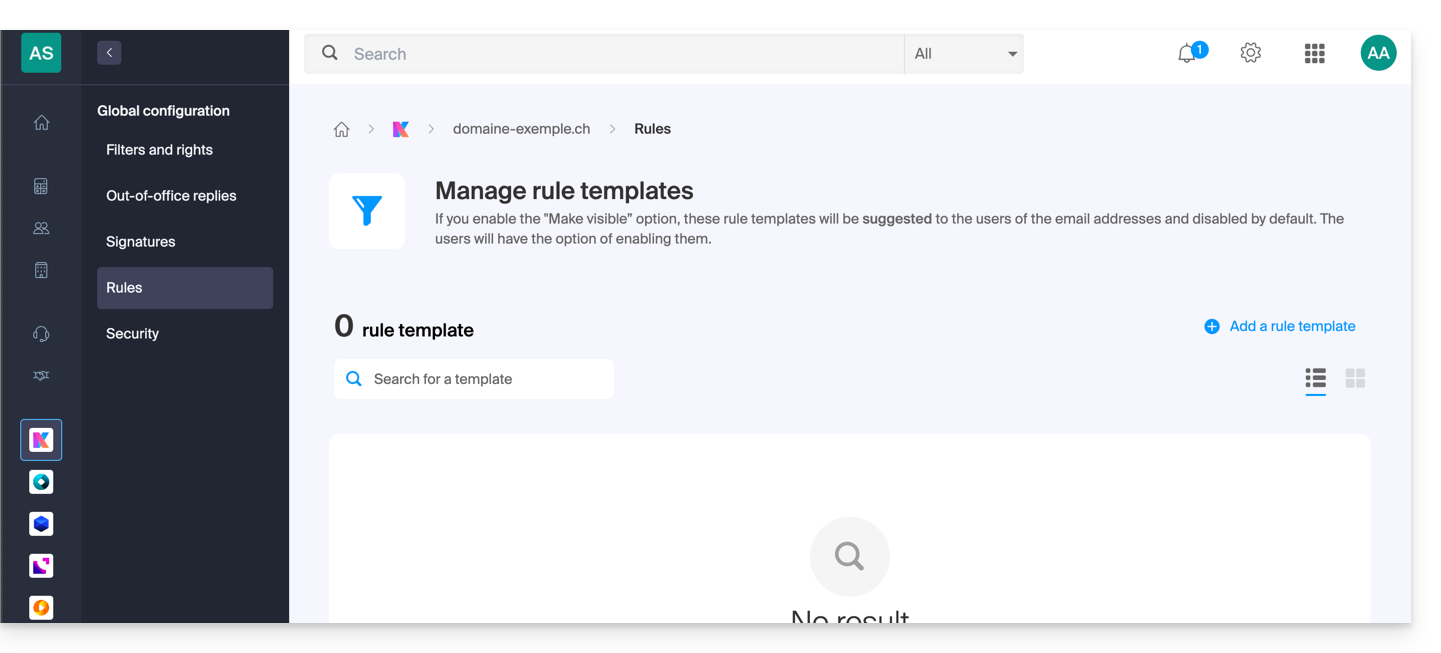
- You can manage the rule templates, which are disabled by default, and which can then be customized and activated by email address users.
e. Security
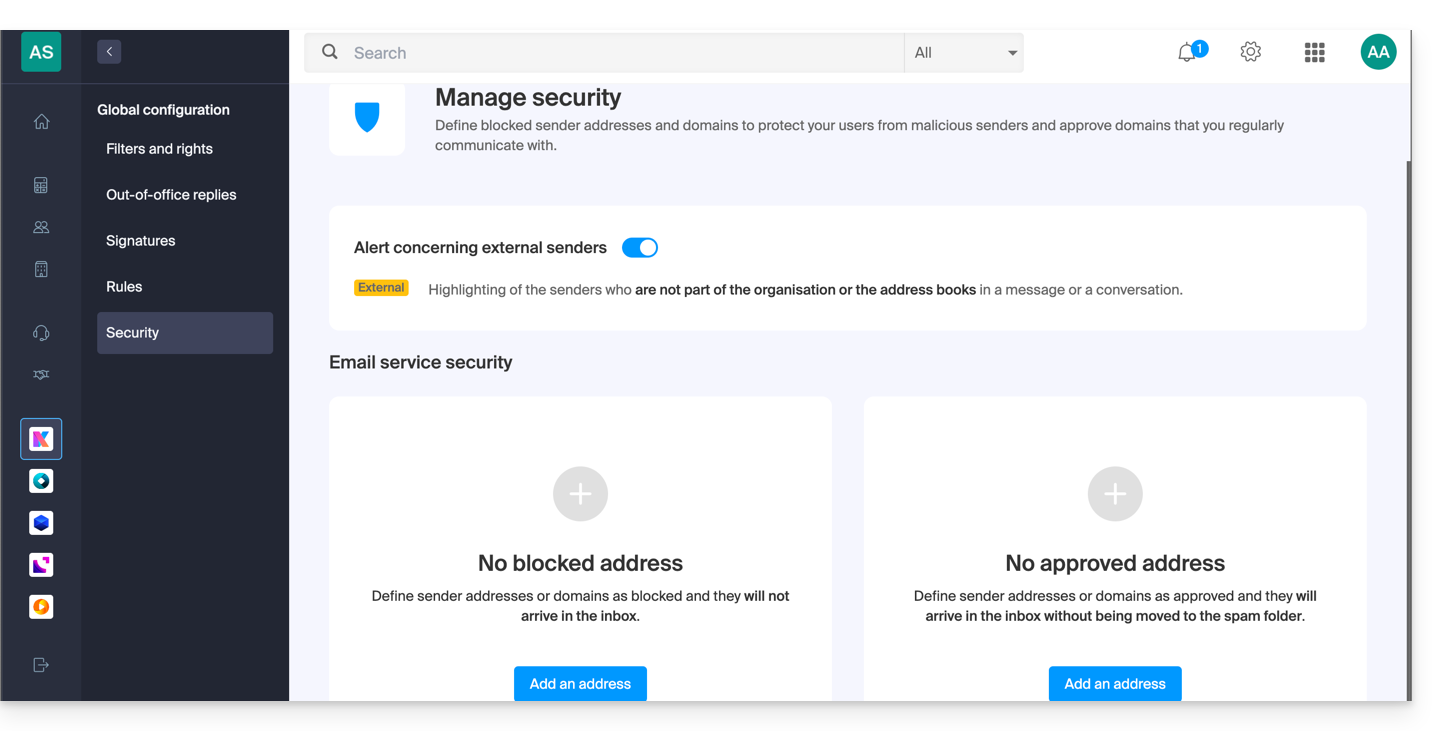
- You can manage the external email warning and, below that, add senders whose emails will always go to the Spam folder, or, conversely, which will never be filtered.
Link to this FAQ: https://faq.infomaniak.com/843
Has this FAQ been helpful?
This guide helps you identify and correct most email errors encountered after sending an email to a recipient. Refer to this other guide if you are looking for information about errors encountered when setting up an email address in a software/email client.
Introduction
- Generally, an error message related to email occurs due to…
- … an incorrect configuration of the domain name used with your email,
- … a problem with your recipient's (email provider).
- In all cases, a delivery failure report (Mailer Daemon or Mail Delivery Subsystem) containing the explanation is sent to the sender.
Find and identify the email error
When your message fails to reach the recipient, an initial failure report (Temporary Delivery Failure Report) is sent, indicating that the server will attempt to resend your message several times.
A final non-delivery report (Final Delivery Failure Report or Undeliverable Mail) issued by the recipient's server is sent to the sender (via the Infomaniak mail server, which is why Infomaniak is mentioned at the beginning of most error messages you may receive) to inform them that the email could not be delivered even after several attempts.
The notification always contains the reason for the failure. Example below:
This is the mail system at host smtp-1-1234.mail.infomaniak.ch.
I'm sorry to have to inform you that your message could not be delivered to one or more recipients. It's attached below.
For further assistance, please send mail to postmaster.
If you do so, please include this problem report. You can delete your own text from the attached returned message.
The mail system anna.a@abc.xyz: host mxbw-abc-xyz.abc-ab12.abc.ch[123.456.789.00] said: 550 5.1.1
anna.a@abc.xyz recipient rejected, account administratively disabled (in reply to RCPT TO command)
Therefore, here, the address of your correspondent is visibly suspended by their email provider (account administratively disabled).
Sometimes, you need to look for the reason behind the error message you received within its attachments (often a plain text file). Example:
Reporting-MTA: dns; mxbw.abc.ch [123.456.789.00]
Received-From-MTA: dns; smtp-1-1234.mail.infomaniak.ch [12.345.678.99]
Arrival-Date: Tue, 01 Aug 2023 15:49:22 +0200
Final-recipient: rfc822; anna.a@abc.xyz
Diagnostic-Code: smtp; 552 RCPT TO:anna.a@abc.xyz Mailbox disk quota exceeded
Last-attempt-Date: Tue, 01 Aug 2023 15:49:22 +0200Here, the mailbox of your external contact at Infomaniak appears to be full (Mailbox disk quota exceeded).
Most common cases
SPF Failure
The SPF (Sender Policy Framework) record is not configured correctly:
Subject: Delivery Status Notification (Failure)
From: Mail Delivery System mailer-daemon@domain.xyz
To: Anna.A anna.a@abc.xyz
This is an automatically generated Delivery Status Notification.
Delivery to the following recipient failed due to SPF failure:
anna.a@abc.xyz
Technical details of SPF failure:
The sender's domain domain.xyz does not have a valid SPF record. Please contact your email administrator to correct the SPF configuration.Solution: check the configuration of your domain name, and in particular the SPF record if your website is hosted on Wix or another provider.
Unknown User
The email address specified in the message is invalid or does not exist:
Subject: Delivery Status Notification (Failure)
From: Mail Delivery System mailer-daemon@domain.xyz
To: Anna.A anna.a@abc.xyz
This is an automatically generated Delivery Status Notification.
Delivery to the following recipient failed permanently:
anna.a@abc.xyz
Technical details of permanent failure:
The email address does not exist. Please check the recipient's email address and try again.Solution: carefully check the recipient's email address and correct it if necessary; ensure that you are using a valid email address for the recipient.
Temporary Failure
The recipient's mail server is experiencing temporary issues or is unavailable.
Solution: Wait a while, then try sending the message again later. If the problem persists, contact the recipient's technical support for assistance.
Blocked by SPAM Filter (or Content Rejected)
The recipient's mail server blocked the message due to anti-spam filtering rules:
Subject: Delivery Status Notification (Failure)
From: Mail Delivery System mailer-daemon@domain.xyz
To: Anna.A anna.a@domain.xyz
This is an automatically generated Delivery Status Notification.
Delivery to the following recipient failed due to the message being rejected as spam:
anna.a@domain.xyz
Technical details of delivery failure:
The content of the message triggered the spam filters of the recipient's email server. Please review the message content and try again.Solution: check if your message contains elements that may be considered spam (keywords, suspicious links, etc.). Contact the recipient to verify if the message was filtered into the spam folder.
Refer to this other guide about outgoing spam and this other guide about incoming spam.
Bad Reputation
The recipient's mail server blocked the message due to anti-spam filtering rules:
gmail-smtp-in.l.google.com said: 550-5.7.1
Our system has detected that this message is likely suspicious due to the very low reputation of the sending domain.
To best protect our users from spam, the message has been blocked.
Please visit {{URL_5}} for more information.Solution: check the reputation of the domain and determine if one of your email addresses has recently been unintentionally used for malicious purposes.
Domain Not Found (or DNS Error)
The recipient's domain name could not be resolved or does not exist.
Solution: check the spelling of the recipient's domain and correct it if necessary; ensure that the domain name and DNS are valid and active.
Mailbox Full
The recipient's inbox is full, preventing new messages from being received.
Solution: Inform the recipient of the situation and ask them to free up space by deleting emails or archiving items.
This cannot happen with email addresses managed by Infomaniak, as they do not have a storage size limit.
Part of their network is on our block list
If the error message (usually displayed after sending an email from an online tool hosted on the server where your website is located, such as an order confirmation from PrestaShop or another online store you manage) contains the following:
host hotmail-com.olc.protection.outlook.com[104.47.30.97] said: 550 5.7.1
Unfortunately, messages from [89.123.456.789] weren't sent. Please contact your Internet service provider since part of their network is on our block list.Solution: change the email sending method. The sending is unauthenticated and originates from the server with a specific IP address, which is apparently blocked by the recipient for some reason (Infomaniak does not intervene to request unblocking). Therefore, you need to configure the online tool to perform authenticated sending.
Less frequent errors
Deferred - Delayed
The error message Deferred - Delayed - Warning: message still undelivered after 4 hours, Will keep trying until message is 3 days old means that the Infomaniak mail server tried to connect to your recipient's mail server to send the message, but for an undetermined reason, it was unable to do so. This error message specifies that the Infomaniak server will continue to try to send your message during the period specified in the error message. If, after this period, the message has still not been delivered, you will receive a final error message indicating that your message could not be delivered and that your recipient did not receive it.
Greylisting Delay
This Greylisting Delay error occurs when the recipient's mail server uses a technique called "greylisting," which Infomaniak also uses. This technique imposes a temporary delay during the first attempt to deliver a message from an unknown sender. The Mailer Daemon may send an error report indicating that the delivery was delayed due to greylisting. The error may also mention banned sender. You should retry your sending attempt a few minutes/hours later.
Malware message rejected
This Malware message rejected error occurs when the message contains an attachment, a link to a storage site such as Dropbox, or dynamic content, including in the "forwarded" part of the message (in the case of a message forward, for example). Try resending the message from the Infomaniak Mail web app (online service ksuite.infomaniak.com/mail) instead of a messaging application, and remove any content that may be causing this error.
Message Size Exceeded / File Too Large
These Message Size Exceeded / File Too Large errors occur when the size of the message (or attachments) exceeds the limit allowed by the recipient's email server. The Mailer Daemon will return an error report indicating that delivery failed due to the message size exceeding the limit.
Rate Limit Exceeded
This Rate Limit Exceeded error occurs when the sender has exceeded the frequency or volume limit allowed by the recipient's email server. Email servers may impose limits to prevent spam or system overload.
Sender denied: auth guards failed
Please refer to this other guide if you encounter the Sender denied: auth guards failed error.
The message contains a unicode character in a disallowed header
This error, The message contains a unicode character in a disallowed header, may appear if you have inserted a special character, such as a heart ♥, in the body of the email, the subject, or especially in the full name. The risk of rejection by providers is very high: it is best to keep the use of signs, characters, and fonts as simple as possible.
Link to this FAQ: https://faq.infomaniak.com/858
Has this FAQ been helpful?
This guide explains how to delete folders that appear grayed out in the Infomaniak Mail web app (online service ksuite.infomaniak.com/mail) or in certain email software/clients such as Apple Mail, Mozilla Thunderbird, or Microsoft Outlook.
Ghost folders
Some email software/clients, such as Microsoft Outlook, allow you to create subfolders of non-existent folders. For example, it is possible to create the folder /abc/klm/xyz even though the folder "klm" does not exist.
In Mail Infomaniak or other software, ghost folders like the folder "klm" appear in gray and cannot be deleted directly because they are only "paths" to a real subfolder.
To delete these ghost folders, you must first delete their subfolders (in this example: xyz).
Stubborn Folders
If, when viewing your Infomaniak email address in Outlook, ghost folders persist or reappear immediately after deletion, here are the technical procedures recommended by Microsoft to force synchronization:
1. Force a reset of the Outlook folders
Sometimes, Outlook's local folder table is corrupted. A simple command can often fix this without deleting anything:
- Close Outlook completely.
- Press the
Windows + Rkeys on your keyboard. - Type
outlook.exe /resetfoldersand press Enter (this restores missing or corrupted folders from the server).
2. Reset the IMAP cache (.ost)
If the problem persists, forcing Outlook to rebuild its local database is often the most effective solution:
- Close Outlook.
- Go to the folder:
C:\Users\[Your Username]\AppData\Local\Microsoft\Outlook. - Identify the
.ostfile with the name of your Infomaniak address and delete it (or rename it to.oldfor safety). - Restart Outlook; the software will redownload all your messages and folders cleanly from the Infomaniak servers.
3. Using the MFCMAPI Tool (Advanced Level)
MFCMAPI allows you to directly access the MAPI structure of your mailbox to delete items that the standard Outlook interface refuses to touch:
- Download the latest version of MFCMAPI from GitHub (Official source).
- Launch
MFCMAPI.exeand go toSession > Logon; select your Outlook profile. - Double-click on your Infomaniak email account in the list.
- In the new window, expand
Root Container(orRacine - Boîte aux lettres), thenIPM_SUBTREE. - Locate the problematic folder, right-click on it, and select
Delete folder. - Warning: In the dialog box, first try a simple deletion; if that fails, try again by checking
DELETE_HARD_DELETE(permanent deletion at the server level).
4. Final check via Webmail
If a folder is deleted in Outlook but keeps reappearing, be sure to check in the Infomaniak Mail web app to see if the folder is present there, and first delete it via the web interface before applying step #1 (resetfolders) in Outlook.
Deleting an account and reconfiguring it immediately remains the simplest alternative if MFCMAPI seems too complex.
Link to this FAQ: https://faq.infomaniak.com/865
Has this FAQ been helpful?
This guide explains what the "External" label means in the web app Mail (online service ksuite.infomaniak.com/mail) and the mobile app Infomaniak Mail (application for iOS/Android smartphones or tablets) when reading certain messages: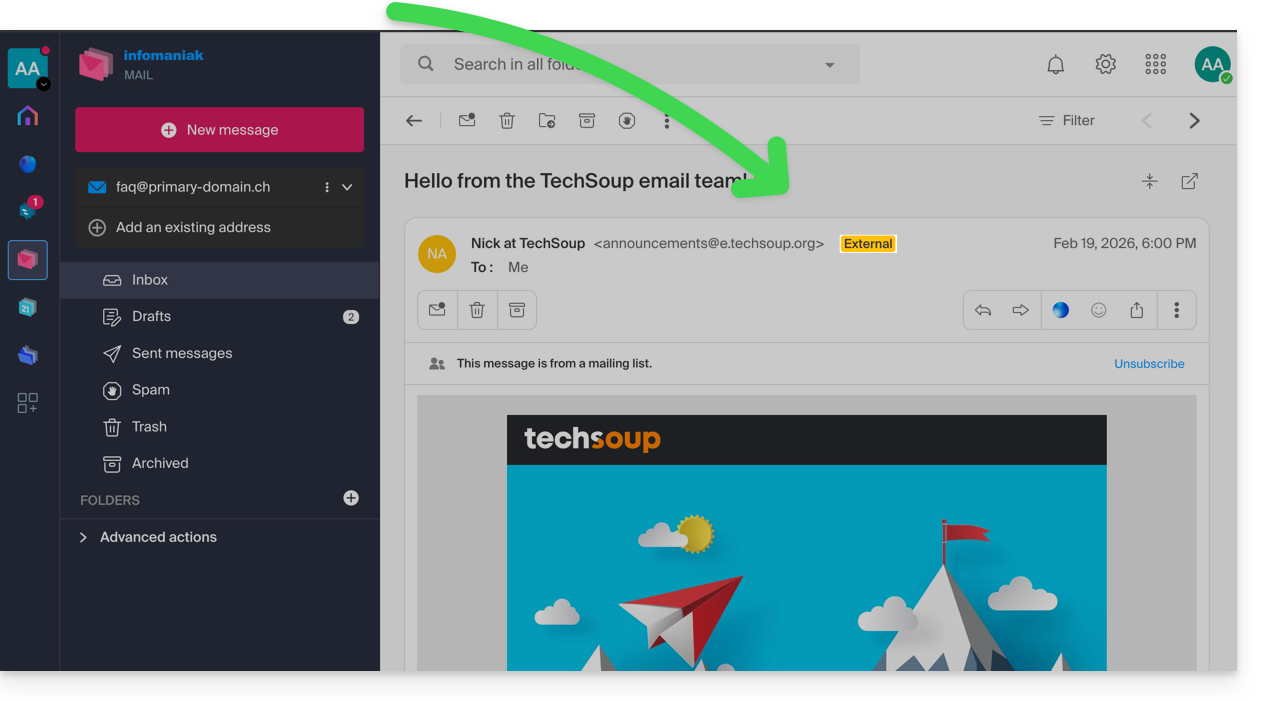
Introduction
- The "External" label is displayed in the following cases:
- The sender's domain name (or alias) does not match the email address configured in Mail.
- The sender is not in your contacts (including suggested contacts).
- The email comes from an address hosted outside the Organization.
- With certain free offers, such as my kSuite, the label will appear as "unknown" instead of “external”.
Enable or disable the label
You can enable or disable the label; the effect is immediate for incoming emails and when replying to an external email. To do this:
- Click here to access the management of your Mail Service in the Infomaniak Manager (need help?).
- Click directly on the name assigned to the Mail Service in question:
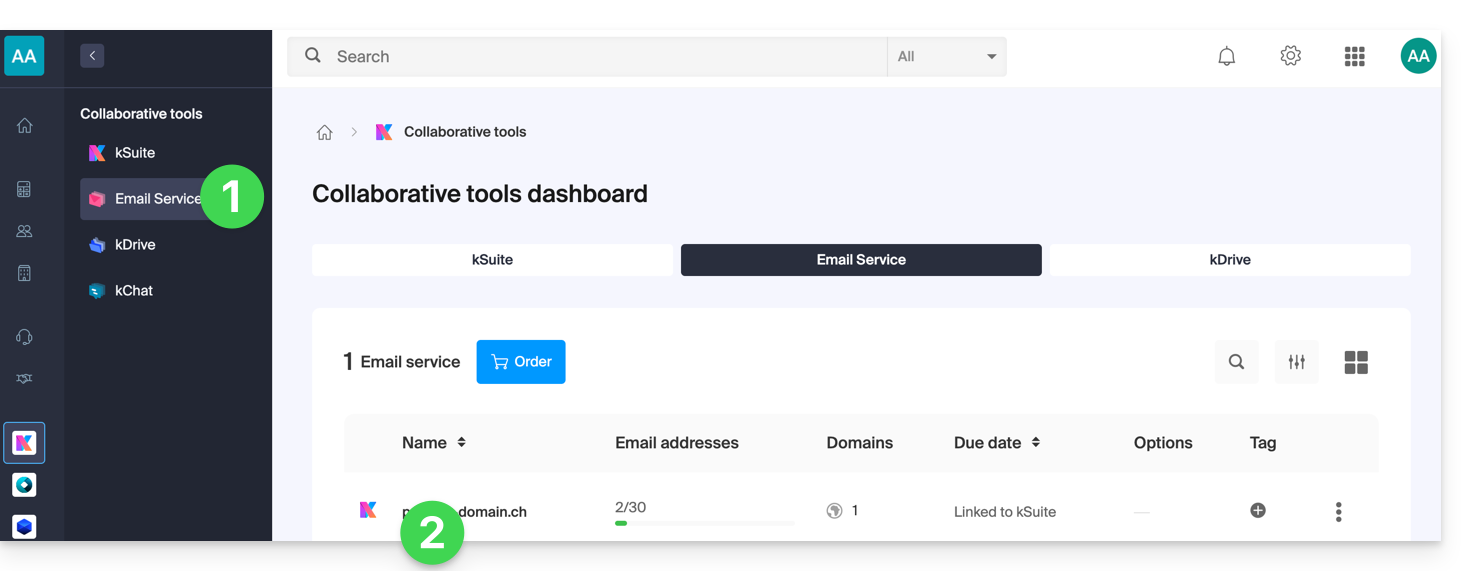
- Click on Global Settings in the left-hand menu:
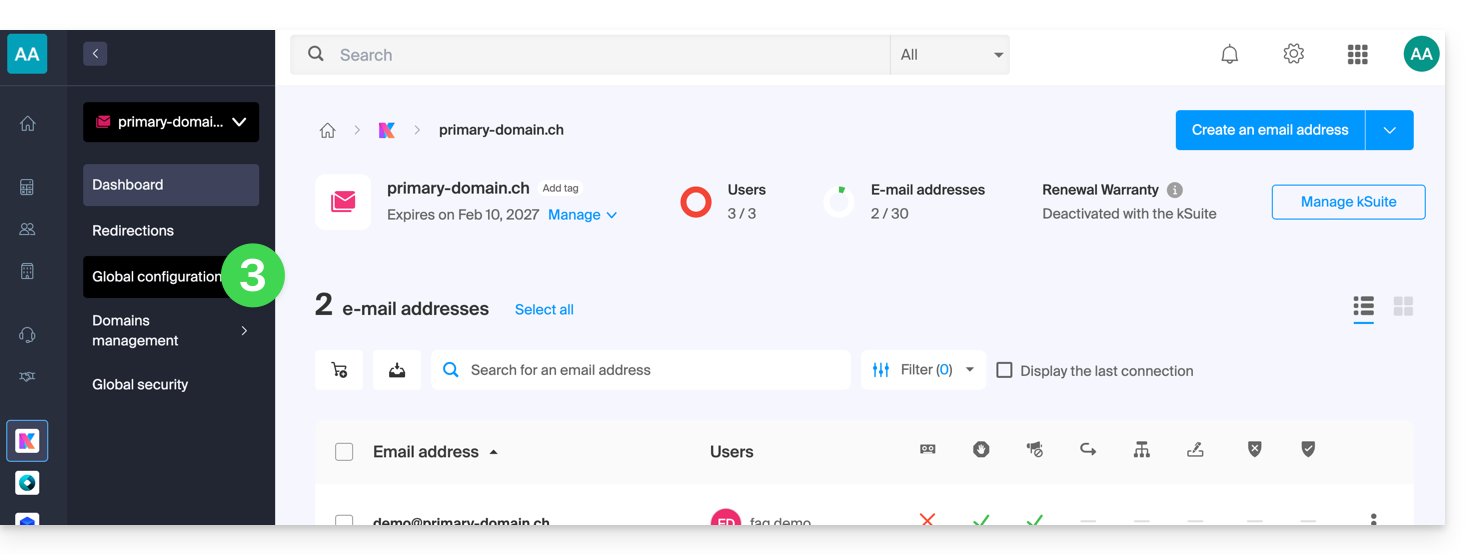
- Click on the Security tab.
- Activate or deactivate the toggle switch:
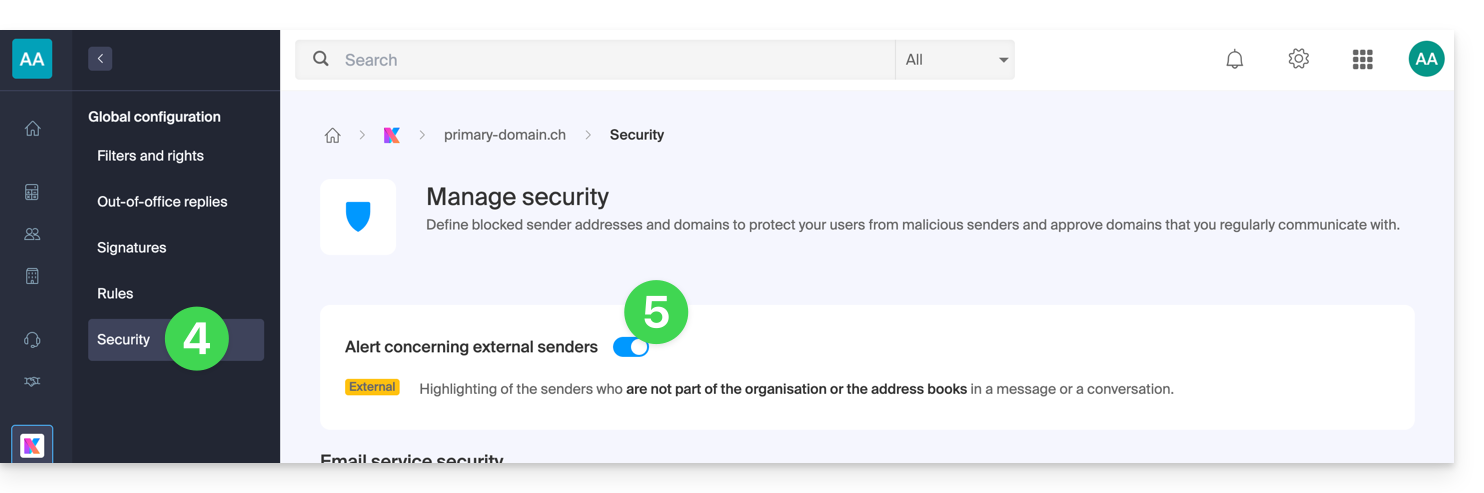
Link to this FAQ: https://faq.infomaniak.com/964
Has this FAQ been helpful?
This guide addresses issues that may arise when using Infomaniak applications (such as kChat, kDrive, Infomaniak Authenticator, etc.) or tools (such as config.infomaniak.com, the Infomaniak Manager, etc.) with old / outdated / obsolete hardware (OS, browser, devices, etc.).
Introduction
- For example, it will not be possible to comfortably access Infomaniak services with an iPhone 5s or 6 on iOS 12.
- It is therefore recommended to regularly update browsers and operating systems to benefit from the best possible experience with the Infomaniak infrastructure.
- Also, please refer to this other guide which focuses specifically on browsers and their components.
- And are you using the latest version of the Infomaniak app in question?
Update the OS, browser, etc.
Old systems or browsers can cause slowdowns, errors, or incorrect display. It is therefore preferable to rely on components that are regularly updated, as Infomaniak apps work optimally on updated systems and with recent hardware.
Example for kChat:
| kChat | Minimum requirement |
|---|---|
| Web app (browser) | Chrome 134+, Firefox 128+, Safari 17.4+, Edge 134+ |
| Mobile app (iOS) | iOS 15.1+ (iPhone 6s or later) |
| Mobile app (Android) | Android 7.0+ with updated Chrome |
| Desktop app (macOS) | macOS 12 (Monterey) or later |
| Desktop app (Windows) | Windows 10 or later |
| Desktop app (Linux) | Ubuntu 22.04 LTS or an equivalent maintained distribution |
If you encounter issues with your web browser, try updating it or installing an alternative:
- Google Chrome
https://www.google.com/chrome/
(The site automatically detects the operating system and offers the latest version) - Mozilla Firefox
https://www.mozilla.org/firefox/new/
(Download and update page for Windows, macOS, and Linux) - Microsoft Edge
https://www.microsoft.com/edge
(The link offers automatic updates or downloads depending on the system) - Safari (macOS only)
https://support.apple.com/fr-fr/HT204416
(Safari updates are done through macOS system updates) - Opera
https://www.opera.com/fr/download
(Allows you to download the latest version for your system) - Brave
https://brave.com/download/
(Download page with automatic operating system detection)
Technologies used by Infomaniak
Many web tools developed by Infomaniak use Angular. The need for updated or recent hardware to run the applications is not specific to Angular itself but rather a general requirement for running any modern web application. Here are some reasons why updated hardware is often necessary:
- Angular relies on advanced features of modern browsers, which are often absent or poorly managed in older versions.
- Recent browsers optimize JavaScript execution and graphics rendering, which improves the responsiveness of Angular applications.
- Updated versions fix known vulnerabilities, reducing the risk of compromise.
- Modern browsers are more compliant with the latest HTML, CSS, and JavaScript specifications, ensuring better compatibility.
- Modern APIs (camera, geolocation, notifications, etc.) are only accessible via recent browsers, which are essential for interactive experiences.
Link to this FAQ: https://faq.infomaniak.com/1025
Has this FAQ been helpful?
This guide details the different ways to address an email to multiple recipients, including hiding the email addresses of other participants.
Introduction
- When sending emails, it is sometimes necessary to include multiple recipients using the following fields:
- To
- CC:
- French: Copie Conforme
- English: Carbon Copy
- BCC:
- French: Copie Conforme Invisible
- English: Blind Carbon Copy
- Do not overload the To and CC fields with recipients who are not directly concerned by the email.
- Use the BCC field to protect the email addresses of recipients when there are multiple people on the list.
- For multiple, recurring, and/or large-scale email sends exceeding the imposed limits, it is recommended to use dedicated tools instead:
Understanding and using these 3 email fields
The To field
This field is used to indicate the primary recipient(s) of the email, those who receive the email as a direct copy.
- Use this field for the primary recipients who are directly concerned by the content of the email.
- Examples: work meeting, project report, direct communication with a client.
The CC field
Used to send a copy of the email to other people in addition to the main recipients. All recipients can see who received a copy of the email.
- Use this field to include secondary recipients who need to be informed but are not the main participants in the discussion.
- Example: inform a supervisor about a conversation, include colleagues who are interested in the topic without requiring them to participate.
The CCI field
Used to send a copy of the email to people without the other recipients knowing that they also received the email.
- Use this field to include recipients who should receive the email without the other recipients being aware.
- Example: sending an email to a group with a supervisor in CC for follow-up, to avoid disclosing email addresses to all recipients (often used in mass emails).
Using the available fields in Mail Infomaniak
To access the relevant fields in your Infomaniak email account:
- Click here to access the Infomaniak Mail web app (online service ksuite.infomaniak.com/mail).
- Click on New message.
- Click on CC & BCC:
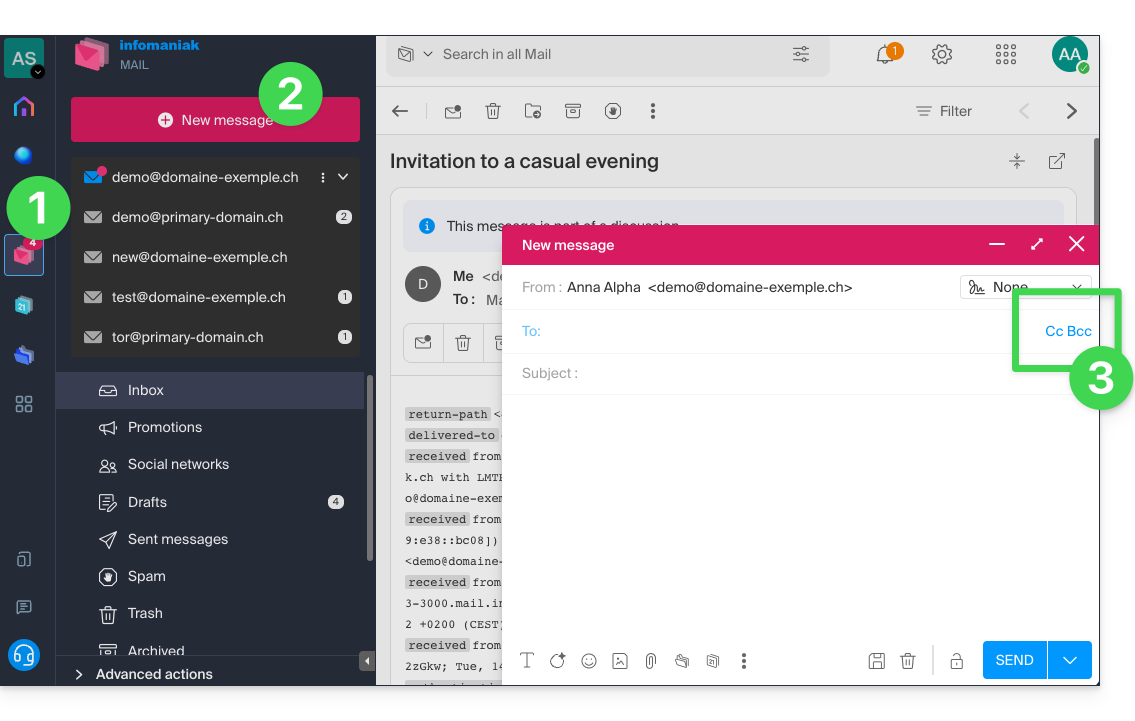
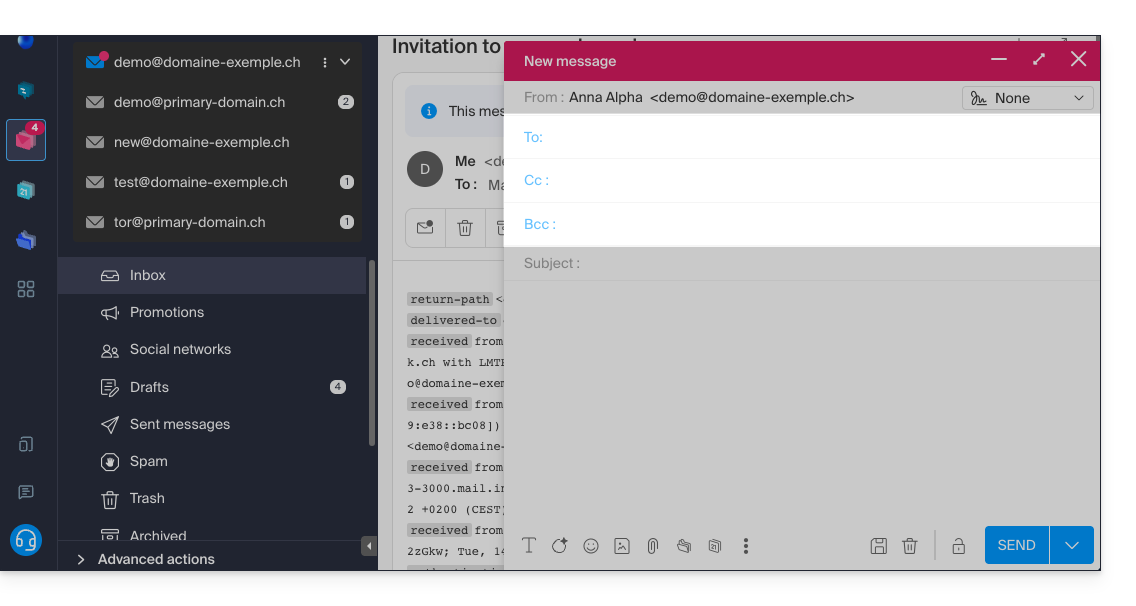
- Additional fields will appear, allowing you to enter the email addresses of your recipients:
Examples of use
Each of these fields has a specific function and can be used strategically depending on the context of your communication. Be transparent and ethical in the use of the CCI field to avoid misunderstandings or conflicts:
- Team communication
- To: main project members
- CC: Project Manager, other relevant departments
- CCI: Director for information without direct involvement
- Email marketing
- To: do not use (or simply indicate the sender's email address)
- CC: do not use
- BCC: list of subscribers to protect individual email addresses
- Important announcement
- To: main recipients (e.g., managers)
- CC: board members, key collaborators
- BCC: other stakeholders for confidential information
- Meeting announcement
- To: John Doe, Jane Smith
- CC: projet.manager@entreprise.com
- BCC: directeur@entreprise.com
- Event invitation
- To: main guests
- CC: coordination@evenement.com
- BCC: list of secondary guests (to protect email addresses)
Link to this FAQ: https://faq.infomaniak.com/1049
Has this FAQ been helpful?
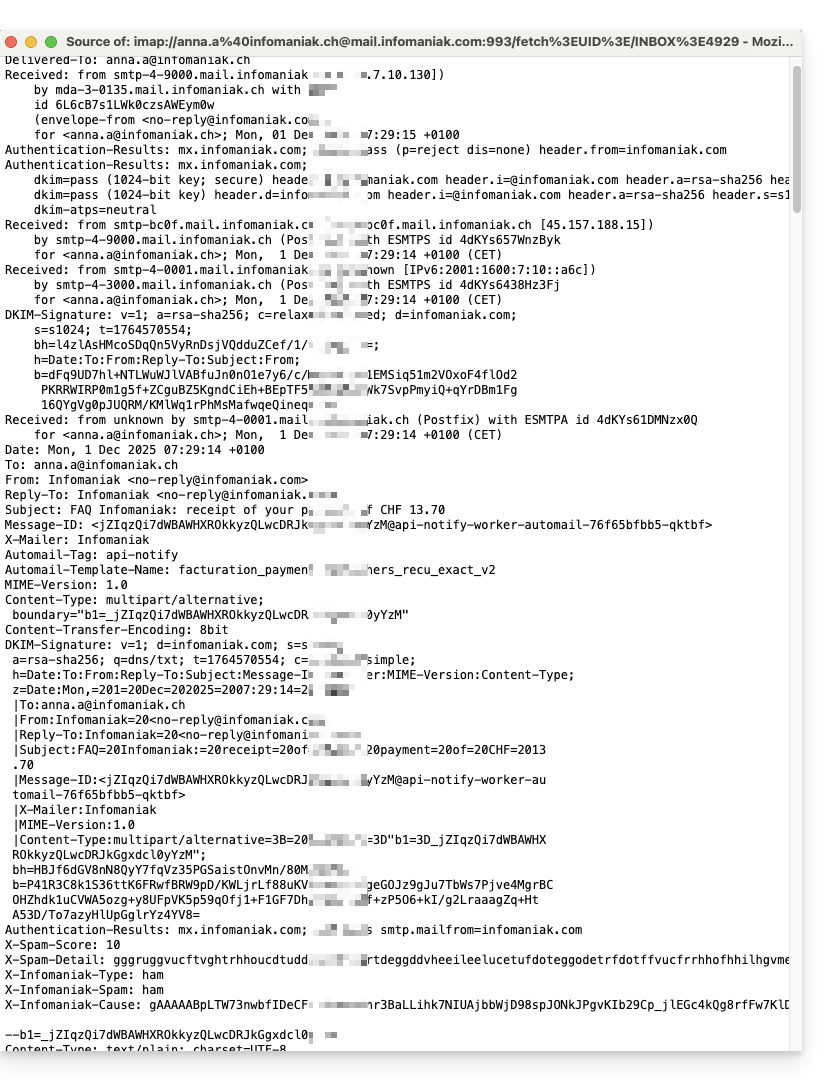
This guide explains how to view and forward email headers.
Introduction
- An email consists of a header (
header) and the actual content of the message (body). - Most email software/clients do not directly display the headers, but displaying or forwarding them allows Infomaniak support to identify the problems encountered.
- Email headers (= source) provide various information, such as:
- the sender
- the recipient
- the date
- the subject
- the servers involved in the transmission between the sender and the recipient:
Display headers in Mail Infomaniak
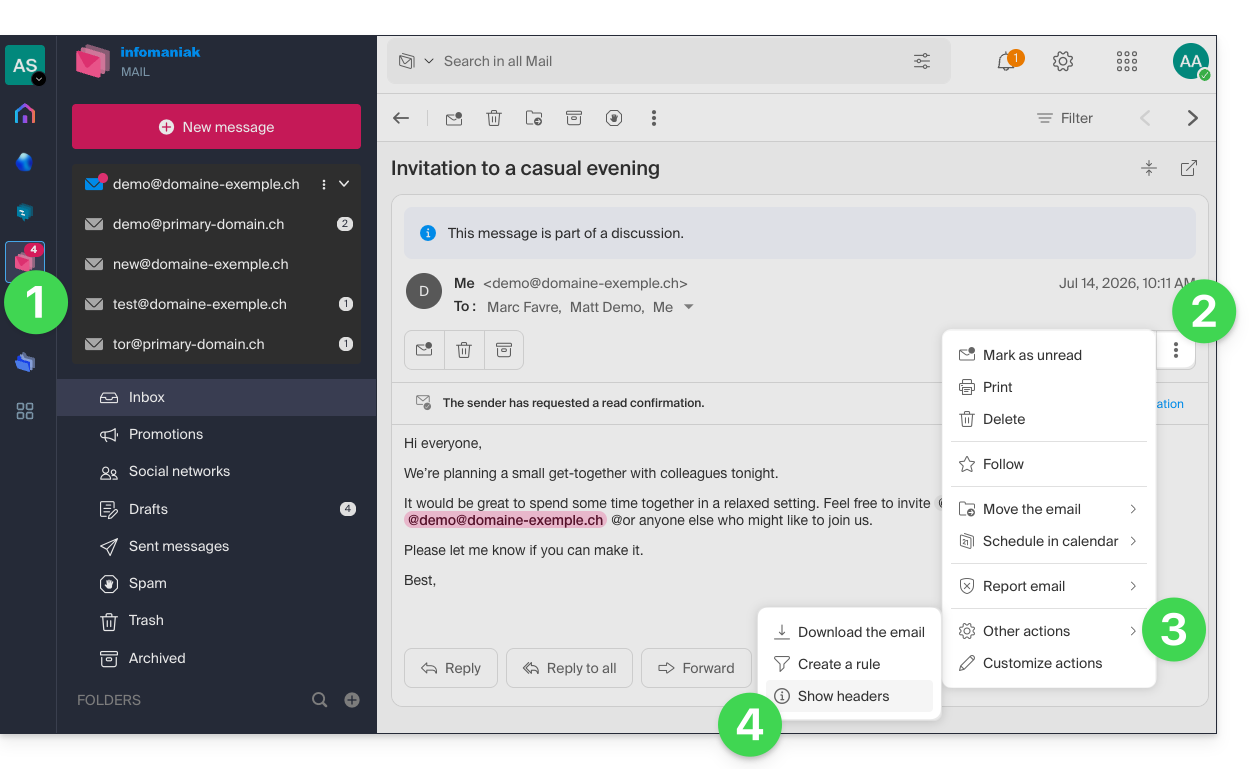
To view the headers of an email from the Infomaniak Mail interface:
- Click here to access the Infomaniak Mail web app (online service ksuite.infomaniak.com/mail).
- Open the relevant message and click on the action menu ⋮ on the right.
- Click on the menu for other actions.
- From the menu that appears, select View Headers:
- Repeat the operation to hide them:

To display headers using external email software/clients, please refer to this other guide.
Forwarding email headers
To forward the headers of an email, in response to a support request or to the recipient of your choice, simply…
- …copy and paste the headers displayed using the method described above.
- … forward the email message.
However, to ensure that the headers are included, it is essential to forward the message not in the body of the message, but as an attachment only. The attached email will typically be in .eml format, and this file contains all the necessary headers.
A third method for fully transmitting emails is explained in this other guide.
Link to this FAQ: https://faq.infomaniak.com/1055
Has this FAQ been helpful?
This guide explains how to switch from a POP configuration to an IMAP configuration for the same email account in your email software/client. Indeed, for many reasons, it is strongly recommended to use the IMAP protocol instead of POP.
Introduction
- If your email address is already configured with the POP protocol in your email software/client (Mozilla Thunderbird, Microsoft Outlook, etc.), it is impossible to switch to the IMAP protocol directly on the account.
- Indeed, most common email software/clients do not allow you to modify an existing POP3 account and define it as IMAP instead.
- The solution is therefore toadd the same email account but using the IMAP protocolin your email software/client, then move your messages and folders from the POP account (on your computer) to the IMAP account (on the email server).
⚠️ Warning: a POP3 account in your email software/client means that Infomaniak usually does not have any backups. Therefore, be sure to back up your messages on your end before performing any critical operations.
Switching from POP to IMAP in Microsoft Outlook
Some versions of Outlook, such as 2016, prevent you from easily adding a second account with the same name (identical email address).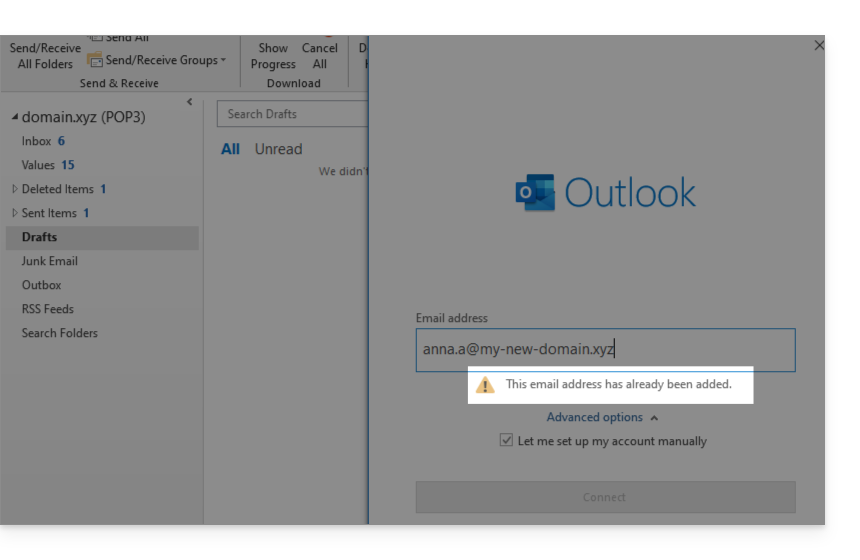
To work around this, you need to add the account from the Profiles section: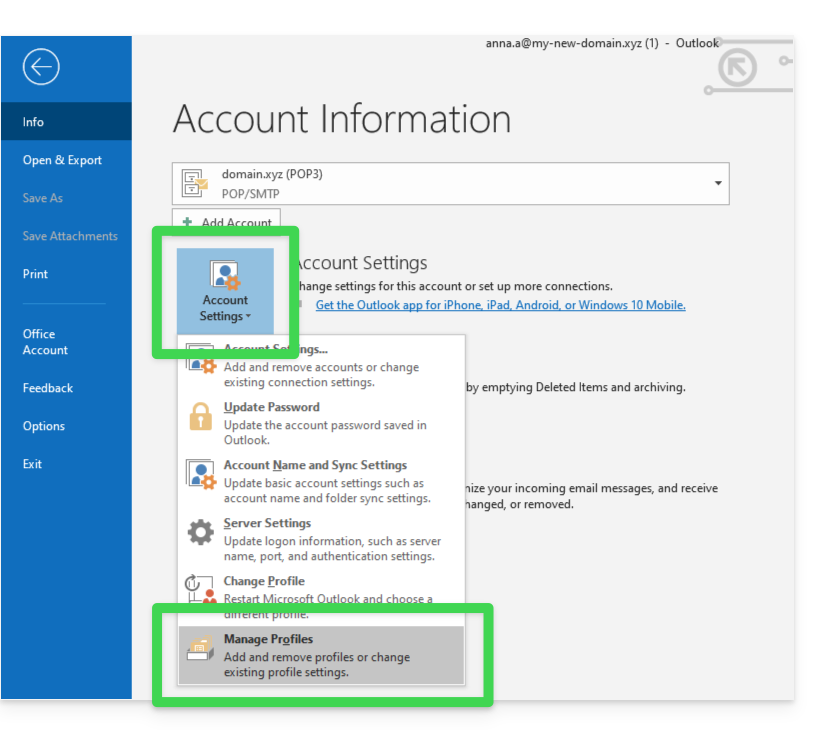
From there, you can add the additional account using IMAP: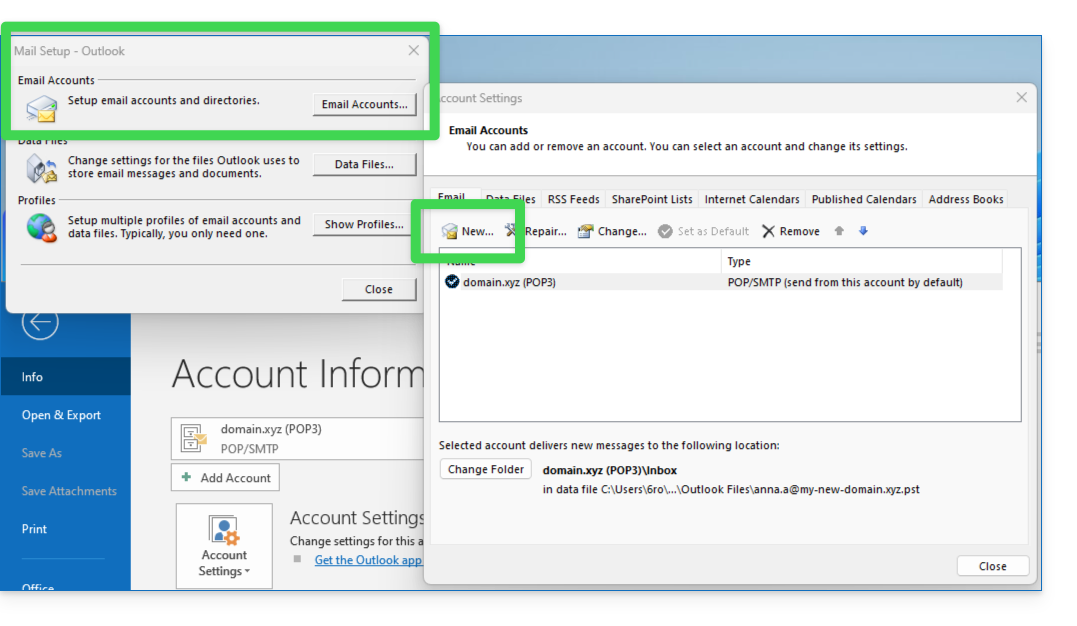
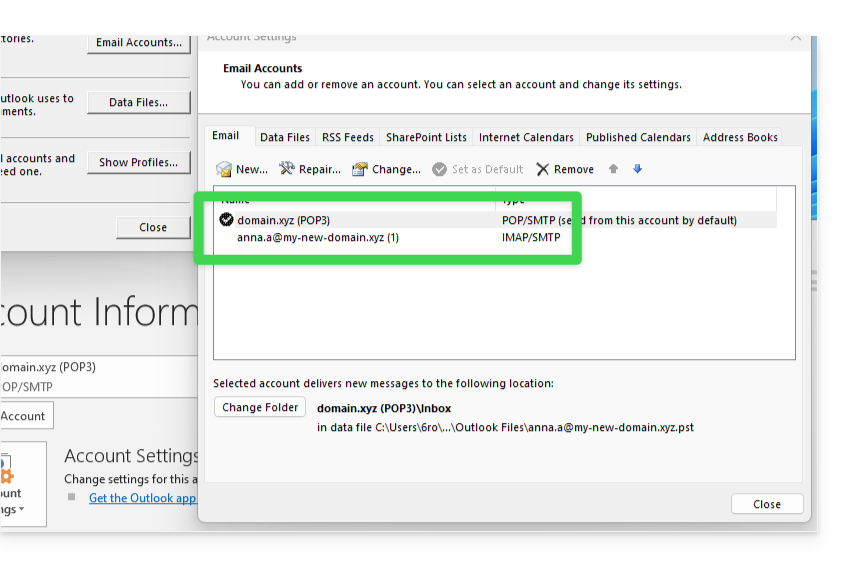
- Configure the new email account using the IMAP protocol (the same account as the one configured in POP, but this time in IMAP):
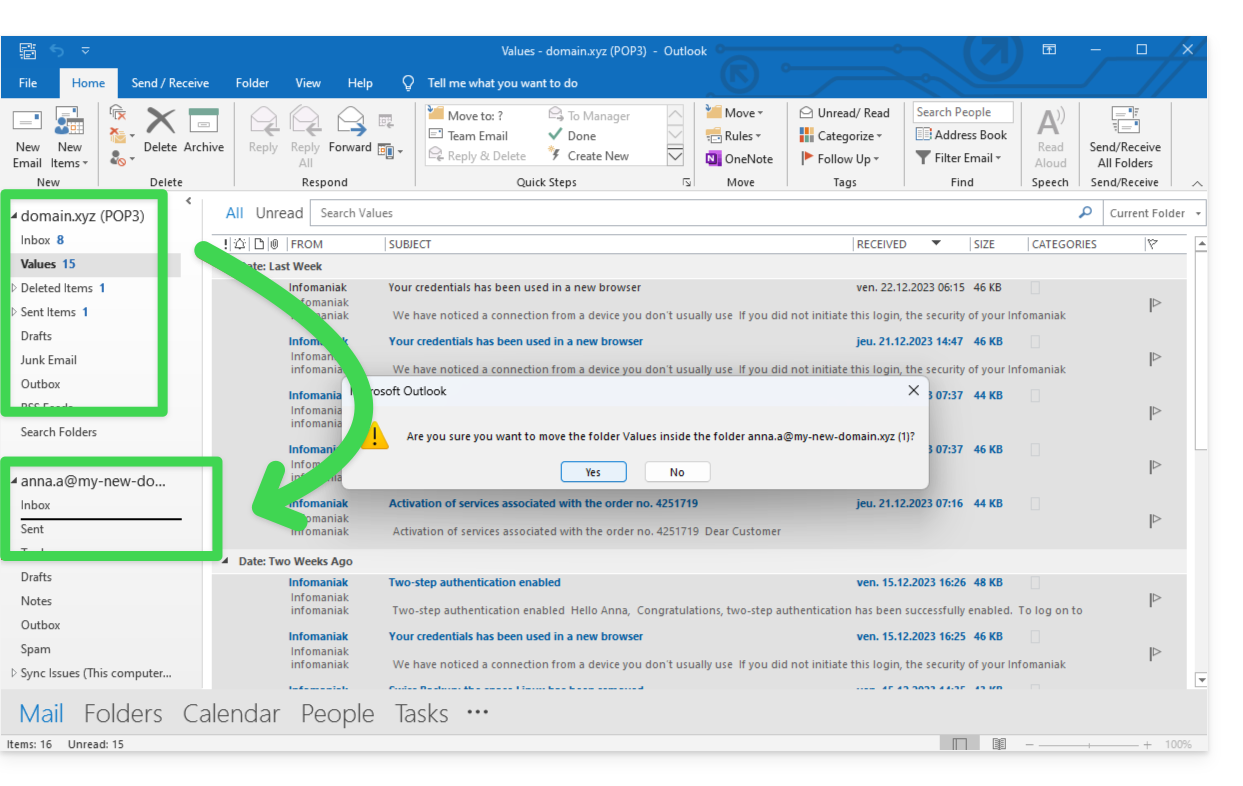
- Move each folder by dragging it to the inbox of the new account configured in IMAP:
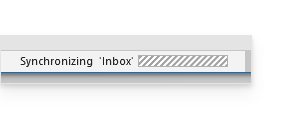
- Wait for the transfer to complete (this may take some time depending on the amount of data being transferred to the server); the progress is indicated at the bottom of the window:
If your POP account kept a copy of the messages on the server (an option that is not recommended and can be found in the advanced settings of your Outlook), you may end up with duplicate messages.
Switching from POP to IMAP in Apple Mail
Deleting a mail account configured in POP deletes the messages it contains. It is therefore recommended to disable the POP account instead of deleting it!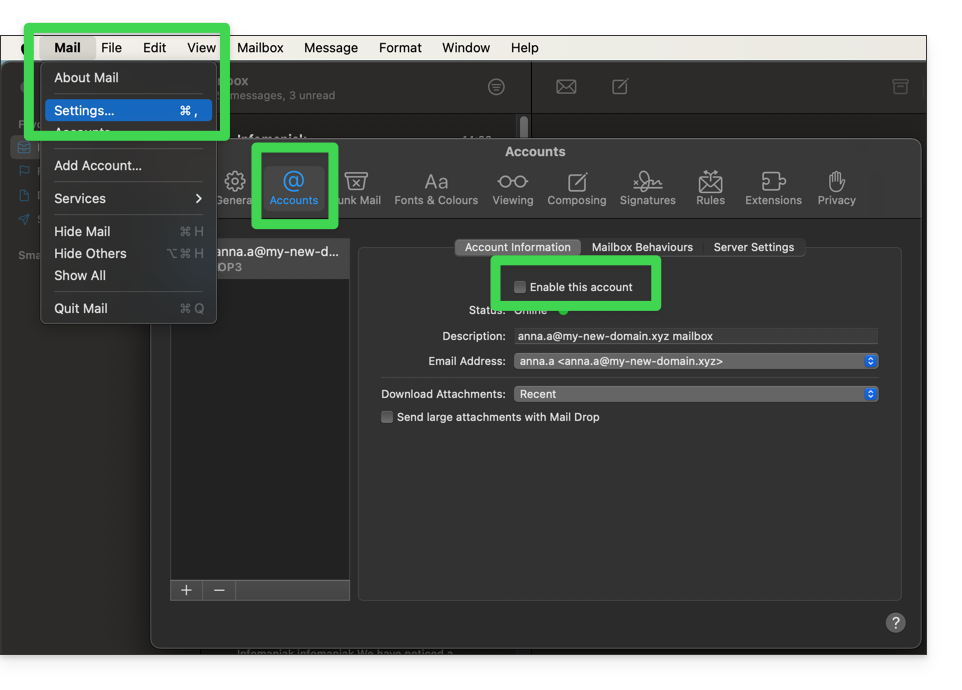
Once the POP account is disabled, refer to this other guide to configure your email address in Apple Mail, using IMAP.
Once you are finished, all that remains is to drag the messages from your POP account's folder structure to the new IMAP account's folder structure.
Link to this FAQ: https://faq.infomaniak.com/1122
Has this FAQ been helpful?
This guide details the mechanisms of email spoofing and the protection measures against unwanted messages that appear to come from your own domain.
Has my account been used without my knowledge?
Receiving an email that appears to be sent by you is a common psychological manipulation technique. This does not necessarily mean that your email account has been compromised. In most cases, it is simply a forged "From" header, similar to someone writing your address on the back of a paper envelope before mailing it.
Make sure that your own address is not listed in the allowlist of your anti-spam filterIf it is found, the security system ignores the security scan, assuming that the message is legitimate.
Diagnosis: Spoofing vs. Hacking
It is crucial to distinguish spoofing from intrusion. The global email sending protocol (SMTP) was designed without native sender identity verification.
Although Infomaniak's infrastructure applies rigorous security standards, it is technically impossible to prevent a non-secure, third-party server located anywhere in the world from sending a message claiming to be you. However, tools exist to make these messages undetectable or blocked by your recipients.
Strengthen your domain's integrity
To protect your digital reputation and limit the impact of these impersonations, implementing authentication protocols is the professional standard:
- SPF & DKIM: These digital signatures certify that your messages originate from our authorized servers.
- DMARC: This essential protocol allows you to give instructions to servers worldwide (e.g., "If the email is not signed by Infomaniak, reject it or place it in spam"). This is the most powerful tool foranalyze and limit fraudulent use of your domain.
- Catch-all management: Avoid using a "catch-all" address, which collects all messages sent to non-existent addresses on your domain, as it naturally attracts large volumes of spam.
Failure Notifications (Backscatter)
If you receive non-delivery reports for messages you never wrote, you are experiencing the phenomenon of Backscatter. Third-party servers that are poorly configured or botnets are using your identity to send mass content. When they encounter a non-existent address, the remote server sends the error to the displayed sender: you.
Link to this FAQ: https://faq.infomaniak.com/1127
Has this FAQ been helpful?
This guide explains how to copy the content of one or more external email addresses via IMAP (all email messages, folders, subfolders, in short, the entire structure of your existing mailbox with other providers) to one or more of your existing addresses at Infomaniak, using the Infomaniak import tool!
Introduction
- This operation does not affect the data already present in the destination address or the source address.
- The entire external mailbox will be imported.
- Once the import process has started, it is no longer possible to interrupt it.
- Any duplicates are handled: identical content will only be copied once.
- Refer to this other guide if you are looking for alternatives to this IMAP process.
Copy emails from another provider to Infomaniak
Prerequisites
- You must have a Mail Service in your Infomaniak Manager.
- You must have a quota of available addresses or adjust it beforehand if necessary.
- Ensure that the email service is properly secured.
- Create one or more addresses in this Mail Service.
- The destination email address must be linked to the user (= the Infomaniak account) you are using (this is not a requirement for the bulk import explained below).
- The source email address, from which the content will be copied, must have been used (or be compatible) with the IMAP protocol:
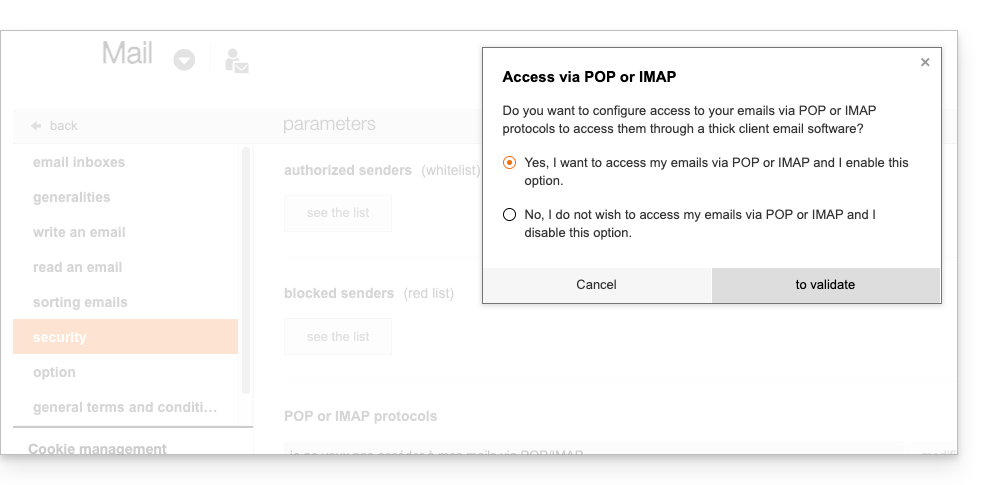
Next, to import the email content:
- Click here to access the import tool (online service https://import-email.infomaniak.com).
- If necessary, log in to your Infomaniak account for the relevant Organization; the import will be done to one of the email addresses linked to the Infomaniak Mail web interface (online service ksuite.infomaniak.com/mail) of the Infomaniak account you are using.
- Click on the import via IMAP.
- Click on the single import.
- Fill in the field on the left with your source email address (the content of which will be copied).
- Fill in the field on the right with the password for that same source email address (see requirements).
- If necessary, modify the Advanced Settings to specify an IMAP server address:
- Enter the IMAP server name (hostname provided by your email provider), for example
imap.domain.ch(or .net, .com, etc. depending on your email address in step 5 above). - Enter the port number (default 993) and enable SSL.
- Enter the IMAP server name (hostname provided by your email provider), for example
- Click Confirm:
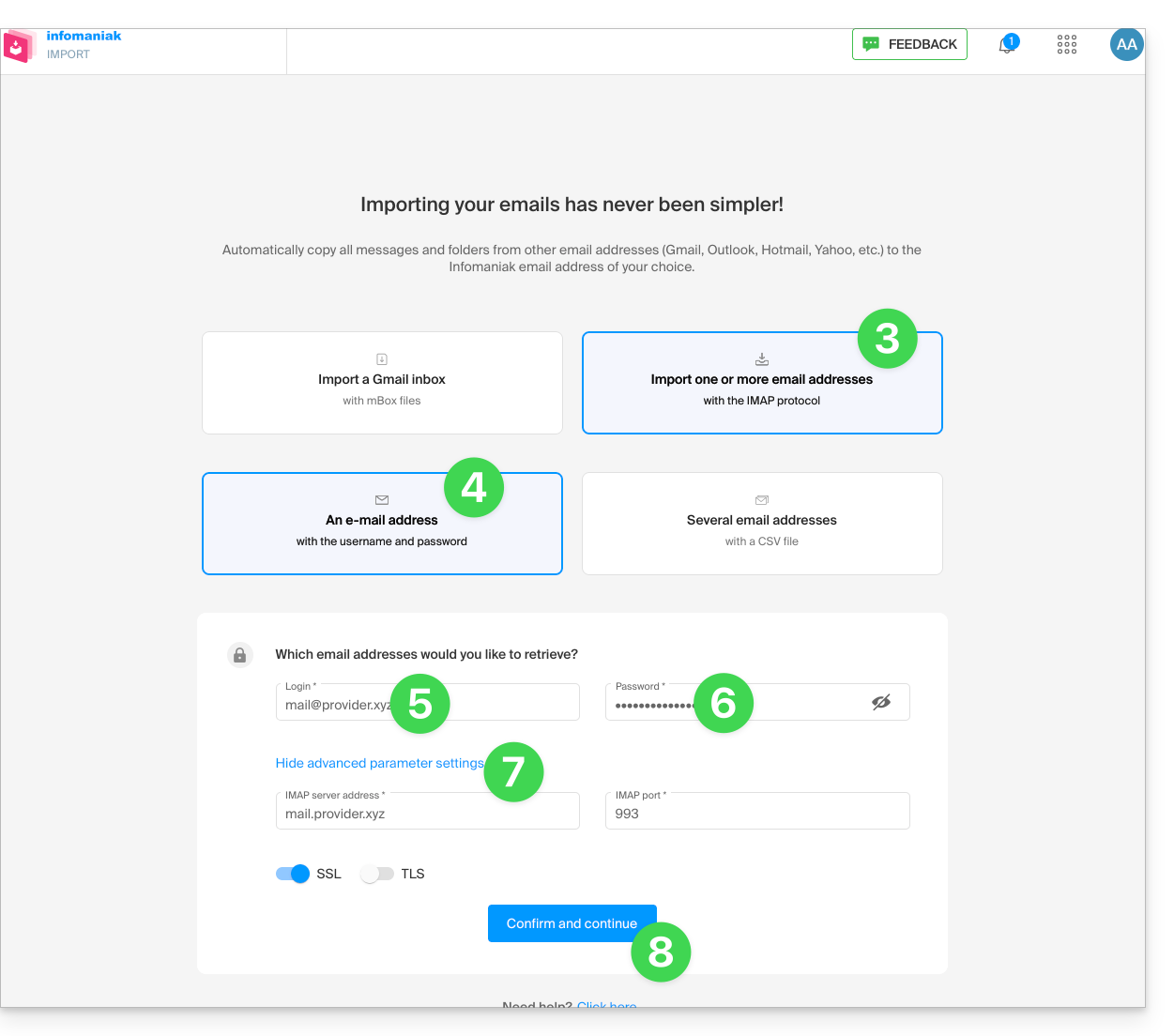
- If necessary, enter a second email address to be imported at the same time.
- Choose the email address to which the emails will be imported; the drop-down menu lists the email addresses currently linked to your Infomaniak Mail web interface (online service ksuite.infomaniak.com/mail) of the Infomaniak account you are logged into.
- After selecting the desired destination address from the list, click the blue Import Emails button:
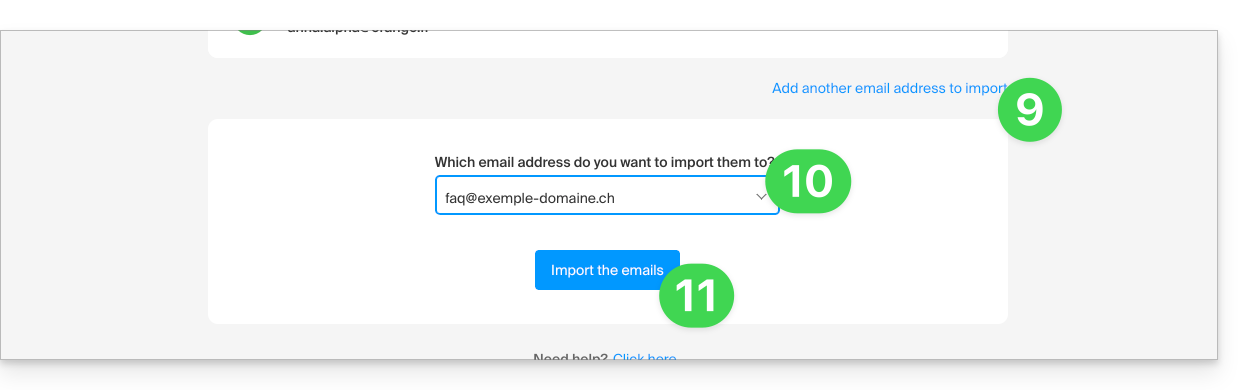
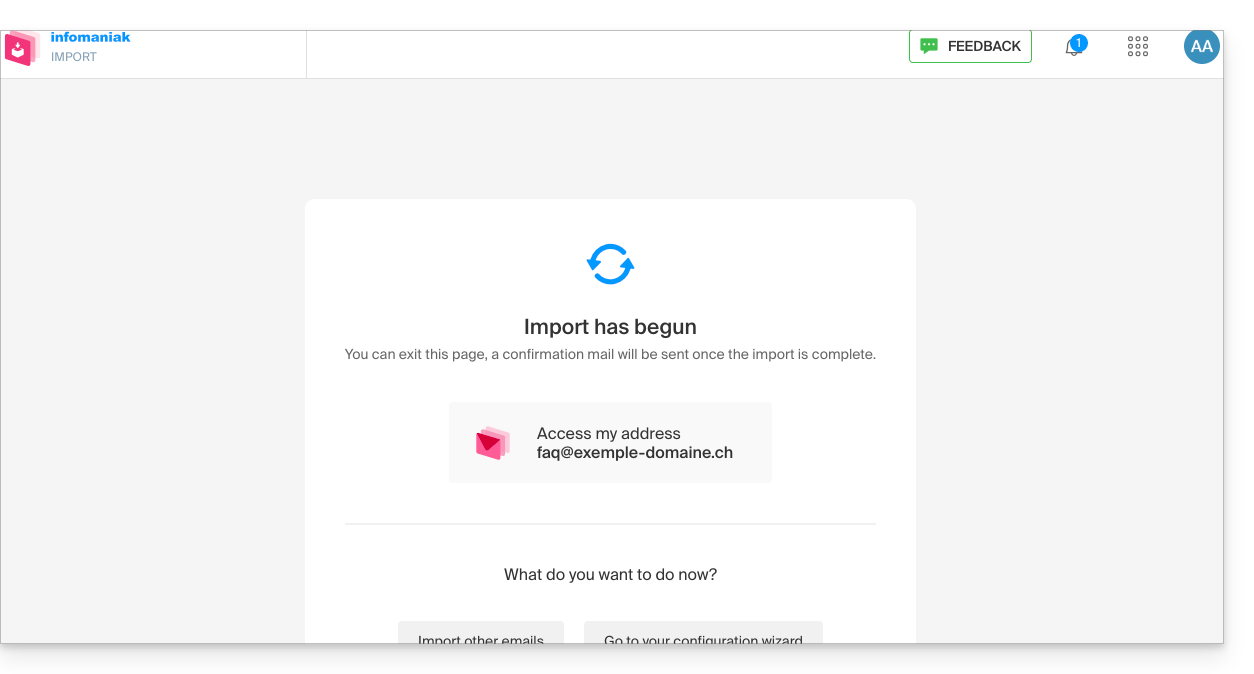
- The copy process begins; you can wait and see the result on the page once the import is complete, or close the window (the import continues in the background, and progress can be tracked - see below):
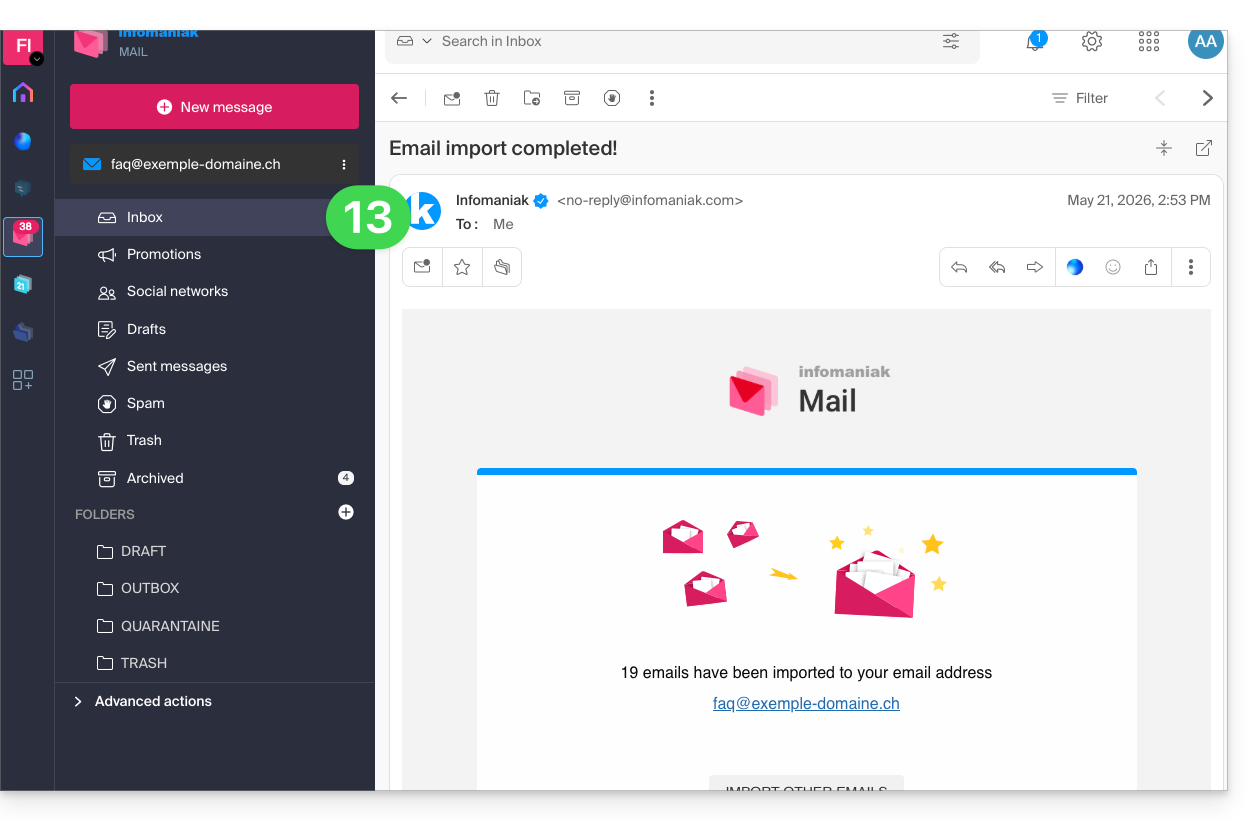
- A confirmation email will be automatically sent to all email addresses involved in the operation once the import is complete, indicating the number of messages copied:
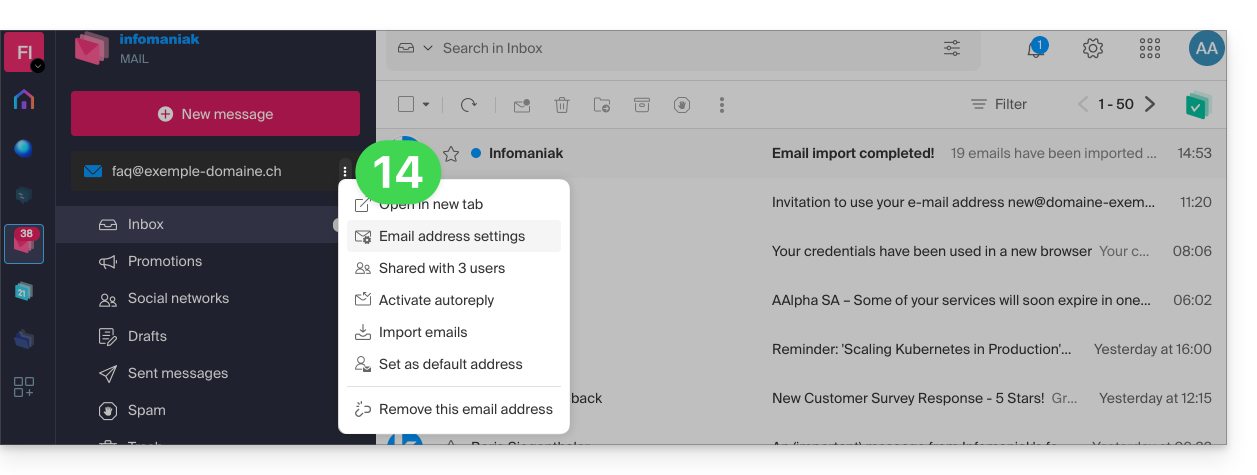
- A tracking feature is available in the settings of the destination email address, only on the web app Mail (online service ksuite.infomaniak.com/mail):
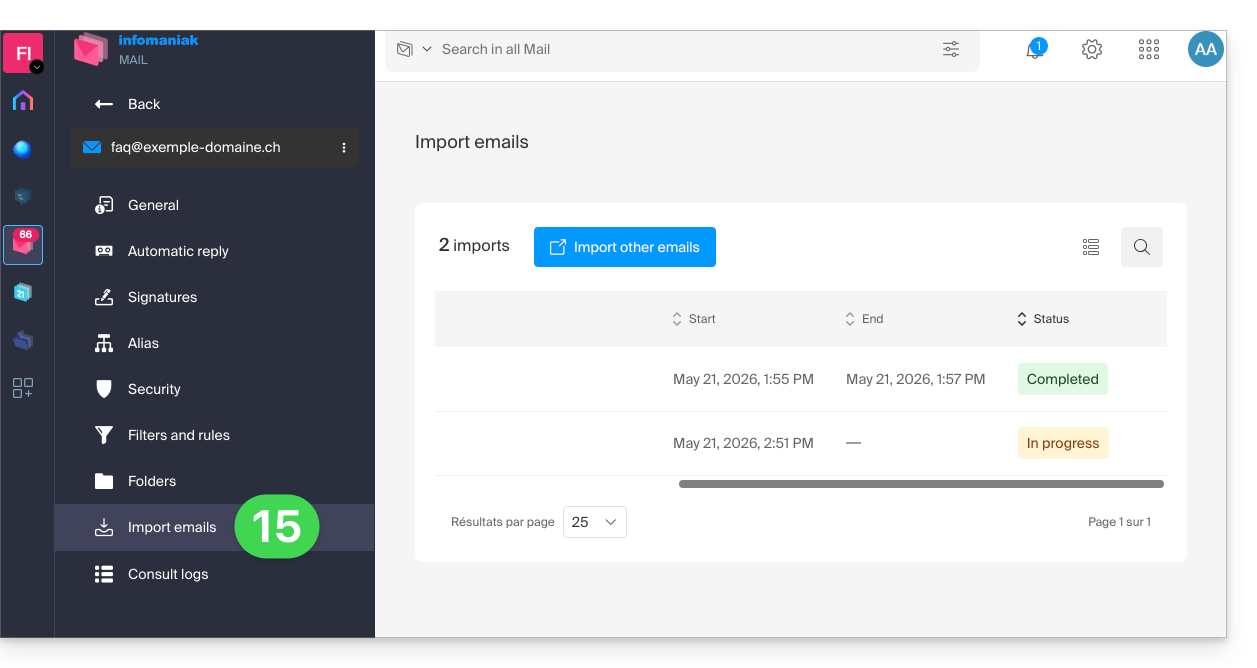
- The tracking feature allows you to view the import history for the address in question:
Import content from multiple email addresses in bulk
This method using a CSV file will not work for Google or Microsoft addresses due to their authentication system – also, please refer to the prerequisites mentioned earlier in this guide.
To import the content of multiple external email addresses (maximum 25 at a time) to one or more Infomaniak email addresses:
- Click here to access the import tool (online service https://import-email.infomaniak.com).
- If necessary, log in to your Infomaniak account for the relevant Organization, as the import will be done to one of the email addresses associated with the Infomaniak Mail web interface (online service ksuite.infomaniak.com/mail) of the Infomaniak account you are using.
- Click on the import via IMAP.
- Click on advanced mode: Import multiple email addresses from a CSV file (
.csvformat). - Download the example
CSVtemplate: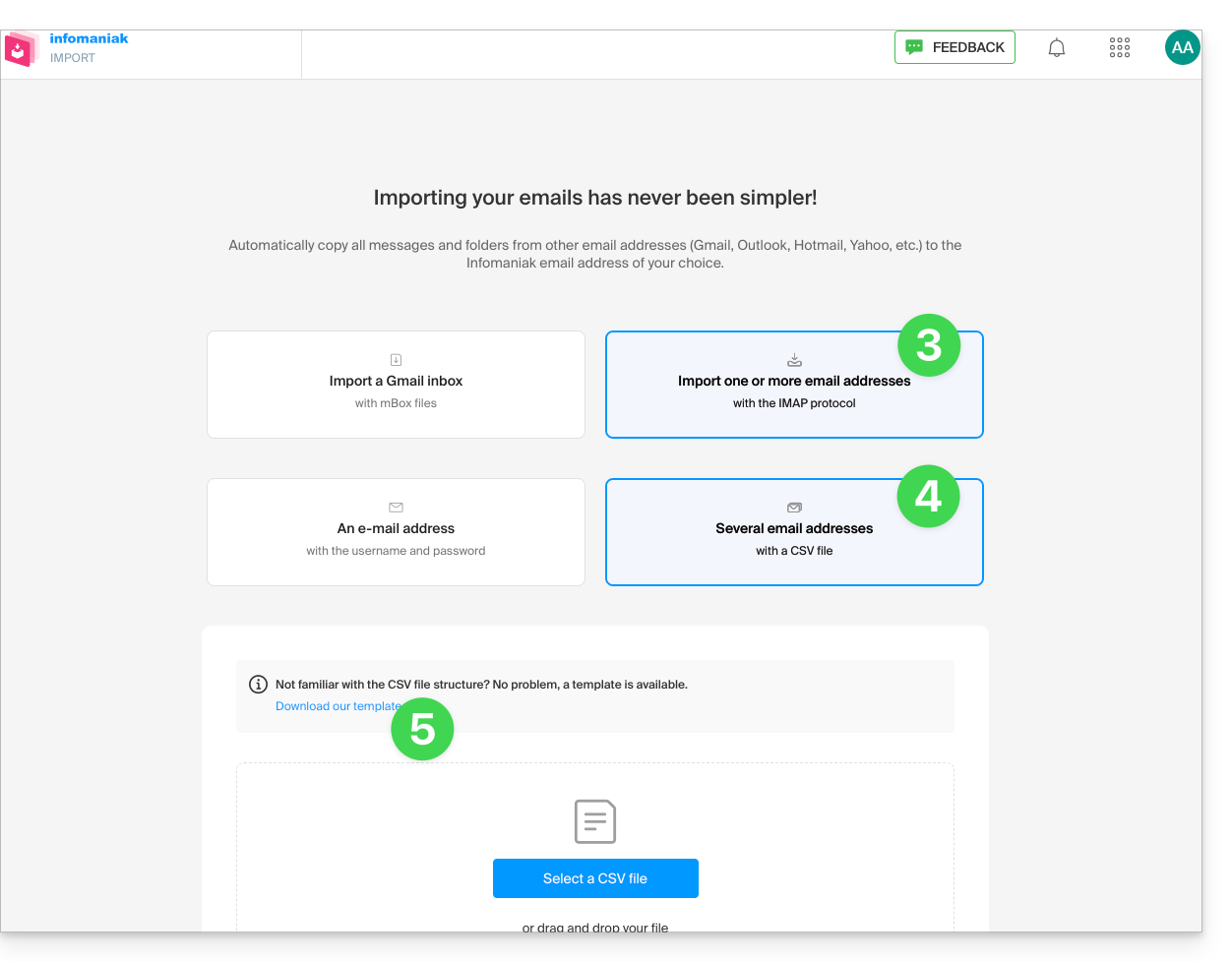
- The template has this format:
source-email@domain.com;sourcePassword;imap.source-host.com;sourcePort(993);sourceSsl(1or0);dest-email@domain.com
- The template has this format:
- Edit the
csvfile to create one with the correct information needed for the copy (see prerequisites):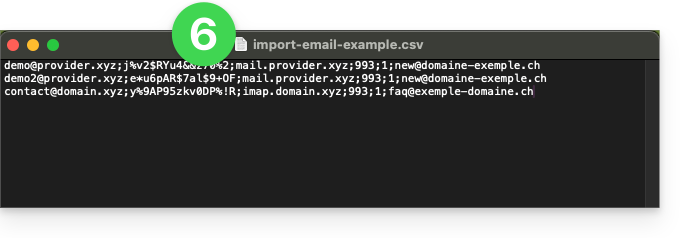
- Upload the file using the Select CSV file button.
- Once the file is uploaded to the tool's page, correct or ignore any errors; click Import.
- The copy starts, you can wait and see the result on the page once the import is finished, or close the window (the import continues in the background and a progress report is available - see below).
- A confirmation email will be automatically sent to all email addresses affected by the operation once the import is complete, indicating the number of messages copied.
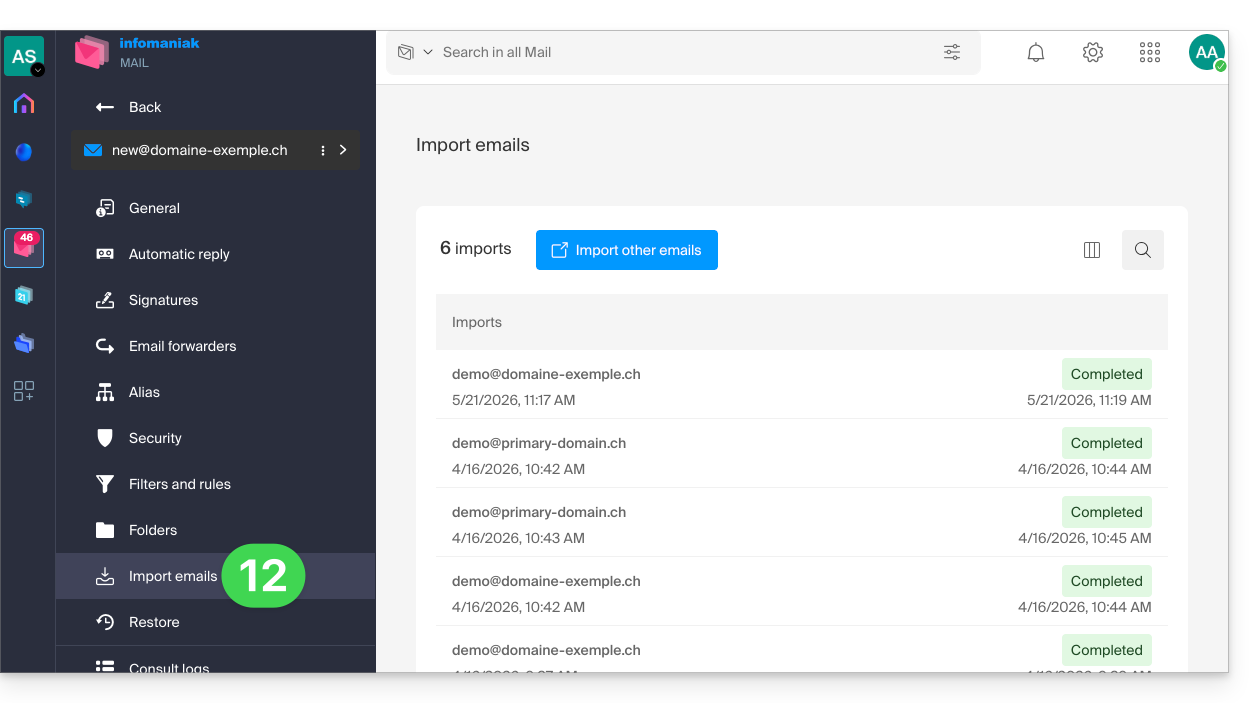
- A progress report is available in the settings for the destination email addresses, on the Mail web app (online service ksuite.infomaniak.com/mail) only.
- The progress report allows you to view the import history:
Link to this FAQ: https://faq.infomaniak.com/1144
Has this FAQ been helpful?
This guide is intended for users who have chosen Infomaniak, a hosting provider committed to the planet: you will find below the details of the calculation method used to display CO2 on invoices, as well as some tips to reduce your own digital footprint.
Introduction
- For Web Hosting and Mail services, Infomaniak displays the amount of CO2 emitted annually, a figure based on a rigorous Life Cycle Assessment (LCA) method that combines two key factors:
- Material impact (Full life cycle)
- Using emission factors from the ResilioDB database, the calculation includes emissions generated during the manufacturing (BLD), transport (DIS), and end-of-life/recycling (EOL) of each piece of equipment (servers, RAM, disks, etc.).
- Energy impact (Actual consumption)
- The actual electricity consumption of the servers is measured via IPMI probes.
- This energy is then converted into CO2 equivalent using Infomaniak's specific energy mix, which is very low in carbon (11.77g CO2eq/kWh).
- Material impact (Full life cycle)
- The total impact is then distributed according to the customer's unit of usage (per hosted website or per mailbox).
What can you do?
If the hosting provider optimizes its infrastructure, the end-user also plays a key role. Here's how to reduce the environmental impact of your services.
For websites
The goal is to minimize the energy consumption of servers and visitors' devices:
- Technical optimization: Compress images, minify scripts, and use modern formats (WebP).
- Clean design: Limit autoplay videos, advertisements, and heavy scripts that consume bandwidth.
- Best practices: For WordPress in particular, it is recommended to consult the GreenIT guides.
For email
Email communication can also be optimized:
- Simplicity: Prefer plain text emails over HTML emails and limit the use of large, graphical signatures.
- Attachments: Prefer sending download links (via kDrive or SwissTransfer) instead of large attachments, or use compressed PDF format.
- Cleanup: Unsubscribe from unnecessary newsletters and use tracking tools to avoid sending emails that are not opened.
It is recommended to regularly monitor statistics to improve environmental performance. While waiting for Infomaniak's future integrated tools, it is possible to audit the impact of web pages via GreenFrame.io.
Link to this FAQ: https://faq.infomaniak.com/1160
Has this FAQ been helpful?
This guide explains how to export the content of an email address hosted by Infomaniak.
Introduction
- Infomaniak does not offer an export function (e.g., for
PSTfiles). - Infomaniak stores your emails for the entire duration of your contract, and depending on your plan, with integrated backups without size limits for normal use of a shared service, in accordance with Art. 1 of the Mail Service's specific terms and conditions.
- The manual export option below works on Windows: this allows you to back up your emails into a single archive that can be easily restored.
Manual Export
To export all messages contained in your email address hosted by Infomaniak:
- Install the free Thunderbird application.
- Configure the relevant email address using IMAP (to include subfolders).
- Make sure that all the desired content is present (synchronize the mailbox from the beginning - not just the last 30 days, for example).
Then…
- … or you can install the free BackupThunderbird application, which allows you to create an archive (encrypted if necessary) and restore it later…
- … or you can simply display Windows' hidden files, then find and back up this profile folder
C:\Users{USER}\AppData\Roaming\Thunderbird\Profiles{PROFIL_USER}\
because it contains all your email messages.
Download emails locally
Another solution (not recommended) could be to configure an email software/client by choosing to receive messages using the POP3 protocol, which will download the messages locally and only affect the inbox.
Link to this FAQ: https://faq.infomaniak.com/1167
Has this FAQ been helpful?