Knowledge base
1000 FAQs, 500 tutorials and instructional videos. Here, there are only solutions!
Understanding how to create a (virtual) email forwarding address within an Infomaniak Mail service
This guide explains how to create a mail forwarding address, a feature available on the Mail Services, and which is used to create addresses solely intended for forwarding emails.
Introduction
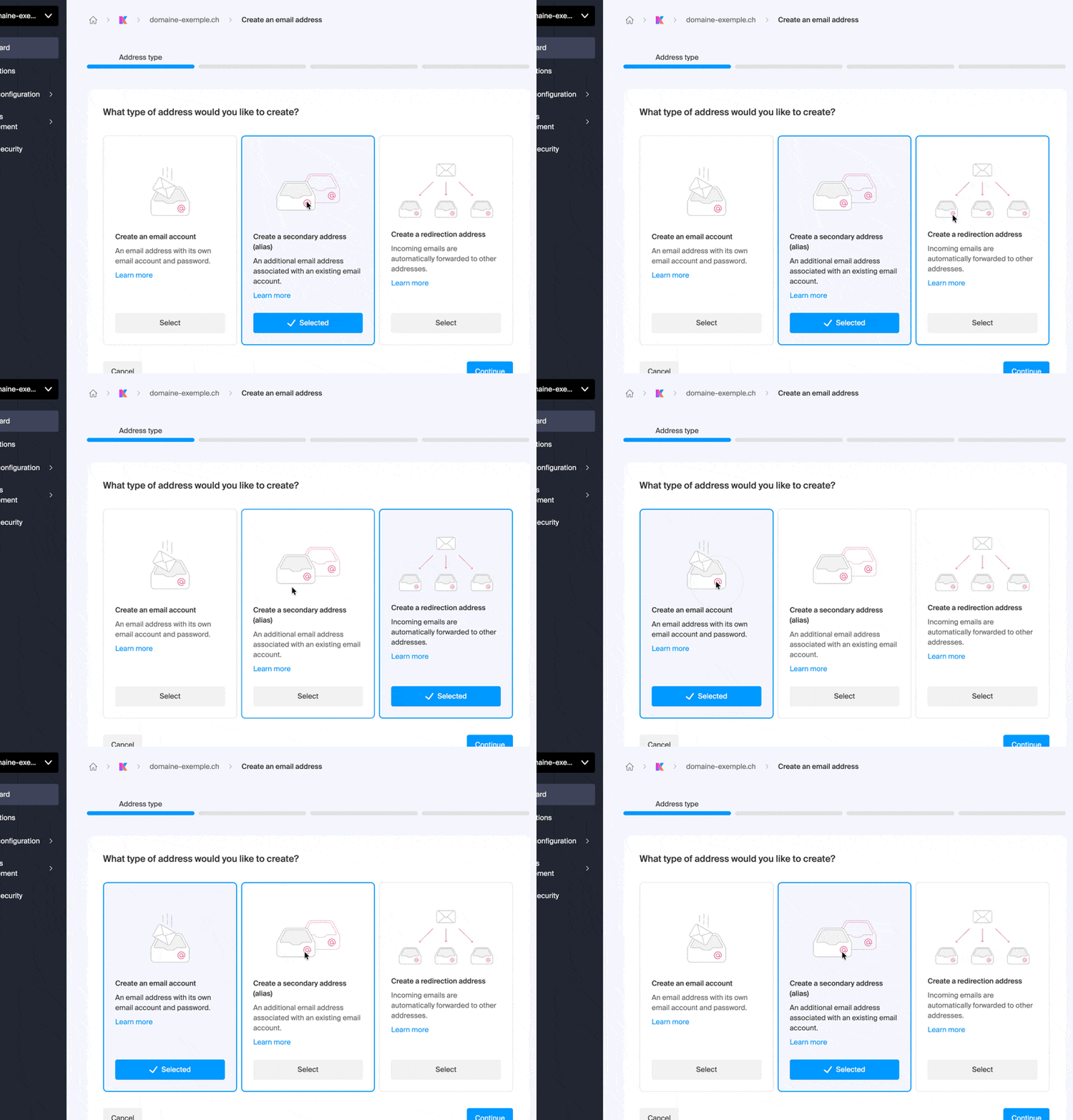
- 3 types of addresses are offered by the creation assistant:
- Number of redirection addresses that can be created per available address (according to the Mail Service quota):
- kSuite Free = 1
- kSuite Standard = 20
- kSuite Business = 20
- kSuite Enterprise = 20
- Mail Service Starter = 1
- Mail Service Premium = 20
- For example: Paid Mail Service for 10 addresses = 200 redirection addresses available
- A redirection address is intended solely to redirect incoming emails to one or more (max. 10 users per redirection) other existing addresses.
- Registered recipients who are to receive the redirected emails must first accept their addition for the redirection to them to work.
How to redirect email traffic?
Redirection involves configuring an email address to automatically forward received messages to one or more other destinations.
There are two main scenarios:
1. Redirection address (virtual address)
- The address does not have its own storage space and only serves as a relay to the destination addresses.
- Please refer to this other guide for more information.
2. Redirection from an existing address
- The address has its own inbox, but copies or forwards messages to other accounts.
- For example, emails sent to
contact@domain.xyzare automatically redirected tojohn@domain.xyzandresponsables@domain.xyz. The “responsables@…” address can itself be redirected to other people as well… - Refer to this other guide for more information.
Why use redirects?
This system offers great flexibility in managing communication flows:
- Centralized messaging: in the event of an address change or an employee leaving, redirection allows you to continue receiving messages at a single point of contact without losing any information.
- Multiple distribution: a single incoming message can be distributed simultaneously to multiple recipients, facilitating collaborative work.
- Eco-friendly management: the administrator can choose to automatically delete emails from the original address after they have been redirected. This avoids storing duplicate data and optimizes server resource usage.
If the goal is simply to create a variation for a main address (for example, a common spelling mistake or a different extension), it is best to use the alternative email addresses (alias) system. Redirection is preferred for automatically sending emails to external accounts or separate mailboxes.
Link to this FAQ: https://faq.infomaniak.com/2903
Has this FAQ been helpful?