Knowledge base
1000 FAQs, 500 tutorials and instructional videos. Here, there are only solutions!
Automatically check SPF/DKIM/DMARC
This guide presents the Global Security tool, which allows you to verify that the relationships between a domain name and an Infomaniak Mail Service are optimal in terms of security. This involves checking the SPF / DKIM / DMARC records, and the Global Security tool allows you to adjust the configuration if necessary.
Any DNS addition or modification may take up to 48 hours to propagate (❓: help).
Accessing the Global Security diagnostic tool
To access Global Security:
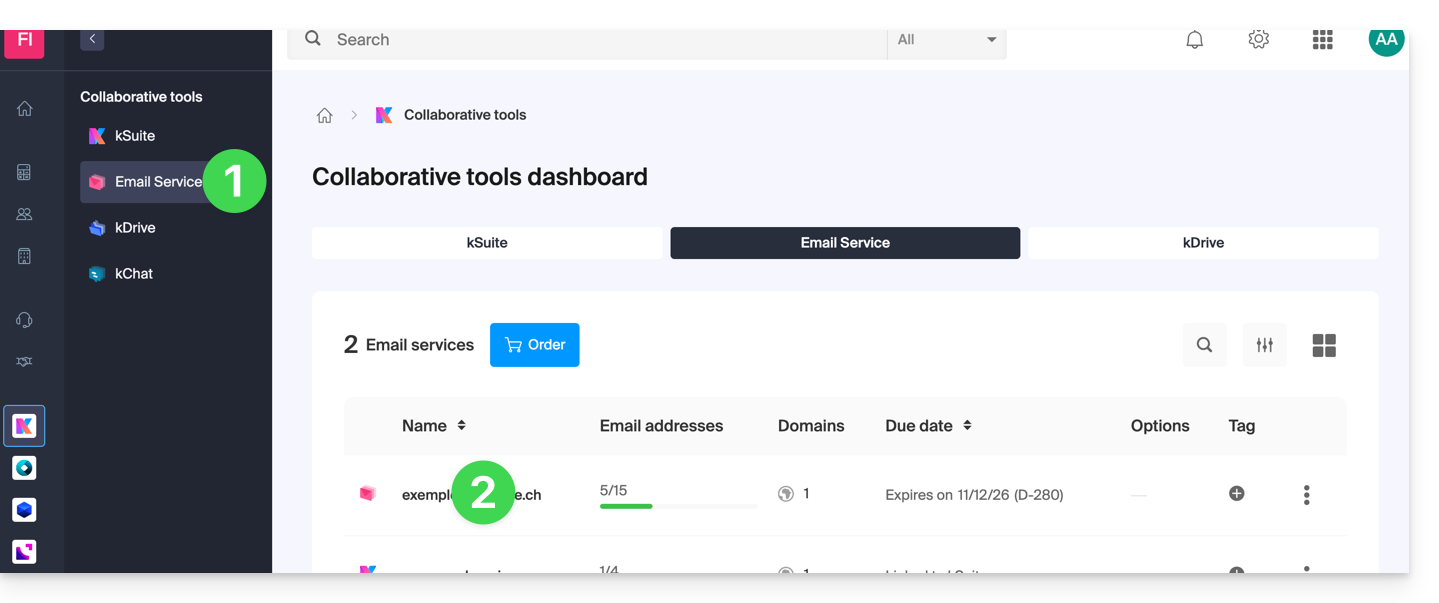
- Click here to access the Mail Service management in your Infomaniak Manager (❓: help).
- Click on the name of the Mail Service in question:
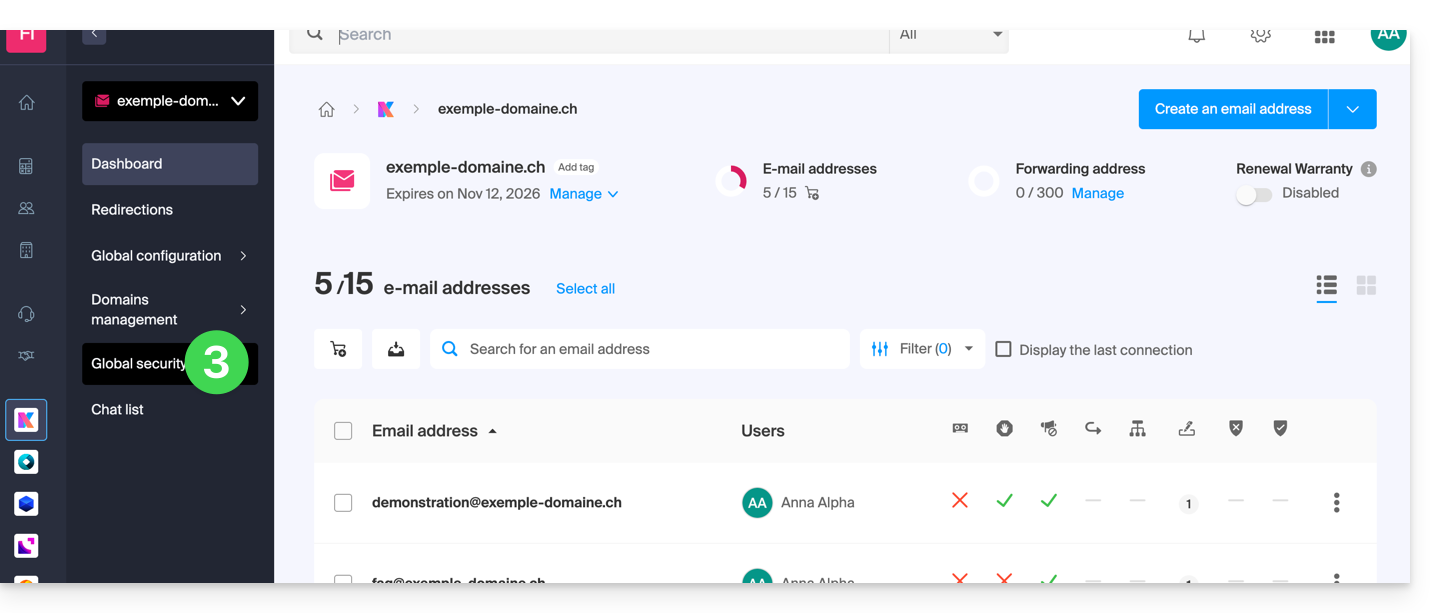
- Click on Global Security in the left-hand menu:
Check that the email service is working correctly
Once you are on the Global Security page, review and check the 3 security mechanisms inherent to emails: SPF, DKIM, and the DMARC policy. These settings should be displayed in green: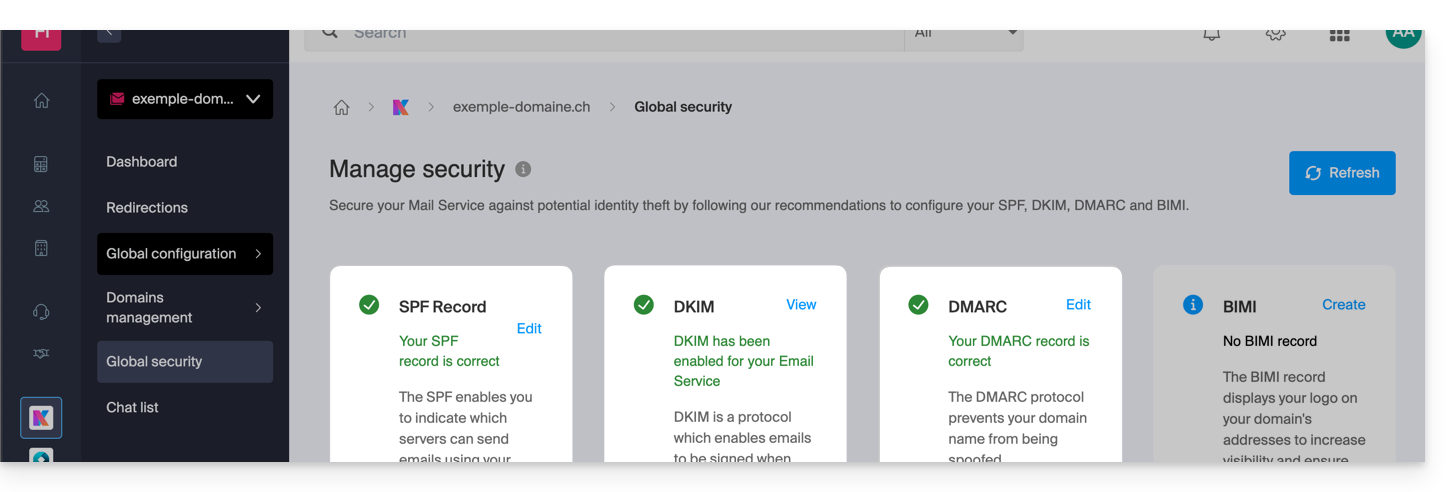
If this is not the case, it may explain why an email that is not spam is being treated as such.
Click on Edit or Create to configure SPF, DKIM, and DMARC according to the recommendations below to secure your Mail Service against potential identity theft:
SPF (Sender Policy Framework)
SPF (❓: help) allows the owner of a domain name to specify which servers are authorized to send emails on behalf of that domain. This helps reduce the risk of spam and phishing, as the recipient's email server can verify whether the sender is authorized by consulting the DNS records of the sending domain: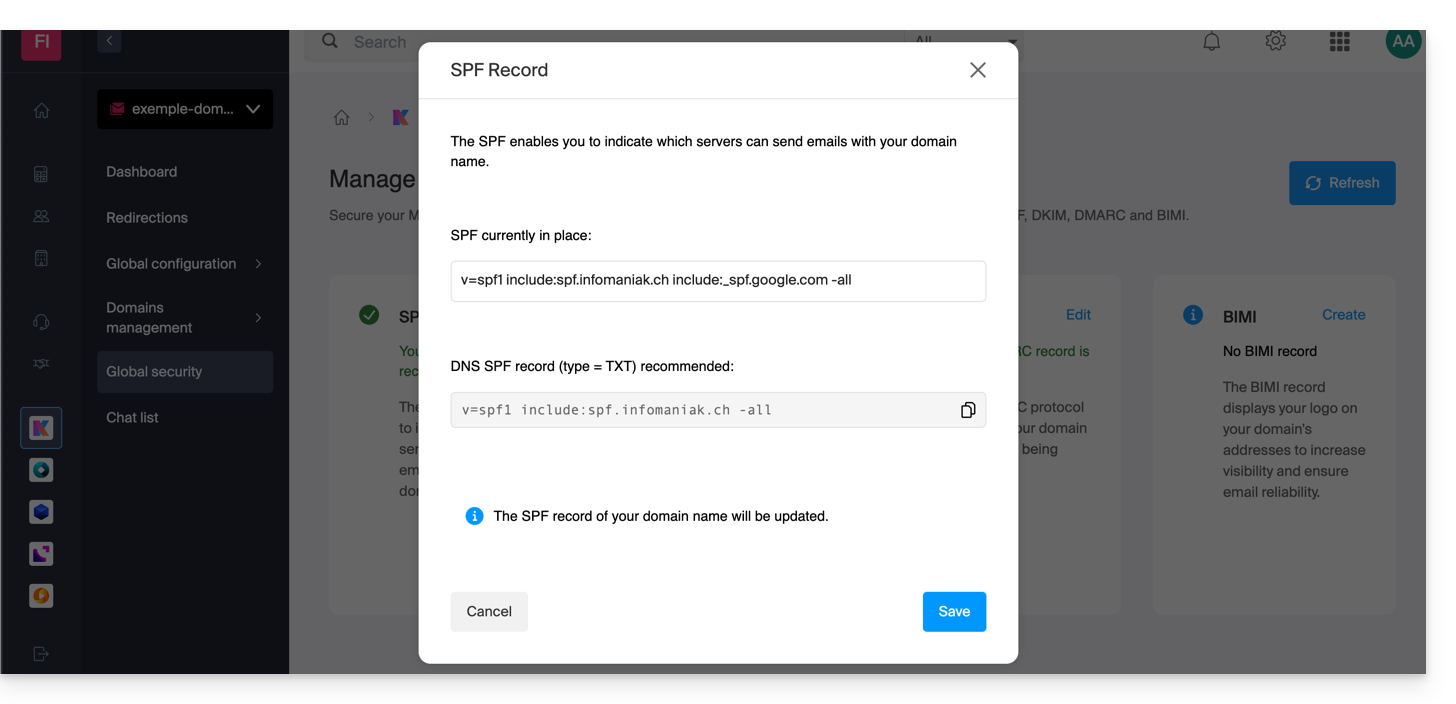
The analyses provided by the Global Security tool are only relevant if the domain name is hosted with Infomaniak and is configured to direct mail traffic to Infomaniak.
Under these conditions, and if a problem is detected, you will find a Fix button that will allow you to automatically update your SPF record.
If correcting one or the other of the issues mentioned is not possible, it means that the correction must be made to the configuration set up by the owner or technician of the sender's domain name.
If your domain name points to Wix or another provider, the SPF record must be configured with the provider in question (❓: help).
DKIM (Domain Keys Identified Mail)
DKIM (❓: help) is a protocol that allows you to sign emails when they are sent.
When your domain name (or its DNS zone) is managed elsewhere, you will find the DKIM record to be added to the DNS zone in this section: Global Security > DKIM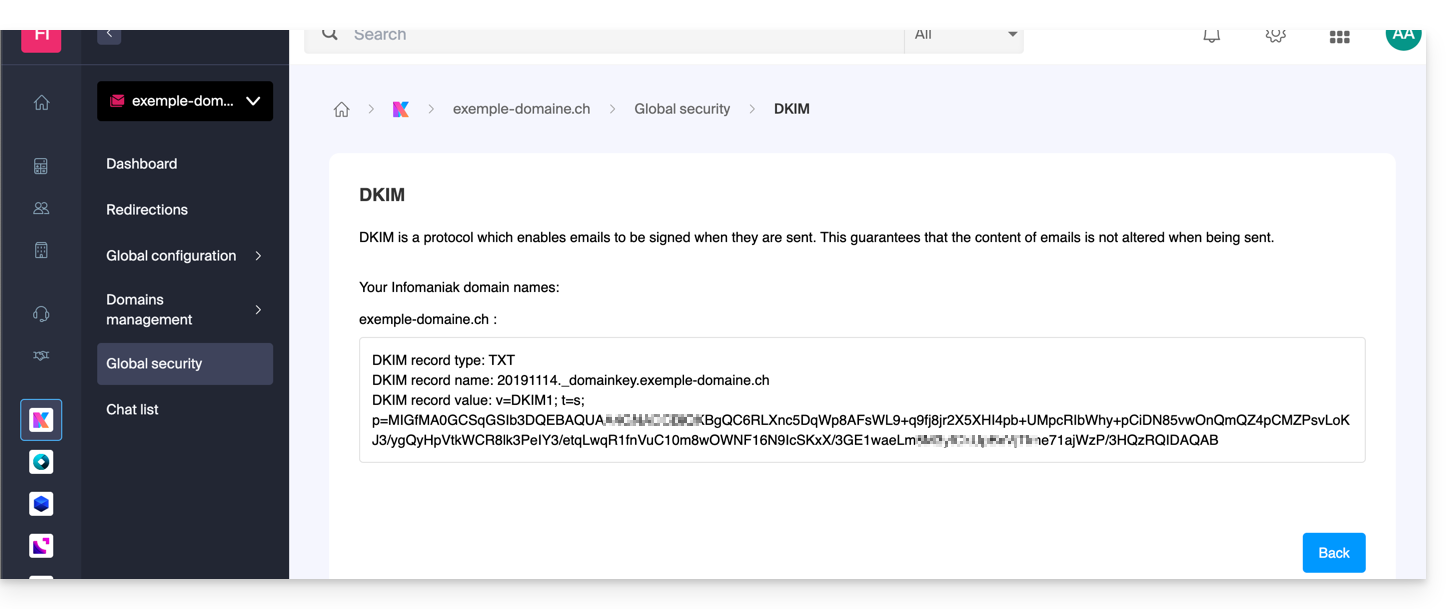
You can configure multiple DKIM records on your domain without any limit, unlike DMARC or SPF, which is crucial if you use multiple third-party email providers for your daily communications.
DMARC (Domain-based Message Authentication, Reporting, and Conformance)
DMARC (❓: help) allows you to indicate to other email servers (the email providers of the contacts to whom you send emails) the policy to follow in the event of receiving a "suspicious" email (not authenticated, for example) from your email server (hosted by Infomaniak). In addition, you can be notified of the "incident" by a summary message called a "DMARC report" (❓: help), which provides information on the recent activity of your email related to the domain name.
DMARC requires a valid SPF and DKIM. An assistant allows you to configure DMARC according to Infomaniak's recommendations in simple mode or entirely as you wish in advanced mode (this expert mode allows you to enter the record of your choice):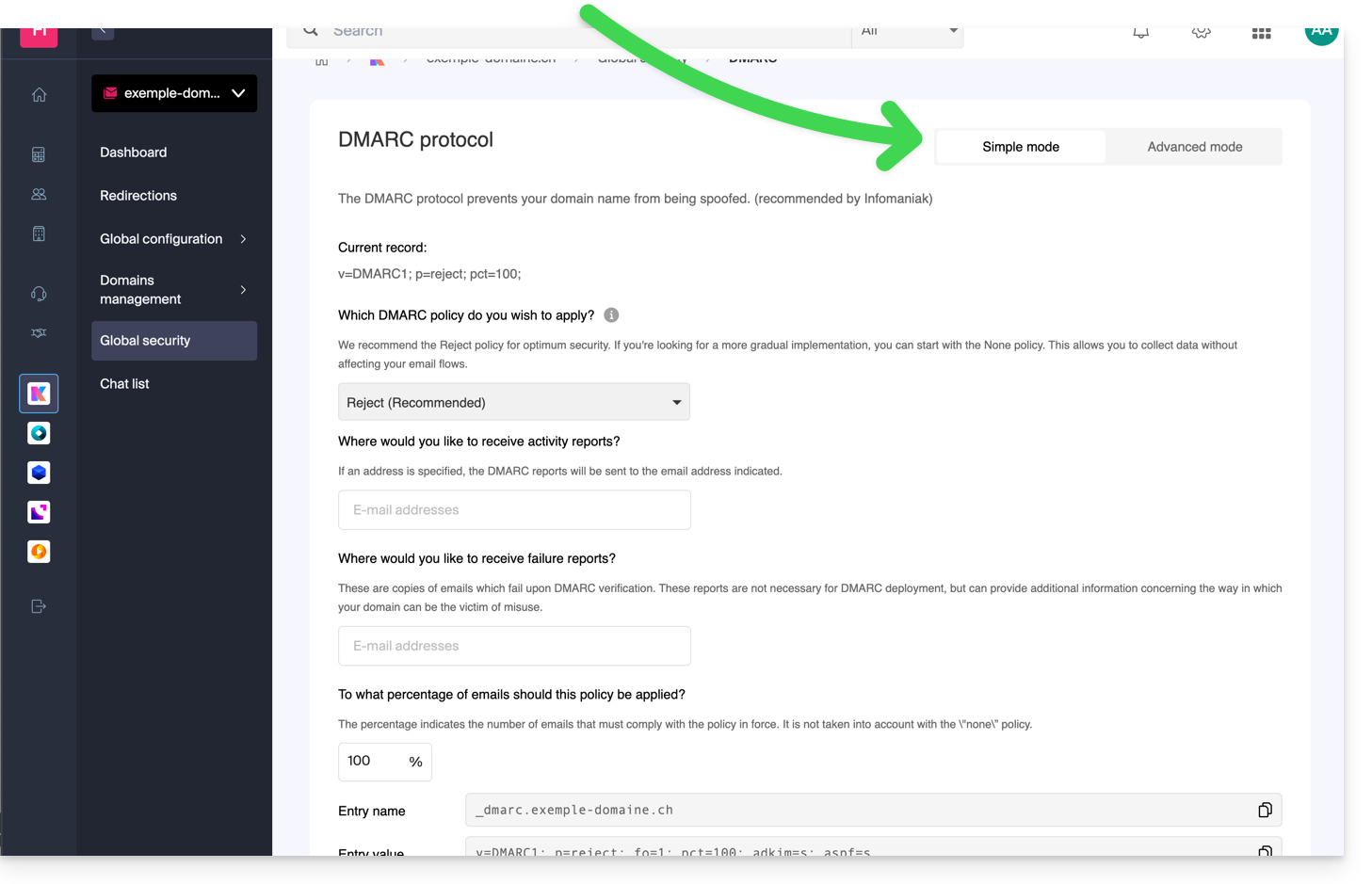 The corresponding entries (TXT type) will then be automatically applied to the DNS zone of the domain name in question (if administratively possible - domain managed within the same Organization, for example).
Infomaniak is unable toanalyze your DMARC reports and records. nor can we comment on the validity or compliance of these, as this is entirely your responsibility.
To check the records within your DNS, you can also use an external and free service like the one mentioned at the bottom of this other guide.
Refer to this other guide if you are looking for information on the fourth point on the Global Security page.
Link to this FAQ: https://faq.infomaniak.com/2692
Has this FAQ been helpful?