Knowledge base
1000 FAQs, 500 tutorials and instructional videos. Here, there are only solutions!
Troubleshooting Streaming Radio Buffering Issues
This guide concerns the buffering and latency of Streaming Radio. While latency is inevitable, proper buffer management can optimize your broadcasts while minimizing interruptions.
Introduction
- The buffer, or memory buffer, is a small memory area that must be filled before the Player starts playing the music from your live audio stream. It corresponds to a few seconds of sound. It is designed for a more comfortable listening experience, in order to avoid small interruptions in the stream being audible, which leads to choppy and unpleasant sound.
- The receiving and broadcasting servers are also equipped with buffers; real-time transmission is never instantaneous due to several technical factors:
- A latency of 3 to 4 seconds between the sound generation and its reception is normal.
- Players always buffer at least 1 to 2 seconds before starting playback.
- Icecast uses a 64K byte buffer by default, which is equivalent to approximately 4 seconds of streaming in mp3 128k.
- Encoding clients also have buffers to avoid interruptions.
- Reducing the size of the buffers can reduce latency, but this practice is risky.
- Since Internet connections do not guarantee a constant bandwidth, smaller buffers can lead to interruptions.
Analyze buffer stability
The diagnostic available in your Manager displays the amount of memory occupied by the buffer each second. If the stream is working correctly, the values should be stable: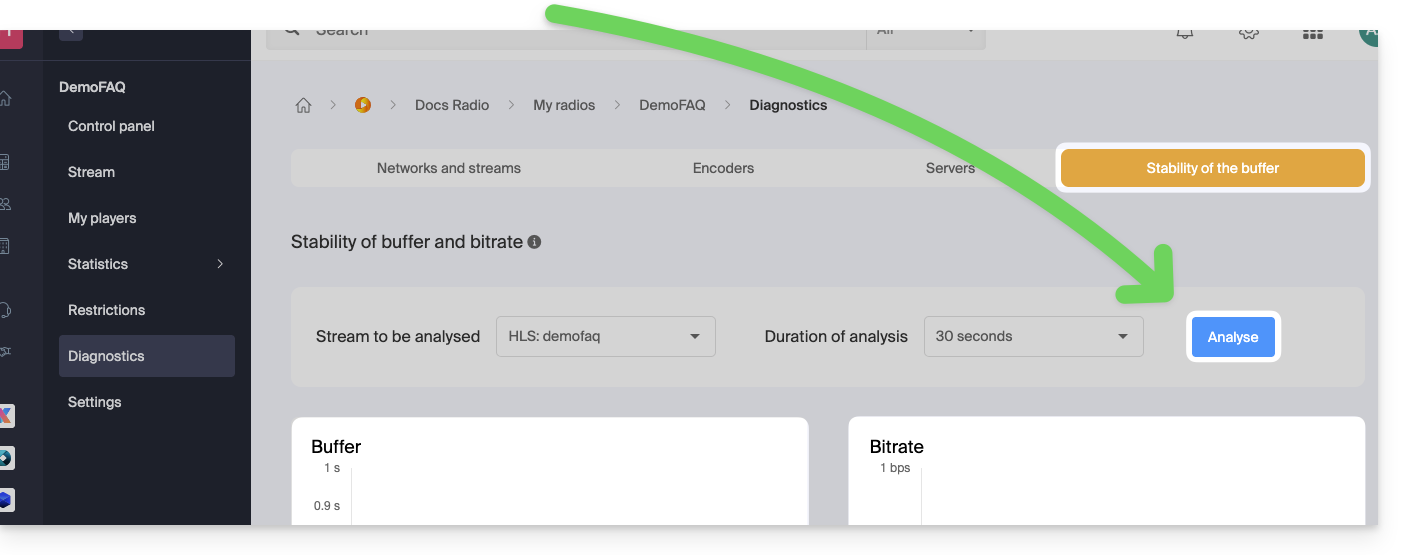
An unstable buffer indicates either poor connection quality or line saturation. Consult this other guide if you are looking for troubleshooting steps.
This test is also useful for detecting temporary saturation of an Internet connection. If the buffer is sometimes stable and sometimes unstable, it may be a sign that some users sharing the Internet connection are occasionally saturating the line, causing disruptions to your stream.
To verify this hypothesis, run a long-duration buffer test during peak usage hours and observe any potential disruptions.
Link to this FAQ: https://faq.infomaniak.com/1695
Has this FAQ been helpful?