Knowledge base
1000 FAQs, 500 tutorials and instructional videos. Here, there are only solutions!
Manually Synchronize Contacts & Calendar (macOS) in CardDAV/CalDAV
This guide explains how to connect the desktop apps Contacts and Calendar (desktop applications on macOS) with the contacts & calendars hosted by Infomaniak.
Preamble
- Instead of the manual configuration below, it is recommended to use the .mobileconfig configuration profiles offered by Apple.
- Infomaniak contacts & calendars are linked to your Infomaniak account; when you log in to ksuite.infomaniak.com/contacts or /calendar you will probably have to perform two-factor authentication (2FA) when logging in.
- In this case, an application password is required to establish synchronization between your device and Infomaniak tools.
- But don't worry, creating such a password is offered to you by following the configuration assistant.
- The various services offered by Infomaniak are all compatible with the corresponding standard protocols (CalDAV/CardDAV for contacts & calendars for example), therefore if you encounter a problem with third-party software, contact its publisher or a Partner and consult the support policy as well as article 11.9 of the Infomaniak TOS.
Manual configuration (contacts & calendars)
To configure the two services on macOS:
- Click here to access the Infomaniak configuration tool (online service https://config.infomaniak.com) — log in if necessary to your Infomaniak account on the Organization on which your services to be synchronized are managed.
- Choose synchronization on this device.
- Choose to synchronize contacts & calendars.
- Click on the Manual Synchronization tab.
- Click the Generate button to obtain an application password:
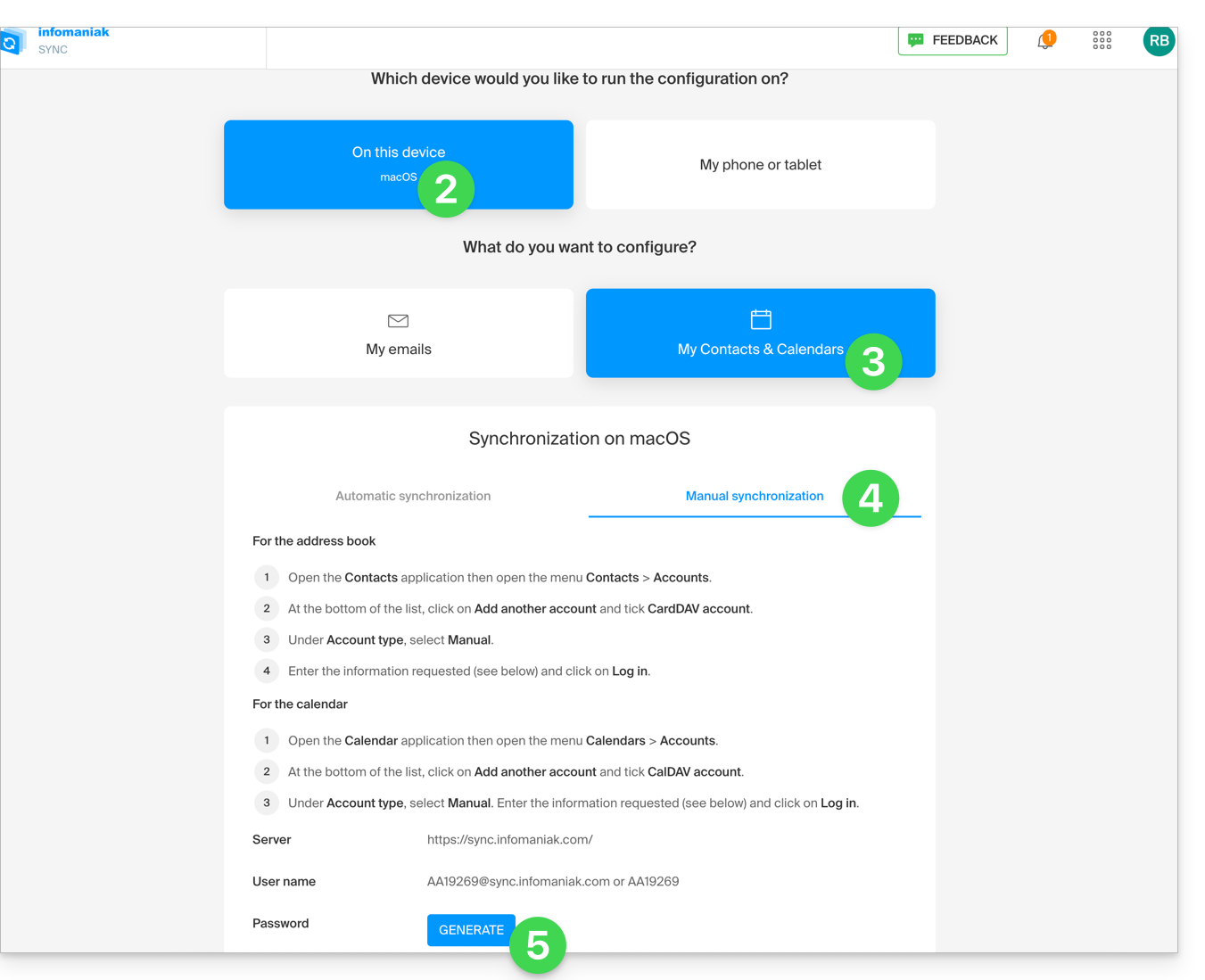
- Note the information that will be displayed on your screen.
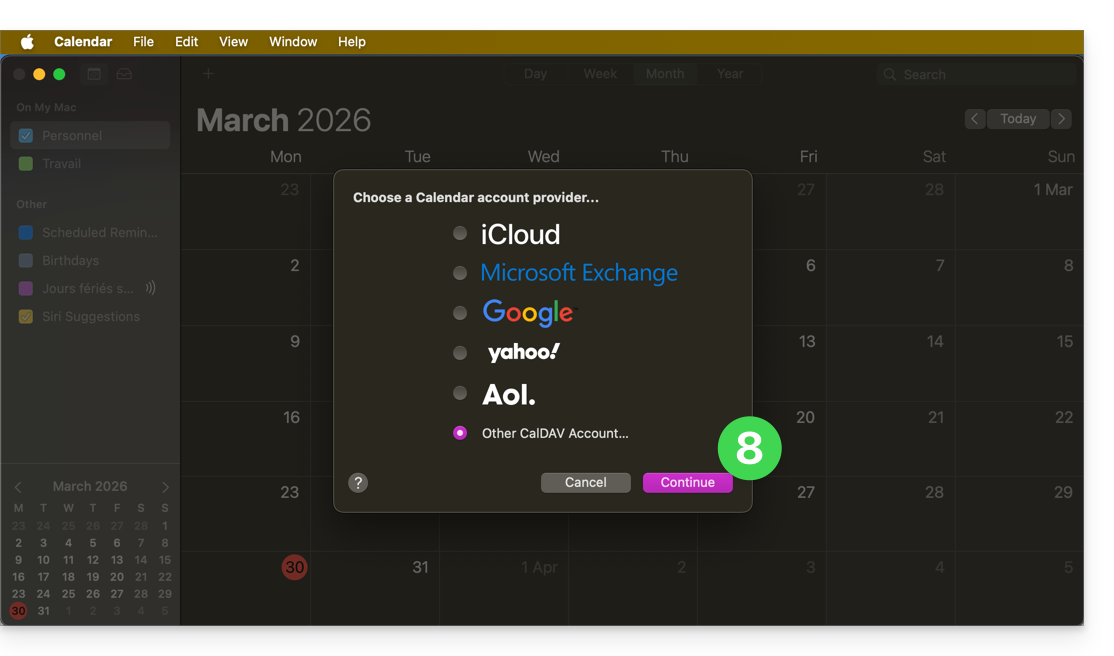
- Then open the Calendar application on your device.
- Add a new account, making sure to select CalDAV:
- Enter the information noted in point 6 above:
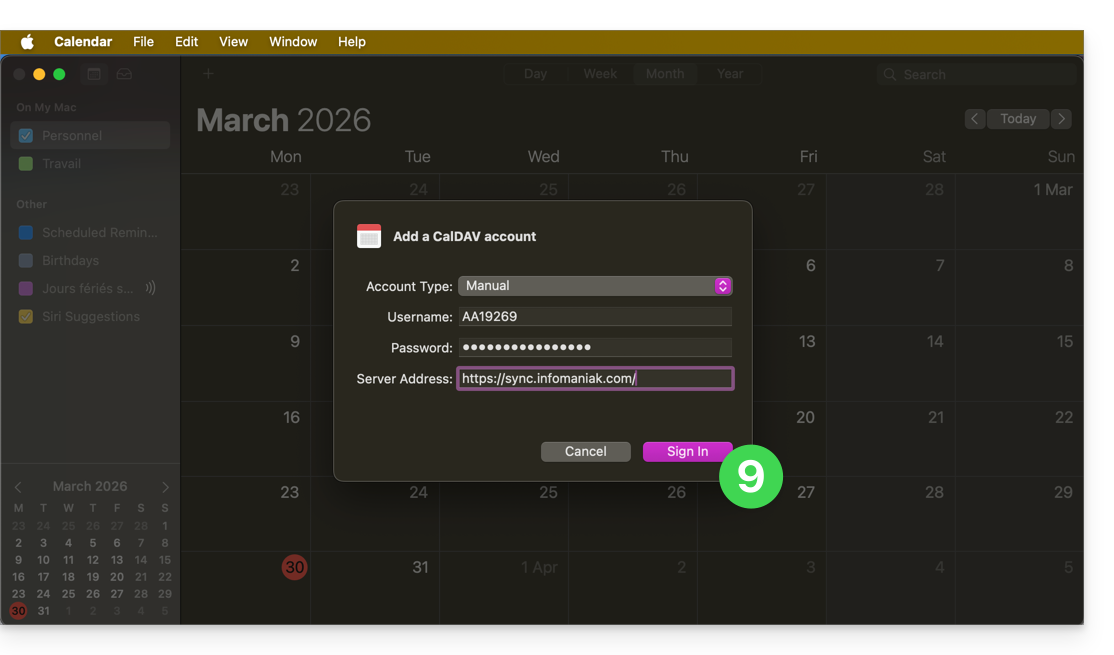
- Username: enter in uppercase the username indicated by the synchronization assistant (for example
AB12345)… - Password: the one from point 5 above (i.e. an application password in case of two-factor authentication enabled) or the one of your Infomaniak user account if you have not enabled 2FA…
- Server address:
https://sync.infomaniak.com/
- Username: enter in uppercase the username indicated by the synchronization assistant (for example
- There you go, you can open your macOS Contacts and Calendar applications.
If your applications were already open, you need to restart them. You will then see the information added by the synchronization: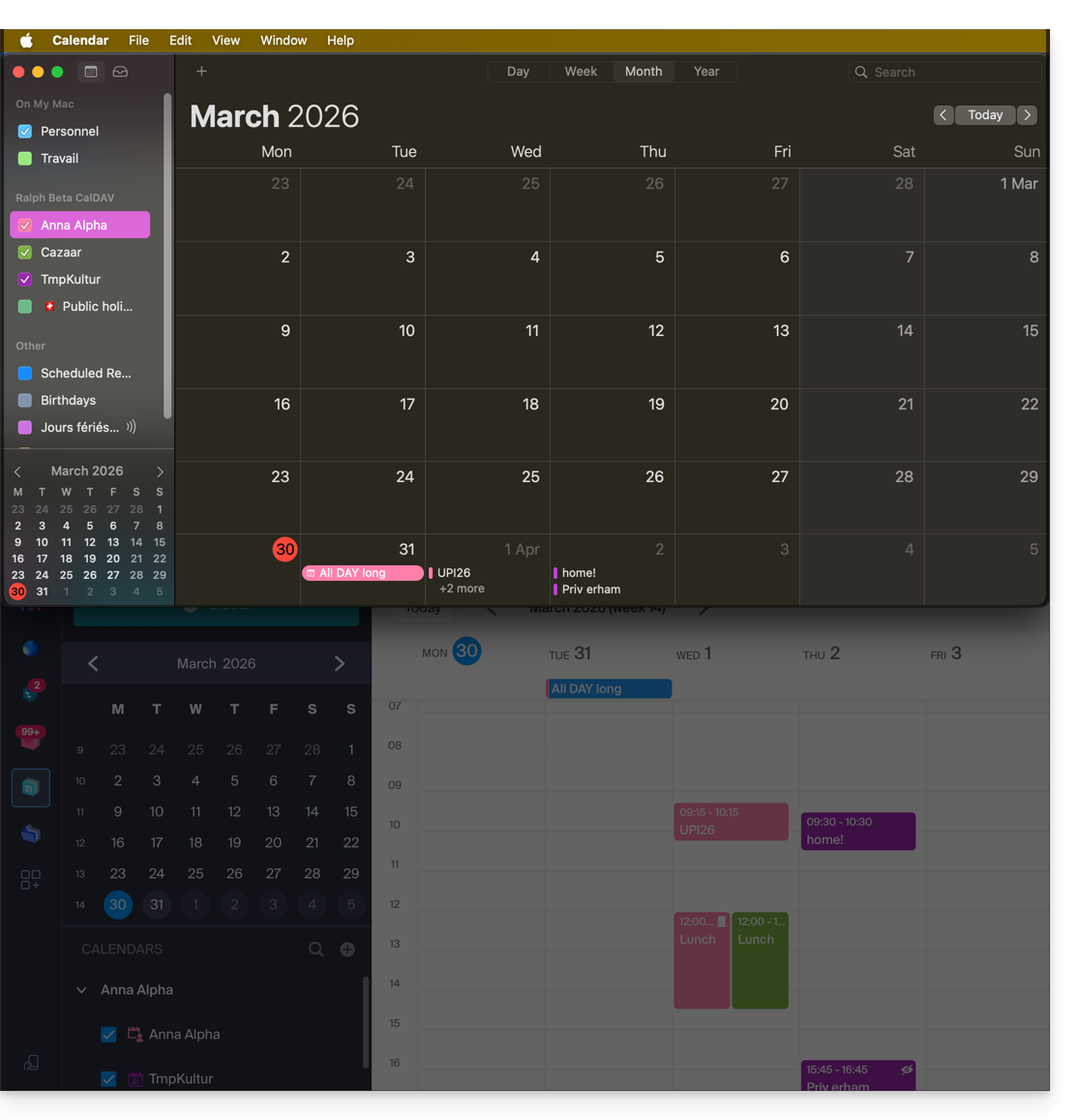
Synchronization particularities
Refer to this other guide.
Delete a CardDAV or CalDAV account
Refer to the chapter "Stop using an account" by changing the system version at the top of the page * if necessary.
*Why is it necessary to choose the guide version exactly matching your macOS / iOS system version? Apple introduces sometimes subtle changes with each new system version, for example a path on iOS 15…
… becomes this on iOS 18…
Link to this FAQ:
Has this FAQ been helpful?